Daily insights for city builders, delivered every morning at 6 AM ET. I’m Brandon Donnelly — a Toronto-based real estate developer and founder of Globizen. I’ve been writing here since 2013.

  • The Hong Kong window ledge

    image

    My friends at the architecture practice Valente Rodgers told me something fascinating about the Hong Kong real estate market last night. Both partners worked as architects in Hong Kong for a number of years.

    In Hong Kong, you’re allowed to deduct certain projecting windows from your calculation of Gross Floor Area

    This is provided they’re a certain height above the finished floor level, they don’t project beyond certain distances from the outer face of the building’s structural elements, and so on. The precise measurements seem to vary depending on things like the building’s use.

    Since space is such a precious commodity in Hong Kong, it shouldn’t surprise you that lots of developers and architects take advantage of this. The result being a proliferation of these projecting window ledges all across the city. 

    It’s a phenomenon that happens in many cities when a perfectly legal loophole is found in the land use policies.

    In Toronto it used to be solariums. You could also deduct these from your overall GFA, which means a lot of them them got built in condos and apartments of a certain vintage.

    In New Orleans it was the camelback house. These were houses with a single storey toward the street and a second storey toward the rear of the property. This was done because property taxes were assessed based on the height of the house as it met the street. Pushing the density toward the rear of the lot meant homeowners weren’t taxed more. 

    I find these outcomes fascinating because they have absolutely nothing to do with architectural intent and everything to do with trying to optimize within a given framework.

    But what’s even more interesting about the Hong Kong example are some of the downstream externalities.

    Firstly, it sounds to me like these projecting windows have become a normal part of underwriting projects in Hong Kong. Meaning, if you don’t factor in these projections, you’re effectively giving up free GFA. (Can anyone familiar with the HK market confirm this?)

    However, building these projections also means you can’t do unmodulated and clean floor-to-ceiling windows. And if that’s the desired aesthetic, somebody has got to be willing to pay for that “luxury.” So arguably there’s a socioeconomic dimension to having and not having this ledge.

    Secondly, because space comes at such a premium, these ledges are fully taken advantage of and furniture makers have responded by designing pieces that can dovetail with them.

    Below is a photo of a bedroom in Hong Kong that I found on bohemia.life:

    image

    This may be a custom bed and I don’t know how deep that window projection is, but it begins to show you how valuable these ledges can be from a space perspective.

    I think we should try and come up with a name to describe these sorts of built form phenomena. If you have any ideas, please drop them in the comments below. And if any of you are familiar with the HK market, let me know if I’m off the mark with any of the above.

    Photo by Jason Wong on Unsplash
  • Our bias toward homeownership

    We have a cultural bias toward homeownership in this country. Other countries have it too. We believe that homeownership is what you should aspire to.

    In 2011, Statistics Canada pegged the homeownership rate at 69%. 9.2 million households out of a total of 13.3 million. Other more recent data suggests that it’s probably a bit lower, though still higher than that of the US since the financial crisis.

    Regardless, more owners than renters.

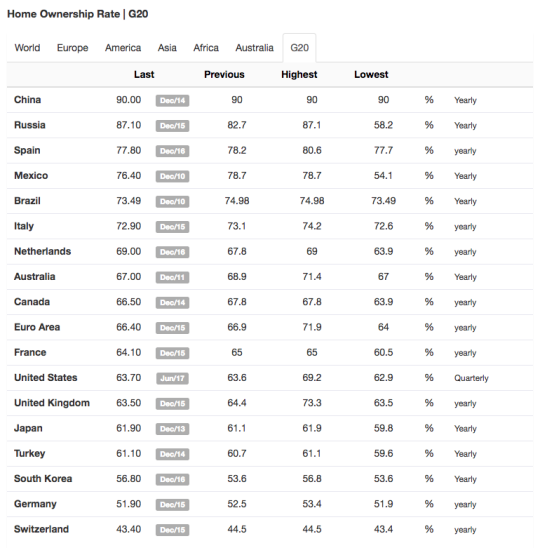
    I am not here to throw stones. I get it. I own my home. However, I do think it’s important to put this into perspective. Below is a chart from Trading Economics of homeownership rates in the G20:

    image

    At the bottom of the list – with the lowest homeownership rates – are Germany and Switzerland. Germany appears almost evenly split between owners and renters. And Switzerland is more renters than owners. 

    Both of these countries are wealthy. Both have a higher GDP per capita than that of Canada according to the World Bank and the International Monetary Fund. 

    Anecdotally, I can also say that some of the wealthiest people I know have made the decision to rent. They have simply decided to invest their capital elsewhere.

    I’m not trying to insinuate any sort of correlation with these statements, but I am trying to draw attention to a cultural bias.

  • The city refused my laneway house

    image

    This afternoon I stood up at the Committee of Adjustment (Etobicoke York) to present the laneway house proposal that Gabriel Fain Architects and I have been working on for the past year and that I have been working on since 2009.

    But before I could start I was told that Councillor Palacio had just submitted a last minute letter to the Committee. I was given a few minutes to read it, but the big bold “REFUSE” was probably the only word I needed to read.

    I was then asked if I had read planning staff’s report. I acknowledged that I had read it and that I was aware that they were also recommending refusal of the application. I also noted that a number of my immediate neighbors sitting behind me were also opposed to the proposal.

    That’s how my presentation started. 

    At this point you might be wondering: why bother?

    I stood up today because, as most of you already know, laneway housing is something that I feel strongly about. This isn’t just about my individual project. I mean, why do all of this work for one small dwelling unit? For me, this is about city building and trying to affect positive change. (I would also love to live on a laneway.)

    I could go on here about how the proposal was shorter than other existing structures on the lane, how the FSI was in check, how we had carefully studied shadows, and how planning staff had already supported greater densities and multiple dwellings on lots of similar size in the area. 

    But that’s not what today was really about.

    Today I heard loud and clear that whether the proposal was a laneway tiki hut or a 2 storey laneway suite, the community did not want more people living in the area and they most certainly did not want more renters living in the area.

    My message to the Committee was that in my humble opinion this is inevitable. Look to Vancouver. Look to Edmonton. Look to many other cities. What we are debating today, or at least what we should be debating today, is what these laneway houses or suites or tiki huts are going to look like.

    Right or wrong, our proposal was an attempt to answer that question. We looked carefully at what others had done before us, including our friends at Lanescape and Evergreen, and we proposed something that we believed was sensitive to its context.

    We were unsuccessful.

    But here’s the silver lining. At the end of it all, and right before a motion was made to refuse the application, one of the committee members said something very impactful. He more or less said: “I agree with you. This is inevitable.”

    Sadly today was not that day.

    I would like to thank everyone who came out today and everyone who got up to speak in support of laneway housing. It meant a lot to me. Some of you are also readers of this blog and it was great to meet you in person. Thank you.

  • From retail to logistics

    Over the past few weeks we’ve been talking about the future of the mall on this blog. It’s a topic that I’m very interested in.

    Yesterday the Wall Street Journal published an article talking about the trend of converting retail/shopping facilities to logistic centers. 

    Here’s an excerpt:

    “In Mesquite, Texas, FedEx Corp. next month will open a 340,000 square-foot distribution facility on what once was the site of the former Big Town Mall. Located along U.S. Highway 80 in Texas, the mall declined after newer malls were built nearby. It was demolished in 2006 and the land was later rezoned for industrial use.”

    It turns – and we’ve talked about this – that good retail locations are also good distribution locations. They are usually located close to humans and infrastructure.

    Here’s another example from the article:

    In North Randall, Ohio, Amazon.com Inc. is considering the site of the former Randall Park Mall as a fulfillment center, according to Port of Cleveland, a local government agency focused on spurring job creation and economic growth in Cuyahoga County. Amazon didn’t immediately respond to requests for comment.

    For a short time when it opened in 1976, Randall Park Mall was the largest shopping center in the world and had been “a thriving heartbeat” for the local economy, according to Mr. Davis. But the mall closed in 2009 as stores struggled with fewer shoppers.

    Assuming this trend continues and people continue to buy things online, one has to wonder about the placemaking that should or needs to happen in these areas.

  • North America’s second city?

    image

    Over the weekend Richard Florida sent out a tweetstorm that compared Toronto and New York City, and made the argument that Toronto’s “incredible diversity, density, and industry mix” is making the city feel a lot more like New York and London compared to any other North American city. 

    He even went so far as to say that, even though it may not be the bigger metro in terms of raw population, Toronto increasingly feels like North America’s second city after NYC. I’m obviously incredibly biased in this discussion, so I would be curious to get your thoughts in the comment section below.

    If you can’t see the embedded tweetstorm below, click here. Regardless, you’ll likely need to click through to see the entire thread.

    //platform.twitter.com/widgets.js

  • Skip-stop

    After Junction House was announced, an interesting discussion emerged on Twitter around 2 storey suite designs.

    There are, of course, many examples of multi-level apartments in the city. There’s 75 Portland by CORE Architects. There’s District Lofts and Mozo by architectsAlliance. And there’s Village by the Grange (pointed out during the discussion), which has a number of 2 and even 3 storey suites.

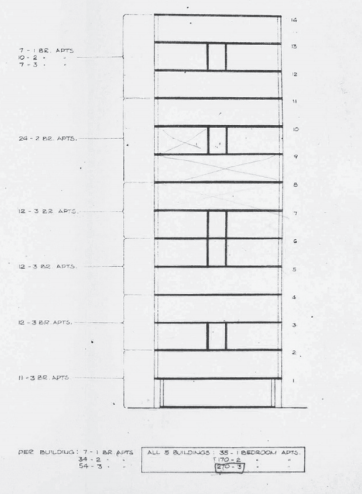
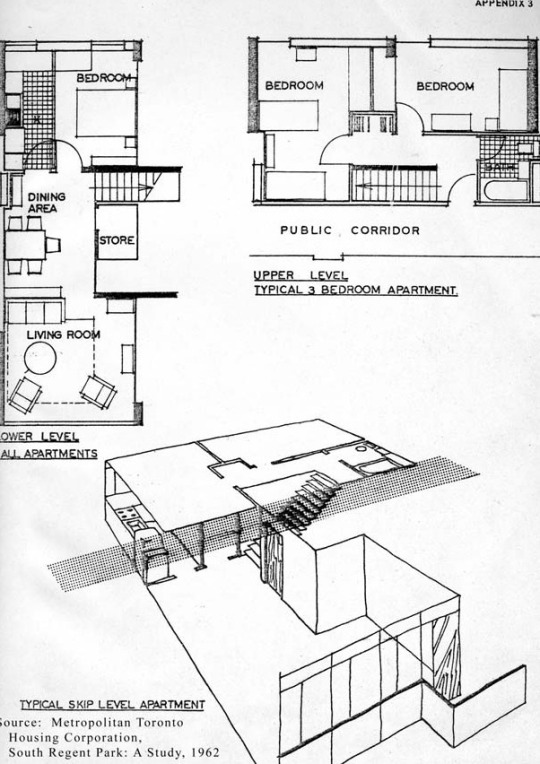
    Another example that was raised by Gil Meslin is 14 Blevins Place. Now demolished, Blevins Place was designed in 1955 and completed in 1957 as part of the Regent Park South urban renewal project. It was designed by the British-born Toronto architect Peter Dickinson and by Page + Steele.

    In 2005, prior to its demolition, the building was identified as a listed heritage building, but it was never elevated to a designated heritage building.

    Perhaps most notable about the building are its “skip-stop corridors” and its 2 storey suites. See below images taken from this Heritage Impact Assessment by ERA Architects.

    imageimage

    The reality is that modern architecture has had a long history of employing multi-level units and skip-stop corridors. Le Corbusier and Oscar Neimeyer were said to be experimenting with them as far back as the 1930s.

    But I think most would agree that Toronto is a very different city today compared to what it was in the 1950s. Some still believe that no child should grow up in an apartment, but I disagree with that belief system. I lived in an apartment as a kid and somehow I survived.

  • International and domestic migration in the US

    In response to President Trump’s proposed immigration bill, Brookings recently analyzed census data from earlier this year to demonstrate the importance of immigration for growth within much of the United States. 

    I’d like to share three tables from their analysis.

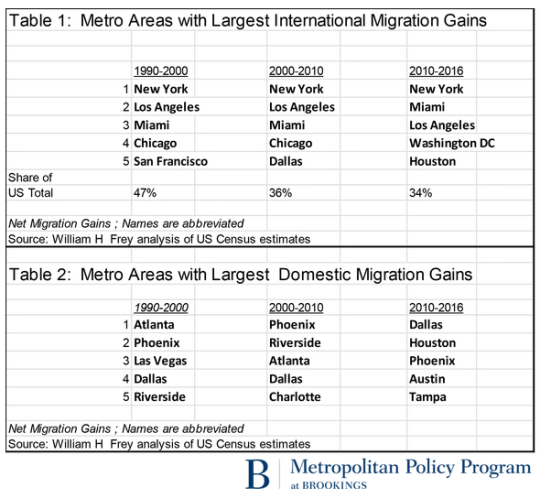
    The first two look at international migration grains and domestic migration gains over the last 3 decades (the last decade isn’t quite a decade).

    Here you can see that New York, Los Angeles, and Miami (all port cities) have dominated international migration to the US since 1990. But at the same time, international migration has become less geographically concentrated. From 1990-2000 the top 5 cities received almost half of all immigrants moving to the US. More recently, that number has dropped to 34%.

    Domestic migration is different in that it’s a zero sum game. When one US city gains, another US city loses. Here there is a very clear migration trend toward cities in the southwest – arguably because of weather, job growth, cheaper housing, and probably a bunch of other factors.

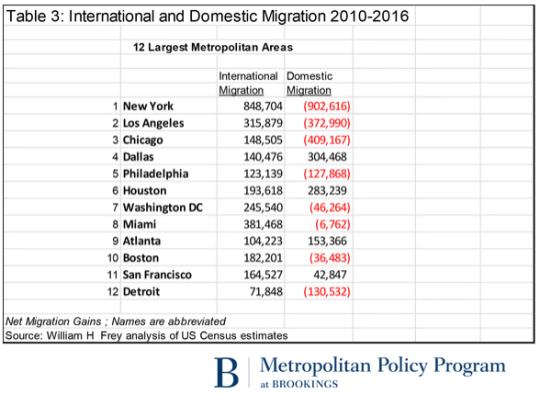
    If we look at actual international and domestic migration numbers over the last 6 years, the 12 largest metropolitan areas look like this:

    The key takeaways here are that 8 of these cities are losing people to domestic migration and only 7 of these cities have a positive net migration number – meaning their population is actually growing.

    What is clear is that the international migration column is a pretty important one if you believe that growth is valuable. 

    If you’re Dallas, Houston or Atlanta, maybe you care a little less about that column. But for most of the other cities, international migration is either the only way you’re growing (look at Miami go) or keeping your population losses in check (see Philadelphia).

  • Don’t fall off the “humor cliff”

    Some of the most successful people I have ever met in business are also some of the funniest people I have ever met. This, of course, isn’t universally true. But I don’t think it’s pure coincidence. These are people you want to be around and do business with. 

    There’s lots of research out there to suggest that humor is an incredible way to build relationships and strengthen workplace cultures. Joel Stein recently penned an article about this at Stanford Business called Humor Is Serious Business. Naturally the article itself is also funny. Here is an excerpt:

    “The reason humor works as a bridge (just go with it) is that laughter sparks the release of oxytocin, a hormone that facilitates social bonding, increases trust, and quickens self-disclosure. This is key in a workplace since all the other ways to release oxytocin are no longer permitted by Human Resources. In a 2015 study, psychologists Alan Gray, Brian Parkinson, and Robin Dunbar had participants watch either a funny or neutral video clip before engaging in a self-disclosure exercise with a stranger: People who watched the funny clip revealed 30% more personal information relative to those who watched the neutral clip.”

    The article goes on to talk about how humor at the negotiating table can lead to increased concessions and how, if you’re in a senior position and you make fun of yourself, people tend to assume you’re highly confident in your abilities. It also humanizes you.

    One of the interesting things about this topic is that, according to research by Stanford professor Jennifer Aaker and lecturer Naomi Bagdonas, most of us fall off a “humor cliff” when we enter the workforce. That’s roughly the moment where we start laughing less and finding stuff less funny.

    We shouldn’t let that happen and I’m going to make a concerted effort. Not just because of business, but because laughter is good for you.

  • Introducing Junction House

    image

    Earlier this week I posted this teaser photo on social (full photo above) and said to stay tuned for a big announcement. Well, that announcement is here and you can read all about it over on the Globizen blog. Please let me know what you think in the comment section below.

  • Just put up a sign

    Back before the 2008 financial crisis, I did a short stint working for a real estate developer in Dublin, Ireland. 

    Most of our projects were in Ireland, but our consultant teams were sometimes from all over.

    One day we were having a meeting with our architect from Germany and we started talking about a particular project’s green space.

    But this wasn’t the sort of green space that was supposed to be actively used. It was a green space that, I guess, you were just supposed to look at and admire for its greenness. 

    So one of my Irish colleagues asked, while referencing the proposed design: “How are we going to keep people off the grass?”

    Our German friends didn’t immediately appreciate the concern and responded with: “What do you mean?”

    Irish: “How will we stop people from walking and hanging out on the grass?”

    German with serious face: “Oh. We will put up a sign.”

    At that point, every Irish person in the room just started laughing and more or less said: “Yeah, that’ll never work.”

    Cultural differences can be subtle.