Daily insights for city builders, delivered every morning at 6 AM ET. I’m Brandon Donnelly — a Toronto-based real estate developer and founder of Globizen. I’ve been writing here since 2013.

  • Crowd Surf

    When Snap Inc. announced its Q2 financial results earlier this month, it reported 173 million daily active users – an increase of 21% year-over-year. But this fell short of what was expected. Analysts were expecting 175.2 million DAUs

    (Snap defines a DAU as anyone who opens the Snapchat app during a defined 24 hour period.)

    Regardless of your position on this stock, one thing is clear about the company: they are very creative and they continue to innovate.

    The company is currently testing a new feature called “Crowd Surf.” What it does is automatically stitch together related Snapchat Stories from the same location to form seamless videos. 

    It made its debut at a concert in San Francisco. The real magic is how Crowd Surf was able to assemble a continuous audio track using an assortment of 10-second Snapchat Stories, all taken from different locations at the concert and all from different users.

    Click here and scroll down for a preview video.

    To accomplish all of this, Snap takes a “sound print” of the audio playing in a particular location from people’s Stories. It then filters each of the clips so they sound more alike and autogenerates a stitched together video.

    You obviously need a critical mass of users and content for this to work, which is why the feature was introduced at a concert. But it’s certainly a remarkable way of creating valuable content from decentralized user inputs.

    I guess the only question is: How long until Instagram copies this?

    Photo by Yvette de Wit on Unsplash

  • Supply, not foreigners

    The chief economist at the Canada Mortgage and Housing Corporation (CMHC), Bob Dugan, recently published a piece in Macleans called: why the foreign buyers tax isn’t making Vancouver more affordable.

    Here’s an excerpt:

    One year after the implementation of the foreign buyers tax, monthly sales to foreign investors now hover around 4 per cent of all sales. But our latest Housing Market Assessment, released in July, still shows a red flag for Vancouver—with particular concern given to overvaluation and price acceleration. Average prices in Vancouver have rebounded to where they were before the tax’s implementation. In between, there was a marked drop, but it appears to have been temporary. In short, Vancouver is largely right back to where it was before the tax.

    He goes on to argue that while there are many factors affecting home prices, “supply is by far the chief factor.” This, of course, is a refrain you hear from everyone in the real estate business, so I’m not going to belabor the point.

    But I would like to point out some of the percentages. 

    Before the tax, foreign sales in Vancouver (to buyers who do not have a permanent address in Canada) were thought to sit at roughly 10%. Immediately following the tax, when everyone was trying to assess the impact, this dropped to ~0.9%. And now it’s back up to somewhere around 4%, according to the article.

    Arguably, there has been a slight reduction. Though who knows how accurate these percentages are. There is now a strong incentive to hide foreignness. 

    Regardless, CMHC doesn’t believe it’s working.

  • Thom’s Trent

    image

    This afternoon I walked Trent University’s campus with my father on our way back from the cottage. It is embarrassing that it has taken this long.

    Trent University straddles the Otonabee River in Peterborough, Ontario. It admitted its first students in 1964 and by the early 1970s the renowned Canadian architect Ron Thom had completed the campus plan and its original college buildings, including Champlain College, Lady Eaton College (originally a female-only dormitory), the Bata Library, and the Chemistry Building.

    The photo at the top of this post is one I took of the south elevation of Champlain College, on the north edge of the west bank’s main plaza. (Yes, the sign on the far left says “no skateboarding.”)

    Rob Thom is perhaps not as well known as other Canadian modernists such as Arthur Erickson. But his two masterpieces – Massey College at the University of Toronto and this campus – were instrumental in helping to define modernism in Canada. It is a shame that alcohol and illness ended his life at the young age of 63.

    The first thing that struck me was the rubble aggregate walls. I immediately went to touch them. (See, again, above.) That, combined with the very clear Prairie influences and the terracotta colored pavers, gave the campus grounds an incredible warmth.

    Also notable was the connection to the natural landscape. Around the corner from where I took the above photo was a staircase leading down to the river. At the bottom of the staircase was a broad set of concrete steps and a handful of young people jumping in and out of the water.

    If you happen to find yourself in this part of southern Ontario, I would encourage you to check out Thom’s campus. And maybe bring your bathing suit.

  • Lifelogging

    Swarm recently released version 5.0 of its mobile app. Blog post here. Instead of gamification (leaderboards and so on), the emphasis is now on lifelogging – a more personal collection of all the places you’ve been.

    Here’s what that looks like:

    The most notable change is a front and center map that shows you all of your check-ins. You can also zoom in and really explore where you’ve been, geographically. Swarm refers to it as a “virtual memory book.”

    Lifelogging is absolutely the main reason why I use Swarm and why it still finds itself on my home screen. One of the reasons I enjoy blogging is that it’s a public diary. Swarm is a modified version of that for me. So this change feels right.

    My other Swarm use cases are being able to share check-ins to Twitter and serendipitous encounters with friends.

    But the more I use Swarm the more I think that divorcing this use case from Foursquare (this happened in 2014) was a mistake. If Swarm is now about lifelogging (instead of just playful check-ins) and if Foursquare is about finding the perfect place to go out, then why not merge these experiences? 

    Tell me where I should be going, let me make lists of places I want to go, and then let me log it to my diary along with tips for other people.

    At the time of the divorce, the data seemed to suggest that very few people did both of these things within the consolidated app. People either checked-in or they looked for a place to go. Rarely did they do both.

    Perhaps that would be different with lifelogging.

  • One hour drive

    I’m taking next week off so that I can respond to emails from various places in Ontario and Quebec instead of from my desk. The out of office messages really fly at this time of year, so it’s usually a pretty good time to try for a recharge.

    Because of that, this post feels appropriate. 

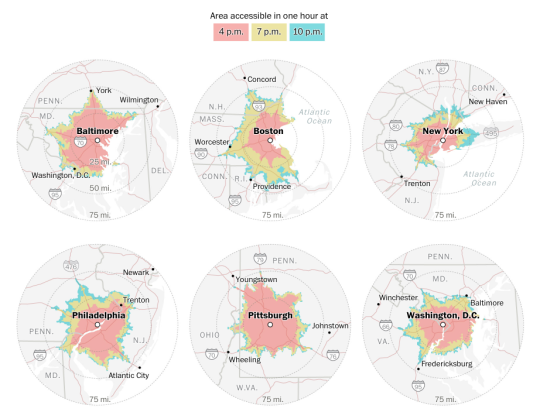
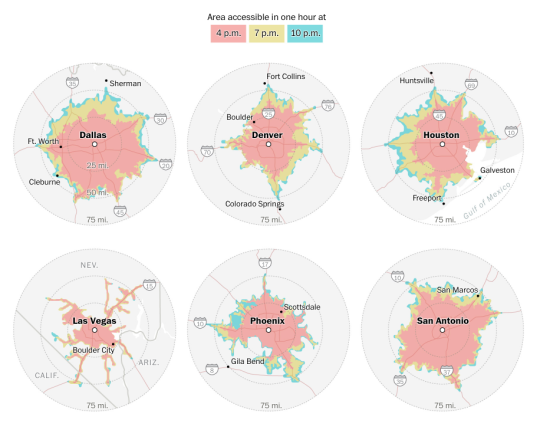
    Sahil Chinoy of the Washington Post recently looked at anonymous cell phone and vehicle data (from Here Technologies) to see how far you could drive in one hour if you were trying to escape the downtown of various U.S. cities on a Friday afternoon in the summer.

    This exercise was done for 3 departure times on July 28, 2017: 4pm, 7pm and 10pm. The mappings all leverage 3 years of historical speed data.

    Here is a first set of maps showing a few cities in the northeast and in the mid-atlantic. Every city is shown at the same scale so that they can be easily compared.

    image

    And here is a second set of maps showing a few, more car-oriented, cities.

    image

    Not surprisingly, older transit-oriented cities like New York don’t do well in this contest. No matter what time you leave, it’s hard to make it past 30 miles. Whereas in the case of Vegas, it doesn’t really matter what time you leave. You should be able to clear 50 miles.

    That’s the other interesting thing to note about these maps – the spread between distances at the various times.

    I’m sharing these because I’m a sucker for diagrams, but I don’t think they tell the whole story. The modal splits and the population and employment densities are all very different across these cities. New York’s core competency is in moving lots of people in trains, not in cars.

    Although, perhaps the ironic thing about these diagrams is that a tighter drive radius might actually say something about how efficiently land is being used.

  • Seattle vs. Vancouver

    A reader recently shared an article with me called: Why Seattle builds apartments, but Vancouver, BC, builds condos. Thanks for that.

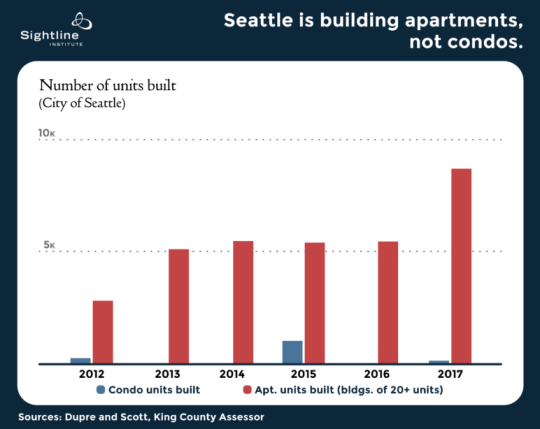
    It’s a good summary of the differences between these two markets and why over the last five years less than 4% of all new residential units built in Seattle have been condos. The story is obviously very different in Vancouver.

    It’s also a good reminder that incentives matter. Capital has a funny way of flowing to where the returns are greatest.

    Chart: Sightline Institute

  • A story about Toronto

    Marcus Gee of the Globe and Mail recently published “a made-up story about Toronto that never appeared, but should.”

    It goes like this:

    Toronto city hall is pressing a prominent developer to put up a taller building.

    Mayor John Tory is telling Big City Condo Corp. that the condominium it has planned for the downtown corner of Maple and Oak streets is simply too small. The proposal calls for a 25-storey residential tower. Mr. Tory said it could easily rise to 40 or even 50 storeys.

    He dismissed complaints from locals who said the tower would overshadow the neighbourhood and put too many more cars on the street. The intersection is well served by public transit, with two lines crossing there. The mayor called it a golden opportunity to create urban density.

    He insisted the city must build up instead of out if it wants to avoid more sprawl. “We love tall buildings,” he said. “We need more of them. We can’t keep spreading out and out and out. We need to grow up, and I mean that quite literally.”

    Again, this is made-up. And if you’re from Toronto, you knew that. 

    We are still grappling with the urban intensity that should come along with being an important global city.

    Photo by Redd Angelo on Unsplash

  • Why dynamic road pricing is inevitable

    The Economist recently published an article called: How and why road-pricing will happen. If you’re a regular reader, you’ll know that there’s been lots of talk and support

    over the years

    on this blog for dynamic road pricing.

    It’s politically unpopular, but it’s an incredibly rationale way to deal with traffic congestion. 

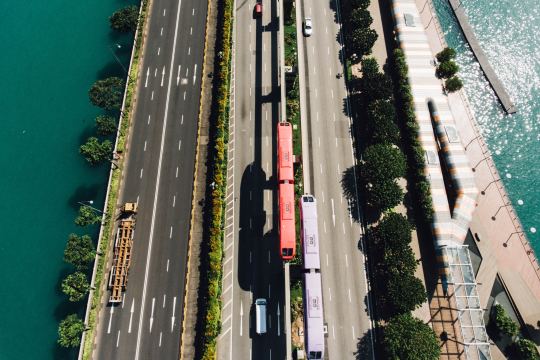
    In Singapore – home of the world’s first congestion charge zone (1975) – they constantly monitor traffic congestion. As soon as average speeds drop over a three-month period, they simply raise the charge. Congestion gone.

    We know this works, but for many reasons road pricing is highly divisive. According to The Economist, there are a few reasons why this is going to become a bit more politically palatable.

    For one, the take from gas taxes and vehicle duties has been declining in Britain over the past couple of years. Electric vehicles will only exacerbate this trend. So governments are going to be forced to look elsewhere for money.

    Secondly, traditional tolls and congestion charges are becoming increasingly ineffective. Today in central London, private-hire vehicles are said to make up about 38% of all car traffic – almost double the share of traditional black taxis. 

    These are cars circling around the city, picking up passengers. Blunt charges based on suburbanites entering the city in the morning and leaving in the afternoon is simply not capturing the way that many of us move around our cities today.

    In other words, urban mobility is undergoing dramatic changes and the revenue and congestion management tools are going to need to adapt. If you’re interested in this topic, check out the full article here.

    Photo by chuttersnap on Unsplash

  • Motivation and coordination

    Albert Wenger of Union Square Ventures recently gave a talk at the 2017 Blockstack Summit about “Decentralization and the Knowledge Age.”

    He starts by talking about motivation and coordination.

    The state, he argues, is good at coordination, but not so good at motivation. The market, on the other hand, is good at motivation, but not so good at coordination. Money and self-interest are powerful incentives.

    He then talks about how networks have improved the market, the firm, and the state. When the cost of sharing information drops, everything gets better.

    But there are downsides to networks. For one, they form monopolies. Consider Facebook in social. Google in search. Amazon in ecommerce.

    They also create environments ripe for censorship and “algorithmic abuse.” Everything you see in your feeds is optimized to make you respond and/or feel a certain way. The line between delivering you relevant content and deliberate manipulation is perhaps a fine one.

    So what’s the solution? Decentralized blockchain networks are one exciting possibility. But they also have their own limits and drawbacks. Albert touches on those in his talk.

    The video is about 24 minutes. If you can’t see it below, click here.

    [youtube https://www.youtube.com/watch?v=LgQT874KHuw?rel=0&w=560&h=315]

  • Saying no to “Mountain Modern”

    Jackson, Wyoming is one of my favorite places on the planet. (Here is a ski/snowboard video that my friends and I made a few years ago in Jackson.)

    Earlier this year, Eagle Point Hotel Partners and the Brooklyn-based design firm Studio Tack completed a renovation of the Anvil Motel in Jackson – it’s now the 49-room Anvil Hotel

    Apparently reclaimed motels are the new hospitality trend.

    What I appreciate about their approach, is the emphasis on creating something that feels local and contextual. Here are a couple of snippets from Surface Magazine:

    The designers wanted to avoid a rustic feel, or what Ruben Caldwell, one of Studio Tack’s four partners and an avid backcountry skier, calls “Mountain Modern,” referring to architecture, common in places like Vail, Colorado, and Lake Tahoe, California, that excessively uses reclaimed wood and Cor-Ten steel. “We knew we didn’t want to steer anywhere near that,” says Chou, a long-time snowboarder who more recently got into skiing. “It takes a bit of familiarity with ski towns to know what you don’t want to do.”

    The vibrancy of Jackson’s local culture impressed the design team—and Caldwell so much so that he moved there full-time last year. “As a design team,” Caldwell says, “we’re hyper-aware of the need for projects to be deeply embedded into the local scene.”

    It’s easier to copy and paste. But the results are always better when you take a bit of time to understand a place. 

    Image: Anvil Hotel