Daily insights for city builders, delivered every morning at 6 AM ET. I’m Brandon Donnelly — a Toronto-based real estate developer and founder of Globizen. I’ve been writing here since 2013.

  • Attention = money; why the attention economy is broken

    “…the path to profit is to manufacture attention more cheaply than what you get paid for it.” Ev Williams

    A big part of our economy is centered around attention. Some would argue we are living in a de facto attention economy. That is now our scarce resource. There are only so many waking hours in a day and every company and social media platform is fighting for their sliver of your attention.

    However, the irony of the attention economy is that, while it has gotten easier to make and share “content” with the world, the quality of that content matters less than the attention it garners. Because that’s what the system rewards. Whatever you may think about Trump, he has mastered the art of attracting attention.

    Ev Williams – co-founder of Twitter and CEO of Medium – recently wrote a piece on this topic called: Words still matter. It is very much about the mission driving his publishing platform, Medium. Here is an excerpt:

    It’s not that there aren’t journalists, publishers, and thinkers doing great work and putting it out there. But the realities of the attention economy are very tough for those who create things designed for anything but the widest possible (i.e., lowest-common-denominator) audience. For ad-driven sites, the revenue per reader has been dropping for years (while the experience worsens and privacy disintegrates), leaving little room for research, fact checking, or polish… let alone nuance or complexity. The system demands quantity. It demands speed. And it demands little else — except our clicks.

    Their solution is the Medium Partner Program. It is an “open paywall” that allows publishers of great content to lock some of their best content behind a paywall. Their view is that to fix the attention economy, we need to move beyond ad-supported lowest-common-denominator content. 

    This not entirely novel, but they are calling themselves the first “open paywall” platform. I would be curious to hear your thoughts about this in the comment section below. I’ve had a few people suggest to me that I employ a similar approach for this blog. I’m not convinced.

  • Empowering food truck entrepreneurs

    When I lived in Philadelphia I survived on food truck food. My go-tos were an egg and cheese breakfast sandwich for $2.50, a bowl of spaghetti for $4.50, and a pretty substantial chicken burrito for somewhere around $5 or $6. The food was good. It was filling. And it was all priced perfectly for a poor student, which I was at the time.

    I still remember when Renzo Piano came to the University to talk about potentially renovating the design school. Somebody stood up and asked if he had considered the placement of food trucks in his plans. Piano responded by saying: “I am Italian. Don’t worry. I will provide for the food.” This is how ingrained food trucks were and are in the culture of the city.

    The other great thing about these food trucks is that they are a low-cost way of starting your own culinary business. Many were run by immigrants. And some of these “trucks” were so small that I used to have to duck in order to make my way to the concession window. There was nothing fancy about them. But they worked.

    These days I don’t really eat at food trucks anymore. They are not as widespread here in Toronto as they are in Philly. I also find them expensive and the portions are usually so small that you have to order 2 or 3 things. They feel like the anti-food truck.

    I appreciate that there’s a growing market for trendy and “gourmet.” But there’s value in low-cost options and in lowering the barriers to entry for aspiring food entrepreneurs. There are numerous examples of humble food trucks growing into full fledged restaurants. Let’s encourage more of that.

  • How to revive the American Heartland

    “Every unemployed American is a failure of entrepreneurial imagination.” -Edward Glaeser

    At the end of September, economist Edward Glaeser returned to the Manhattan Institute to deliver the 2017 James Q. Wilson Lecture. If you’re a regular reader of this blog, you may remember that he was there in 2016 and delivered a presentation called “The End of Work.” 

    This year’s talk continues that theme, but focuses on joblessness and economic stagnation in the US Heartland. 

    The solutions he puts forward are based on a very simple economic model for growth that he refers to as “rules and schools.” Simply put: The rules of a place need to support business and entrepreneurship and the people need to be educated.

    One example he gives is of a woman in Detroit who was trying to start a food truck business but had to wait 18 months for a permit. There’s no reason that should happen. He blames the insider restaurant lobby for working to keep competition at bay. The rules are bad. We have similar problems here in Toronto with our food trucks. I think it’s wrong.

    He also pokes fun at the Bilbao effect. Yes, Frank Gehry created a beautiful piece of architecture. But did it lower the unemployment rate?

    The last thing I’ll mention are his comments regarding Amazon HQ2 because I like how he frames it. 

    Firstly, Amazon is going select a city that doesn’t need Amazon. It’s going to go where there’s already abundant human capital. 

    Secondly, “smokestack chasing” is not the right economic development strategy. The key questions should be: How will this benefit our human capital and how many new firms could it create?

    If you have an hour, check out Ed Glaeser’s talk. If you can’t see it below, click here.

    [youtube https://www.youtube.com/watch?v=e8LvHpRCUYk?rel=0&w=560&h=315]

  • Canada’s 1%

    The Globe and Mail recently published an article about Canada’s highest paid workers. It uses census data spanning 2005 to 2015.

    There’s a feature that allows you to enter your before tax income, your location, and your gender to see how you compare to “the 1 percent.”

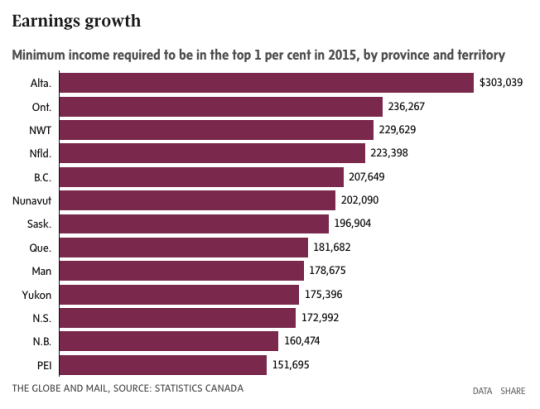
    But in case you don’t feel like doing that, here’s the minimum income required to be in the top 1 percent as of 2015 for each province/territory:

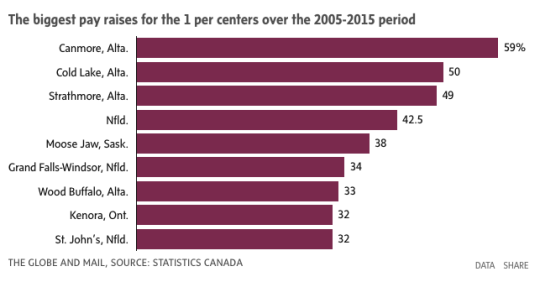
    And here are the communities where the 1% saw the biggest pay increases:

    The data certainly underscores how important commodities have been for growing individual incomes. Alberta, Newfoundland, and Saskatchewan are resource-rich provinces.

    However, the above data doesn’t capture the collapse of oil prices in 2014. So it would be important to also consider what this data looks like outside of a commodities boom.

    Charts: The Globe and Mail

  • Sidewalk Labs, Amazon HQ2, and the Milanese Leonardo

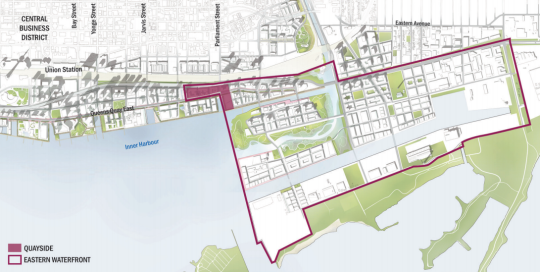
    Earlier this week the WSJ announced that Sidewalk Labs (Alphabet Inc.’s urban innovation organization) is close to a deal with Waterfront Toronto to develop a new 12-acre section of the eastern waterfront. Sidewalk Labs would be their innovation and funding partner. It’s not final yet and it’s still subject to board approval, but the sentiment is that it should go.

    There aren’t a lot of details about the project – other than the fact that it will be fairly big, up to 3 million square feet – but the overall intent is digital city building. It’s about imagining what a city could be if you built it today “from the internet up.” More info about Sidewalk Labs, here.

    I thought of this project as I read Seth Godin’s daily blog post this morning in bed. Here are two snippets from that post:

    When a new technology arrives, it’s often the nerds and the neophiliacs who embrace it. People who see themselves as busy and important often dismiss the new medium or tool as a bit of a gimmick and then “go back to work.”

    There’s never a guarantee that the next technology is going to be the one that moves to the center of the conversation. But it’s certain that a new technology will. It always has.

    Openness matters.

    I’m anxious to learn more details about the project, but this is obviously very exciting. It also creates momentum and strengthens the case for Amazon HQ2 in Toronto. The above 12-acre Quayside area is only the tip of the iceberg. There’s the rest of the eastern waterfront and also East Harbour.
    image

    Some people have been critical of this city’s push for Amazon HQ2. Anthony Lacavera, chairman of Globalive Capital, called this “the biggest Trojan Horse of all time.” His view is that Amazon would simply use HQ2 Toronto as a mechanism for cheaper labor (USD > CAD) and to siphon the best and brightest down to the US.

    Now, I agree that it would be more impactful to create the next Amazon then to simply lure in its second headquarters. Big entrepreneurial successes are what fuel the darwinian evolution of startup hubs. The founders, early employees and investors make boatloads of money and then they start reinvesting that back into the ecosystem by, among other things, backing the next generation of entrepreneurs.

    But does this necessarily mean that an Amazon HQ2 would be detrimental to Toronto by acting as a conduit to the US? Will it discourage entrepreneurship? Should we eschew all US firms out of fear that this may in fact happen? I don’t think so.

    There’s tremendous value in concentrating smart people in one place – ideas build on ideas. And I don’t think technology has been able to disrupt that, at least not yet. One example of this is a theory that Paul Graham calls the Milanese Leonardo:

    You can see how powerful cities are from something I wrote about earlier: the case of the Milanese Leonardo. Practically every fifteenth century Italian painter you’ve heard of was from Florence, even though Milan was just as big. People in Florence weren’t genetically different, so you have to assume there was someone born in Milan with as much natural ability as Leonardo. What happened to him?

    And his reasoning is as follows:

    Nothing is more powerful than a community of talented people working on related problems. Genes count for little by comparison: being a genetic Leonardo was not enough to compensate for having been born near Milan instead of Florence. Today we move around more, but great work still comes disproportionately from a few hotspots: the Bauhaus, the Manhattan Project, the New Yorker, Lockheed’s Skunk Works, Xerox Parc.

    Xerox Parc (Palo Alto Research Company) is a great example of the kind of positive externalities that can happen as a result of smart people being in close proximity to each other while they wrestle with similar problems. It has been well documented that it was Steve Jobs’ visit to Xerox Parc that inspired many of Apple’s early innovations.

    So my view: let’s increase Toronto’s urban metabolism and make it the Florence of 1450.

    Ed Clark – who is leading the charge for HQ2 in Toronto – has been clear that large taxpayer subsidies are not on the table for Amazon. That would not be fair to the existing companies in this city. If that is what it is going to take, then we are not going to win. We will win based on our city, our human capital, and our openness to the rest of the world. That feels right.

    Welcome Sidewalk Labs. Welcome Amazon. This city is open for business and to new ideas. 

    Image: Waterfront Toronto

  • How Trump’s tax plan would impact the mortgage interest deduction

    image

    In the US you can reduce your taxable income by deducting the mortgage interest you pay toward your principal residence. You can’t do this in Canada, at least not on the property where you live.

    However, there are limitations. It is capped at loans up to $500,000 or up to $1M if you’re married and you file jointly. On the other end of the spectrum, you also need a loan big enough such that an itemized deduction will save you more money than the standard deduction.

    Not surprisingly, the MID is popular among homeowners. And from a public policy standpoint, one of its selling features is that it’s supposed to stimulate homeownership. But many have argued that it doesn’t actually do this – it unequally benefits people with larger mortgages. (Canada has a higher homeownership rate than the US.)

    Right now it looks like you need to buying a home worth at least $305,000 in order for the mortgage interest deduction to make economic sense for you. Again, if your loan isn’t big enough, you’re simply going to opt for the standard deduction. 

    In 2015, about 22% of all US taxpayers opted to take advantage of the MID. According to Zillow, only about 29% of all homes in the US are valuable enough for the MID to actually make sense. Though in some cities, like San Francisco, it’s pretty much all of the homes. Of course.

    Zillow also recently looked at what the recent tax reforms put forward by the Trump Administration would mean for the MID and the real estate market

    One of proposed changes is a doubling of the standard deduction. What this means, based on Zillow’s math, is that you would need to be buying a home worth at least $801,000 today for the MID to make sense. This also means that the deduction would now only benefit about 5% of all homes in the US.

    This would seem to only exacerbate the criticism that the MID does not in fact stimulate homeownership in the segment of the market that needs it the most. But perhaps this is the only politically palatable way of removing it – gradually.

    Photo by Erol Ahmed on Unsplash

  • An incomprehensive AirPods review

    Over the past few weeks, I have heard a number of people say that Apple AirPods are hands down the best wireless headphones on the market. 

    Yes, they look like mini hair dryers. But everyone kept telling me that they are simply indispensable if you talk on the phone a lot and/or you’re tired of accidentally unplugging your headphones at the gym.

    I have a wireless headset for my landline at the office and I absolutely love it. I don’t know how I ever worked without one.

    I also fumble over and yank on my headphone cable so often at the gym that my Urbanears are now cutting in and out. I’m not sure if it’s the headphones or my phone’s jack. 

    So I got myself some AirPods. 

    I’m probably late to this party, but they are indeed awesome. They instantly pair with your phone as soon as you take them out of their recharging case and put them into your ears. Want to pause what you’re listening to? Just take one of them out of your ears. It’s all seamless.

    They’re also a game changer if you pair them with the new Apple Watch Series 3. Now you don’t even need your phone to make and take calls.

    Word of mouth: More effective than even Apple’s own superlatives.

  • At the Ritz

    Over the past few weeks Drake has been posting teasers on social media of his temporary condo in Toronto. It’s temporary because he’s waiting for his 35,000 square foot faux chateau to be completed in the Bridle Path. (See, some Millennials in Toronto are still able to break into the housing market.)

    Here is one of those posts taken from Instagram:

    image

    A lot of fans have been wondering which condo building Drake has been teasing. I like Drake, but my interest was peaked more as an architecture and real estate nerd.

    Given the position of the CN Tower in the above picture, it looks like the building is to the north and just slightly to the east. The other clues are the curtain wall system (SOTAWALL THERMO-3 series, I think) and the perimeter heating at the base of the windows. These are somewhat atypical details for a condo in Toronto. Also, if you look closely at the corner you’ll see that the south facade appears to slope outward.

    So my guess: The Residences at the Ritz-Carlton, Toronto – designed by Kohn Pedersen Fox with Page + Steele as the local architect of record.

  • Superstar or bubble?

    “The term “bubble” refers to a substantial and sustained mispricing of an asset, the existence of which cannot be proved unless it bursts.” – UBS

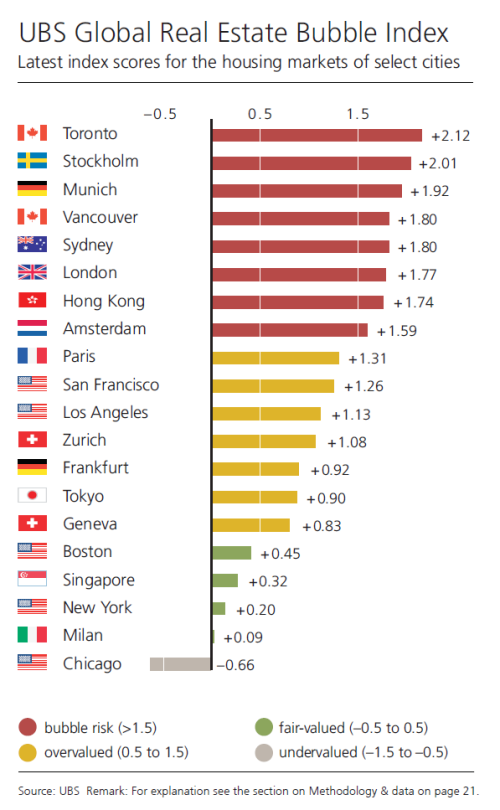
    Last week UBS released its 2017 Global Real Estate Bubble Index. At the top of the list was none other than Toronto, followed by Stockholm, Munich, Vancouver and Sydney. And at the bottom of the list was Chicago – a city that UBS feels is undervalued.

    Here is the full list of index scores:

    image

    The UBS index is a weighted average of the following five sub-indices:

    1. Price-to-income
    2. Price-to-rent (fundamental valuation)
    3. Change in mortgage-to-GDP ratio
    4. Change in construction-to-GDP ratio (economic distortion)
    5. Relative price-city-to-country indicator

    If you look at their price-to-income benchmark in isolation, Toronto drops down to the middle of the pack along with Geneva and San Francisco. Hong Kong, London and Paris sit at the top with the most unaffordable housing. 

    Still, UBS credits “an overly loose monetary policy”, foreign demand, tight zoning, and rental market regulations for the eroding housing affordability in Toronto and Vancouver.

    One of the challenges, of course, is that the capital flowing into real estate is not all local – it’s also global. And many cities around the world are seeing high price-to-income multiples, perhaps because of that. 

    So exactly how much decoupling from local fundamentals should now be considered reasonable in our globalized world? And to what extent is this a result of “superstar economics?”

    Here’s an excerpt from the UBS report:

    The economics of Superstars explains why, in some professions, show business for instance, “small numbers of people earn enormous amounts of money and dominate the activities in which they engage.” By analogous reasoning, prices in the most attractive cities are expected to outperform average cities or rural areas in the long run. Hong Kong, London and San Francisco are exemplars of this theory.

    The intuition is that the national and global growth of high-wealth households creates continued excess demand for the best locations. So, as long as supply cannot increase rapidly, prices in the so-called “Superstar cities” are supposed to decouple from rents, incomes and the respective countrywide price level.

    I guess this is one of the reasons why bubbles are proven after the fact. If you would like to download a copy of the full UBS report, click here.

  • Is Trump good for Canada?

    Richard Florida and Joshua Gans just published an article in Politico called: Trump Is Making Canada Great Again. The overarching argument is that as the US closes its borders, Canada benefits. The best and brightest from around the world are coming here.

    This fall, international student applications at the University of Toronto were up 70% compared to last year. And numerous companies in Toronto are reporting “steady, double-digit increases” in the number of job applications from Americans.

    This is exactly what I was getting at when I made the pithy prediction that Amazon is going to choose Toronto for HQ2. It’s about access to human capital (though I acknowledge the political reality of selecting a city outside of the US). 

    Perhaps here or here might work for a location.

    Here is an excerpt from the Politico article that starts to speak to the importance of foreign-born workers in the US:

    As of 2013, foreign-born workers in STEM fields—science, technology engineering and math—accounted for nearly a fifth of workers with bachelor’s degrees in the United States, 40 percent of those with master’s degrees and more than half of those with Ph.D.s. In the San Jose metro area, consisting largely of Silicon Valley, immigrants comprise more than 55 percent of adults who hold advanced degrees.

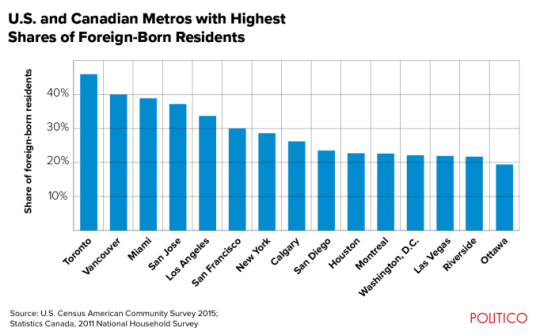
    Here is a chart showing the US and Canadian metros with the highest percentage of foreign-born residents:

    image

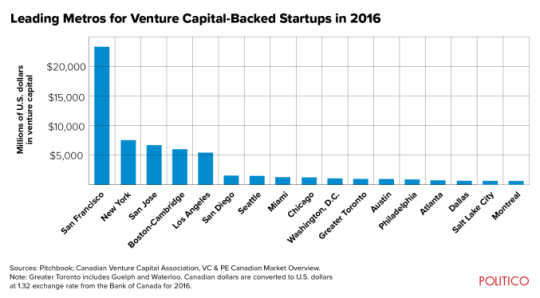
    And here is a chart showing which metro areas receive the most venture capital dollars (in millions of US dollars):

    image

    As to be expected, Toronto, Vancouver and Miami lead in terms of the percentage of foreign-born residents. Though, I would bet that Toronto’s foreign-born population is far more diverse than those of Vancouver and Miami.

    However, when you look at venture capital dollars invested, Toronto is nowhere near the top. Vancouver isn’t even on the list. And I suspect that some of you are surprised to see Miami sitting in between Chicago and Seattle (arguably a city that overperforms in tech relative to VC dollars invested). I was.

    Perhaps Trump will help with this by making Canada great again.