Daily insights for city builders, delivered every morning at 6 AM ET. I’m Brandon Donnelly — a Toronto-based real estate developer and founder of Globizen. I’ve been writing here since 2013.

  • Singapore just capped vehicle growth at 0%

    When I was in New York a few weeks ago, my friend (a New Yorker) said to me that he couldn’t imagine owning a car (he used to but got rid of it with zero remorse). He then elaborated on all of the nuisances that driving in the city produces.

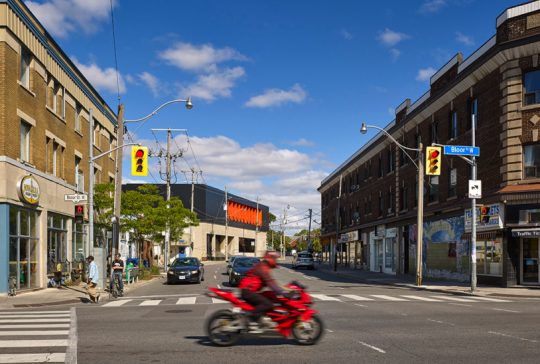
    There are parts of Toronto where you can feel similarly. I feel fortunate to live in one of those parts. Of course, there are other parts of this city where the exact opposite is true. It’s inconvenient not to have a car. These are typically areas where lower land costs have been exchanged for higher transportation costs.

    The City of Toronto has a land area of approximately 630 square kilometers. If that’s all the land we had (the metro area is almost 6,000 square kilometers), you can bet we would think about land use and transportation a bit differently.

    Take for instance, Singapore, a city-state with an area of approximately 719 square kilometers. The Land Transport Authority estimates that 12% of the republic’s total land area is taken up by roads.

    Because of this, they just announced that they have lowered their vehicle growth rate (for cars and motorcycles) from 0.25% per annum to 0% effective February 2018. They can do this through their Certificate of Entitlement (COE) quota. And it won’t be revisited until 2020.

    Put differently: No more cars and motorcycles until, maybe, 2020.

  • Moving up the stack

    The new GoPro HERO6 is a miraculous little camera.

    It now films in 4k at 60 frames per second. It has great image stabilization. And the screen on the back is new for me and a real game changer. The creative possibilities are endless.

    But probably more importantly you can tell that GoPro is investing heavily in their software. They have to make it easier for people to share the content they create.

    They also know that their survival likely depends on some sort of software layer.

    At its peak, GoPro was trading at $86 per share. Right now, as I write this post, it’s $9.40. Some think the company will be sold within the next year.

    Here is a recent quote from Benedict Evans:

    As we saw with first GoPro and now perhaps Sonos, if you’re riding the smartphone supply chain cornucopia but can’t construct a story further up the stack, around cloud, software, ecosystem or network effects, you’re just another commodity widget maker.

    To borrow Marc Andreessen’s line: Software is eating the world.

  • Winner take all, or most, economy

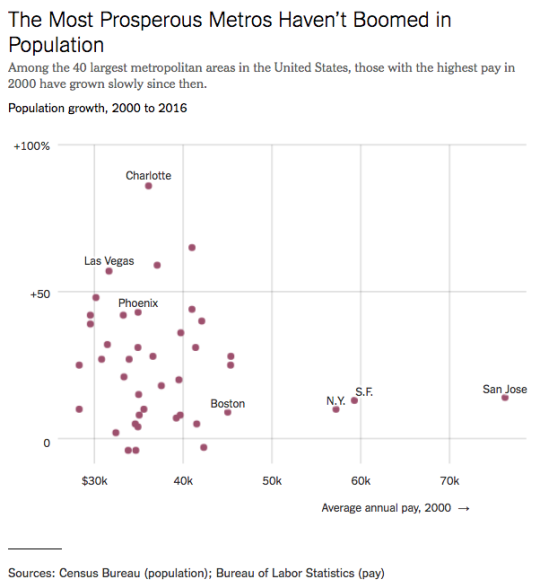
    The world is increasingly spiky. Inequality is growing and it is increasingly geographic in nature. We know that people tend to make more money in urban areas compared to rural areas – even when they possess the exact same level of education. The returns to being smart and educated are simply greater in cities.

    But they also depend on the size of the city. Mark Muro and Jacob Whiton of Brookings recently published data looking at labor market performance – by metro size – from 2009-2015 (right after the financial crisis). What they found is that larger metropolitan areas simply performed better than smaller ones.

    image

    In summary:

    City size matters because it’s a major influence on city prosperity and adaptability as well as local worker fortunes. Bigger cities are more productive. They are more innovative. They draw better-educated workers by offering higher wages.

    The situation is even more pronounced across the pond. According to the New York Times (quote from Richard Florida), a third of Britain’s gross domestic product comes from London alone.

    What is far less clear is what should be done to address the decline of some of the smaller cities in America – cities that are stagnating and feeling left behind. But perhaps the first step is acknowledging what has happened and what remains feasible in today’s global economy.

    Here is another quote from the above NY Times article:

    Mr. Trump’s promise to relieve the pain by reviving the coal and steel industries, by keeping immigrants out of the country and by raising barriers against manufactured imports is only a rhetorical balm to satisfy an angry base seeking to reclaim a prosperous past that is no longer available.

    That rhetorical balm.

  • How to make money with low-risk licensing deals

    image

    This morning the Toronto Star published a detailed autopsy of the failed Trump International Hotel and Tower Toronto. It outlines the players, the investors, and what supposedly went wrong. Of course, the headline is all about how Trump managed to make money from the deal – through his well-publicized licensing business – even though the project went bankrupt.

    At the beginning of this year, the Washington Post reported that Trump’s name had been licensed and linked to over 50 properties and that these contracts have earned him at least USD$59 million in revenue. Outside of the US and Canada, the Trump Organization has (or had) deals in Brazil, Turkey, Azerbaijan, India, Indonesia, the UAE, and so on.

    There would have been more money to be made in the actual development of these properties, but the beauty of these licensing deals – for Trump – is that they are “low-effort, low-risk, high-reward.” In fact, this past summer it was reported that the breakup fee at Trump Toronto – the fee to exit all contracts with the Trump Organization – was at least $6 million (guessing that’s in USD).

    This story is not unique to Toronto. And so I have got to believe that there’s major brand dilution happening here. Does the Trump name really bring credibility to projects in some markets? How sustainable is this licensing business? 

    The only other thing that I would add to the Toronto Star article is that the hybrid condo-hotel model has proven to be difficult in this city. It’s perfectly fine to have residential condos and a hotel in one tower. There are lots of successful examples of those. But when the condo units can be put into a hotel pool (and there’s an IRR expectation on the part of individual owners), many seem to have been disappointed.

    Part of the challenge with this model here in Toronto is that the condo-hotel units typically end up with a commercial property tax rate, which, in this city, is much higher than the residential rate. This can suppress values.

    Photo by NeONBRAND on Unsplash

  • Third Coast Atlas: Prelude to a Plan

    Daniel Ibañez, Clare Lyster, Charles Waldheim, and Mason White have just published a book analyzing the Great Lakes and the Saint Lawrence River. It’s called, Third Coast Atlas: Prelude to a Plan.

    The Great Lakes represent the world’s largest collection of freshwater; a feature that is likely to become

    only

    more valuable. Their coastline is longer than the Atlantic and the Pacific coastlines of the US, combined. Hence the name “Third Coast.”

    The reason the book is called a “prelude to a plan” is that it doesn’t propose a plan or a path forward. Instead, it is focused on analyzing the current state. Here is an excerpt about the book taken from the Daniels Faculty:

    Third Coast Atlas: Prelude to a Plan describes the conditions for urbanization across the Great Lakes region. It assembles a multi-layered, empirical description of urbanization processes within the drainage basins of the five Great Lakes and the Saint Lawrence River. This thick description encompasses a range of representational forms including maps, plans, diagrams, timelines, and photographs, as well as speculative design research projects and critical texts.

    I find this topic fascinating and I suspect that many of you might as well. It’s also an important one. So I wanted to get it on your radar. If you happen to be in Toronto next week, the launch/book signing is happening this Tuesday, October 24, 2017.

  • Amazon orange

    This week (Thursday) was the deadline to submit proposals for Amazon HQ2. About 100 cities across North America are thought to have a bid in. 

    New York lit up every single landmark in the city with “Amazon orange” in an “embarrassing attempt” to try and win this thing. That’s how bad cities want this.

    I already think that Toronto has won an incredible prize with Sidewalk Toronto. Arguably, it may turn out to be more impactful to this city than Amazon HQ2. It’s an opportunity to define the future of, not just this city, but all cities. It’s an opportunity to lead.

    At the same time, I continue to believe that there’s no better place for Amazon HQ2 than here in Toronto. Not surprisingly, our bid emphasized the point that I’ve been hammering home on this blog since Amazon first announced the RFP. Toronto’s key competitive advantage: talent. 

    Below is an excerpt from the submission cover letter. The entire letter emphasizes our ability to grow, attract, and retain top talent.

    Thirty-nine percent of the Toronto Region—and 51% of Toronto proper—are born outside of Canada. We welcome more new immigrants each year than New York, LA, and Chicago combined. We speak over 180 languages and dialects. Toronto is heralded as the most multicultural city in the world, and our labour force and economy benefit directly from our diversity and inclusivity. We build doors, not walls. And those doors open to highly-skilled economic immigrants and international students who can easily become permanent residents and citizens.

    For the full Toronto region submission, click here

    Okay, enough about Sidewalk Labs and Amazon. Regular scheduled programming will resume on the blog starting tomorrow.

  • The neighborhood of the future (part 2)

    I have been traveling since the weekend and so I am behind on my reading. One of the benefits of writing this blog every day is that I am forced to read as much as I can. I have to be a sponge.

    Right now, I am still reeling in excitement over the Sidewalk Toronto announcement and getting caught up on that reading. 

    This week Sidewalk Labs published the entire vision section of their RFP response to Waterfront Toronto. This is the response that won them the Quayside partnership. It’s 196 pages and can be downloaded here.

    I’m still making my way through the package, which I am obviously going to do, but I thought this was a great diagram:

    image

    As is stated in their RFP response, inclement weather affects pedestrians and cyclists more than drivers. Toronto’s most notable response has been our PATH system, which pulls both people and retail below grade, away from the elements.

    But Sidewalk’s research suggests that with the right wind, sun, and precipitation strategies, they may be able to 2x the number of comfortable outside hours per year here in Toronto. That’s what the above diagram shows.

    Of course, there is so much more in their RFP response. But I need more time to digest it all. I’ll be sure to report back to all of you once I have done that. If you don’t feel like going through all 196 pages yourself, you can watch this 4 minute YouTube video instead.

  • The neighborhood of the future

    image

    Daniel Doctoroff (chairman and CEO of Sidewalk Labs and former deputy mayor of New York City) and Eric Schmidt (executive chairman of Alphabet and former CEO of Google) recently contributed a piece to the Globe and Mail about “why Toronto is the ideal place to build a neighborhood of the future.” 

    It’s about the partnership they working on with Waterfront Toronto. I wrote about that announcement, here.

    Here is an excerpt from the Globe article:

    “The eastern waterfront will be a place where residents, companies, startups and local organizations can advance new ideas for improving city life. It’s where a self-driving test shuttle will take its first steps toward becoming a next-generation transit system that’s cheaper, safer and more convenient than private car-ownership. It’s where new insights into advanced construction methods will start to reveal a path toward more affordable housing development. It’s where explorations into renewable energy and sustainable building designs will show promise toward becoming a climate-positive blueprint for cities around the world.”

    These are some of the first details that I have heard about their vision for Toronto’s eastern waterfront. 

    Some of you are probably worried – after reading the above excerpt – that by focusing on self-driving vehicles, we are setting ourselves up to repeat our previous mistakes. But if self-driving vehicles are destined to become a reality (and it certainly feels that way), it is critical that we understand their impact and how they might best dovetail with the public transit systems we already have in place.

    I am thrilled that all of this will be happening right here on our doorstep.

    Photo by Brxxto on Unsplash

  • 10x the scale

    Below is a chart from Benedict Evans comparing annual revenue from the Wintel era (Microsoft + Intel) to the current GAFA era (Google, Apple, Facebook, and Amazon). 

    His argument is that, today, “the scale of tech winners” is about 10x what it was during the previous cycle.

    And here is a chart, from that same post, showing how the internet ate print ads when it comes to global revenue:

    A lot of this has to do with the unprecedented growth of smartphones and the sheer number of people who came and are coming online. Mobile is 10x the PC market.

    But the other interesting narrative from the post is the argument that these companies (GAFA) have learned from previous generations just how aggressive you need to be to survive.

    The shift to mobile posed a structural threat to Facebook. At the time of its IPO, there were serious doubts as to whether the company would be able to pull off this transition.

    Which is why the founder went out and spent 10% of the company to acquire companies that would help with this transition and ensure its survival. That seems to have worked.

    In the words of Andrew Grove: “Only the paranoid survive.“ And in today’s tech world, the rewards for surviving are that much bigger.

  • Supply-side toolkit for greater housing affordability

    image

    McKinsey Global Institute just published a “supply-side toolkit” for cities struggling with housing affordability. This seems to be every successful city.

    The article includes a long list of potential tools. Some of them you may agree with. And others you may disagree with. But I am sure that many of them will be familiar to you. One of the tools in the toolkit is accessory dwelling units.

    Of course, the overarching theme is that housing supply has not and is not keeping pace with housing demand:

    California, for instance, added 544,000 households but only 467,000 net housing units from 2009 to 2014. Its cumulative housing shortfall has expanded to two million units.

    Another one of the tools in the toolkit is “overcoming NIMBYism.” Here is an excerpt:

    People who come to a city to work need to be able to find an affordable place to live there. But the voices of existing homeowners who want to preserve the status quo often drown out those of newcomers, young adults, low-income service workers, and renters who need more housing. After a 2009 audit found that neighborhood councils were not representative of the city’s broader population, Seattle replaced these bodies with a central Community Involvement Commission that includes mayoral and council appointees chosen to represent a broader set of stakeholders.

    I am intrigued by Seattle’s move to create a central body and a new approach to public engagement – one that moves away from local district-councils. However, it appears that this Community Involvement Commission is still very much in its infancy.

    If any of you are familiar with the Seattle market, I would be curious to hear your thoughts on it in the comment section below. I am, however, going to spend some time reading up on it.

    For the full toolkit, click here.

    Photo by Sarah Brink on Unsplash