Daily insights for city builders, delivered every morning at 6 AM ET. I’m Brandon Donnelly — a Toronto-based real estate developer and founder of Globizen. I’ve been writing here since 2013.

  • Saks x Dim Mak

    Steve Aoki was in Toronto today for a collaboration with Saks Fifth Avenue – namely the launch of his fall/winter Dim Mak Collection

    The after party was at Junction House (the pre-development version). Here is a photo:

    I actually wasn’t there (because I’m fighting off some sort of cold), but a friend sent me this photo. 

    It’s such a great space for events and production. It used to be an artist studio, but they moved out because they outgrew the space.

    If you have a need for a large warehouse space, you can actually rent it by visiting here.

  • People you may know

    If you’ve ever wondered how Facebook figures out all of the people you may know, here is some reading material. 

    The short answer is that Facebook doesn’t just know the things you’ve told it about yourself, it also knows what other people have told it about you. 

    One of the ways in which this is done is through its so called “shadow profiles". These are profiles that get created when other people share information about you with Facebook. 

    For example, you may not want to share your work email address with Facebook, but if it’s sitting in someone’s phone and that person decides to share his/her address book with Facebook, then it could show up in your shadow profile.

    And if there’s a common data point, such a phone number, then Facebook can fairly easily link that work email address back to you and start suggesting people from your work that you may know.

    The scary part, of course, is that Facebook is getting your information without you explicitly sharing it with them. It could be coming from that person you gave your business card to at the bar.

    It goes to show you just how fierce the competition is for our attention. It may be an assault on our privacy, but more Facebook connections means a higher likelihood that we’ll stay engaged on the platform.

    Over the past year I have been growing increasingly intolerant of this demand for my time. Slowly but surely I have been turning off all nonessential notifications on my phone. 

    Very few now remain, which is why if you’ve been trying to reach me on Facebook, WhatsApp, LinkedIn or some other platform, and I’m not responding, it’s because there’s a good chance I’m not seeing the notifications.

    And let me tell, it feels liberating.

  • End of the automotive era

    Bob Lutz is a former vice chairman and head of product development at General Motors. Recently, he had this to say about the future of the auto industry. 

    Here are a couple of powerful snippets:

    It saddens me to say it, but we are approaching the end of the automotive era.

    The auto industry is on an accelerating change curve. For hundreds of years, the horse was the prime mover of humans and for the past 120 years it has been the automobile.

    Now we are approaching the end of the line for the automobile because travel will be in standardized modules.

    Everyone will have five years to get their car off the road or sell it for scrap or trade it on a module.

    Bob is 85 years old. This is somebody who spent his entire life in the auto industry telling us that the old model is now done. 

    It reinforces something that I wrote about here, where the “end of the automotive era” was pegged at around 2021. 

    And it is part of the mental model that I have started relying on today for decision making.

    Photo by Alessio Lin on Unsplash

  • Learning from King Street

    Toronto is now a week into the King Street Transit Pilot.

    It’s still early days and transit guru Steve Munro hasn’t yet published any before and after route performance. He will. But already the sentiment seems to be clear: This shit is working. There are many recounts of people’s commute times being more than cut in half. 

    As somebody who walks this stretch of King every day, this isn’t surprising to me. There has been a dramatic reduction in the number of cars on the street.

    What is perhaps surprising is that none of the surrounding streets seem to be any busier. I would like to see the data, but it feels as if most of the cars have simply disappeared. Are more people now taking transit? Has this been your impression?

    Of course, the pilot isn’t perfect. What is not working are the signs that tell drivers they can’t drive through most of the intersections (only turn right). The circular green lights confuse them or they simply don’t care. 

    There have been suggestions for better signals, such as this one:

    image

    And if the pilot in its current incarnation does stick, I am sure there will be many additional improvements like this one made. But even at this early stage, Toronto is calling the pilot a “transit miracle.”

    When City Council approved the pilot in the summer it had a preliminary cost estimate of $1.5 million. (Figure excludes the lost parking revenue associated with removing approximately 180 on-street parking spaces).

    This is a relatively minuscule amount considering it has had an immediate impact, basically overnight, on the commute times of the 65,000 or so people who use this line every day.

    And it feels even more minuscule when you consider that our Scarborough Subway extension is expected to cost $3.35+ billion to build and only service around 64,000 people a day when you look far into the future – 2031 to be exact.

    The lesson here on King Street should be that light rail and surface transit routes can move lots of people very efficiently and cost effectively when you empower them to do precisely that.

  • How a North Carolina casino created a case study on unconditional basic income

    Unconditional basic income is a popular idea these days, particularly in the tech community, as one way to respond to growing inequality. (Though, could our current levels of inequality just be the result of a larger economic cycle?)

    One of the obvious counterarguments is that free money will make people lazy. But there are a number of studies out there, including real world examples, that suggest this isn’t necessarily true.

    Wired recently published an interesting recount of one such example. 

    In the late 90′s the Eastern Band of Cherokee Indians in North Carolina opened up a casino. Many would argue that casinos are horrible as an economic development tool, but in this instance the roughly 15,000 tribal members were all promised an equal cut of the casino’s profits.

    The first payments worked out to about $595 each. But in 2016, each tribal member received approximately $12,000. 

    The operator takes 3% of annual profits as a management fee, and then the rest is funneled back into the community to cover things like healthcare and infrastructure. About half of the casino’s profits go toward these “per capita payments.”

    All of this has made for an interesting case study on what can happen when you distribute unconditional money to low-income households. 

    What researchers discovered was a slew of positive externalities ranging from not only higher household incomes and fewer people below the poverty line, but also better health outcomes and children staying in school longer.

    For the full Wired article, click here.

  • Drip, subscription platform for artists and creators

    image

    Kickstarter has just relaunched a subscription service for artists and creators called Drip. It is an acquisition that Kickstarter made a few years ago and so that’s why it’s a relaunchHere is the blog post announcement.

    The simplest way to describe Drip is as follows: “Kickstarter is for projects, Drip is for people.” In other words, instead of backing a specific project, you back the human for, say, $10 a month. It’s a tool for people to fund creators so that they have the freedom to make their work.

    Now compare this model to that of the 19th century Salon in Paris. Arguably the greatest art event in the Western world during its prime, getting exhibited at the Salon was basically a right of passage for artists.

    But the Salon had specific criteria for what it considered to be good and acceptable art. Perhaps most famously, 19th century Impressionism – which some would call the first truly modern art movement in painting – was not considered acceptable.

    The Impressionists routinely had their work refused by the Salon, which is why they ended up having to organize their own shows. Good for them.

    So when I see something like Drip, I think about how amazing it is that we now have platforms where artists and creators have the freedom to make what they want to make and the market – instead of a stuffy institution – can decide what is good and worth supporting. 

    Check out Shantell Martin if you’re looking to explore Drip. I recently discovered her work and I’m a fan.

    Image: Coney Art Walls by Shantell Martin

  • The Toronto and Vancouver housing markets

    CIBC World Markets recently published this report by Benjamin Tal talking about the Toronto and Vancouver housing markets. Here is an excerpt:

    “But when the fog
    clears it will become evident that the
    long-term trajectory of the market will
    show even tighter conditions. The supply
    issues facing centres such as Toronto and
    Vancouver will worsen and demand is
    routinely understated. Short of a significant
    change in housing policies and preferences,
    there is nothing in the pipeline to alleviate
    the pressure.”

    It’s a good read. Worth your time.

    One stat that stood out and directly relates to some of the topics that we frequently talk about on this blog is the shift in Toronto from low-rise to high-rise housing.

    In the report there’s a chart showing the “change in [housing unit] completions” in 2016 as compared to 2000. The switch from low-rise to high-rise is almost 1:1 in Toronto. In other words, we substituted high-rise housing for low-rise housing. 

    I think this speaks volumes about the fundamentals underpinning the Toronto condo/apartment market. We are continuing to build up because it is the future of housing in this city.

  • Case study: 9-unit infill rental development in DC

    This is an interesting ULI case study about a 9-unit infill rental development in Washington, DC called Oslo (click here if you can’t see the video below):

    [youtube https://www.youtube.com/watch?v=G8FfT6UREuc?rel=0&w=560&h=315]

    The units are a mix of 3-bedroom and 4-bedroom apartments. The target market is recent graduates and millennials who might otherwise be sharing (”group living”) in a townhouse or single-family home to save on rent.

    Another notable aspect of this project is the fact that the previous building was a legal non-conforming 9-unit apartment building. In other words, the current zoning wouldn’t allow it today. So to preserve their zoning status, they had to figure out a clever workaround during construction.

    A project exactly like this – where you’re replacing an existing apartment building – probably wouldn’t be possible in Toronto because of our rental housing demolition and conversion bylaw. 

    But I wanted to share it because I am sure that many of you, including those outside of this city, will appreciate it as a good example of low-rise infill development.

  • The status quo, please

    In 1988, William Samuelson (Boston University) and Richard Zeckhauser (Harvard University) published a seminal paper called, Status Quo Bias in Decision Making.

    In one of the experiments cited in the paper, two groups of people are given a hypothetical task that involves picking from a selection of different investment opportunities.

    In both cases, the groups are told that they are someone who regularly reads the “financial pages”, but that up until recently hasn’t had much money to invest.

    Both groups are then told that they have just inherited “a large sum of money” from their great-uncle. This is now where the groups diverge in terms of the information given.

    The first group is given a neutral version. They are told they can invest in any of the following portfolios: a moderate-risk company, a high-risk company, treasury bills, or municipal bonds.

    The second group is given the same selection of portfolios, but is also given a “status quo selection.” They are told that a significant portion of their great-uncle’s portfolio is currently invested in a moderate risk company. 

    (They are also told that the fees associated with an investment change are insignificant and should not be a consideration for this decision.)

    What do you think happened?

    A number of different scenarios were tested, but as soon as one of the options was presented as the status quo, it became “significantly more popular”.

    This status quo advantage also tended to increase as the number of investment options increased. Perhaps people just got overwhelmed by the options and went with the “safe bet”.

    This phenomenon has become known as the status quo bias. 

    It is one of the reasons why some political offices have term limits. The incumbent bias can make for an uneven playing field. People vote for the name they recognize on the ballot.

    And it is one of the reasons why change, in general, can be so unsettling. The countless studies suggest we have an inherent bias towards the status quo irrespective of its objective merits.

    P.S. This is what came to mind as soon as I heard people calling the King Street Transit Pilot a “disaster” before the first weekday of its run was even over.

  • The King Street Transit Pilot has started

    Back in January 2016, I wrote about Toronto’s ambition to transform King into a “transit first” street across the downtown core. 

    The King streetcar is the busiest surface transit route in the entire city (65,000 riders / day on average) and it was – and continues to be – my opinion that the route was broken. Something had to be done.

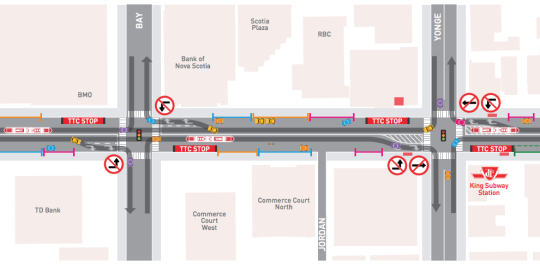
    Well, that something is now happening. The “King Street Transit Pilot” officially started on Sunday, November 12, 2017 at 7am. Here are some of the key changes, many of which are also depicted in the above image:

    – No more on-street parking in the pilot area.

    – Cars can no longer turn left or drive through the intersections of the pilot area (except for taxis picking up drunk people from 10pm to 5am).

    – Cars must now follow a right-in/right-out approach. They can turn right onto King, but then they have to turn right off of King at the next intersection.

    – Most of the streetcar stops have been moved to the “far side” of each intersection. That is, after the lights. Passenger waiting areas are now in the curbside lane and protected by jersey barriers.

    – Cyclists can go through the intersections of the pilot area. “Bike boxes” have been added to intersections where there are north-south bike lanes to help with turning left.

    As to be expected, some people are upset about the above changes. There are also concerns that drivers aren’t going to obey the rules and continue to drive through the intersections in the streetcar lane. But this is a pilot project. It’s about learning and adjusting.

    It’s also important to keep in mind that King has at least 3x more transit riders than cars. This pilot is about figuring out how to best optimize the street so that it moves the greatest number of people as efficiently as possible.

    I’ll report back here on the blog once the pilot has settled in and there is a better understanding of its impact.