Daily insights for city builders, delivered every morning at 6 AM ET. I’m Brandon Donnelly — a Toronto-based real estate developer and founder of Globizen. I’ve been writing here since 2013.

  • Inclusionary zoning is coming to Ontario

    On Monday the province of Ontario posted a draft regulation intended to establish a framework for inclusionary zoning. It builds on a bill that passed last year allowing municipalities – should they choose – to require affordable housing in new developments and redevelopments.

    Below are some, but not all, of the things that are being considered in the draft regulation. Some of these items were recommendations made by the development industry through the Ontario Home Builders’ Association (OHBA) and the Building Industry and Land Development Association (BILD).

    – The total number of affordable units or gross floor area dedicated to affordable housing units would not exceed 5% of the total units or 5% of the total gross floor area (excluding common areas). This number increase to 10% in high density transit station areas.

    – The affordable period would be a minimum of 20 years but no greater than 30 years.

    – There may be opportunities to provide the inclusionary zoning units off-site.

    – The policies would only apply to developments / redevelopments with 20 or more units.

    – The affordable component could not be used to determine community benefits under Section 37. Section 37 would also not apply if the proposed development (with IZ) is in a location where a development / community planning permit is used.

    – Municipalities would be required to offer incentives to help offset the IZ cost burden, but only if the development is not subject to a development / community planning permit. The incentives could include a waiver or reduction in application fees, parkland dedication fees, development charges, and so on. These offsets are very important to the industry and the affordability of the market rate units. But interestingly enough, increases in height and/or density are not being contemplated as a possible incentive or financial contribution.

    – The financial contribution would be based on the following formula: (A – B) x 0.4. A is the total sum of the average market price for all of the affordable housing units and B is the total sum of the affordable price for all of the IZ housing units. In other words, the intent is that municipalities would be required to offset 40% of the costs associated with providing the affordable units.

    Click here for the rest of the draft regulation. The OHBA also published this media release following the draft. They like the “partnership model” but were advocating for a 50/50 public/private cost share on all government-mandated units.

    If you’re looking for more reading on inclusionary zoning, check here, here, and here.

    Photo by Omair Khan on Unsplash

  • The Christmas slowdown

    It has been a busy year end. No slowdown whatsoever on my end as I make my way through the last week of the year in the office. Because I love what I do so much (I’m grateful for that), I have a habit of getting completely absorbed in my work. That’s a good thing, but it also means I probably neglect other things, like I have with my Christmas shopping this year.

    So I’m looking forward to the holiday slowdown so that I can spend more time with family and friends, workout more, and dedicate more time to this blog and photography. 

    I’m also going to be traveling after Christmas. And since I’ve been feeling lately that I need to challenge myself more with this blog, expect it to skew toward a travel/photoblog for about a week. I am sure it will still relate to many of the topics that we regularly discuss on this blog. Or maybe it won’t.

    What are your plans for the holidays?

  • Reprivatization in Warsaw is a double-edged sword

    The Guardian has just published a fascinating article about the reprivatization of property in Warsaw. This is the process by which previously nationalized property is returned to pre-communist owners, or their heirs.

    Not surprisingly, the government gets a lot of these sorts of claims, though many of them are clearly bogus. Between 2007 and 2017, Warsaw City Hall estimates that 447 properties, representing about 4,479 dwellings units, were reprivatized.

    For some, all of this is restitution for widespread expropriation during the communist era. But for others, it quite simply means eviction. 

    The story at the beginning of the article – about a family who is immediately evicted from their apartment and has their belongings thrown out – seems almost hard to believe. One would think that there would be more sensible transition policies in place.

    Another negative has to do with the uncertainty that this creates in the market. Why would you buy and/or invest in a property if there was any inkling that it could be taken away from you? You wouldn’t. 

    Click here to read, ‘They stole the soul of the city’: how Warsaw’s reprivatisation is causing chaos. If any of you are familiar with the Warsaw property market, please do leave a comment below.

  • The Canada mission

    It’s the Christmas and holiday season, which means two very important things. 

    One, it’s time for the latest rendition of Urban Capital’s annual Naughty or Nice party. That was last week and it was #7. Here are the obligatory photo booth snaps to prove it happened.

    And two, the latest issue of Site Magazine (from Urban Capital) is now out. 

    This year I wrote a piece called “The Canada mission”. It’s all about Urban Capital’s pan-Canadian mission to build from coast to coast. How it happened. The challenges. What’s driving it. And what have been the results.

    The article includes case studies from Urban Capital’s two newest markets: Saskatoon and Winnipeg. 

    One of the things that I didn’t fully appreciate until I started researching for the article was just how pioneering these projects were. At the time, there were no proof points to suggest that the pro formas would work. And this is a leap of faith that Urban Capital has had to make on many of its projects.

    Click here to download a PDF of the full magazine.

  • Urban vs. suburban home prices

    Aaron Terrazas, who is a Senior Economist at Zillow, recently gave this presentation about the US and Virginia Beach housing markets. (I discovered it through City Observatory.)

    There are a bunch of interesting graphs/stats in the presentation. Home values in Virginia Beach, for example, have yet to fully recover from the 2007-2008 financial crisis. They are still 8% below their pre-crisis peak, which was in July 2007. (I presume the presentation is dealing in nominal dollars.)

    I’ll give two more examples. 

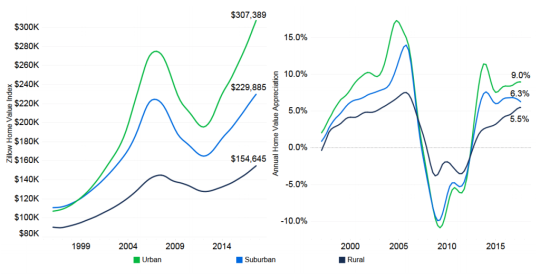
    Below is a chart comparing average home prices for rural (dark blue/purple), suburban (blue), and urban (green) homes. In the late 90′s, suburban and urban homes were roughly equal in terms of average prices. But since then, urban homes have shown greater appreciation. The spread also appears to be widening.

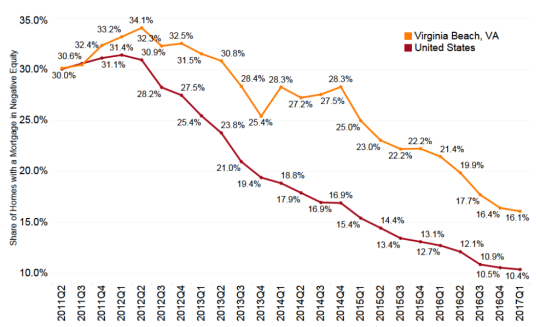
    And here is a graph showing the share of mortgage borrowers in a negative equity position. That is, the value of the home is less than the outstanding balance of the mortgage.

    Now this is only covers people who have a mortgage. According to this Washington Post article, about 34% of all US homeowners don’t have one. Either they have paid it off or they never had one.

    Still, the above numbers stood out to me. They speak to the severity of the financial crisis. At the end of 2011 and the beginning of 2012, over 30% of borrowers were in a negativity equity position. And in Virginia Beach it was more than 1/3 of all borrowers at the peak.

    For the full presentation, click here.

  • Is San Francisco losing its openness?

    Sam Altman has an interesting post up on his blog talking about what he feels is a changing cultural environment in San Francisco (which is where he is based). His argument is that heresies are good for innovation and for moving the world forward. We need people to question established norms. But for that to happen we need environments and cities that encourage it, or at the very least allow it.

    Here’s an excerpt:

    Restricting speech leads to restricting ideas and therefore restricted innovation—the most successful societies have generally been the most open ones.  Usually mainstream ideas are right and heterodox ideas are wrong, but the true and unpopular ideas are what drive the world forward.  Also, smart people tend to have an allergic reaction to the restriction of ideas, and I’m now seeing many of the smartest people I know move elsewhere.

    In San Francisco he is starting to feel that it is becoming increasingly difficult to have wacky ideas and to work on wacky startups. And for this reason, people are starting to leave the city in search of more open cultures. Openness used to be a hallmark of San Francisco. It was once the epicenter of counterculture. Has that changed?

    Here is a final excerpt:

    I don’t know who Satoshi is, but I’m skeptical that he, she, or they would have been able to come up with the idea for bitcoin immersed in the current culture of San Francisco—it would have seemed too crazy and too dangerous, with too many ways to go wrong.  If SpaceX started in San Francisco in 2017, I assume they would have been attacked for focusing on problems of the 1%, or for doing something the government had already decided was too hard.  I can picture Galileo looking up at the sky and whispering “E pur si muove” here today.

    Click here to read the full post.

  • Mastering Bitcoin

    I’m still in the office right now (wading through Excel models) and I’m late for a Christmas party. So by necessity today’s post is going to be a short one.

    Below is a podcast from the Kevin Rose Show called “Bitcoin’s true potential”. It’s with Andreas M. Antonopoulos, who is the author of a number of books on the topic including: Mastering Bitcoin, The Internet of Money, and Mastering Ethereum.

    If you’re pressed for time, here are a couple of time stamps that may interest you:

    18:12 – Global opportunities and challenges for expanded Bitcoin use 
    28:00 – Why Andreas spends Bitcoin almost every day
    29:38 – How reduced volatility will help Bitcoin achieve mass adoption
    32:38 – Bitcoin’s potential market capitalization
    35:35 – Bitcoin versus Visa for consumer transactions
    1:06:10 – The most compelling application areas Andreas is tracking
    1:22:54 – The future of cryptography: ECDSA and SHA-256

    And if you can’t see the embedded podcast below, click here.

    https://embed.simplecast.com/bd660142

  • New York is the only US city with an urban core growing faster than the suburbs

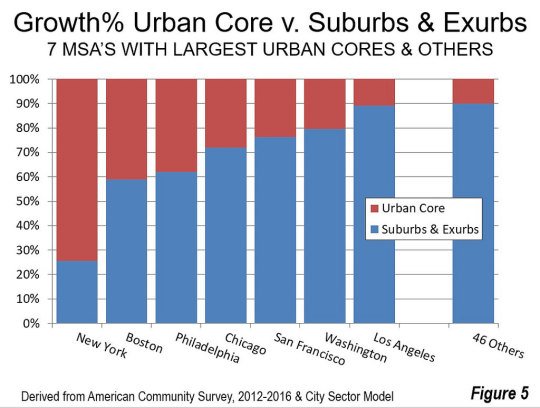
    The latest data from the American Community Survey (2012 to 2016) has placed the suburban and exurban share of the US population (53 major metropolitan areas) at 85.5%. Back in 2000 this number was thought to be around 83.5%.

    Since 2010, automobile oriented suburbs and exurbs have also accounted for 90.5% of population growth. The US – and Canada would be no different – is by and large a suburban nation. And the data suggests this isn’t about to change.

    The one exception is the New York metro area. From 2012 to 2016, 74% of its growth happened in the urban core. No other major metropolitan area in the US comes close to this sort of urbanity. Below is a chart from New Geography that shows you how NYC compares.

    All of the data for this post was also taken from New Geography.

  • Break the internet

    Today I am joining a collective online protest – called Break the Internet – in support of net neutrality in the United States. I’m not American and I don’t live in the US, and so Congress and the FCC don’t care to hear from me. But I can help spread the word. More than half of the people who email subscribe to this blog are based in the US. You can take action.

    Fortunately for us in Canada, the CRTC firmly supports net neutrality. Internet service providers (ISP’s) can offer different packages based on speed and monthly data, but they cannot do this based on content. This is a great thing that many would argue is pro-innovation. But let’s be honest: If the internet environment changes in the US, it would likely have widespread impacts.

    For more on net neutrality, here is a Wikipedia series.

  • So the tech works. What’s next?

    Below is a keynote talk by Benedict Evans about what’s going on in tech today and what may happen in the next ten years. It covers: the growth of mobile; S-curves; Google / Apple / Facebook / Amazon (who knew Amazon had so many employees?); machine learning; autonomous vehicles/impact to cities; mixed reality; crypto-currencies; and so on.

    For those of you interested in crypto-currencies – and that appears to be everyone these days – it’s interesting to hear how Evans describes their current position at the beginning of the curve: “The tech works, but what’s the use case?” This is not to say the potential isn’t huge. It is. Automated trust. Distributed and programmable money. But the future is still unclear.

    If you can’t see the video below, click here.

    [youtube https://www.youtube.com/watch?v=cVYDkPidXrU&w=560&h=315]