Daily insights for city builders, delivered every morning at 6 AM ET. I’m Brandon Donnelly — a Toronto-based real estate developer and founder of Globizen. I’ve been writing here since 2013.

  • Is San Francisco losing its openness?

    Sam Altman has an interesting post up on his blog talking about what he feels is a changing cultural environment in San Francisco (which is where he is based). His argument is that heresies are good for innovation and for moving the world forward. We need people to question established norms. But for that to happen we need environments and cities that encourage it, or at the very least allow it.

    Here’s an excerpt:

    Restricting speech leads to restricting ideas and therefore restricted innovation—the most successful societies have generally been the most open ones.  Usually mainstream ideas are right and heterodox ideas are wrong, but the true and unpopular ideas are what drive the world forward.  Also, smart people tend to have an allergic reaction to the restriction of ideas, and I’m now seeing many of the smartest people I know move elsewhere.

    In San Francisco he is starting to feel that it is becoming increasingly difficult to have wacky ideas and to work on wacky startups. And for this reason, people are starting to leave the city in search of more open cultures. Openness used to be a hallmark of San Francisco. It was once the epicenter of counterculture. Has that changed?

    Here is a final excerpt:

    I don’t know who Satoshi is, but I’m skeptical that he, she, or they would have been able to come up with the idea for bitcoin immersed in the current culture of San Francisco—it would have seemed too crazy and too dangerous, with too many ways to go wrong.  If SpaceX started in San Francisco in 2017, I assume they would have been attacked for focusing on problems of the 1%, or for doing something the government had already decided was too hard.  I can picture Galileo looking up at the sky and whispering “E pur si muove” here today.

    Click here to read the full post.
  • Mastering Bitcoin

    I’m still in the office right now (wading through Excel models) and I’m late for a Christmas party. So by necessity today’s post is going to be a short one.

    Below is a podcast from the Kevin Rose Show called “Bitcoin’s true potential”. It’s with Andreas M. Antonopoulos, who is the author of a number of books on the topic including: Mastering Bitcoin, The Internet of Money, and Mastering Ethereum.

    If you’re pressed for time, here are a couple of time stamps that may interest you:

    18:12 – Global opportunities and challenges for expanded Bitcoin use 
    28:00 – Why Andreas spends Bitcoin almost every day
    29:38 – How reduced volatility will help Bitcoin achieve mass adoption
    32:38 – Bitcoin’s potential market capitalization
    35:35 – Bitcoin versus Visa for consumer transactions
    1:06:10 – The most compelling application areas Andreas is tracking
    1:22:54 – The future of cryptography: ECDSA and SHA-256

    And if you can’t see the embedded podcast below, click here.

    https://embed.simplecast.com/bd660142

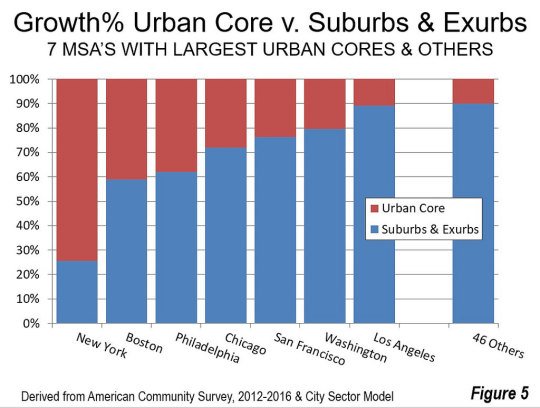
  • New York is the only US city with an urban core growing faster than the suburbs

    The latest data from the American Community Survey (2012 to 2016) has placed the suburban and exurban share of the US population (53 major metropolitan areas) at 85.5%. Back in 2000 this number was thought to be around 83.5%.

    Since 2010, automobile oriented suburbs and exurbs have also accounted for 90.5% of population growth. The US – and Canada would be no different – is by and large a suburban nation. And the data suggests this isn’t about to change.

    The one exception is the New York metro area. From 2012 to 2016, 74% of its growth happened in the urban core. No other major metropolitan area in the US comes close to this sort of urbanity. Below is a chart from New Geography that shows you how NYC compares.

    All of the data for this post was also taken from New Geography.

  • Break the internet

    Today I am joining a collective online protest – called Break the Internet – in support of net neutrality in the United States. I’m not American and I don’t live in the US, and so Congress and the FCC don’t care to hear from me. But I can help spread the word. More than half of the people who email subscribe to this blog are based in the US. You can take action.

    Fortunately for us in Canada, the CRTC firmly supports net neutrality. Internet service providers (ISP’s) can offer different packages based on speed and monthly data, but they cannot do this based on content. This is a great thing that many would argue is pro-innovation. But let’s be honest: If the internet environment changes in the US, it would likely have widespread impacts.

    For more on net neutrality, here is a Wikipedia series.

  • So the tech works. What’s next?

    Below is a keynote talk by Benedict Evans about what’s going on in tech today and what may happen in the next ten years. It covers: the growth of mobile; S-curves; Google / Apple / Facebook / Amazon (who knew Amazon had so many employees?); machine learning; autonomous vehicles/impact to cities; mixed reality; crypto-currencies; and so on.

    For those of you interested in crypto-currencies – and that appears to be everyone these days – it’s interesting to hear how Evans describes their current position at the beginning of the curve: “The tech works, but what’s the use case?” This is not to say the potential isn’t huge. It is. Automated trust. Distributed and programmable money. But the future is still unclear.

    If you can’t see the video below, click here.

    [youtube https://www.youtube.com/watch?v=cVYDkPidXrU&w=560&h=315]

  • 50th year anniversary of Playtime

    This month is the 50th year anniversary of the Jacques Tati film, Playtime. Initially released in December 1967, Playtime is a French comedy that is often considered to be director Tati’s most notable work. Apparently it was commercially unsuccessful at the time of its release. But it has since become recognized, at least by some, as one of the greatest films ever made.

    The film is a satire of modern society. And so it’s also a funny critique on modern architecture and the prevailing ideologies at the time. Watch the trailer below and you’ll very clearly see this relationship: a Frenchman lost in a new, modern Paris. I remember watching one of his earlier movies – Mon Oncle – in one of my undergraduate architecture classes.

    If you can’t see the trailer below, click here:

    [youtube https://www.youtube.com/watch?v=zrYB8hgyq4s&w=560&h=315]

  • We’re hosting a pre-design community meeting in Hamilton

    This fall Slate acquired a retail center in Hamilton called Corktown Plaza. It is the block bounded by John Street South, Young Street, Catharine Street South, and Forest Avenue. It is just south of the Hamilton GO Centre in downtown.

    It is currently a much used single storey retail plaza with a large surface parking lot facing John Street South. It’s still early days, but the long-term plan is to redevelop it into a mixed-use retail and residential complex.

    Before putting pen to paper, the team is hosting a “pre-design community meeting” this Tuesday, December 12, 2017 at 7pm at the Church of Ascension down the street. Address is 64 Forest Avenue (accessible entrance at 258 John Street South).

    Here is the invite (embedded tweet):

    https://platform.twitter.com/widgets.js

    The purpose of the meeting is to gather feedback from the community before beginning design. We want to know what’s working today, what’s not working today, and what would be ideal for the future. 

    CORE Architects and GSP Group (planning) will be in attendance along with the Slate team. The format will be brief presentations followed by interactive breakout sessions. There will be trace paper on hand so that we can all put pen to paper.

    If you live and/or work in the area or are simply interested in the future of Hamilton, please feel free to join us on Tuesday evening. If you can, send a quick email to rsvp@kga-inc.com letting us know you’ll be coming. But just showing up is also perfectly fine.

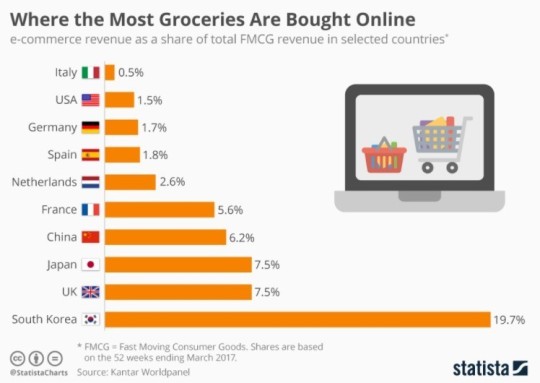
  • South Korea buys 20% of its groceries online

    The World Economic Forum recently posted the below chart showing that 1/5 of all grocery purchases in South Korea are done online. The calculation is e-commerce revenue as a percentage of total fast moving consumer goods revenue in the country.

    image

    The explanation they give for this high percentage is that South Korea has some of the fastest and most ubiquitous internet access in the world. 

    But as soon as I read this I thought to myself: This can’t be the only reason. When was the last time you really wanted to order groceries online but your internet connection was too slow? 

    Also, if you look at all online shopping (not just FMCG), South Korea no longer shows up as such an outlier. So what’s happening with grocery?

    Without actually knowing the market, I would imagine that there are companies in South Korea who have simply figured out how to offer a great online grocery shopping experience.

    South Korea is also one of the denser countries in the world at about 513 people per km2. That would help with distribution. 

    But then again, the Netherlands is also quite dense (414 people per km2). Why are they only at 2.6%? (For comparison, the US is about 33 people per km2.)

    If any of you are familiar with the South Korea market I would love to hear from you in the comments. If they really are at 20%, I am surprised more people aren’t talking about this.

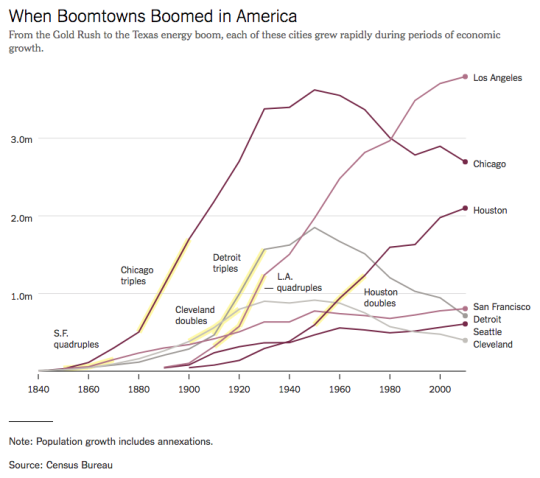
  • Land use restrictions and upward mobility

    Throughout US history, economic growth has typically spurred an “enormous reallocation of population.” Here is a graph from a recent New York Times article called: What Happened to the American Boomtown?

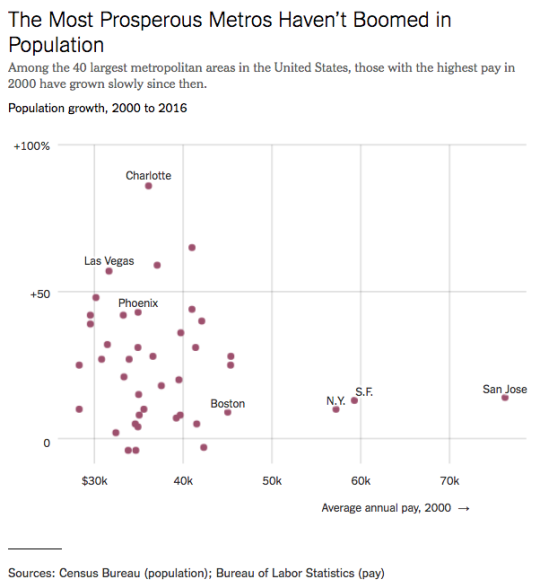
    The argument, here, is that restrictions on development have made it so that the most prosperous cities are actually the slowest growing cities in terms of population. Here is a chart, from the same article, comparing population growth to average annual pay:

    And here is an excerpt:

    But these productive places aren’t growing as fast now as economists believe they should — and as they would if they didn’t impose so many obstacles on new development. Since the 1970s, land use restrictions have multiplied in coastal metros, making it harder to build in, say, San Jose, Calif., than in Phoenix. And the politics of development have become tense, too. In the Boston suburbs, the Bay Area, Brooklyn and Washington, people who already live there have balked at new housing for people who don’t.

    We often talk about the impact of land use restrictions on supply and overall housing affordability. But here is an argument that it could also be impacting upward mobility.

  • What cars can tell you about a neighborhood

    This is an interesting study from a team of AI researchers at Stanford. What they did was use car images taken directly from Google Street View (so images of cars parked on-street) to predict income levels, racial makeup, educational attainment, and voting patterns at the zip code and precinct level.

    Admittedly, it’s not a perfect survey, but when they compared their findings to actual or previously collected data (such as from the American Community Survey), it turns out that their study was actually remarkably accurate. Google Street View allowed them to survey 22 million cars, or about 8% of all cars in the US.

    Here are some of the things they found:

    –  Toyota and Honda vehicles are strongly associated with Asian neighborhoods.

    – Buick, Oldsmobile, and Chrysler vehicles are strongly associated with black neighborhoods.

    – Pickup trucks, Volkswagens and Aston Martins are strongly associated with white neighborhoods.

    Interestingly enough, the ratio of pickup trucks to sedans, alone, is a pretty reliable indicator of voting patterns. If a neighborhood has more pickup trucks than sedans, there’s an 82% chance it voted Republican in the last election.

    Perhaps this isn’t all that surprising given that car purchases are highly symbolic. But given that the American Community Survey costs $250 million a year to administer, this study is a good preview of what cheaper and more realtime data collection might look like.