Daily insights for city builders, delivered every morning at 6 AM ET. I’m Brandon Donnelly — a Toronto-based real estate developer and founder of Globizen. I’ve been writing here since 2013.

  • ULI Hines Student Competition comes to Toronto

    I was speaking with a Penn (my alma mater) student this evening about career options in development and he mentioned to me that he recently participated in the 2018 ULI Hines Student Competition. He also mentioned that this year’s “study site” is in Toronto. (It’s the BMW Toronto dealership between the West Don Lands and East Harbor.)

    For those of you unfamiliar with the ULI Hines Competition, it’s an annual student competition (now in its 16th year) that encourages collaboration among “future real estate developers and the many allied professions, such as architecture, landscape architecture, historic preservation, engineering, finance, and others.” 

    Each year there is a real life study site and multi-disciplinary teams compete for $50,000. I participated in my 2nd year of graduate architecture school and we received honorable mention. So no $50,000, sadly. But it was a valuable experience and I would recommend it to any student who plans to be involved in the built environment after graduation.

    I am looking forward to seeing what the finalists come up with for this site. I think that the study site being in Toronto – and in particular this location – speaks to the momentum that has developed in this part of the city as a result of the West Don Lands, East Harbor, Sidewalk Toronto, and the various planned infrastructure investments. 

    Here is a copy of this year’s briefing materials.
    Good luck to all of the teams that participated.
  • Manhattan apartment rents post biggest decline since 2011

    A friend of mine sent me this article earlier today with a sarcastic comment about the relationship between housing supply and rents.

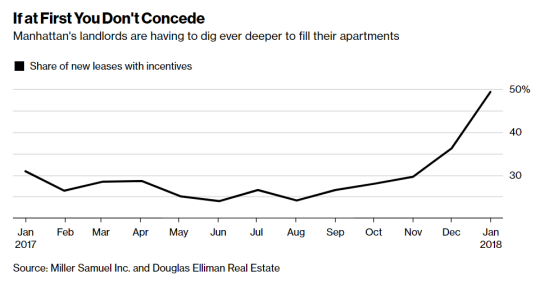
    The article talks about how rents in almost every Manhattan neighborhood have fallen compared to a year ago because of a flood of new apartment supply coming online. The median rent dropped 3.6% (year-over-year) which is the biggest decline since October 2011.

    image

    There has also been a spike in the number of leases with some sort of incentive attached to it (see above). As a landlord you typically want to use incentives, such as free rent, before resorting to lower face rents. Because lower rents mean a lower overall net operating income, which in turns depresses the value of your property.

    But sometimes you have no choice:

    “Landlords have finally realized, ‘OK, we have to adjust these prices because the concessions aren’t doing as much,’” said Hal Gavzie, who oversees leasing for Douglas Elliman. “Customers are looking past the concessions being offered and just looking for the best deals they can find.”

    A few weeks ago I wrote about a similar story playing out in Seattle. It’s almost as if excess housing supply is driving down rents.

  • Chipperfield to build tallest building in Hamburg

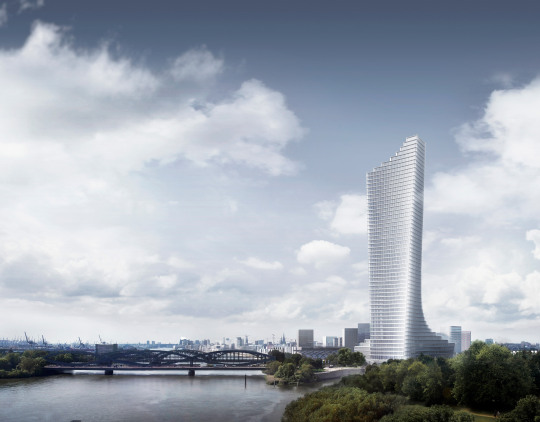
    David Chipperfield Architects has just won a design competition for the tallest building in Hamburg. It is set to rise 230 meters and look something like this:

    image

    There’s a real elegance to its simplicity. It also feels like an appropriate pairing with the nearby Elbphilharmonie designed by Herzog & de Meuron.

    But the first thing I thought to myself when I saw the design was: “Must be office. There are no outdoor spaces.”

    And sure enough, the plan is for 104,000 sm of primarily office. There are also plans for restaurants, shops, exhibition areas, and a hotel and bar.

    Some architects begrudge having to incorporate balconies into their tower designs because they can break up the elevations, muddy the concept, and create thermal bridging concerns.

    This tower – called the Elbtower – is a good example of why that is the case.

    Image via Dezeen

  • What did Benjamin Franklin, Albert Einstein, and Steve Jobs all have in common?

    According to Walter Isaacson – the bestselling author of their biographies – it is this:

    I started with Ben Franklin, and then Einstein, and then Steve Jobs—[they were all] innovative and creative. And I said, “Well, what pattern [leads to] that?” The pattern wasn’t that they were smart, because you’ve met lots of smart people, and they don’t usually amount to much. The pattern tends to be curiosity across disciplines.

    This excerpt was taken from a conversation between Isaacson and Adam Grant, which you can read or watch here. 

    Here is another excerpt that speaks to the way in which Jobs prided himself on working at the intersection of technology and the humanities:

    I’ll give you a tiny example. The Mac that came out in 2000 had a handle on it, and they say, “This is a desktop machine. We don’t need the handle—people aren’t really supposed to move it around. It’ll cost us another sixty dollars [per computer].” And Steve said, “The handle is there because it makes the machine approachable. My mom is afraid of her computer, but if there’s a little thing [where] she can put her hand, where she can touch it and she knows it won’t break, that makes her connect emotionally to the computer better.” And he was right. But it cost money, and the Mac didn’t make as much.

    The entire conversation resonated with me partly because I think of development as being a career that, by necessity, requires you to work across disciplines. 

    I also sometimes wonder if I have too many broad-ranging interests. It can be overwhelming. But apparently that’s a good thing for innovation and creativity.

  • Experiences over fashion — or is that really the case?

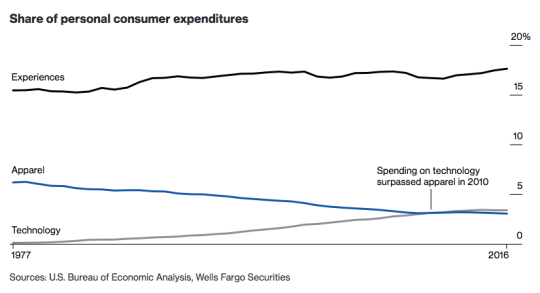
    Bloomberg recently published this interesting piece talking about the death of clothing. The reasons are as follows: we’re spending more on experiences, as well as technology (tech spending surpassed apparel spending in 2010); casual dress in the workplace has become more widely accepted; fast fashion companies like H&M and Zara are putting downward pressure on prices; and social media influencers – instead of big companies – are now the ones showing us what to buy and wear.

    Here is a graph from the article comparing experiences, apparel, and technology expenditures: 

    image

    The first thing I noticed is that experiences, while still increasing, haven’t really spiked since 1977, even though everybody seems to be talking about how social media-fueled Millennials are all about experiences. I was also surprised to see that the share of US employers that allow casual dress every day seems to be closing in on 50%. (Informal survey for the comments and for Twitter: Do you wear casual clothes to work? I’m a no.)

    But perhaps the biggest contributors to this decline are fast fashion and low-cost manufacturing. Stanley Pignal – South Asia business and finance correspondent for the Economist – pointed out on Twitter that since 1982 inflation in US apparel was only 123% compared to 248% for overall CPI. So maybe a lot of the above reasoning is just a distraction.

  • That’s a wrap

    Jackson Hole never disappoints. 

    The valley is this wonderful combination of cowboy town, expansive flat plains, wildlife, snowcapped mountains, challenging skiing and snowboarding, ‘mountain modern’ architecture, and twangy accents.

    One of the highlights of the trip was discovering a hot spring along the side of the Snake River. We never would have found it had it not been for a few locals. Apparently it’s called the “stinky spring.” 

    The setup was no frills — a bunch of rocks arranged as basins in order to catch the surprisingly steamy sulfur water. But the experience of sitting in the mountains and jumping between the icy river and hot springs was priceless. 

    That’s another great thing about ski towns: they change your perception of snow, winter, and the outdoors. When it snows in Jackson, people smile and grab their skis and snowboards. I aspire to bring that same energy to winter in the city.

    I could never be a ski bum, but I can certainly appreciate why others make that choice. Until the 10th annual…

  • Shenzhen has just electrified its entire bus fleet

    image

    This is impressive: Shenzhen recently finished converting its entire bus fleet to electric vehicles. That’s 16,359 buses and around 8,000 charging stations according to Electrek.

    It is estimated that this all-electric fleet saves 345,000 tons of fuel per year and reduces carbon emissions by 1.35 million tons.

    Shenzhen is now working on doing the same to its 12,518 taxis. Already 62.5% of them are electric-powered and the goal is 100% by 2020. 

    But let’s not forget that China still generates most of its electricity from coal. Coal represented 72% of its electricity generation in 2015. And in 2014, carbon emissions from China allegedly made up almost 30% of the world .

    Photo by Anton Strogonoff on Unsplash

  • What’s your favorite Olympic winter sport?

    The 2018 Winter Olympics start this Friday, February 9 in PyeongChang, South Korea. Unlike the past couple of winter games, which struggled with warm temperatures, this should be a cold one.

    The Winter Olympics tend to be less popular than the Summer Olympics, with fewer athletes and countries participating. 207 countries participated in the 2016 Summer Olympics in Rio de Janeiro, but only 88 countries participated in the 2014 Winter Olympics in Sochi. A big part of this has to do with the fact that winter sports generally require winter and snow and not every country has those things.

    I like the Winter Olympics. And perhaps not surprisingly, my favorite sport is snowboarding. This year I’m really rooting for Canadian snowboarder Mark McMorris. If you don’t know who Mark is, watch this short video. He has had a tough time over the years with a number of serious injuries, but he managed to bounce back and qualify for the Olympics. He won bronze in Sochi and is hungry for gold.

    The Olympics are always a good reminder that if you want to be the best, you’re going to have to be prepared to work beyond hard and make many many sacrifices in your life. And even then, there are absolutely no guarantees. 

    So what’s your favorite Olympic winter sport?

  • One year of Inclusionary Housing in Portland

    image

    About a year ago, Portland enacted “Inclusionary Housing” policy requiring new apartment buildings of 20 units or more to offer up a portion of the units at below market rents.

    Developers are able to select from a few different options and the rents are calculated according to a percentage of the city’s median family income (30-80%). I’m not sure how this policy would apply to new condo buildings.

    This is an interesting account by The Portland Mercury of what this policy may be doing to the housing market. I say may because it’s only been a year and there could be other factors at play.

    Between 2013 and 2017, Portland typically built between 3,000 and 6,000 new units per year. Since the IH policy went into effect on February 1, 2017, 682 new units have applied for permit. 

    About half are coming from one developer who appears to be building the requisite affordable units in exchange for no parking minimums. They are now proposing buildings with zero parking.

    Again, in all fairness, it’s only been a year. But already Mayor Ted Wheeler is looking at other incentives to encourage more new construction in the central city. The biggest levers: height and density.

    All of this begins to speak to the very real impact of inclusionary zoning on development feasibility.

    Photo by Zach Savinar on Unsplash

  • Will autonomous vehicles make location irrelevant?

    I am not convinced that autonomous vehicles will make “location” irrelevant. 

    But I do agree with the following line from this recent Bloomberg article called, A Driverless Future Threatens the Laws of Real Estate.

    “The link between property and transport has been perhaps the most durable in human history.”

    So this remark by David Silver could very well be correct:

    “Real estate might be the industry that is most transformed by autonomous vehicles.”

    Technological advances in mobility have historically brought about decentralization because each advance – from streetcars to the automobile – made it reasonable to travel further distances.

    Of course, autonomous vehicles are also expected to free up our time and focus while in transit – although trains do that for us today albeit with that pesky last mile problem.

    But just like the internet in the late 90′s didn’t make location irrelevant (the opposite appears to have happened), I am similarly unconvinced when it comes to autonomous vehicles. What we consider a desirable location may simply shift.

    So this is not to say that the won’t see profound change in our cities. We will. Which is why we’re all trying to get ahead of it.