Daily insights for city builders, delivered every morning at 6 AM ET. I’m Brandon Donnelly — a Toronto-based real estate developer and founder of Globizen. I’ve been writing here since 2013.

  • Neighborhood depopulation

    Recently we’ve been talking about California’s Proposition 13 and how it may be creating a disincentive for longtime homeowners to move. They’re enjoying below market property taxes, and so they stay put, even if they may have too much house.

    But this concept of “overhousing” isn’t unique to California. The Globe and Mail just ran a piece talking about how Toronto’s designated “Neighborhoods” are losing people as the nests empty out, seniors remain put, and the broader city booms.

    The rate of depopulation that created the spare bedrooms in Toronto’s low-rise neighbourhoods is stark: “Since 2001, about 52 per cent of the land mass of Toronto has reduced in density of population by about 201,000 people,” Mr. Smetanin says. “Other parts of Toronto have grown by 492,000.”

    The irony of this phenomenon is that the city’s Official Plan considers these Neighborhoods to be “physically stable”, as well as “one of the keys to Toronto’s success.” However, things are clearly changing behind that physical stability.

    Photo by Verne Ho on Unsplash

  • UNStudio announces new tech architecture company (and thoughts on the smart home)

    Dutch architecture firm UNStudio has just launched a new company called UNSense, whose purpose is to explore and develop “new sensor-based technologies that are specifically designed to positively impact people’s physical, mental and social health.” They are calling the new business an “arch tech company” and it is their belief that, at some point, all architecture firms will become arch tech companies. You can learn more about UNSense, here.

    This announcement got me thinking about the state of smart home technologies, which, of course, is this massive buzzword that everyone is throwing around these days. Many of us have smart thermostats, voice assistants (that may be listening to our every word), wifi lights, and so on. And you can do some pretty neat things with software like IFTT, such as program your lights to come on at sunset or when you walk in the door.

    But as cool as they may be, these smart home devices have always felt like patchwork add-ons to me. I understand that this is partially driven by what customers can easily adopt and I don’t mean to discredit the value that they bring, but today’s post is about reminding us to also think more fundamentally, as opposed to just incrementally.

    Smart thermostats, for instance, give us the functionality to adjust our heating/cooling from our phone. But at the end of the day, they still control the same underlying system, which, by the way, is a fairly simple one. When it gets cold (because of our R-3 windows), the heat turns on. When it gets warm enough, the heat turns off. Zoned systems certainly add another layer of sophistication, but are we optimizing for the right variables?

    UNSense works at three scales: Cities, Buildings, and Interiors. And if you look at what they are trying to do at the building scale, it is around the interface between inside and out. Designing transformable facade systems and buildings that can respond to their environment and our changing needs. These are not new ideas, but in today’s tech-driven world, the timing may just be right.

    If you think about the climate we have here in Toronto, it is actually an incredibly difficult design problem. We have cold winters and hot humid summers, which means we have to solve for two different extremes. Mechanical systems have made that a lot easier to do, but if we’re going to meet the energy and greenhouse gas emission targets that we’re all talking about, we’re going to need a hell of a lot more than just smart thermostats.

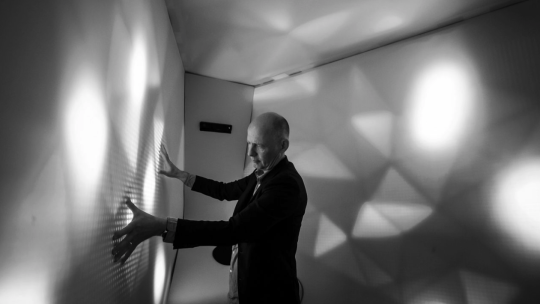
    Image: UNSense

  • Would it be insider trading if Kylie Jenner traded on her tweets?

    Lately I have really gotten into Matt Levine’s daily newsletter about “Wall Street, finance, companies and other stuff.” Maybe that’s how I should describe this blog: Cities, real estate, design, and other stuff.

    If you aren’t familiar with Matt’s writing, here is an article that he wrote about Kylie Jenner’s recent tweet concerning Snapchat. You know, the one that wiped out $1.3 billion of market value because she revealed – using only 88 characters, I might add – that she was no longer using the app.

    https://platform.twitter.com/widgets.js

    The article was spurred on by this question:

    “Would it be insider trading for Kylie Jenner to buy short term out of money put options on Snap and tweet out that she’s no longer using Snap?”

    And this is the start of his answer:

    Insider trading, as I am constantly saying around here, is not about fairness; it is about theft. It is not illegal to trade on your own nonpublic knowledge of your own intentions. Warren Buffett can buy stocks before he announces that he’s bought them, even though that announcement will predictably make the stocks go up. 

    If I did describe this daily blog like Matt describes his daily newsletter, this post would clearly fall into the “other stuff” camp. But maybe you too will find it interesting. If you do, you can subscribe here. 

  • Thoughts on housing in the Bay Area

    I was out for drinks recently with a friend of mine who is a developer in California and she mentioned a few things to me that I thought were really interesting. 

    First, she talked about how virtually nothing gets built in the Bay Area “as of right.” And so the market is hugely supply constrained. She said, you’re lucky if you can get your entitlements in 2 years. It’s starting to take longer. I immediately said: “That’s Toronto.”

    Second, we talked about Proposition 13, which was timely given this recent post. One of the consequences of Prop 13, beyond helping golf clubs survive, is that longtime homeowners seem to be highly incentivized not to move. 

    Their property taxes are so below market that it can be more cost effective for them to stay put as opposed to downsize – even if they have too much house. This means far less turnover in the housing market.

    Third, there really does seem to be a feeling in the Bay Area that it’s at a breaking point in terms of affordability. When a successful software engineer making $200,000 a year can’t afford housing, people naturally start to look to other cities.

    We hear this refrain all the time in the media, but because I’m not active in that market, it was far more impactful hearing it from a friend.

  • The City as a Place for People

    The City of London Corporation recently published a report called “The City as a Place for People”, which talks primarily about itself and how great London is as a magnet for talent. 

    But as self-serving as it may be – the report is timed to be ahead of this year’s MIPIM – there appears to be some data and interviews backing up the claims.

    58% of “institutional investors” said that London is the best European city for business. Dublin was next at 22%. 

    A separate survey of 2,568 “corporate decision makers” in Europe revealed that 21% of respondents felt that London was the best European city for business, followed by Paris (13%) and Frankfurt (7%). When asked which city had the best talent pool, the responses were fairly similar.

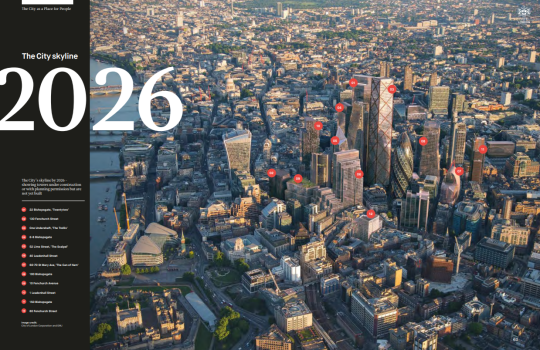
    Also included in the report is a rendering of the City’s skyline by 2026. These are always fun to see. Here is a screen grab:

    image

    It is showing all towers under construction and all towers with their planning permissions in place. If you’d like to download the full report, you can do that here.

  • The density delusion

    Joel Kotkin and Wendell Cox recently published a piece in the Orange County Register called, “California’s housing crisis and the density delusion.” I’m sure you can guess where this is going, even if you don’t follow the work of Joel Kotkin. But if you do, you will know that he is an ardent supporter of suburbia and the single-family home.

    Here is an excerpt from the article:

    In reality, the YIMBY’s suggestion that new, dense housing will improve affordability for all is patently absurd. Decades of densification in Los Angeles has seen ever higher rents, displacing low-income, especially minority households. Many former transit customers have been driven to lower-rent areas with less transit service, precipitating a massive decline in ridership, even as billions continue to be spent building new rail lines. The Wiener Bill [my link, not theirs] could exacerbate this trend, and likely increase the need for low-income housing, already well beyond the capability of public coffers.

    I fully appreciate the argument that high-density housing isn’t for everyone and that we shouldn’t be “forcing everyone back to the ‘glory’ days of the city of tenements.” But I disagree with many of their points, including the argument that density doesn’t encourage transit ridership. Density isn’t everything, but it’s an important something.

    The article is definitely worth a read, particularly if you disagree with their positions. That’s how you avoid confirmation bias. I was trying to keep that in mind as I read it. Maybe it worked.

  • Amazon buys video doorbell company

    So Amazon is buying Ring (they make video doorbells, among other things) for north of $1 billion. Supposedly, it is the second largest acquisition that Amazon has ever made – the first was Whole Foods.

    If you consider that Amazon is also looking to enter the delivery business, it should be obvious that they want to control everything related to the home delivery process.

    For one, it likely enhances Amazon Key and helps with the “porch pirate” problem. Apparently Amazon has had to restrict same-day delivery from some high crime neighborhoods because of this exact problem.

    And there’s already speculation about what this could mean for grocery deliveries. Amazon needs to find a frictionless way to get your food orders into your refrigerator. 

    There are also many possible tie-ins to Alexa/Echo. It’s probably safe to assume that Jeff Bezos sees a lot more than just a doorbell with a camera in it.

  • “I hate golf”

    I am a big fan of Malcolm Gladwell, and not just because he’s Canadian and went to the University of Toronto (my alma mater), although those facts certainly don’t hurt.

    I’m late to his podcast, Revisionist History, so in case some of you are as well, I would encourage you to check it out. Every episode reexamines something from the past and questions: Did we get it right the first time? It’s very Gladwell. It’s a must listen.

    The episodes span a secret research project setup by the Pentagon in downtown Saigon during the Vietnam War to why rich people are obsessed with the game of golf. Spoiler: He hates golf.

    The golf episode will be of particular interest to many of you because it deals with real estate. Malcolm wades into something known as California Proposition 13, which is a constitutional exemption that keeps property taxes artificially low.

    It is what has allowed these “vast, gorgeous, and private” golf courses to continue to exist in expensive cities like Los Angeles. Otherwise they would have long ago drowned under the property taxes following reassessment.

    This also leads to a philosophical debate about what constitutes a change in ownership, since many clubs are member owned and Proposition 13 requires that there not be a change in more than 50% of the ownership. 

    But I’ll stop there. Give it a listen. Malcolm is just excellent.

    Photo by Rémi Müller on Unsplash

  • Switching to summer time

    Summer time starts this weekend, at least in this part of the world. Africa and Asia generally don’t observe daylight savings time (DST), so if you just switched your clocks forward an hour, know that you are in the global minority.

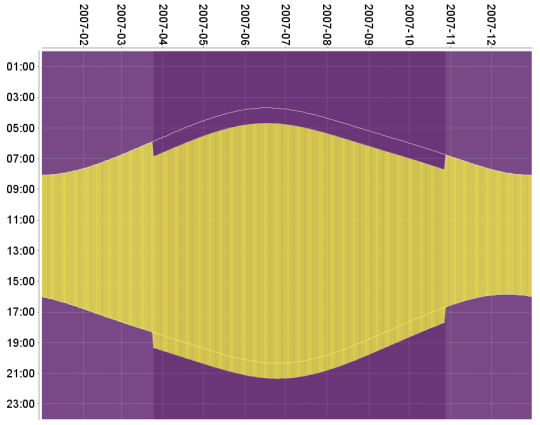
    The whole point of DST is that it gives us an extra hour of sunlight in the evenings during the summer months. The trade-off is a later sunrise, but since the days are longer to begin with, it’s something we have clearly come to accept.

    Here is a graph showing the impact of daylight savings time on sunrise and sunset times in Greenwich. It’s from Wikipedia and it’s the clearest diagram I could find that quickly explains the change.

    There’s a lot of debate around whether or not DST should be abolished or if we should simply adopt summer time, permanently. A bill is currently being reviewed that would allow Florida to observe DST year-round.

    Some groups, like retailers, seem to benefit from daylight savings time. More evening sunshine hours means we’re more likely to shop. But it has a negative impact on other things such as drive-ins. (Do people still go to drive-ins?)

    There are also arguments that it causes a decrease in economic output and an increase in traffic accidents – apparently we’re all groggy and accident-prone after having our sleep routines disrupted.

    So what would be your recommendation?

    1) Do nothing – status quo

    2) Abolish daylight savings time

    3) Observe daylight savings time year-round

  • Last-mile electric scooters — will they work?

    I’ve been hearing a lot about Bird recently. Perhaps it has something to do with the $15 million Series A round they raised last month (February 2018) and the $100 million Series B round they announced earlier today.

    A “Bird” is small electric scooters that look like this and can be rented from your phone for short haul trips. They are currently available in Santa Monica, Venice, UCLA, Westwood, and San Diego, and they are intended to be ridden in existing bike lanes.

    What may be particularly interesting to this blog audience is the fact that Bird is calling itself a “last-mile electric vehicle sharing company.” The pitch: 40% of car trips (in the US?) are less than 2 miles long. Let’s replace those using electric scooters.

    One of the first things that came to my mind is that this feels more accessible than cycling. Cycling to work can be a commitment. You have to think about your attire and the sweat factor, among other things.

    Would you agree?