Daily insights for city builders, delivered every morning at 6 AM ET. I’m Brandon Donnelly — a Toronto-based real estate developer and founder of Globizen. I’ve been writing here since 2013.

  • Attract and extract

    Chris Dixon’s recent piece on why decentralization matters is currently making the rounds online. It clearly explains the first two eras of the internet and how the third era is developing as we speak. Cue decentralized cryptonetworks.

    I particularly like how he describes the relationship that centralized platforms – like Facebook – have to their users and to their complements (other businesses, software developers, creators, and so on). 

    Here are two graphs from his article:
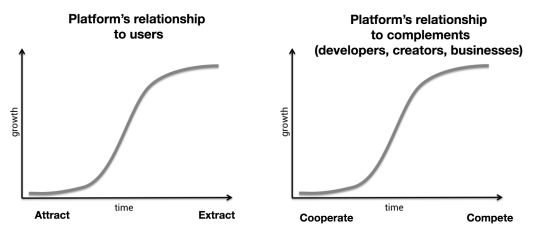
    In the early days it’s all about cooperation and doing everything you can to attract users. The platform gets more valuable the more users are on it and so the immediate goal is to build up the network effects and lock people in.

    But as the platform grows, the relationship flips (top of the S-curve). In Dixon’s words, it becomes a zero-sum game whereby to continue growing the platform starts extracting data from its users and competing with its complements.

    The promise of cryptonetworks is that they will do away with many of these negative externalities, but at the same time empower the kind of sophistication that we see today with centralized platforms.

    The venture capitalists are circling because a fundamental shift in the architecture of the internet will mean disruption. I’m following it because I want to understand how it may apply to real estate and the built environment.

  • Is it only a matter of time before Amazon enters the delivery business?

    Yesterday I ordered something from Amazon Prime. The guaranteed delivery time was today before 9pm, but within an hour of ordering the delivery estimate was updated and it ended up arriving on the same day about 5 hours after my order. I thought this was pretty amazing, particularly because the package was a bit time sensitive.

    Delivering to individual residences is more expensive than delivering to more centralized businesses and stores. And with the rise of online shopping, UPS now delivers as many as 31 million packages every day. Because of this, every little detail counts. 

    Last year the company started installing Bluetooth receivers on the inside of its delivery trucks. If a driver incorrectly loads a package that isn’t on their route, it pushes out a loud beep. (This is one of the many tech and data-driven projects that UPS is working on to ensure it stays competitive.)

    Previously there was no final check. If there was a rogue package on the truck, it meant the driver would have to stray from their route, coordinate a handoff, or delay the package for another day. These mishaps can really add up when you’re delivering 31 million packages in a single day.

    With Amazon squeezing delivery times and with the rumors that it’s going to start its own delivery business (to compete directly with UPS and FedEx), one has to wonder about the impact that these volumes will have on our cities. Perhaps autonomous vehicles will really become the new roaming retail outlet – ready to deliver as soon as we click buy.

  • Cities are the destinations

    image

    Resonance Consulting out of Vancouver has a new report out: 2018 Future of Millennial Travel. You can download a free copy here. Resonance does great work and really gets content marketing.

    The first chapter immediately caught my attention, perhaps because it’s called, Cities are the Destinations. It talks about how big cities as a travel destination are a highly underreported tourism metric. Historically it’s been all about beach vacations and escaping.

    According to their survey, Millennials (aged 20 to 36 years old as of March 16, 2017) are almost as likely to travel to a major city (38%) as they are to travel to a beach resort (40%) in the next 24 months. (I wonder where the mountains fit in.)

    Also interesting is that this number increases when household earnings increase beyond $100,000. This subset of respondents is most likely to visit a major city on their next vacation (40%). It’s all about new experiences.

    I’m not an expert on travel and tourism, but Resonance is calling this a sea change and a likely indicator that, in the near future, big cities will become the dominant travel destination. Is your city ready?

    Photo by Nathan Ziemanski on Unsplash

  • Jets and real estate

    Jackson Hole Airport (JAC) has one runway. It is 6,300 feet long by 150 feet wide and it was originally constructed in 1959. In 1965, the first of many proposals was put forward to lengthen the runway to 8,000 feet so that jets could fly into the airport. But it was never adopted. Subsequent proposals were made in 1992 and 1999, but they were again highly contentious and similarly never adopted. The runway remains 6,300 feet long.

    However in the early 1980s jets began using the existing runway and the area started to boom. According to this old New York Times article from 2002, the town’s growth exactly parallels the introduction of jet service at JAC. The town doubled from 9,000 people in 1980 to 18,000 people in 2000. Its per capita income also shot up from a steady $20,000 in 1984 to more than $67,000 in 2011 – making Teton County one of the richest in the US.

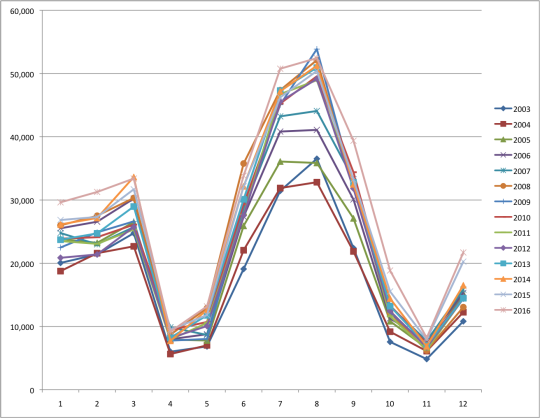
    Tourism destinations and second home markets like Jackson Hole are heavily dependent on access. In 2003, a total of 211,788 passengers flew through JAC airport and, in 2016, it was over 340,000 people. But second home markets are also the first to get hit during macroeconomics shocks. Following the 2008 financial crisis, passenger volumes at JAC didn’t recover until 2014.

    If you look at air traffic throughout the year you’ll also see that it is highly seasonal. Below is a chart showing monthly passenger volumes at JAC from 2003 to 2016 (data from the Bureau of Transportation Statistics). Some of you may be surprised to see that more people visit Jackson Hole in the summer, compared to the winter. But what’s perhaps even more conspicuous is the sharp drop off during the swing seasons.

    image

    I am thinking about all of this not only because I just got back from Jackson Hole, but also because I am very interested in the demand drivers that fuel the real estate in many of these mountain towns. It’s easy to get it wrong. Unlike major urban centers – which often operate under a perpetual supply deficit – you can’t just build and necessarily expect people to come.

    Revelstoke Mountain Resort, for instance, first opened in 2007 with grand aspirations of building one of the largest ski resorts in North America. But they got crushed in 2008 and have never fully recovered – at least relative to their original plans. Maybe the answer is a bigger airport.

  • ULI Hines Student Competition comes to Toronto

    I was speaking with a Penn (my alma mater) student this evening about career options in development and he mentioned to me that he recently participated in the 2018 ULI Hines Student Competition. He also mentioned that this year’s “study site” is in Toronto. (It’s the BMW Toronto dealership between the West Don Lands and East Harbor.)

    For those of you unfamiliar with the ULI Hines Competition, it’s an annual student competition (now in its 16th year) that encourages collaboration among “future real estate developers and the many allied professions, such as architecture, landscape architecture, historic preservation, engineering, finance, and others.” 

    Each year there is a real life study site and multi-disciplinary teams compete for $50,000. I participated in my 2nd year of graduate architecture school and we received honorable mention. So no $50,000, sadly. But it was a valuable experience and I would recommend it to any student who plans to be involved in the built environment after graduation.

    I am looking forward to seeing what the finalists come up with for this site. I think that the study site being in Toronto – and in particular this location – speaks to the momentum that has developed in this part of the city as a result of the West Don Lands, East Harbor, Sidewalk Toronto, and the various planned infrastructure investments. 

    Here is a copy of this year’s briefing materials.
    Good luck to all of the teams that participated.

  • Manhattan apartment rents post biggest decline since 2011

    A friend of mine sent me this article earlier today with a sarcastic comment about the relationship between housing supply and rents.

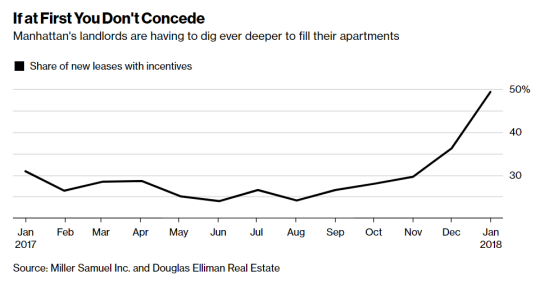
    The article talks about how rents in almost every Manhattan neighborhood have fallen compared to a year ago because of a flood of new apartment supply coming online. The median rent dropped 3.6% (year-over-year) which is the biggest decline since October 2011.

    image

    There has also been a spike in the number of leases with some sort of incentive attached to it (see above). As a landlord you typically want to use incentives, such as free rent, before resorting to lower face rents. Because lower rents mean a lower overall net operating income, which in turns depresses the value of your property.

    But sometimes you have no choice:

    “Landlords have finally realized, ‘OK, we have to adjust these prices because the concessions aren’t doing as much,’” said Hal Gavzie, who oversees leasing for Douglas Elliman. “Customers are looking past the concessions being offered and just looking for the best deals they can find.”

    A few weeks ago I wrote about a similar story playing out in Seattle. It’s almost as if excess housing supply is driving down rents.

  • Chipperfield to build tallest building in Hamburg

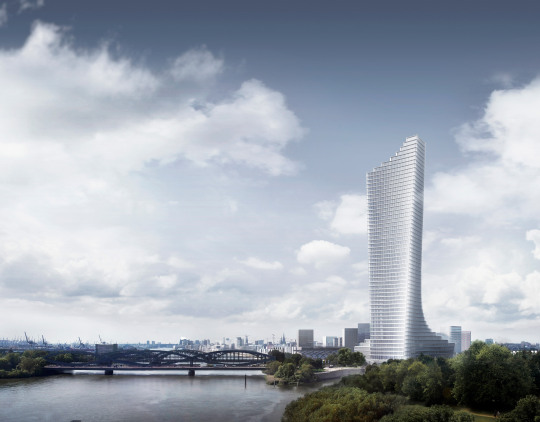
    David Chipperfield Architects has just won a design competition for the tallest building in Hamburg. It is set to rise 230 meters and look something like this:

    image

    There’s a real elegance to its simplicity. It also feels like an appropriate pairing with the nearby Elbphilharmonie designed by Herzog & de Meuron.

    But the first thing I thought to myself when I saw the design was: “Must be office. There are no outdoor spaces.”

    And sure enough, the plan is for 104,000 sm of primarily office. There are also plans for restaurants, shops, exhibition areas, and a hotel and bar.

    Some architects begrudge having to incorporate balconies into their tower designs because they can break up the elevations, muddy the concept, and create thermal bridging concerns.

    This tower – called the Elbtower – is a good example of why that is the case.

    Image via Dezeen

  • What did Benjamin Franklin, Albert Einstein, and Steve Jobs all have in common?

    According to Walter Isaacson – the bestselling author of their biographies – it is this:

    I started with Ben Franklin, and then Einstein, and then Steve Jobs—[they were all] innovative and creative. And I said, “Well, what pattern [leads to] that?” The pattern wasn’t that they were smart, because you’ve met lots of smart people, and they don’t usually amount to much. The pattern tends to be curiosity across disciplines.

    This excerpt was taken from a conversation between Isaacson and Adam Grant, which you can read or watch here

    Here is another excerpt that speaks to the way in which Jobs prided himself on working at the intersection of technology and the humanities:

    I’ll give you a tiny example. The Mac that came out in 2000 had a handle on it, and they say, “This is a desktop machine. We don’t need the handle—people aren’t really supposed to move it around. It’ll cost us another sixty dollars [per computer].” And Steve said, “The handle is there because it makes the machine approachable. My mom is afraid of her computer, but if there’s a little thing [where] she can put her hand, where she can touch it and she knows it won’t break, that makes her connect emotionally to the computer better.” And he was right. But it cost money, and the Mac didn’t make as much.

    The entire conversation resonated with me partly because I think of development as being a career that, by necessity, requires you to work across disciplines. 

    I also sometimes wonder if I have too many broad-ranging interests. It can be overwhelming. But apparently that’s a good thing for innovation and creativity.

  • Experiences over fashion — or is that really the case?

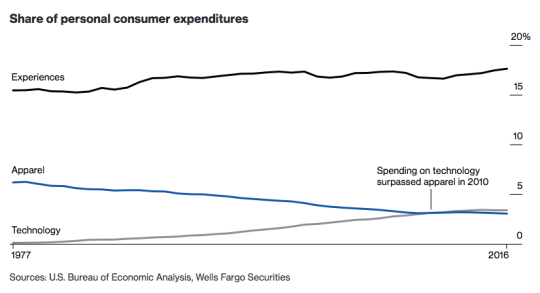
    Bloomberg recently published this interesting piece talking about the death of clothing. The reasons are as follows: we’re spending more on experiences, as well as technology (tech spending surpassed apparel spending in 2010); casual dress in the workplace has become more widely accepted; fast fashion companies like H&M and Zara are putting downward pressure on prices; and social media influencers – instead of big companies – are now the ones showing us what to buy and wear.

    Here is a graph from the article comparing experiences, apparel, and technology expenditures: 

    image

    The first thing I noticed is that experiences, while still increasing, haven’t really spiked since 1977, even though everybody seems to be talking about how social media-fueled Millennials are all about experiences. I was also surprised to see that the share of US employers that allow casual dress every day seems to be closing in on 50%. (Informal survey for the comments and for Twitter: Do you wear casual clothes to work? I’m a no.)

    But perhaps the biggest contributors to this decline are fast fashion and low-cost manufacturing. Stanley Pignal – South Asia business and finance correspondent for the Economist – pointed out on Twitter that since 1982 inflation in US apparel was only 123% compared to 248% for overall CPI. So maybe a lot of the above reasoning is just a distraction.

  • That’s a wrap

    Jackson Hole never disappoints. 

    The valley is this wonderful combination of cowboy town, expansive flat plains, wildlife, snowcapped mountains, challenging skiing and snowboarding, ‘mountain modern’ architecture, and twangy accents.

    One of the highlights of the trip was discovering a hot spring along the side of the Snake River. We never would have found it had it not been for a few locals. Apparently it’s called the “stinky spring.” 

    The setup was no frills — a bunch of rocks arranged as basins in order to catch the surprisingly steamy sulfur water. But the experience of sitting in the mountains and jumping between the icy river and hot springs was priceless. 

    That’s another great thing about ski towns: they change your perception of snow, winter, and the outdoors. When it snows in Jackson, people smile and grab their skis and snowboards. I aspire to bring that same energy to winter in the city.

    I could never be a ski bum, but I can certainly appreciate why others make that choice. Until the 10th annual