Daily insights for city builders, delivered every morning at 6 AM ET. I’m Brandon Donnelly — a Toronto-based real estate developer and founder of Globizen. I’ve been writing here since 2013.

  • Amazon buys video doorbell company

    So Amazon is buying Ring (they make video doorbells, among other things) for north of $1 billion. Supposedly, it is the second largest acquisition that Amazon has ever made – the first was Whole Foods.

    If you consider that Amazon is also looking to enter the delivery business, it should be obvious that they want to control everything related to the home delivery process.

    For one, it likely enhances Amazon Key and helps with the “porch pirate” problem. Apparently Amazon has had to restrict same-day delivery from some high crime neighborhoods because of this exact problem.

    And there’s already speculation about what this could mean for grocery deliveries. Amazon needs to find a frictionless way to get your food orders into your refrigerator. 

    There are also many possible tie-ins to Alexa/Echo. It’s probably safe to assume that Jeff Bezos sees a lot more than just a doorbell with a camera in it.

  • “I hate golf”

    I am a big fan of Malcolm Gladwell, and not just because he’s Canadian and went to the University of Toronto (my alma mater), although those facts certainly don’t hurt.

    I’m late to his podcast, Revisionist History, so in case some of you are as well, I would encourage you to check it out. Every episode reexamines something from the past and questions: Did we get it right the first time? It’s very Gladwell. It’s a must listen.

    The episodes span a secret research project setup by the Pentagon in downtown Saigon during the Vietnam War to why rich people are obsessed with the game of golf. Spoiler: He hates golf.

    The golf episode will be of particular interest to many of you because it deals with real estate. Malcolm wades into something known as California Proposition 13, which is a constitutional exemption that keeps property taxes artificially low.

    It is what has allowed these “vast, gorgeous, and private” golf courses to continue to exist in expensive cities like Los Angeles. Otherwise they would have long ago drowned under the property taxes following reassessment.

    This also leads to a philosophical debate about what constitutes a change in ownership, since many clubs are member owned and Proposition 13 requires that there not be a change in more than 50% of the ownership. 

    But I’ll stop there. Give it a listen. Malcolm is just excellent.

    Photo by Rémi Müller on Unsplash

  • Switching to summer time

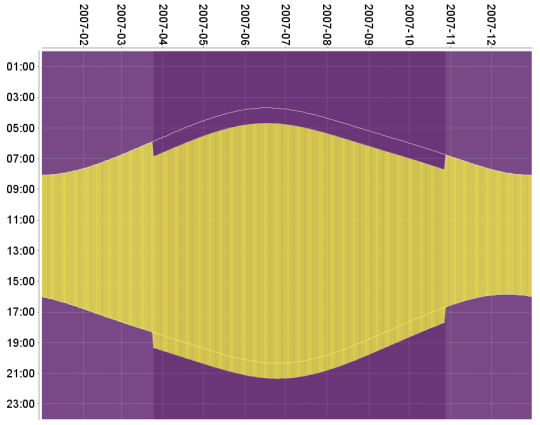
    Summer time starts this weekend, at least in this part of the world. Africa and Asia generally don’t observe daylight savings time (DST), so if you just switched your clocks forward an hour, know that you are in the global minority.

    The whole point of DST is that it gives us an extra hour of sunlight in the evenings during the summer months. The trade-off is a later sunrise, but since the days are longer to begin with, it’s something we have clearly come to accept.

    Here is a graph showing the impact of daylight savings time on sunrise and sunset times in Greenwich. It’s from Wikipedia and it’s the clearest diagram I could find that quickly explains the change.

    There’s a lot of debate around whether or not DST should be abolished or if we should simply adopt summer time, permanently. A bill is currently being reviewed that would allow Florida to observe DST year-round.

    Some groups, like retailers, seem to benefit from daylight savings time. More evening sunshine hours means we’re more likely to shop. But it has a negative impact on other things such as drive-ins. (Do people still go to drive-ins?)

    There are also arguments that it causes a decrease in economic output and an increase in traffic accidents – apparently we’re all groggy and accident-prone after having our sleep routines disrupted.

    So what would be your recommendation?

    1) Do nothing – status quo

    2) Abolish daylight savings time

    3) Observe daylight savings time year-round

  • Last-mile electric scooters — will they work?

    I’ve been hearing a lot about Bird recently. Perhaps it has something to do with the $15 million Series A round they raised last month (February 2018) and the $100 million Series B round they announced earlier today.

    A “Bird” is small electric scooters that look like this and can be rented from your phone for short haul trips. They are currently available in Santa Monica, Venice, UCLA, Westwood, and San Diego, and they are intended to be ridden in existing bike lanes.

    What may be particularly interesting to this blog audience is the fact that Bird is calling itself a “last-mile electric vehicle sharing company.” The pitch: 40% of car trips (in the US?) are less than 2 miles long. Let’s replace those using electric scooters.

    One of the first things that came to my mind is that this feels more accessible than cycling. Cycling to work can be a commitment. You have to think about your attire and the sweat factor, among other things.

    Would you agree?

  • You can now buy a new home, online

    My friend Matthew Slutsky runs a company called BuzzBuzzHome that allows you to search for new construction homes. This week they launched a feature that allows you to put down a deposit on a new home – online – with your credit card. It’s live right now for the Barra on Queen in Kitchener, Ontario.

    I know that Matthew and his team have been working on this for years (I saw earlier demos), and so I wanted to publicly congratulate them on the blog. I’m not sure who their competitors are right now, but this feels to me like one of the first online real estate marketplaces where you can actually just hit “buy now.” Huge accomplishment.

    I am sure many of you will have objections that we will hear about in the comment section below. But I have little doubt that this is the future. People used to say that the masses aren’t going to buy clothes online because of the need to try things on. I own suits that I have purchased online. People will buy real estate online.

    The more important question: When will it go mainstream?

  • Playoff time in the city

    I just finished watching the Raptors beat the Pistons in overtime to clinch a playoff berth. This is, by far, the earliest in the season that they have ever done that. They are also the first team in the NBA to do that this year. And this is after being down 17 tonight.

    The Raptors feel like a different team this year. They have the grit and toughness to come back and squeak out games like they did tonight. Seeing DeRozan run the floor and throw it down with less than 10 seconds left in the game is a powerful display of that. They are finding ways to win.

    As of today, FiveThirtyEight is giving the Raptors a 55% chance of making the finals. That would be a franchise first. And a 17% chance of winning the title. I am really enjoying watching the best Raptors team that this city has ever seen. And I’m looking forward to playoff time in the city. It transforms this place.

  • RioCan REIT announces new residential group

    On Monday, RioCan REIT announced its new residential brand: RioCan Living. This is the group that will now be responsible for redeveloping the 43 properties within their portfolio that they have identified as having intensification potential. Here’s how they are describing the new brand: “RioCan Living delivers best in class purpose-built rental units and condos along Canada’s most prominent public transit lines.”

    It has been interesting watching RioCan over the last 6 months. In the fall they announced that they would be selling off somewhere around $1.5 billion of their portfolio to rebalance toward Canada’s six largest markets, and in particular the Toronto market. And with this recent unveiling it is clear that they are doubling down on transit-oriented mixed-use communities as a way to future-proof their retail portfolio against disruption.

    Major markets. High-density. Transit-oriented. This shouldn’t surprise any of you. Here is a link to their latest investor presentation in case you’re curious.

  • Road pricing for whom?

    New York City is considering a congestion charge for drivers entering Manhattan below 60th street. It is part of Governor Cuomo’s Fix NYC plan. But we all know how difficult these things are to implement.

    Last month, Felix Salmon wrote a piece in Wired where he argued that our cities are dying of traffic congestion and that the cause is ride-hailing services like Uber and Lyft. The solution: A tax on ride-hailing services.

    The article elicited a few reactions, including this one by Charles Komanoff over at Streetblogs and this one by Joe Cortright over at City Observatory. Joe’s message: “The problem isn’t the ride-hailed vehicles, it’s the under-priced street.” 

    Precisely.

    Felix later followed-up with a post on his blog where he clarified that the reason he loves this idea – of taxing ride-hailing companies, not riders – is that it’s far more politically palatable than a blanket tax on all cars. I don’t disagree.

    Which is why I think my idea is something which is eminently politically possible, in contrast to congestion pricing, which has been implemented exactly nowhere in the USA.

    Americans love their cars, and they love the freedom that cars represent, and they hate the idea that they should be taxed for driving their cars. Tolls on roads and bridges are bad enough, but a fee just to drive in to a city?

    That said, I’m with Charles and Joe. 

    Last year, it was reported that roughly 25% of all Uber trips in New York City were UberPool trips. I’m not sure what the number is today, but these are people who are car pooling to get around. That’s generally considered to be a positive thing.

    Are these really the trips we want to be discouraging (and singling out) with a charge simply because we don’t have the moxie to do what is right and makes rational sense?

    Photo by Austin Scherbarth on Unsplash

  • Those wretched rear houses!

    Chris Bateman does some terrific sleuthing in the Globe and Mail this week to determine that the girl pictured in the below photo, dated May 15, 1913, is Dora (Dorothy) Cooperman – daughter of Morris Cooperman, a clothing presser.

    image

    Dora is standing in front of 3 wood-framed “rear houses” located behind 21 Elizabeth Street in an area known then as St. John’s Ward, or simply, The Ward. Behind her is City Hall, which we refer to today as Old City Hall. 

    If you’re familiar with Toronto, it shouldn’t take you long to figure out that she is standing in what is today the middle of Nathan Phillips Square in front of (new) City Hall. 

    The Ward no longer exists today, but as far as neighborhoods go its history is one of the most interesting. It was a high-density and mixed-use precinct that served as an important landing ground for successive waves of immigrants until it was deemed a slum and ultimately cleared. I wonder what it would look like today had it remained. Perhaps a bit like Kensington Market.

    It housed the Irish fleeing the Great Famine in the 19th century and was the center of Toronto’s Jewish community until the 1920s. The Cooperman family came from Kiev and identified as Jewish.

    There are so many interesting aspects to the above photograph. Everything from Dora’s pose to the juxtaposition between her surroundings and the grand (old) City Hall in the background. (Sidebar: I would like to try and recreate this same perspective. Would anyone like to model?)

    I also wonder why the city required a report to wake them up to the squalor that was living out in the Ward when they could have, presumably, just looked out their west facing windows.

    In 1911, Charles Hastings and Arthur Goss published what Batemen describes as a “landmark report that stunned civic officials, who had long ignored the poverty on their doorstep.” Hastings was the city’s medical officer of health, and Goss was the’s city first official photographer and author of Dora’s above portrait.

    One of the interesting things that Bateman explains about this report – and this is really the point of today’s post – is that it supposedly called out one particular housing typology as being highly problematic: rear houses. 

    These were houses that existed off the main street and could only be accessed via a laneway, like the one Dora is standing in. Today we would call them laneway houses. And so this report is evidence of over a century of anxiety around this particular housing type.

    It is obvious why overcrowding would have been deemed a serious problem at the start of the 20th century, but now one has to wonder how influential this report may have been in establishing the tone around these “rear houses.”

    Whatever the case may be, Dora’s story is an example of the role that this typology has played in housing people of modest means throughout this city’s history. It is also interesting, but perhaps not a coincidence, that affordability continues to be a part of the pitch around laneway housing and laneway suites. 

    Dora lived in a laneway house.

  • Hmm…architecture and basic income

    Albert Wenger recently published a post on his blog about architecture and basic income. Albert is a venture capitalist and is currently working on a book called World After Capital, which I have mentioned before on this blog. He is also an advocate of basic income as a solution to the growing inequality that the modern economy seems to be producing.

    In this latest post he wades into the world of architecture with two assertions that I would like to respond to today. The first is that with basic income the current trend of everyone piling up in large cities will end. We will decentralize in search of cheaper land on the outskirts of cities. And the second is that affordable housing could perhaps be produced with a more open source approach to architectural drawings and new construction.

    In terms of his first point, I’m not entirely clear why someone earning a basic income would suddenly decentralize. In the comments there is some discussion about how retirees, on a fixed income, often move outward in search of more affordable housing. I understand that phenomenon, but I am not convinced in this scenario. 

    There has been lots of talk about the demise of cities because of new technologies and other factors. But agglomeration economies have proved, again and again, to be a powerful centralizing force. Let’s also not forget about the environmental impacts of large scale decentralization, which would only be partially mitigated by the widespread adoption of electric vehicles. 

    Secondly, you can build a house without an architect. The issue isn’t that good bathroom details are hard to come by. Some of the bigger issues are likely the availability of land (decentralization, I guess, is supposed to solve this); construction costs (it’s a highly inefficient process that generates copious amounts of waste); and the immense regulatory burdens imposed on new construction (process, time, and costs).

    All of this stemmed from a visit that Albert did with a group of architecture students who are researching the relationship between architecture and basic income. I would be very curious to see what they produce.

    What are your thoughts?

    Photo by Mathyas Kurmann on Unsplash