Daily insights for city builders, delivered every morning at 6 AM ET. I’m Brandon Donnelly — a Toronto-based real estate developer and founder of Globizen. I’ve been writing here since 2013.

  • Studio Gang’s first project in Los Angeles

    This past week Studio Gang unveiled its first project in Los Angeles, a curvaceous apartment (300 rental units) and hotel (149 rooms) tower in Chinatown.

    The developer is Paris-based Compagnie de Phalsbourg and the hotel component is expected to be operated by the European brand, MOB Hotel.

    Above is the only rendering I could find. If you would like to read a bit more about the project, check out Curbed LA.

    Image: Studio Gang

  • New, mini, electric skateboard

    image

    Boosted — which is a California-based company that makes electric skateboards — has just released a new smaller and more affordable version called the Mini S.

    Casey Neistat — who helped popularize the original models through his wildly successful YouTube channel — recently vlogged about it and it ended up crashing their website. That’s how things work these days.

    Now, this new version is still USD 750 (so CAD 1,000), but it is significantly less than their other, bigger, models.

    The Mini S goes up to 18 mph and lasts for about 7 miles (optional extended range battery available). So it’s perfect for short jaunts around the city and as a solution to that pesky last mile problem. 

    I am seriously considering getting one for my short commute to the office. That way I’m not breaking a sweat in my suit. But $1,000 remains an awful lot for a skateboard.

    What do you think?

    Image: Casey Neistat via Boosted

  • The challenges of the metropolis beyond Habitat III

    This morning I woke up to an email from the Urban Ecology Agency of Barcelona. They are a public consortium dedicated to urban sustainability and made up of the City Council of Barcelona, the Municipal Council and Metropolitan Area of Barcelona, and the Barcelona Provincial Council. The email was about this upcoming “urban congress” taking place in Barcelona from May 22-24:

    Sadly, I have no plans to be in Barcelona next month. But if any of you are based or traveling there, the conference is all about the future challenges that cities will face and about contributing to the new urban agenda. The main topics are: sustainability, city planning, social cohesion, and competitiveness. 

    Habitat III – which is in the title of the conference – was a United Nations conference on housing and sustainable urbanization. It took place in Quito, Ecuador in October 2016. However, it forms part of a much larger framework around sustainable global development. More info here.

    Barcelona is also one of my favorite cities, so I am happy to share this one with all of you. If you’d like to register for Post-Habitat III, head over here.

  • Tim Hortons is moving its HQ to downtown Toronto

    Yesterday it was announced that Tim Hortons would be moving its corporate headquarters from Oakville, Ontario to downtown Toronto. 

    They’ll be taking 6,000 square meters of space in the PATH-connected Exchange Tower and moving all 400 employees by the end of this year.

    I’m more of a Starbucks coffee drinker, but I am interested in this move. Here’s what their president, Alex Macedo, had to say about it (quote from the Financial Post):

    “Consumer trends are changing very fast. We want to remain an innovative company,” he says. “We want to be able to react to guest changing behaviours so we thought being positioned in Toronto would allow us to do that.”

    This is a good follow-up to a post I wrote back in April 2015, which talked about the trend of companies moving from the suburbs to downtown Toronto. I guess that is still happening.

  • Likely to liquefy in an earthquake

    Today’s post is going to be a short add-on to yesterday’s post about the sinking Millennium Tower in San Francisco. Today, the New York Times published the below map showing the areas of the city likely to “liquefy in an earthquake.” It goes on to note that “at least 100 buildings taller than 240 feet were built in areas that have a “very high” chance of liquefaction.”

    The article might leave you with the feeling that current building codes are inadequate for the pending “Big One” in San Francisco. So I thought I would reblog this post from last fall which talks, in more detail, about how one of the best structural engineering firms in the world designed the tallest building in San Francisco.

    Image: New York Times

  • Sinking tower solution

    Many of you are probably aware of the 58-storey Millennium Tower in San Francisco which is estimated to have sunk about 17 inches and to have tilted about 14 inches to the west since it was built.

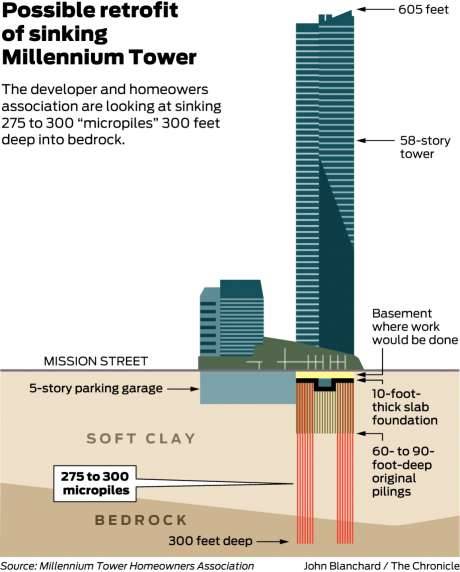
    Well today it was announced that they may have a fix. Here is what is apparently being proposed as a retrofit (image from SFGate):

    image

    The tower was originally built on top of a 10 foot thick raft or mat foundation, which was then supported by concrete piles that went down 60-90 feet into soft clay. Notably, the piles didn’t reach bedrock.

    The proposed solution involves drilling 275-300 new micropiles into the bedrock below. But here’s where things get really interesting: The plan is to stabilize the west side of the building first and allow the east side of the building to continue sinking. In theory, this will give the building an opportunity to level out before they fully stabilize it. 

    According to SFGate, the entire retrofit is expected to take anywhere from 2 to 5 years, and cost somewhere in the range of $200 to $500 million. The original tower cost $350 million to build. (I’m assuming that’s just the hard cost number.)

  • Hamilton’s Pier 8

    In December of last year, the City of Hamilton launched an RFP process to find a team (from the list of prequalified bidders) to develop a new urban community at Pier 8 along the waterfront. The ambition is somewhere around 1,500 new residential units and approximately 13,000 square meters of commercial and institutional space.

    That process has narrowed the pool to 4 teams and 1 will ultimately win the exclusive right to develop the new community. Here are the teams, along with a link to their submission materials, including a short video that I understand was a requirement of the RFP.

    – GulfDream (link)

    – Tridel (link)

    – Urban Capital / Core Urban / Milborne Group (link)

    – Waterfront Shores (link)

    This is a super exciting project for Hamilton. So I would encourage you to take a look at the presentation materials. At this point, you only have until Tuesday, April 17, 2018 to provide any comments to the City’s evaluators. If you’d like to view the boards in person, you can do that this Monday and Tuesday in the main lobby of City Hall.

  • Going down east

    I live in Toronto. 

    When I am headed north to cottage country, I say that I am going up north.

    When the Florida snowbirds talk about escaping the winter, they usually say that they are headed down south.

    These geographic references are fairly straightforward.

    If a friend were to move to Vancouver, I might say that she or he moved out west. This one starts to get a bit more interesting because it speaks to a location that is out, or away, from the center. Toronto is the center and that person has moved out from it.

    But the one that really made me think was down east. My mother was born in the Canadian Maritimes and when she references this part of the country she calls it down east. 

    I used to ask her: “Why is it called down east? Geographically, it is actually up east.”

    Turns out that down east is (probably) a nautical reference. It is used to identify parts of the east coast in both New England and Canada. The prevailing winds in these parts blow from the southwest. So when sailors traveled from the west to east they were going downwind.

    So there you have it. Do you have any peculiar geographic references in your part of the world?

    UPDATE: I should have also mentioned that the St. Lawrence River generally flows north-easterly and that there’s an elevational difference between what was formerly known as Upper Canada and Lower Canada.

    Photo by Matthias Jordan on Unsplash

  • How elevation impacts risk taking

    image

    There’s an old saying that we shape our buildings and environments and then they in turn shape us. 

    Here is a fascinating research report about “the influence of physical elevation in buildings on risk preferences.” I discovered it through this MarketWatch article, which my friend John forwarded me this afternoon. 

    Here is a quote from the article:

    We then examined the correlation between hedge-fund volatility and office location in terms of number of stories above ground. We found that as the elevation of hedge-fund managers’ offices increased, they were more willing to take risks that resulted in more volatility. This was true even when statistically controlling for factors such as total assets, fund strategy and several other variables that could have led more resourceful hedge funds to occupy expensive offices that are often found on higher levels of buildings.

    Does this mean taller cities are also more volatile cities? Assuming this is all true, it once again proves that we are maybe not the rational decision makers that many us probably think we are.

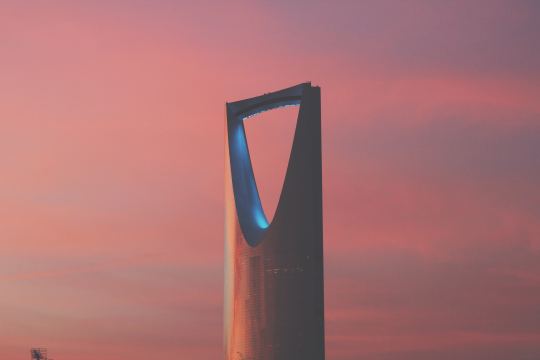
    Photo by Hala AlGhanim on Unsplash

  • Regional accents and “da Bulls”

    I find regional accents fascinating. 

    I generally think that Toronto has a fairly neutral accent. But then again, when I lived in Philadelphia, I used to notice the accident every time I came home. Maybe it is because I had adopted a bit of the Philly accent. For the record, I never picked up “youse.”

    According to some classifications, most of Western and Central Canada would fall under “General Canadian.” But I find that there are noticeable differences between the accents in Toronto and, say, Calgary. Really there are differences even within the Greater Toronto Area.

    CityLab has a recent article up about why city accents are fading in the US midwest. They chalk it up to two main factors: education and geographic mobility. But I also wonder if today’s online connectivity isn’t muting some of the local varietals.

    That’s the interesting thing about accents, they – much like the language itself – are constantly changing and evolving. On that note, I’ll end with this classic parody of the Chicago accent: Da Bulls!