Daily insights for city builders, delivered every morning at 6 AM ET. I’m Brandon Donnelly — a Toronto-based real estate developer and founder of Globizen. I’ve been writing here since 2013.

  • How U.S. cities make money

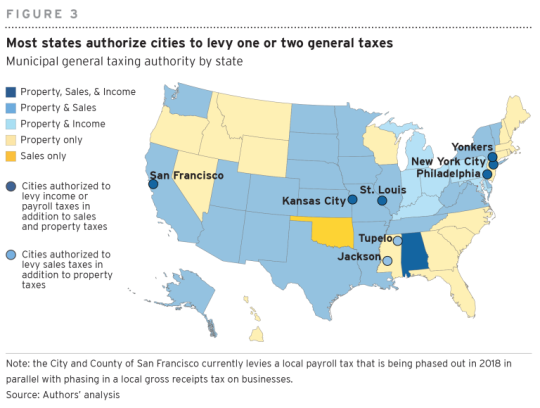
    The below figure shows the taxing authority of US cities by state. In some cases there’s a city or two with additional taxing authority. New York City, for instance, has been authorized by the state to levy property, sales, and income taxes, whereas other cities in the state can only levy property and sales taxes.

    image

    The figure is from a recent report by Brookings called, City budgets in an era of increased uncertainty. In addition to revenue sources, the report also covers spending limits and tax structure alignment. 

    The report concludes that cities generally have a stronger fiscal position when their tax structure aligns with their economy. For example, cities such as Las Vegas that have lower than average property values and are only authorized to collect property taxes, do not score well.

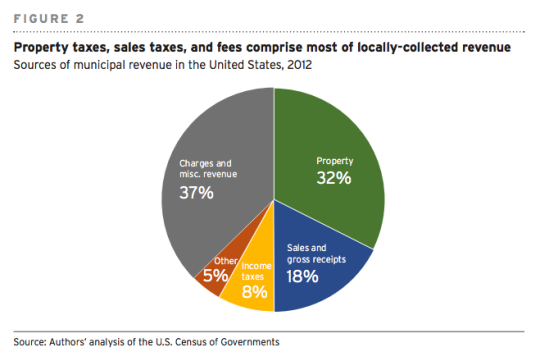
    One thing that the above figure does not get across is that more money now comes in from non-tax revenues, user fees, and other charges. According to 2012 census data, 37% of all municipal revenue in the United States came from these sorts of charges.

    image

    To download a PDF of the full report, click here.

  • Learning about O-zones

    I spent this evening reading about Opportunity Zones, or “O-zones”, in the United States. 

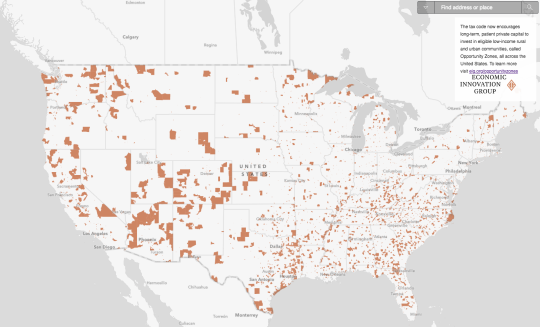
    For a census tract to become an O-zone, it has to have a poverty rate of 20% or higher, or the median household income has to be less than 80% of the surrounding area. Governors are also only able to designate 25% of their eligible census tracts.

    Here is a map of the areas that have been designated as Opportunity Zones.
    image

    Here is how these O-zones work. (All excerpts taken from this Forbes article.)

    The law’s engine is a new breed of financial product, the opportunity fund, that offers investors a trifecta of attractive tax breaks. Here’s how it works. Investors who sell assets have 180 days to plow their taxable capital gains into an approved opportunity fund, which must hold 90% of its assets in Opportunity Zone projects. To put money to work fast, the law requires that the funds invest all of their cash within some specified time frame. (The Treasury Department is still deciding on that and other crucial details.) Tax on the original reinvested gain isn’t due until 2026, and the taxable gain is cut by 15%. Meanwhile the new opportunity investment grows tax-free, like a Roth IRA, provided it’s held for at least ten years. (If it’s sold earlier, it can be rolled into another opportunity fund and remain tax-free.)

    Here is how it could get the real estate industry to take action.

    For real estate developers, O-zones offer cheap real estate and unlimited, untaxed upside if a neighborhood takes off. Developers must do more than stash cash in crumbling property. To qualify for tax perks, they must make swift and significant upgrades (at least equal to the cost of the initial purchase). With real estate projects come new office buildings, industrial districts, restaurants and affordable housing—all of which can lay the groundwork for an economic boom. “The real estate aspect is a great catalyst to attract new businesses,” says AOL founder Steve Case, an early supporter of the O-zone initiative, whose Rise of the Rest Fund invests in backwater areas. “But it’s the startups that will be the real job creators.”

    And here is how it could influence where new businesses decide to locate.

    “If Facebook could have chosen to locate itself in an Opportunity Zone, like the Tenderloin in San Francisco, the investors would’ve paid no capital gains on their equity,” says Parker, who presumably would have been one of the big winners. The promise of mega-returns could send VCs, investment banks and private equity firms scrambling to launch their own opportunity funds to create incubators, scour second cities for overlooked talent or move portfolio companies into O-zones. “It wouldn’t surprise me if a lot of Silicon Valley VCs started to tell founders, ‘We’d like you to go over the bridge to Oakland, or we’d like you to go to Stockton,’” Parker says.

    If you’d like to learn more about Opportunity Zones, check out the Forbes article.

  • Thank you, DeRozan

    Look, I get it. 

    The Raptors had plateaued. When the Cavaliers swept them in the playoffs earlier this year we all knew there were going to be significant changes in the off-season. Many people who know more about basketball than I do also seem to believe that sending our franchise player DeMar DeRozan to San Antonio in exchange for Kawhi Leonard is a win for us. The betting odds also seem to reflect this win.

    But, like many people here in Toronto, the first emotion I felt this morning when I heard the news was sadness. Here is a guy who has played his entire professional career in Toronto (9 years) and has openly and continually expressed his loyalty to this city. He wanted to retire a Toronto Raptor. He declared himself to be Toronto.

    Of course in the end this is a business. And the primary goal of this business to win championships. If you don’t think you’re in a position to win championships – or lose to the Golden State Warriors in the finals, which is probably the most that teams can hope for right now – then it behooves you to make the necessary changes, however painful they may be.

    I have no idea how this all went down, but the Instagram story that DeRozan posted this morning makes it abundantly clear that he feels betrayed. He feels he was told one thing, and that one thing isn’t what ended up happening. That’s the truly sad part for me. But I’m not going to speculate. Instead, I would like to thank DeMar DeRozan for his dedication and loyalty to this city. He was one of Toronto’s finest city builders.

  • Lyft reveals plans for bikes and scooters

    On Monday, John Zimmer and Logan Green, the co-founders of Lyft, published this Medium post announcing their “approach to partnering with cities to introduce bike and scooter sharing” to their platform. 

    “Approach to partnering with cities” is undoubtedly a carefully chosen set of words given all the backlash going on right now around dockless scooters.

    Nevertheless, this is an exciting announcement. I could have used a scooter this afternoon to get to a meeting. And this is all part of their larger goal of transforming Lyft into a multi-modal platform – one that will also support conventional public transit.

    Here is an excerpt from the Medium post:

    Transit, bikes, small electric vehicles, and infrastructure such as safe pedestrian paths and bike lanes, all play a large role in decoupling people’s right to mobility from car ownership. We know we can’t accomplish this alone, and we’re committed to working with cities and residents to bring these elements together in the most cohesive way to maximize a reduction in vehicle miles traveled.

    The company has also set the goal that 50% of all trips on the Lyft platform will be shared rides by 2020. It is yet another example of the lines between public transit and ride sharing apps becoming blurrier. 

    Full post can be found, here.

  • Value of distribution and reach for consumer facing products

    image

    Forbes recently pegged social media influencer Kylie Jenner’s net worth at somewhere around $900 million. That makes her the youngest (she’s 20) person on Forbes’ annual ranking of “America’s Richest Self-Made Women.” 

    And if the trend line continues, she’ll be the youngest self-made billionaire, ever. Mark Zuckerberg apparently holds that title right now. But he was a classic underachiever and only became a billionaire at age 23.

    Most of Kylie’s net worth is derived from Kylie Cosmetics, which launched less than 3 years ago, but did an estimated $330 million in revenue last year. Forbes values the company at almost $800 million. And Kylie owns every bit of it. 

    The reason I am mentioning this today is because I was fascinated by the above Forbes article. It’s such a powerful example of social media leverage. Forbes put it differently: “Social media has weaponized fame.” 

    Kylie has 111 million followers on Instagram (plus many more on her other social channels) and that’s really the most important part of this equation. She has the distribution and reach to acquire boat loads of customers. It doesn’t matter what you’re selling if nobody knows you’re selling it.

    The rest of her business is pretty much outsourced. Seed Beauty (out of Oxnard, California and Nanjing, China) handles the manufacturing, packaging, and shipping fulfillment. Shopify (headquartered in Ottawa) is her e-commerce platform.

    We could of course have a debate about whether a celebrity-fueled business is really all that sustainable. And perhaps there’s risk in relying so heavily on social for customer acquisition. But youngest billionaire is youngest billionaire.

    Image: Forbes

  • Live/work photography studio on Stoney Lake

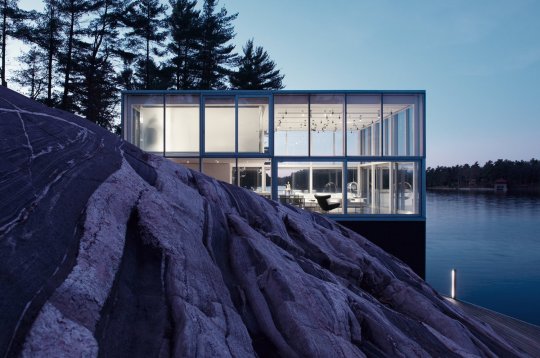
    It’s the dog days of summer right now and I suspect that some of you may be spending your time (or at least some of it) near water. So here is one of my favorite lakeside homes. It is a live/work photography studio sitting on top of a boathouse on Stoney Lake in the Kawartha Lakes region of Ontario. It is by gh3*. They do terrific work.

    image

    I love the relationship to the Canadian Shield (see above). And I love how it is a dramatic departure from the archetypal Ontario cottage. I am more impressed by a project like this (it has 1 bedroom) than I am by a 5,000 square foot “cottage estate.”

    Some of you may be wondering how a largely all glass curtain wall box performs environmentally during these dog days of summer and I am wondering the exact same thing. But it is north facing. And the goal was to create a space that would enable photos not possible in a conventional studio.

    For more on the project, including other photos, go here.

  • Toward a Concrete Utopia: Architecture in Yugoslavia, 1948–1980

    image

    A new exhibition on postwar architecture in (the former) Yugoslavia opens up today (July 15) at the Museum of Modern Art in New York. It’s called, Toward a Concrete Utopia: Architecture in Yugoslavia, 1948–1980and it runs until January 13, 2019.

    Here is a bit more about the exhibition:

    Situated between the capitalist West and the socialist East, Yugoslavia’s architects responded to contradictory demands and influences, developing a postwar architecture both in line with and distinct from the design approaches seen elsewhere in Europe and beyond. The architecture that emerged—from International Style skyscrapers to Brutalist “social condensers”—is a manifestation of the radical diversity, hybridity, and idealism that characterized the Yugoslav state itself.

    And here is a panel discussion about the exhibition (click here if you can’t see the video below):

    [youtube https://www.youtube.com/watch?v=M2S0bBTHu-8&w=560&h=315]

    Architecture tells you a lot about a place and what was happening at the time in which it was built. I would love to see this exhibition and I hope to do exactly that if I’m in New York City before the new year.

    Image: MoMA

  • Condo rents in Toronto are up 11.2% from last year

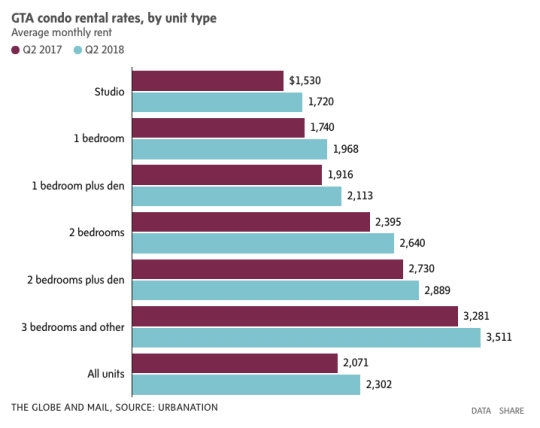
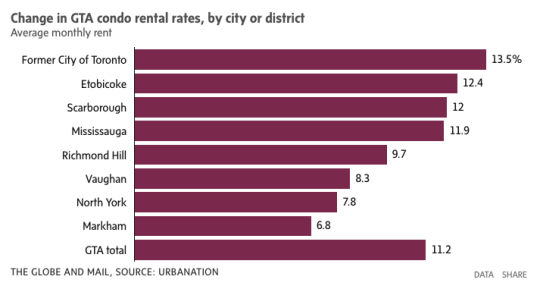
    Yesterday Urbanation released its Q2-2018 rental report for the Greater Toronto Area. It tracks both purpose-built rentals and condominium rentals, the latter being condominium units that are listed for rent on MLS. The average condo rent, for all unit types across the GTA, is up 11.2% year-over-year to a face rent of $2,302 per month.

    Here is a chart from the Globe and Mail:

    The former City of Toronto, which includes downtown, is actually up 13.5%:

    But here are the stats that I really wanted to draw your attention to today (figures from the Globe).

    According to Urbanation, there were some 384,000 condo apartments in the Greater Toronto Area in 2017 and nearly 1/3 of them were rented out. Given that the Canada Mortgage and Housing Corporation pegs the total number of rental apartments in the GTA at approximately 311,596, condo apartments represent about 40% of all our rental housing stock.

    So condo buildings are actually doing quite a bit of heavy lifting when it comes to providing rental housing in this region.

  • Why Millennial homeownership is so low

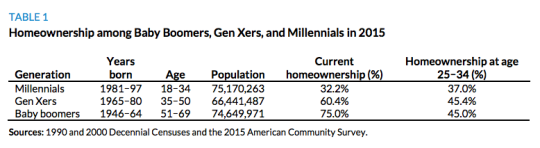
    The Urban Institute has a new study out that looks to explain why Millennial homeownership rates are lower than that of previous generations. The typical refrain is that Millennials have a lot more student debt and that the cost of housing in urban centers has risen faster than income levels. But this report tries to put some math behind those explanations. All data is for the US.

    Not surprisingly, marriage and kids are significant drivers, and Millennials appear to be delaying both. According to the study, being married increases the probability of owning a home by 18%. If marriage rates in 2015 were the same as they were in 1990 (this is the time period for the study), the Millennial homeownership rate would be 5% higher. Having a kid increases the probability by about 6.2%.

    There’s also a widening spread between the homeownership rates for more educated and less educated Millennials. Presumably the distinction is a 4 year university degree. Between 1990 and 2015, the spread between the two groups increased from 3.3% to 9.7%. This was identified as an area of “great concern” because of the possible long term implications.

    Combine this phenomenon with the stats that white households have a higher homeownership rate compared to all other racial groups and that having parents who are homeowners increases the likelihood of also owning a home (let’s ignore, for a second, the other intergenerational transfers of wealth), and you have a recipe for rising wealth disparities.

    Of course, some of you will undoubtedly argue that in this part of the world we are overly fixated on homeownership as a mechanism for wealth creation. I mean, there are many examples of very wealthy countries with homeownership rates that are far less than what they are here in Canada and the US. But that’s a discussion for a different blog post.

    If you’d like to go through the full Millennial Homeownership report, you can do that here.

  • The real reason we want entertaining spaces

    According to a recent study out of UCLA, which I discovered via this Curbed article, American families tend to spend most of their time at home in informal, rather than formal, spaces. That means more time in the kitchen and family room, as opposed to in the living room and formal dining room. 

    I’m sure this comes as no surprise to all of you. Was a study necessary? Maybe you even have plastic on the furniture in your formal rooms because, you know, they’re reserved for “entertaining.” The reason I mention this is because I thought it was funny how Kate Wagner describes this phenomenon in her Curbed article:

    The ironic inefficiency of hyper-exaggerated high-end entertaining spaces belies a truth: These spaces aren’t really designed for entertaining. They’re designed for impressing others. And not just impressing others: After all, it’s general politeness to compliment a host on their home no matter how impressive it is. The real goal, deeply embedded in these oversized, over-elaborate houses, is not for guests to say, “Oh wow, this is nice,” but to make them think, “Oh wow, this is nicer than what I have and now I feel jealous and insecure.” In true American irony, these giant “social” spaces (and McMansions in general) are birthed from a deeply antisocial sentiment: making others feel small. Considering that so often our guests are members of our own family adds another layer of darkness to the equation.

    For those of you who aren’t familiar with Kate Wagner, she is the founder of McMansion Hell, which is a hilarious website dedicated to blasting McMansions. A pejorative term for houses that privilege raw size and the appearance of wealth over quality. Now that you know that, I am sure the above blurb makes a lot of sense.