Daily insights for city builders, delivered every morning at 6 AM ET. I’m Brandon Donnelly — a Toronto-based real estate developer and founder of Globizen. I’ve been writing here since 2013.

  • Uber to invest $200 million in Toronto

    Uber CEO Dara Khosrowshahi was in Toronto today, where he announced that the company plans to invest more than $200 million over the next five years to expand the autonomous vehicle research lab that it already has here in the city. 

    The Toronto outpost of Uber’s Advanced Technologies Group (ATG) – which is its only international outpost – is led by renowned University of Toronto professor, Raquel Urtasun. She is also the cofounder of the Vector Institute for Artificial Intelligence and splits her time between Uber and UofT.

    With this investment, Uber also expects to open its first engineering facility in Canada and grow its local headcount to 500, up from the 200 or so it has today. Some of these hires will be local. Some will be international. And some will be transplants from Uber’s other offices.

    Also notable about the announcement is that Khosrowshahi mentioned that he thinks fully autonomous vehicles roaming the streets of our cities is a good 10 years away. But I wonder if that isn’t political PR speak intended not to spook its drivers. So are we closer to the mid-2020′s?

    Either way, as a proud Torontonian and UofT alumnus, I was happy to see this announcement. I think it’s far more exciting than the Apple event that took place earlier this week.
  • Invisible walls

    image

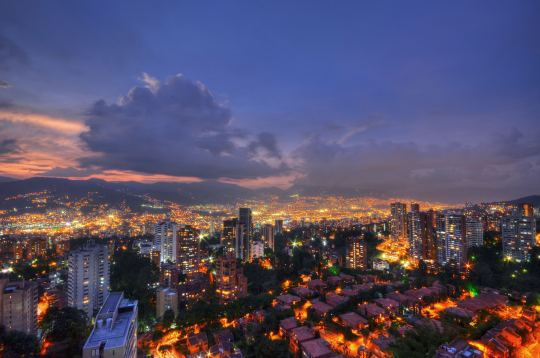
    This is an interesting working paper by a team of researchers at NYU’s Marron Institute of Urban Management. The paper examines the relationship between urban density and organized violence, first in Colombia and then within a sample of 200 global cities.

    The finding is that organized violence actually increases the population density of the surrounding areas within a city because it creates a kind of “invisible wall” – effectively a no-go zone.

    This makes perfect intuitive sense, but it’s not something I ever considered. Geography and other natural constraints typically drive density. Think about the island of Manhattan. But so too can invisible walls.

    For the full working paper, click here.

    Photo by Joel Duncan on Unsplash

  • Microsoft Canada moving to CIBC Square

    image

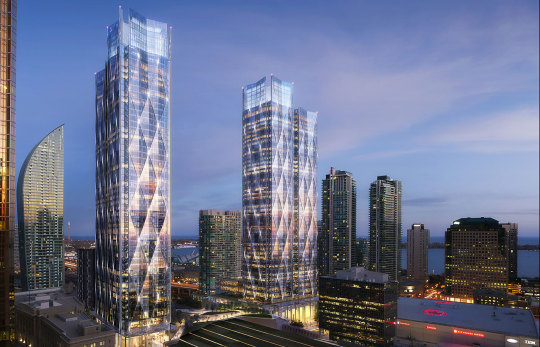
    Today, Microsoft announced that it will be moving its Canadian headquarters from Mississauga to the new CIBC Square development that is currently under construction in downtown Toronto (and rendered above). 

    According to RENX, Microsoft will occupy 132,000 square feet across 4 floors in the first tower. Occupancy is scheduled for September 2020.

    I love this project. The design architect is WilkinsonEyre. And there’s going to be an elevated one-acre park spanning the rail corridor between the project’s two towers.

    But it’s also noteworthy because it is an example of a major suburban tenant deciding to relocate to a transit-oriented urban environment. (I have a post on this somewhere.) 

    Image: WilkinsonEyre

  • How we make the decisions that matter most

    I’m listening to the below podcast right now with Sonal Chokshi, Chris Dixon, and Steven Johnson. Steven recently published a new book called, Farsighted: How We Make the Decisions That Matter Most. If you can’t see the embedded podcast below, click here.

    [soundcloud url=”https://api.soundcloud.com/tracks/497128947″ params=”color=#ff5500&auto_play=false&hide_related=false&show_comments=true&show_user=true&show_reposts=false&show_teaser=true&visual=true” width=”100%” height=”300″ iframe=”true” /]

    It is about the big and meaningful decisions that we make as individuals – such as where to live or who to marry – as well as the big and meaningful decisions that we make as a collective – such as how to plan a city or fight climate change. But most importantly, it is about how we can get better at them.

    Supposedly, part of the science (and art) behind deliberative decision making is using tricks to get our minds to see problems and their complexities differently. That could involve scenario planning and even considering the weirdest possible outcomes. In fact, Steven finds a lot of value in fictional storytelling.

    There could also be implications for city building. Tech is allowing us to collect a lot more data about the ways in which our cities operate today. But as we get better at running complex simulations, we should also get a lot better at understanding the long-term implications of our decisions.

    I may just have to get Steven’s new book.

  • Tridel unveils smart condominium in South Core

    A few weeks ago, Canadian developer Tridel unveiled its first “smart condominium” at Ten York – a recently completed 69 storey building in the South Core neighborhood of Toronto. Above is an archive photo of the building under construction. I chose this one because its siting between the Gardiner Expressway (left) and Harbour Street (right) is also noteworthy.

    Smart anything is one of those tech buzzwords that is, I know, starting to feel vapid. But Tridel has done some interesting things here with their Tridel Connect platform (a collaboration with SmartONE Solutions). And if you happen to also be in the business of designing and constructing multi-family buildings, I think you’ll find it to be a useful case study.

    At Ten York, you can now use your phone as a key fob. People buzzing up are shown to you on your wall pad so you can confirm identity. The suite entry doors use digital locks, which means you use an access code instead of a key. Additional codes can be created for family and friends or for service providers like dog walkers and cleaners. You’re also given a log of who has come and gone. And of course there’s an automated parcel delivery system.

    If you’d like to see all of the features in the live, I suggest you take a look at the “b-roll video” that was included as part of their press release. Tridel is excellent at implementing new technologies and I know that they frequently reserve test suites in their projects to try some of them out. This is a great thing for the industry and for consumers.

    Image: Tridel

  • Unzipped wall on King Street West

    image

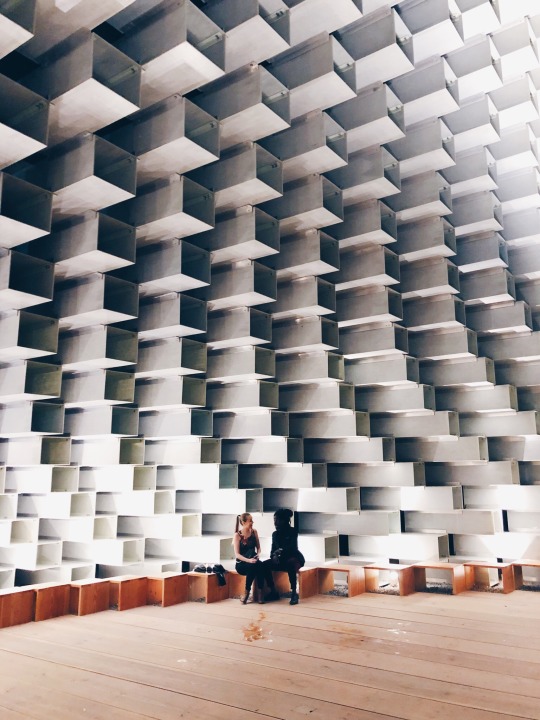
    Last night I checked out the Unzipped Toronto exhibition, which is the relocated Serpentine Pavilion (pictured above) that was designed by Bjarke Ingels Group in 2016. 

    It was initially housed in Hyde Park London, but it’s now on King Street West Toronto. Westbank purchased the “unzipped wall” after it was installed in London and supposedly it will eventually find a permanent home in Vancouver.

    The official opening of Unzipped Toronto is September 15th, 2018. It will be free and open to the public. If you’d like to get a complimentary ticket, you can do that here. 

    The timing of all this lines up with condo sales for Bjarke Ingels’ first project in Toronto. I believe that will be starting this fall. And I am sure they will end up setting some new records for the King West submarket.

  • Red streetcar tracks

    A few months ago when I wrote about “Toronto’s great streets” I mentioned that Queens Quay West – while magnificent – has had its share of issues. Cyclists and pedestrians often find themselves battling for space. And drivers are consistently driving in the wrong places.

    Part of the problem, I think, is that the turning radii (among other things) are a bit atypical and unusual compared to the rest of the city. And so if you’re at all in mental autopilot, it can be fairly easy to make a wrong turn. You really have to be paying attention.

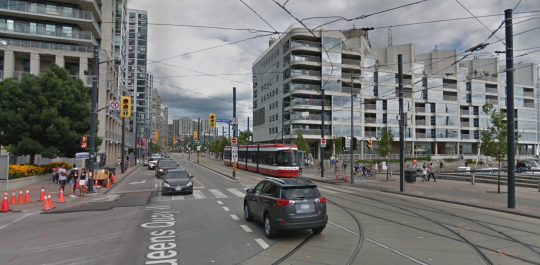
    Below is a screenshot from Google Street View showing the foot of Lower Spadina, looking east on Queens Quay West. If you’re making a left turn from the former onto the latter, you need to end up on the left (north) of the streetcar tracks (even though the tracks themselves might be directing you elsewhere).

    There’s lots of signage telling you not to drive onto the tracks, but that hasn’t really been working. So the tracks were recently painted in bright red. You can see what that looks like here. Some people are still getting mixed up, but it’s certainly more noticeable.

    What I am wondering today is whether all of this signage and paint should be considered a symptom of poor design. In other words: Should good design require few instructions? Or, is this simply a normal part of iterative city building?

    What do you think?

  • Limits of housing affordability

    The San Francisco Chronicle recently published an article called, “SF residential projects languish as rising costs force developers to cash out.” It talks about the impact that rising costs (both construction and other) are having on new housing supply. Some developers aren’t building even though may have entitled sites. And that’s because the math doesn’t work, even though we’re in a market with a severe housing shortage.

    Here is an excerpt from the article that talks about the kind of pricing that is needed in order to make a project work:

    Chris Foley, a real estate investor and partner in brokerage firm Polaris Pacific, said that in the current construction environment a condominium developer needs to sell units for at least $1,400 a square foot for a wood-frame building and $1,800 a square for a taller, steel-frame midrise or high-rise. Even in a city where more than 80 percent of the population is priced out of the market, those numbers are a stretch, Foley said.

    San Francisco also has inclusionary zoning, which requires a certain percentage of units in any new development to be priced below market. According to the article, it is 18% for new rental projects and 20% for new condo projects. That’s a cost that needs to be absorbed by the remaining market rate units – so price accordingly. 

    The MIRA tower designed by Studio Gang is currently under construction and has 156 affordable units and 393 market rate units. The market rate pricing looks something like this:

    That’s the case with three buildings rising near the new Transbay Transit Center: Mira, the Avery at 400 Folsom St., and One Steuart Lane, which overlooks the Embarcadero at the foot of Howard Street. Unless there is a remarkable drop in the market, units in all three of those buildings will probably have an average sales price of more than $2,000 a square foot and penthouses could fetch $3,000 or even $4,000 a square foot. A 3,326-square-foot penthouse at 181 Fremont St., which opened last spring, recently sold for $15 million, or $4,500 a square foot.

    Projects being squeezed by rising costs is something that we are also seeing here in Toronto. And I don’t believe that the general public fully appreciates that there are limits to the costs that can be shouldered by new development. And the reason for that is because there are limits to what people can afford to pay for new housing.

    Photo by Jamie Street on Unsplash

  • Friluftsliv (or open air living)

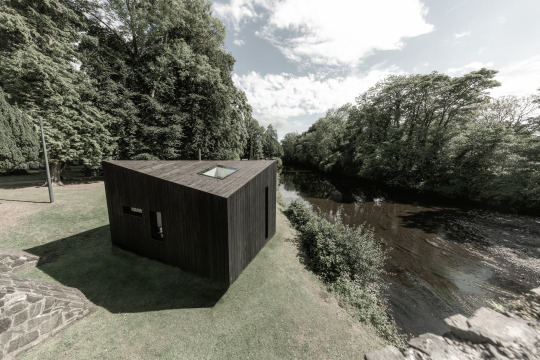
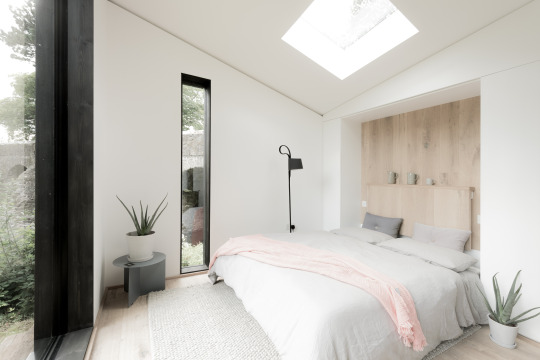
    Johnathon Little (husband) and Zoe Little (wife) recently launched a new housing concept out of the UK called Koto, which is supposedly Finnish for “cozy at home.” 

    (Before Koto, Johnathon worked for Snohetta in Oslo.)

    The goal of the company is to create beautiful, small, and prefabricated houses and cabins that allow people to connect with nature. 

    It is inspired by the Nordic concept Friluftsliv. The literal translation is “open air living” but, more specifically, it is about the benefits of nature on our mental and personal wellbeing.

    Their small cabin has a footprint of 15 square meters and their large cabin has a footprint of 40 square meters. Base prices run from about £33,500 to £63,500. A bathroom is optional.

    The most obvious use case for me is that of a bunkie. For more on Koto, check out their website and Instagram.

    Photos: Koto

  • A more distributed startup geography

    The Economist recently argued that Silicon Valley’s innovation hegemony is waning and that it is a product of two factors: there appears to be more innovation happening elsewhere (good news), but that innovation in general also seems to be harder to achieve (bad news). Here is an excerpt from the article:

    Other cities are rising in relative importance as a result. The Kauffman Foundation, a non-profit group that tracks entrepreneurship, now ranks the Miami-Fort Lauderdale area first for startup activity in America, based on the density of startups and new entrepreneurs. Mr Thiel is moving to Los Angeles, which has a vibrant tech scene. Phoenix and Pittsburgh have become hubs for autonomous vehicles; New York for media startups; London for fintech; Shenzhen for hardware. None of these places can match the Valley on its own; between them, they point to a world in which innovation is more distributed.

    Part of the problem, of course, is rising costs in the Bay Area. Everything from the cost of living to the cost of operating a business. The article cites a recent survey where nearly half of all respondents said they are planning to leave the Bay Area in the next few years. This is up from 34% only two years ago.

    I don’t doubt that rising costs are causing some people to look to other cities, as well as other countries in the case of draconian visa policies. But I am suspect of the claim that we’ve heat peak “innovation” – however you want to define that.