Daily insights for city builders, delivered every morning at 6 AM ET. I’m Brandon Donnelly — a Toronto-based real estate developer and founder of Globizen. I’ve been writing here since 2013.

  • Introducing Stephen Avenue Place

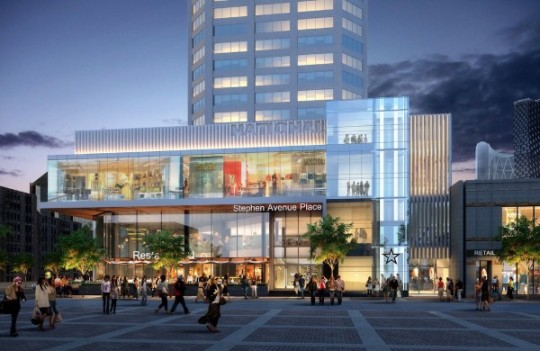
    Today, the Slate Canadian Real Estate Opportunity Fund I announced a new name for its 40 storey tower at 700 2nd Street in Calgary: Stephen Avenue Place

    It also announced that it has partnered with Oliver & Bonacini Hospitality and Concorde Entertainment Group to create three new dining destinations at the property: a top floor restaurant, a food hall, and a high-energy restaurant/bar/patio at street level.

    Here are a couple of excerpts from today’s press release:

    Stephen Avenue Place offers 620,000 square feet of rentable space at the nexus of the historic Stephen Avenue Walk and 2nd St. This classic of the Calgary skyline will undergo a significant renovation – from its public-access ground floor to exclusive tenant amenities and top-floor restaurant – that will reposition it as a modern hub for energy, innovation, business, dining and shopping.

    The acquisition and renovation of Stephen Avenue Place is part of Slate’s growing investment in Calgary. In the past 18 months, Slate has increased its footprint in Calgary to 2.3 million square feet with the purchase of 21 office properties, including 12 downtown.

    “We are thrilled to acquire and develop such a high-quality property in downtown Calgary that offers businesses, diners and shoppers the very best in location, amenities and access,” said Slate founding partner Blair Welch. “Stephen Avenue Place will undergo an extensive renovation to fully reflect the way we work and live now, while respecting and celebrating its history and future as a Calgary landmark.”

    For the full press release, click here. And to learn more about Stephen Avenue Place, including leasing opportunities, click here.

    Disclosure: As many of you already know, I work for Slate Asset Management L.P. I am responsible for the company’s ground-up development efforts.
  • What motivates us

    Earlier this week it was announced that Instagram founders Kevin Systrom and Mike Krieger have resigned from the company. Supposedly it had to do with weakening independence from the parent company, Facebook. But I’m not really in a position to comment on the specifics.

    Fred Wilson wrote a good post about the news this week. The point he makes is that it is extremely rare for founders to stay on, at least for extended periods of time, after their company has been acquired. So it is actually quite remarkable that Instagram’s two founders stayed on for 6 years.

    But what I really want to talk about today is this quote from Fred’s post

    “The truth is that many entrepreneurs don’t make for great corporate citizens. Entrepreneurs like to be in charge, to be able to move quickly without a lot of friction, and they like to feel a deep sense of ownership in what they are working on.”

    It stood out to me for two reasons. One, because I agree with it. And two, because it reminded me of Daniel Pink’s book, Drive: The Surprising Truth About What Motivates Us. His overarching argument is that motivation is intrinsic and that we are best driven by the following: autonomy, mastery, and purpose.

    That sounds pretty similar to the things that entrepreneurs also seem to like.

  • Amazon and retail

    This is an excellent talk by NYU professor Scott Galloway about Amazon, online grocery, and many other aspects of the retail landscape. The bits about Amazon’s scale and reach are fascinating. There is about 30 minutes of him speaking quickly and then another 15 minutes of Q&A. If you can’t see it below, click here.

    [youtube https://www.youtube.com/watch?v=_HyiY_m_YxI&w=560&h=315]

  • Project Profile: Pavillon du lac

    Over the years on this blog I have posted the occasional “Project Profile”, where I have shared a noteworthy development project, an interesting piece of architecture, or some other kind of project that I thought would interest all of you. Everything is now a project.

    This morning I decided that I should do that more often. I’m not sure if it will be every week, but hopefully it’ll be fairly regularly. I also have a few other alliterative blog series that I have started in the past and should continue.

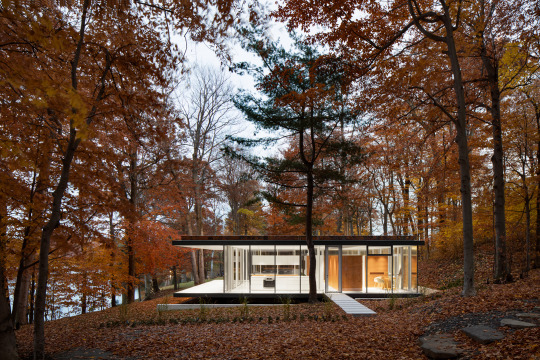
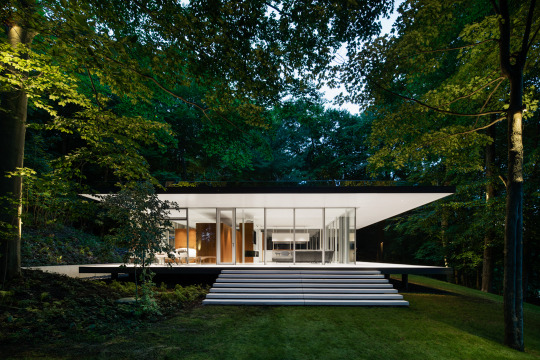
    This week’s Project Profile is the Pavillon du lac in Quèbec (somewhere) by Montréal-based Daoust Lestage. All of the photography used in this post is by Adrien Williams

    The first thing you may notice is that it is evocative of Philip Johnson’s Glass House and Mies van der Rohe’s Farnsworth House (1951) – but probably more the latter.

    Le Pavillon du lac was completed in 2015. It has 2 bedrooms and is about 1,240 square feet. The entire glass pavilion is housed between two thin flat slabs with cantilevering overhangs on two of its elevation. They create a kind of portico that frames views of the water. All of the glass is triple-glazed.

    image

    One of the key distinctions for me is how the house sits on the ground. As is the case with the Farnsworth House, le Pavillon du lac sits on stilts, elevated off the ground. The ground floor slab is then able to ignore whatever topography there may be beneath it. 

    image

    At the same time, there are elevations of the house where the ground has been carved into (see below). This creates a small moat around the perimeter and roots the building within the landscape. 

    image

    For more photos of le Pavillon du lac, click here.

  • The double opt-in introduction rule

    image

    I am a fan of the double opt-in introduction. I am guilty of not doing it, but I’ve been hearing of this approach from a few people and I think it makes a lot of sense. And it is probably only going to make more sense as we all become even more connected.

    The way the double opt-in introduction works is that before you make a cold introduction, you simply ask both parties if they would like to be introduced to the other party. If one party doesn’t opt-in, then you don’t make the introduction. Simple.

    The reason this is so valuable is because, without this double opt-in framework, it can be easy to get sucked into a call or meeting that you may not want to be a part of, which in turn means that you’re not in control of and managing your own schedule. Somebody else is doing that for you.

    This may seem harsh, but as we’ve discussed before on the blog, there’s a ton of value in saying no. We all need filters, especially today. And if we don’t say no often enough, we’re all bound to run out of time for the things that really matter and that we should be focusing our attention on.

    The underlying principle behind the double opt-in introduction is that it’s a lot easier to say no to an introducer than it is to a person you have just been introduced to: “Sorry, I have no interest in talking and/or meeting you.” Now that’s not very nice.

    Photo by Andrew Neel on Unsplash

  • Rules are meant to be broken

    Things are busy right now as we get ready to unveil Junction House this fall and so I’m a bit behind on my news and reading. 

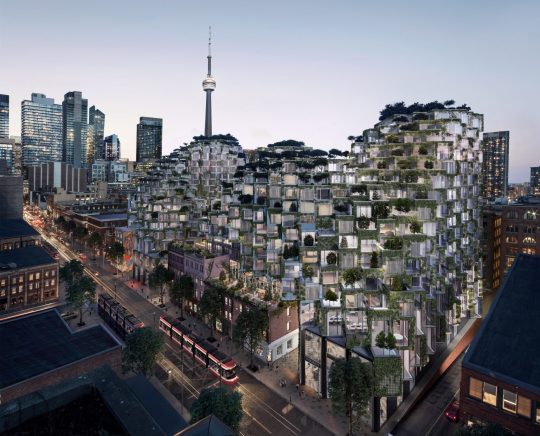
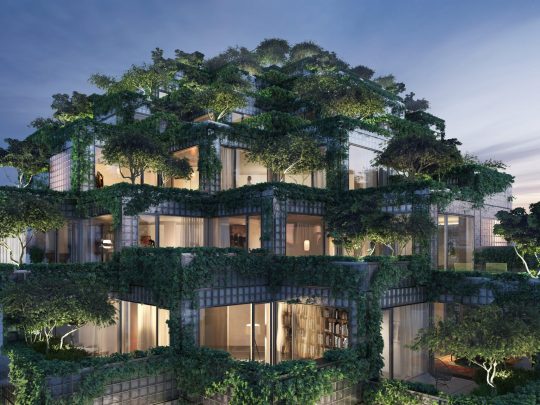
    I just finished reading Alex Bozikovic’s Globe article on BIG’s new KING Toronto project (official name). It is an interesting piece about creating villages and a sense of community in new developments – something that Bjarke Ingels has been focused on for many years. 

    Below are a few renderings of the project. I’m excited for this one. And as I said before on the blog, I am sure it will be precedent setting in a number of ways.

    One remark from the article that stood out for me is this one here:

    Still: The design breaks a lot of rules. Which is why it took two years of difficult negotiations with city planners to reach approvals. “We wanted it to be quieter,” says Lynda MacDonald, a senior Toronto planner who was involved in overseeing the project. “It’s a very large project, and we wanted to make sure it respected the character of King Street.”

    I am often asked why we don’t see more innovation in architecture and real estate. There are a number of reasons for that. One of them is risk. Development is in many ways a game of risk mitigation. 

    But another reason is that when you try and do something unconventional that disrupts the status quo, you also call into question the typical planning criteria used to evaluate projects. And that may slow you down.

    Alex accurately points out in his article that we are used to doing things around here in one of two ways:

    The King Street project is also an ambitious experiment with urban design. There are basically two species of tower in Toronto: a midrise slab of six to 10 storeys, which steps back at the top; and a “tower-and-podium,” a model borrowed from Vancouver that combines a fat, squared-off base (or “podium”) with a tall, skinny residential tower. Both can work, but can also create the big-box blandness that many people dislike about new urban housing.

    None of this is to suggest that we should ignore the character of a particular area. It is critical and I believe that KING Toronto has been mindful of that. 

    But I also firmly believe in ambitious city building and I think there’s no question that KING Toronto is doing exactly that.

    Images: Hayes Davison via Dezeen and courtesy of Westbank

  • Building a better São Paulo

    São Paulo, and Brazil more broadly, are near the top of my list of places that I want to visit. 

    Starting in the 1930s, Brazil became an early adopter of modern architecture with projects like the Ministry of Education and Health Building. It was one of the first countries outside of Europe to push modernism.

    So I am overdue for a tour of Oscar Niemeyer and Lucio Costa’s work.

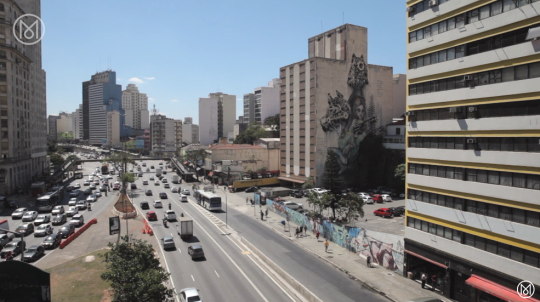
    Here is a short 7 minute video from Monocle about some of the ways in which São Paulo is reinventing its city center.

    It is for the launch of their new book, The Monocle Guide to Building Better Cities, and it got me excited about visiting the city (and country) sometime soon.

  • Our social connectedness

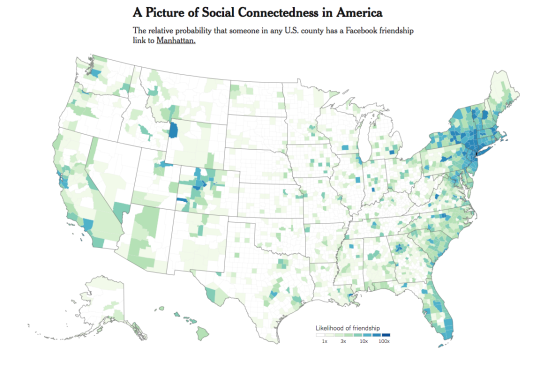
    Economists at Facebook, Harvard, Princeton and NYU recently analyzed anonymous Facebook data in order to study our social connectedness. The New York Times’ Upshot wrote about it here and it is a must read.

    There are a number of interesting takeaways from the study. One of them is that geography, distance, and political boundaries actually matter a great deal when it comes to our connectedness. 

    In other words, Americans are more like to be connected to someone nearby – within county or state boundaries – than they are to someone further away who may be infinitely more similar. This may seem somewhat intuitive.

    But at the same time, having a dispersed network also suggests certain things. Here’s the relationship that they discovered:

    These networks are important in part because of other patterns that are correlated with them. Counties with more dispersed networks — where a smaller share of Facebook friends are located nearby, or among the nearest 50 million people — are on average richer, more educated and have longer life expectancies. Places that are more closely connected to one another also have more migration, trade and patent citations between them.

    Counties that are more geographically isolated in the index are more likely to have lower labor force participation and economic mobility, and they have higher rates of teenage births. Some of the most economically distressed parts of the country appear to be the most disconnected: Among the 10 U.S. counties with the highest share of friends within 50 miles, six are in Kentucky.

    Again, it is worth checking out the full article. There’s also an interactive map to play around with.

  • Less is a bore

    image

    Architect Robert Venturi died this week at his home in Philadelphia. He was 93. Here is his obituary from the New York Times.

    Robert Venturi was, along with his partner and wife Denise Scott Brown, a central figure in 20th century American architecture. He is often referred to as one of if not the father of postmodernism. But apparently he wasn’t too keen on that moniker.

    Venturi is famous for writing both “Complexity and Contradiction in Architecture” and “Learning from Las Vegas”. But his firm also employed somewhere around 100 people at its peak.

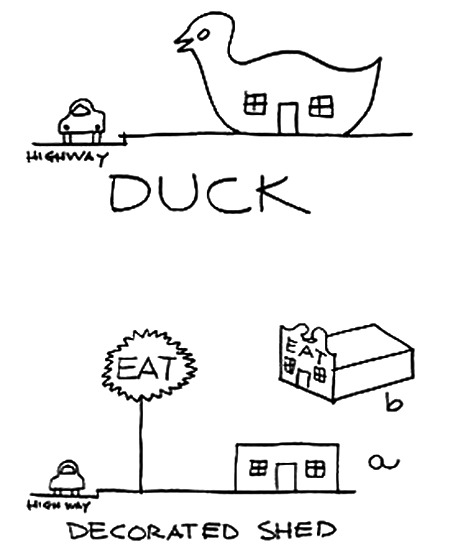
    Venturi was critical of modernism for its hatred of ornament and for its purist belief that “less is more.” He argued that decoration had long been used in architecture to convey meaning, hence the response: “less is a bore.”

    Out of his work in Las Vegas came the notable comparison between a “duck” and the “decorated shed.” See above. The duck is modernism. The building itself becomes the symbol. No ornament is needed.

    The decorated shed, on the other hand, uses signage and other ornament to convey its symbolic qualities. The building itself can then be fairly nondescript, which also makes it flexible to a variety of different uses.

    This decorated shed approach is what guided the firm’s work and in 1991 he was awarded the Pritzker Prize in Architecture. 

    I love that he tried to have the award go equally to his partner Denise Scott Brown. The jury declined his request but he still used “we”, instead of “I”, throughout the entirety of his acceptance speech. Good.

    Thank you, Robert Venturi, for all of your contributions to architecture, as well as to the University of Pennsylvania.

  • Electric scooters in Los Angeles

    Bloomberg Businessweek just published this article summarizing the impact that Bird and its electric scooters are having on Los Angeles. Here are a couple of highlights:

    – Bird launched a year ago and is, today, valued at around $2 billion.

    – The company has around 15,000 scooters on the road in Los Angeles. We already know that this is making some/many people grouchy.

    – The cost to rent a scooter is $1 plus $0.15 a minute.

    – LA has an incentive program in place that allows Bird to expand its fleet within low-income areas. Still, their scooters tend to be concentrated in wealthier areas of the city.

    – Beverly Hills is trying to figure out how to handle/regulate these scooters and currently has a 6 month ban in place.

    – Supposedly, you can ride a Bird through West Hollywood but you’re not allowed to park it anywhere.

    The company is based in Santa Monica, so it’s not surprising that they have such a stronghold in the LA market. Still, there appears to be a lot of latent demand for this kind of mobility.

    image

    According the US Department of Energy, almost 60% of vehicle trips in the US last year were less than 6 miles. And around 40% were less than 2 miles. 

    So these “last mile scooters” do appear to have a lot of utility. Do any of you regularly use an electric scooter to get around?