Daily insights for city builders, delivered every morning at 6 AM ET. I’m Brandon Donnelly — a Toronto-based real estate developer and founder of Globizen. I’ve been writing here since 2013.

  • The Trump family real estate empire

    He is tall, lean and blond, with dazzling white teeth, and he looks ever so much like Robert Redford. He rides around town in a chauffeured silver Cadillac with his initials, DJT, on the plates. He dates slinky fashion models, belongs to the most elegant clubs and, at only 30 years of age, estimates that he is worth “more than $200 million.” 

    Judy Klemesrud, New York Times, 1976

    Last week the New York Times published a special investigation looking at the Trump family’s real estate empire and the suspect tax schemes that they allegedly employed over the years to preserve, grow, and pass it down. 

    According to the Times, all of which has been rebuked by a lawyer for the president, Donald Trump received at least $413 million in today’s dollars from the family empire. 

    I just finished reading the investigation in its entirety. It’s a long one. But if you’re interested, you can do the same here. If you’d prefer the Coles Notes version (Cliff Notes for you Americans), have a scroll through the headlines in this article instead.

  • Create things people love

    I just finished listening to this podcast about venture capital and consumer products. One of the underlying questions is whether we are currently in a “consumer downturn.” Rebecca Kaden of Union Square Ventures (USV) talks about the importance of “platform shifts” for venture returns. These are moments where a new technology hits the marketplace and there’s a corresponding mass consumer adoption. When and where will that next shift occur? Maybe it’ll be in real estate.

    I like the discussions at 10:00 and 13:50. The first deals with the importance of non-paid customer acquisition strategies for consumer products. Rather than relying on bought attention, you really need organic growth strategies, which is often an indication that people are passionate about your product. This is arguably more important when you’re fundamentally reliant on massive growth/scale, but whether we’re talking about software or a home, I still believe it’s paramount. Create things people love.

    The second point is about commerce, Amazon, and how USV avoids investing in companies that are unlikely to ever win against Bezos. Kaden’s position is that Amazon’s advantage is and has been more executional than structural. They are simply really good at doing things better. But Amazon wins at logistics, speed, and value. They are not as focused on experience, entertainment, and discovery. And people still want that.

    I’ll stop there. If you can’t see the podcast below, click here.

    [soundcloud url=”https://api.soundcloud.com/tracks/507691569″ params=”color=#ff5500&auto_play=false&hide_related=false&show_comments=true&show_user=true&show_reposts=false&show_teaser=true&visual=true” width=”100%” height=”300″ iframe=”true” /]

  • Project Profile: Golf Exécutif Montréal Clubhouse

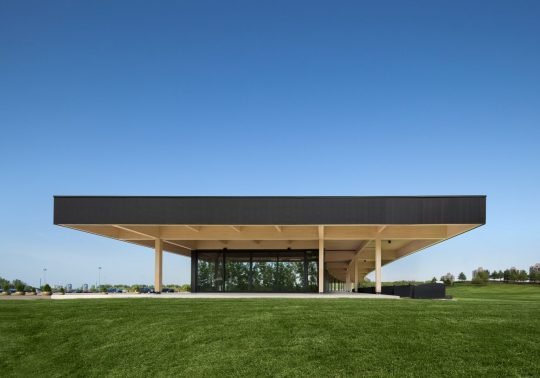
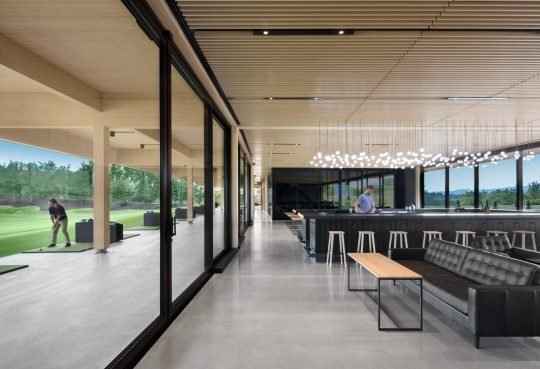
    I’m not a very good golfer (probably because I don’t golf), but this clubhouse in Montréal has me wanting to try my hand at the driving range again. Designed by Architecture49, the clubhouse itself is 855 square meters, but the roof area is around 1,800 square meters – so more than double as a result of the overhangs that protect golfers from poor weather. Black zinc panels and pale wood get me every time.

    Images: Dezeen

  • Apple and the Milanese piazza

    image

    This past July, the Apple Piazza Liberty opened in Milan. Above is a photo from the opening via Apple. There’s a band playing in the middle of the piazza.

    The store is central to Apple’s vision of transforming its retail locations into “town squares.” And in this case, the store is quite literally an Italian piazza.

    There’s a lot that is interesting about this store and this strategic move, as well as what this could signal about the future retail. (Curbed discusses that here.)

    The urbanists who read this blog will likely lament the privatization of public space. Because at the end of the day, it is a gray area. Can I hang out an Apple Town Square all day and just read a book?

    But at the same time, this is not necessarily a new idea. From the very beginning, the modern shopping mall was intended to be a new kind of town square. Or at least that’s how Victor Gruen saw it.

    However, what is perhaps new is this appropriation of public spaces for the purposes of what is arguably a new kind of retailing experience – one that almost feels paradoxical. 

    In the case of Apple Piazza Liberty, as well as in some of its other town squares, the actual retailing space is mostly hidden. Here it is underground. (How much to rent the basement?)

    And yet, Apple’s presence feels monumental and almost sublime. Glass box, waterfall, and subtle Apple logo sitting in the middle of a beautiful Milanese piazza.

    What a statement.

    Image: Apple

  • Reintroducing Junction House

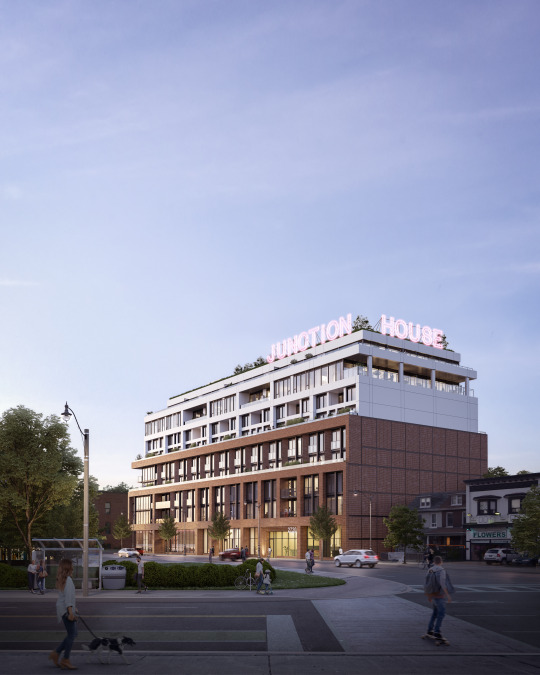
    Today we released the above rendering for Junction House and announced that sales will begin this fall.

    144 condominium homes. A mix of 1, 2 and 3 bedroom suites, including our Two-Storey House Collection and our Laneway House Collection. Prices starting in the $400s.

    One of our partners also happened to serendipitously send me this Globe & Mail article today talking about the increasing demand for and shortage of mid-rise housing:

    “The market is substantially undersupplied in mid-rise,” said Mr. Hildebrand, who notes that mid-rise projects in the GTA [Greater Toronto Area] were just 31 of 2017’s new launches, accounting for 3,833 units (12 per cent of the total).

    Stephen Price, CEO of Graywood Developments, went on to say this in the article:

    “There’s a huge appetite for medium density in Toronto. Many don’t want to live in the downtown core, this buyer is more interested in being in a community and there is a greater propensity to buy larger more livable units.”

    Given the huge influx of inquiries we received today after the above announcement was made, I would say that feels right. And our focus at Junction House is very much on “larger and more livable.”

    If you’re at all interested in a new home at Junction House, I would encourage you to get on our priority list, here.

  • The vertical farmer

    Bloomberg is running a video series right now called Next Jobs. It is a look at the careers of the future. Episode four is about a vertical farmer named Katie Morich and a startup called Bowery Farming, which does this out of a nondescript building in New Jersey. 

    The video focuses more on Katie’s life and less on vertical farming. But it did introduce me to Bowery Farming, which I am intrigued by. So I thought I would share both the video and the company. It is a compelling pitch: local production; ideal conditions; no pesticides; and software that optimizes it all.

    [youtube https://www.youtube.com/watch?v=AGcYApKfHuY&w=560&h=315]

  • Unpacking the family condo

    John Lorinc has a piece in the Autumn 2018 issue of University of Toronto Magazine that is worth a read. It covers families in Toronto being priced out of the low-rise housing market and/or making the conscious decision to live in an apartment or condo.

    He raises an important question:

    The big question hovering over this generational transition is all about city-building, and whether increasingly dense metropolitan regions such as Toronto and Vancouver can figure out how to turn all those newly sprouted forests of highrises into true communities that are both affordable and appealing to the wide range of people who call these cities home.

    The reality seems to be that more people in this city – out of economic necessity and/or because of a lifestyle preference – are choosing to raise a family in multi-dwelling housing. I live in a condo and my neighbors are raising a child two doors down from me.

    I am sure that we will continue to see more of this and I am sure that we will get better at designing for families. We are trying to do our part with the 2-storey homes that we have incorporated into our Junction House project. 

    I would, however, like to respond to the underlying tone in the article that but for developers being stubbornly resistant to larger 3-bedroom apartments in this city, we would have a myriad of new condominiums filled with families.

    The reality is that there are market and structural forces (including cultural biases) that steer what gets built.

    There are affordability considerations. Larger condos cost more money than smaller condos. And that prices out many families, particularly if there are cheaper alternatives available in the form of low-rise housing. 

    The reason we appear to be at an inflection point today is because the cheaper alternatives are disappearing. (This of course returns us to the broader question of overall housing affordability.)

    There are also timing and financing considerations that likely create a supply-side bias. Most lenders require that a certain number of condo units be pre-sold before construction starts. 

    This means that, as a developer, you need people that can both afford what you’re selling and that are willing to buy three to five years out, and perhaps even longer. That can be difficult for many families.

    Lastly for this post, there’s the GST/HST New Housing Rebate in Ontario, which I have argued before on the blog could be incentivizing smaller suite sizes and could use a refresh for today’s home prices.

    All of this is not to say that we shouldn’t be designing for urban families and that we shouldn’t be focused on delivering more affordable housing to this and other cities. Those are two very important things.

    It is simply to say: there’s a lot going on here that needs to be unpacked. 

  • The new donut

    Years ago Aaron Renn coined an urban paradigm that he labeled “the new donut.” The old donut, of course, is one that many of you will know well: poor downtown (hole in the donut) and wealthy suburbs (ring around the hole in the donut). This is a well documented phenomenon in many American cities.

    The new donut reflects today’s return to city centers. It is the filling in – albeit only partially – of the middle of the donut. The reason I say only partially is because the data clearly suggests that, in many cases, there’s now a trough between the immediate core and the outer suburbs. 

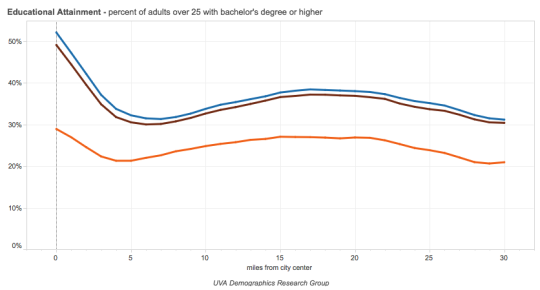
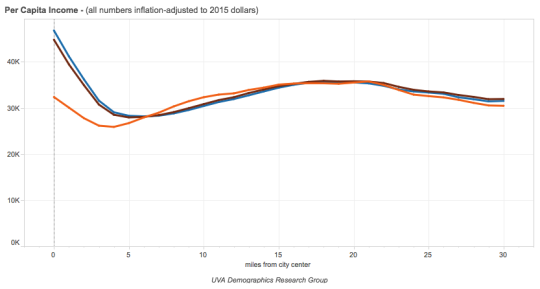
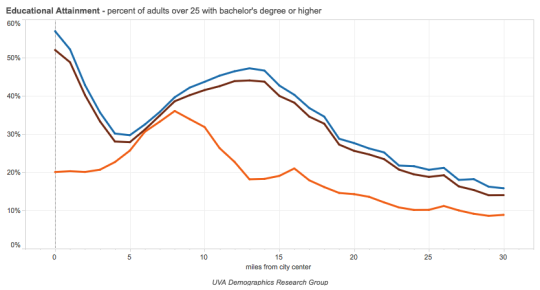
    In 2015, the University of Virginia published a study called The Changing Shape of American Cities. It looked at things like educational attainment and per capita income in 1990 and then compared it to more recent 2012-2015 data. But most significantly, it plotted this data against “miles from city center.” (I discovered this study via City Observatory.)

    Here are educational attainment and per capita income for the 50 largest metro areas in the US. The orange line is 1990 data. The brown line is 2012 data. And the blue line is 2015 data. The x-axis is “miles from city center.”

    imageimage

    Compared to 1990, it is clear that there has been noticeable spike in education and income in city centers. For the above composite index, more than 50% of adults over 25 now have a bachelor’s degree. But it has also accentuated the trough that appears to sit, on average, about 5 miles out from the center. 

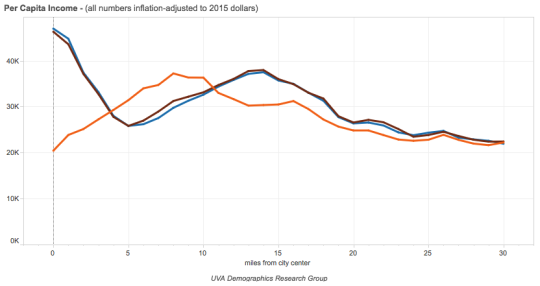
    In some metro areas, such as Charlotte (shown below), there has almost been a complete inversion. Education and income were highest 5 to 10 miles out from the center, but that has since flipped, along with a dramatic spike right in the center.

    imageimage

    This is the new donut. If you’d like to see the graphs for all 66 American cities that form part of the study, you can do that here

  • #DeleteFacebook

    Earlier this week I deleted my Facebook account. If we were friends on the service and you can no longer find me, this is the reason why. 

    Part of why I did this certainly had to do with privacy. I read Brian Acton’s (WhatsApp cofounder) account in Forbes this week. And I have been following many of the discussions over the past year:

    Privacy legislation is perhaps the only thing that could pose an existential threat to a business that’s entirely powered by watching and recording what people do at vast scale. And relying on that scale (and its own dark pattern design) to manipulate consent flows to acquire the private data it needs to profit. –Natasha Lomas

    But at the same time, I’m still on and use Instagram and WhatsApp (both Facebook companies), and I use Twitter pretty much every day.

    So I am certainly not in a position to be smug about this decision. Hopefully this post does not come across that way.

    The simple truth is that I had more or less stopped using the service. I had long ago turned off mobile notifications and so it had become more of a hassle than anything else.

    Every now and then I would go on and find notifications and messages that I wasn’t responding to. 

    So it had finally reached a point where I thought to myself: Why keep my data here (by the way, you can download all of your data from the site) and why check it sporadically if I’m not really deriving any value out of it? Simplify.

    I enjoy Instagram because taking photos is one of my primary passions outside of real estate and design. And I enjoy Twitter as a source of news and mostly civil conversation. 

    I am easy to get ahold of. I don’t need Facebook for that. Any of the social links at the top of this page (if you’re reading this post on the web), will get you there.

  • The rise of proptech

    A friend of mine flipped me this New York Times article today talking about the rapidly growing interest in proptech and about Opendoor – a topic and a company that I have written about many times before on the blog.

    Here’s a snippet about proptech:

    The hauls are part of a race by investors to pour money into technology for real estate, or what Silicon Valley now calls proptech. Having watched tech start-ups upend old-line industries like taxis and hotels, venture capitalists are casting about for the next area to be infused with software and data. Many have homed in on real estate as a big opportunity because parts of the industry — like pricing, mortgages and building management — have been slow to adopt software that could make business more efficient.

    On the Opendoor front, which is the largest/most valuable company in the proptech category, they have now raised over $1 billion. By the end of this year they plan to be in 22 cities across the United States.

    Interestingly enough, they have started experimenting with other business models, beyond just buying and flipping homes. They now circumvent agents and sell some homes directly to customers.

    But Eric Wu, the CEO of Opendoor, believes that you can’t automate proper advice and so that will remain. The role of agents is simply about to shift from “administration” to that of “advisory”.

    I have been arguing for years that the home buying and selling process is ripe for change. And what we are seeing today is really the start of that.

    According to the NY Times, real estate tech startups raised $3.4 billion in funding last year. Some firms, such as Fifth Wall Ventures, are entirely dedicated to the space.

    This is money betting on change.

    Photo by Grant Lemons on Unsplash