Daily insights for city builders, delivered every morning at 6 AM ET. I’m Brandon Donnelly — a Toronto-based real estate developer and founder of Globizen. I’ve been writing here since 2013.

  • First-year building project

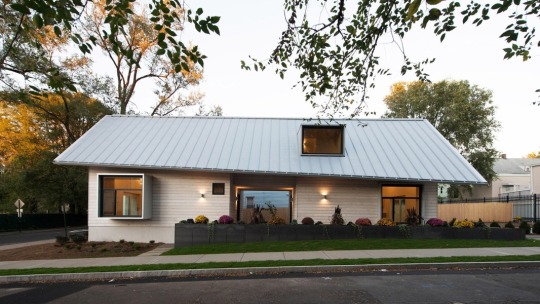
    Each year, first-year graduate students at the Yale School of Architecture are tasked with designing and then physically building a new single-family house in an economically depressed neighborhood. Sometimes, like this year, the house may have multiple dwelling units.

    I have always thought that this is a great exercise both from a pedagogical standpoint and from a positive impact standpoint. Young architecture students get to experience designing and building something from scratch, and lower-income families get a new house. I toured one of the completed houses in New Haven back in, I think, 2005. 

    This building project, which was started in 1967, is fairly unique among architecture schools, though others have replicated the model. When I was living in the US, I spent a few weekends working on homes for Rebuilding Together Philadelphia. But the scope was fairly limited. It was nothing like this.

    I think more schools should do this. And I also wonder if there aren’t permutations of this model that could live outside of the university context.

    Image: Yale

  • Average age of a first-time mother

    image

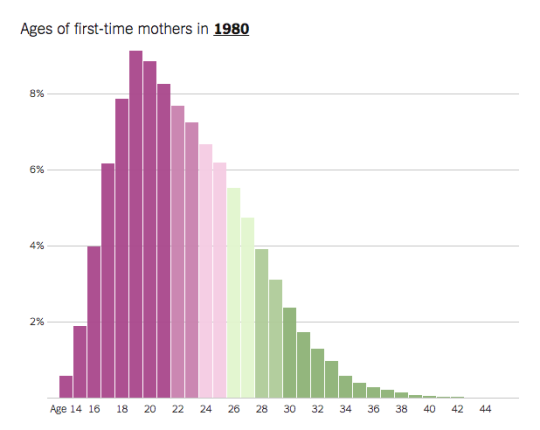
    According to a recent study in the New York Times, the average age of a first-time mother in Manhattan is 31.1 years old. In San Francisco County, the number is nearly 32. And in the US as a whole, it was 26.3 in 2016.

    This is what the national distribution looked like in 1980:

    image

    And this is what it looked like in 2016:

    image

    Perhaps not surprisingly, the biggest factor influencing the age of a first-time mother is education. Becoming educated and building a career takes time. First-time mothers tend to be older in big cities (particularly on the coasts) compared to rural areas.

    The concern that researchers have with all of this is that it is symptomatic of growing inequality. Scrolling over the NY Times’ map, it would appear that there’s nearly a 10 year gap between the coasts and many parts of the country.

    On the one hand you have people who are finishing high school and having kids fairly soon after. And on the other hand, you have people going to college, establishing their career, and waiting, in some cases a decade, to have kids.

    This is significant because it can create a virtuous circle (excerpt from article):

    “A college degree is increasingly essential to earning a middle-class wage, and older parents have more years to earn money to invest in violin lessons, math tutoring and college savings accounts — all of which can set children on very different paths.”

    Unequal childhoods can lead to unequal outcomes.

    Images: New York Times

  • Japan’s solution to housing affordability

    image

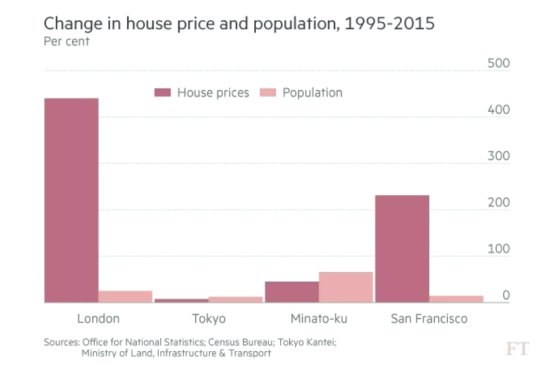
    There’s a debate among urbanists as to the full impact of housing supply on overall affordability. But it should make intuitive sense that as new people move to a city and as new jobs are created, there will be a need for additional housing. Here is an excerpt from Vox citing a recent FT article talking about how Japan may have figured out the solution to rising home prices:

    The reason, argues Financial Times writer Robin Harding, is that Tokyo does a better job of allowing housing supply to keep up with housing demand. In 2014, Tokyo issued permits for 142,417 new housing units. In contrast, the entire state of California — which has three times the population of Tokyo — issued permits for only 83,657 new housing units. Little wonder that demand for housing has outstripped supply in the Bay Area.

    In the United States, local housing markets are plagued by grassroots “Not In My Back Yard” (NIMBY) activists who organize to stop efforts to build town homes and apartment buildings in their local neighborhoods. Because every construction project is located near somebody, the result tends to be that little housing gets built anywhere.

    I don’t have a copy of the FT article and I do firmly believe that supply matters a great deal, but I think there are also a number of other factors that need to be taken into consideration here. Japan has a depopulation problem. The country has lost about 1.4 million people since 2010

    They also have fairly insular views around immigration. They are over 3.5x larger than Canada in terms of population and yet they take in fewer immigrants each year. So I think it’s worth looking at this conclusion closely. (This is me trying to avoid confirmation bias.)

    Image: Vox

  • In support of narrative memos

    This is not new. It has been reported on before. But I just finished reading this article about Jeff Bezos’ relentless commitment to “high-quality and high-velocity decision making” at Amazon.

    Here are a couple of high level points:

    – There are decisions that cannot be easily reversed (Type 1) and there are decisions that can be (Type 2). Knowing which is which is important. To help get better at this, they are very diligent about tracking the outcomes of previous decisions.

    – Make decisions without all of the info you wish you had, because if you don’t, you’re probably moving too slow. Speed is paramount. If you’ve categorized your decisions properly (see above), being wrong may not actually be that costly.

    – There’s a company philosophy centered around “disagree and commit.” It is about moving forward – since speed is so important – without full consensus. In other words: We may not all agree, but can we disagree and commit to this?

    Perhaps the most interesting, and seemingly paradoxical, aspect of Amazon’s “high-velocity decision making process” is that it is built upon narrative memos, instead of PowerPoint decks. In fact, decks have been banned at the company since 2004.

    The reason for this is that narrative memos are more difficult to write, which means you really have to understand what you’re talking about. It encourages deeper thought and it allows nuances and interdependencies to come through.

    Apparently important meetings start with everyone just sitting in a room reading the narrative memo, which are often between 4-6 pages. Once everyone has read the memo and is on the same page, the meeting starts.

    As someone who writes a daily narrative, this approach really resonates me. It would be a hell of a lot easier if I could just show up here every day and throw down a few bullet points. But then both of us would get far less out of this practice.

    Writing takes time. Bezos has acknowledged that these memos cannot be written in a day or two. But clearly there’s a belief that more time spent up front translates into greater overall speed. Their market cap suggests that is working.

  • The world’s best brands — 2018 edition

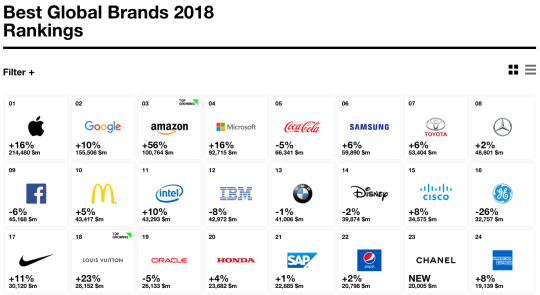
    At the beginning of this month, Interbrand released its annual ranking of the world’s best global brands. This year’s 2018 report marks the 19th year of the study. If you’d like to download a free copy of the report, you can do that here. But below is a snapshot of the first 24 brands:

    Apple and Google are in top position for the 6th year in a row. And Amazon is on a hockey stick trajectory with its brand value jumping by 56%. More than half of the list is comprised of the following five sectors: Automotive (16), Technology (13), Financial Services (12), Luxury (9), and Fast-Moving Consumer Goods (9). Luxury is currently the fastest growing sector.

    In their report, they outline five themes that have emerged and that are helping these brands outperform. They are:

    1. Positive utility – not enough to just make people feel good through storytelling; you need to create real value and a positive impact in the world
    2. Subscription mindset – there’s an increasing amount of brand value in subscription-based businesses (29% in 2018 compared to 18% in 2009); you need to offer your products and services with the least amount of friction as possible
    3. Customer-centricity – bring the voice of your customer into every aspect of your business; be nimble enough to respond quickly
    4. Learning from luxury – the top performing category in this year’s ranking; about exclusivity and authenticity
    5. Role of brand – make your brand part of the decision-making process; build brand equity and trust

    I’ll stop there and let you all dig into the rest of the report if you’re interested. 

    But one thing I found particularly interesting about the study is that they used – insert buzzwords here – “AI-powered social listening” to try and measure the emotion and sentiment floating around on the internet around specific brands. The goal was to pin down the perceived trustworthiness of specific brands.

    Not surprisingly, they found a pretty strong correlation between customer trust and purchasing intent. Makes sense to me.

  • Cities are always changing. What’s happening in Miami Beach?

    image

    The Miami Herald has a recent article up asking: Has Miami Beach lost its mojo? While the beach will always be an immense draw, there’s concern that entertainment dollars could now be starting to favor mainland neighborhoods like Wynwood, Brickell, and the Design District. 

    Here are some of the reasons why it is believed that may be happening:

    – Structural changes to the retail landscape

    – High rents have pushed out all of the interesting and distinctive tenants

    – City is too lenient when it comes to the nighttime economy; South Beach has become a circus

    – Investors and developers are worried about the Beach’s exposure to sea level rise

    – Strips like Ocean Drive and Lincoln Road have simply completed their urban cycle and are no longer attractive and novel

    – Overdevelopment of luxury housing (curiously, there’s a preservationist quoted in the article who appears to believe that restricting development to only mid-rise will result in less luxury housing)

    Many of these points are certainly not unique to Miami Beach. We know the retail landscape is changing. But as I was reading through the article, I was once again reminded that cities are always changing – even when we try and stop them from doing that.

    There are over 900 historic buildings in the Miami Art Deco District. Most are low-rise and mid-rise. This includes the iconic Ocean Drive. And yet the above article is all about the changes that the Beach has seen and experienced over the years.

    Oftentimes we only associate change with new buildings. But architectural preservation does not guarantee any sort of urban stasis. Cities are far more complex than that.

    Image: Photo by Ryan Spencer on Unsplash

  • Canadian minimalism

    I have one more note to share this week about Junction House and then I promise we’ll be back to regular scheduled programming. Below is a copy of the press release that went out yesterday afternoon. It includes a few more renderings for the project.

    ————————————

    October 11, 2018 (TORONTO) – After unveiling plans for a Studio Gang-designed tower at Yonge and St. Clair earlier in the summer, Slate Asset Management enters the fall market with a new mid-rise condo offering in the Junction. Designed by acclaimed Canadian architects, superkül, and emerging local interior design firm, Dialogue 38, Junction House further solidifies Slate’s approach of leading with design and city building when it comes to residential development.

    “We invest in designers because we believe in design innovation,” says Brandon Donnelly, VP of Development for Slate Asset Management. “For us, good design moves beyond aesthetics and actually solves problems and creates value for people. We want to empower each of our collaborators to come up with bold ideas, as well as think beyond our individual projects and consider the broader community.“

    Sited at 2720 Dundas St W, just as the road begins to bend, Junction House is conceived as a new gateway into one of Toronto’s most vibrant neighbourhoods. The ambitious design brief challenged superkül and Dialogue 38 to define a Canadian brand of minimalism that at the same time reflects the historic material palette and creative energy of the Junction community.

    “One of our inspirations was picking up on Scandinavian and Japanese approaches to minimalism, but through the lens of the Junction. What would that look like? How could we make sure our homegrown brand of minimalism is seen as approachable and in keeping with the neighbourhood?” says Donnelly. “We also really wanted to look at multi-storey suites – which eventually became The House Collection – and explore how we could replicate the single-family experience in a boutique mid-rise format,” he adds, citing the influx of families into the Junction and the need for new residential options in the city more broadly.

    “The building was designed from the inside out,” says Andre D’Elia, Principal at superkül. “We focused on the suites because, ultimately, that is where people are going to live and spend most of their time. We didn’t just design a nine-storey building, we designed 144 homes that occupy the same built form.”

    When it came to the exterior cladding, D’Elia says the focus was on reflecting the immediate context, while elaborating on the details. “We immediately thought of red brick, which is prevalent in the neighbourhood, and ended up cladding the first five storeys of the building with it. In order to add a sense of movement we staggered and angled the brick columns to play with light and shadow. We’re also introducing some old-world brick-coursing to add visual interest and mirror the local context.”

    Dialogue 38 was tapped for the interiors after Donnelly visited a café designed by the firm in the east end of downtown. “Their work is what motivated us to reach out, because it seemed to get the Canadian minimalist sensibility we were after,” explains Donnelly.

    Bennett Lo, Founder of Dialogue 38, says his approach was to focus on delivering design that would last. “We’re all influenced by trends and lifestyle, but our designs need to stand up against time. How do you produce something that is going to have immediate appeal and provide its own kind of interest, without feeling dated in a few years? The idea was to strip the design back and focus on the essentials, while at the same time incorporating aspects of the area. The suites and common areas will have smooth concrete ceilings and warm touches of wood throughout – and the lines are clean and open.”
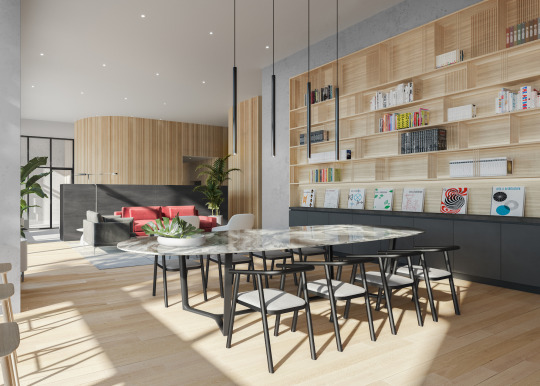
    The nine-storey building will also feature an expansive lobby that doubles as a co-working space, as well as a gym that draws on the warm materials of the suites and common areas. Lo says the design of the amenity space is optimized to encourage active use. “We focused on the amenities that we know people use, and spent our energy crafting spaces that embody the spirit of the building. The benefit of a boutique mid-rise is the opportunity to extend your living space in to the amenity spaces, and provide moments of social engagement in the building.”

    “We’re a short walk to the UP Express station at Bloor, which can take you downtown in less than 10 minutes. That proximity gives us an opportunity to have a dialogue between the Junction and the rest of the city. The proposed sign marks the Junction’s location and lets you know where you’re going, but also, where you should be,” says Donnelly.

    Junction House offers 1, 2, and 3-bedroom suites, as well as its signature House Collection, ranging from 500 sq. ft. to over 1,500 sq. ft. and starting from the $400s. To register visit: JunctionHouse.ca

    Press Contact:

    Vakis Boutsalis, kg&a

    Vakis@kga-inc.com / 416 537 0954 / 416 578 1741

    About Slate Asset Management L.P.

    Slate Asset Management L.P. is a leading real estate investment platform with over $6.0 billion in assets under management. Slate is a value-oriented manager and a significant sponsor of all of its private and publicly-traded investment vehicles, which are tailored to the unique goals and objectives of its investors. The firm’s careful and selective investment approach creates long-term value with an emphasis on capital preservation and outsized returns. Slate is supported by exceptional people, flexible capital and a proven ability to originate and execute on a wide range of compelling investment opportunities. Visit slateam.com to learn more.

  • A video and some art

    We made a video for our Junction House project. If you can’t see it embedded below, click here. You may have already seen some of the cut-downs on my socials, but this is the full version.

    [vimeo 293178524 w=640 h=300]

    The stickers under our projecting Junction House sign box irk me, but otherwise we’re all really happy with the way the video turned out. We wanted it to feel real and authentic.

    I am also thrilled to announce that we have partnered with a few local artists for this project. 

    The first is Leeay Aikawa. She is a multidisciplinary artist who moved to Toronto from Japan in 2003 and now works and resides in the Junction. We’re excited to have the opportunity to exhibit her work. You’ll find it in our “sales gallery” when that space opens.

    The next artist will remain a secret for now (though that’s a hint). Stay tuned to the blog and the socials.

  • Order without Design

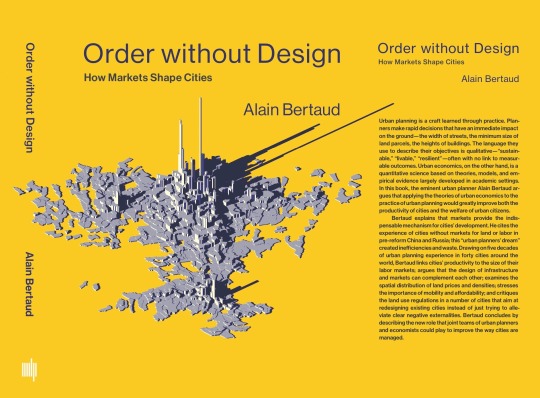
    Alain Bertaud has a new book coming out later this year from MIT Press called, Order without Design: How Markets Shape Cities. If you’re based or happen to be in New York, there’s a book launch on Tuesday, December 11, 2018 at NYU. You can RSVP here

    The book argues that, “operational urban planning can be improved by the application of the tools of urban economics to the design of regulations and infrastructure.” I haven’t read it yet and it’s not available until December, but I’ve just added it to my reading list.

    I am of the opinion that none of us involved in the built environment should be working in insolation, without some understanding of the myriad of other forces shaping our cities. Cities are too complex and important for narrow views.

    From what I’ve read about this book, it subscribes to that philosophy. And so I’m giving it a place in the queue.

    Image: NYU

  • Battle of the Bungehuis

    image

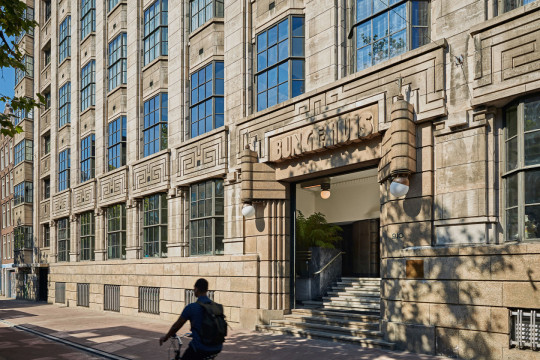
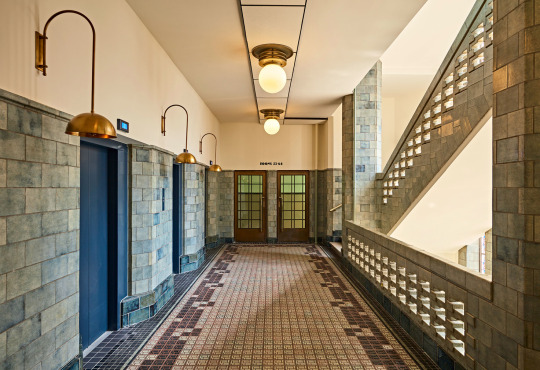
    This past July, Soho House Amsterdam opened up in the storied Bungehuis building. Not really news, other than the fact that FT just published this article talking about the building’s history and some of the project’s hurdles, which I of course found interesting.

    Completed in 1934, the Bungehuis originally served as the offices for a prominent trading company. The architect was ADN van Gendt. When he died during the building’s construction, Willem Jacob Klok took over.

    Also noteworthy about the building’s construction is that, according to Wikipedia, twenty houses had to be demolished in order for it to be constructed.

    This underscores a point that I have made before on the blog. Cities are not static. Most of us probably look at the Bungehuis and consider it to be quite a handsome piece of architecture. Some of us may even go so far as to say that we don’t make buildings like they used to.

    Soho House is on record saying that they were “not very budget-conscious” during the renovation because of the sense of responsibility that they felt around the building and its history.

    image

    But I think it’s important to note that this building was initially built for a for-profit company and things had to be demolished in order for it to come to fruition. 

    I can’t say for sure whether this development was opposed in the 1930s, but it may have been. Cities and buildings have a way of ingratiating themselves over time.

    In any event, starting in the 1970s, the building became home to the arts faculty at the University of Amsterdam. And as recent as 2015, it became home to the Bungehuis occupations – a protest occupation started by students and staff of the University who were opposed to a slew of academic cuts.

    image

    Then in a state of poor repair, the building was ultimately sold to Aedes Real Estate, who now leases it to the Soho House Group for their private club and 79 room hotel. Above is a picture of the club’s rooftop pool and lounge.

    The big hurdle, or at least one of them, was the fact that Amsterdam currently has a moratorium on new hotels – as a way to try and mitigate “overtourism” – unless it can be demonstrated that it will represent “an extraordinary addition to the existing stock.”

    Since Soho House Amsterdam opened in July, I guess we know the answer to that test. But it sounds like it may have been a battle. That wouldn’t be a first for this building.

    Images: Soho House Group