Daily insights for city builders, delivered every morning at 6 AM ET. I’m Brandon Donnelly — a Toronto-based real estate developer and founder of Globizen. I’ve been writing here since 2013.

  • Increasing housing supply in Ontario

    The Government of Ontario is currently working on a Housing Supply Action Plan that they hope will address “the barriers getting in the way of new ownership and rental housing.”

    Through initial consultations, they have already identified 5 key themes (my words below):

    1. The approvals/entitlement process for new housing is too slow
    2. There are too many restrictions on what is allowed to be built (that is, we should be encouraging more “gentle density” and “missing middle” type infill)
    3. Development costs are too high
    4. Tenants need protection; regulation is making it increasingly difficult to be a small landlord
    5. Overall housing innovation

    The province is also looking for public input and is currently running this online survey. It is open until January 25, 2019. And I would encourage all of you to complete it and help shape the action plan.

    My understanding is that the plan should be ready by Q2-2019.

  • Embracing our cities

    This is a great TED talk by Edward Glaeser about why it is time to embrace our cities. If you can’t see it below, click here.

    [youtube https://www.youtube.com/watch?v=ILDwnzQNlGc&w=560&h=315]

    The talk was filmed in 2012 – right around the time that Triumph of the City was released – but the video was published at the beginning of this year.

    It is also a good add-on to yesterday’s post about transportation costs and cities. I love how passionate Glaeser gets about these topics.

  • A decentralizing or centralizing force?

    I was on two panel discussions over the last week and, as is the case with all real estate panels, the topic of parking invariably came up, as did the impact of autonomous vehicles.

    There seems to be a general consensus that the advent of driverless cars will result in less demand for parking. Every developer I know is trying to build as little parking as possible and is thinking about how – when the time comes – they might convert their parking into something more productive. I have yet to speak to anyone who is building excess parking in order to prepare for autonomy.

    Where there’s a split, however, is whether autonomous vehicles will represent a decentralizing or a centralizing force for our cities. Historically, new technologies have lowered transportation costs and encouraged decentralization. Before the advent of rail, the US population hugged the coasts, because it was cheaper to navigate across the Atlantic than it was to move inland.

    A similar phenomenon also played out with our streetcar suburbs and with our car-oriented suburbs. These new technologies made it possible for people to travel further distances in order to get to work and other places. So it is not at all surprising that many people today are inferring that autonomous vehicles will produce this same outcome.

    But there is a counterargument. 

    We know that the demand for transportation services is highly elastic. Uber and other ride sharing apps have demonstrated this to us. Lower fares translate into dramatic increases in demand. So the opposing argument is that as the cost per kilometer drops – autonomous electric vehicles are going to be much more cost effective to operate – we’re going to see boatloads of induced demand.

    This induced demand will then force us to look toward road pricing and other demand management tools in order to cope, which then begs the question: How much cheaper and more convenient will autonomous vehicles really be? 

    At the same time, it is important to acknowledge that autonomous vehicles should correct many of the inefficiencies currently caused by humans acting like humans. There is also the opportunity to operate these autonomous vehicles more like public transit than as personal vehicles. And that will have a profound impact on urban mobility.

    Still, it is not yet clear, at least for me, that autonomous vehicles will be the decentralizing force that many assume they will be.

  • Forever mural now complete

    image

    Ben Johnston completed his “Forever” mural at Junction House last week. More photos on his Instagram.

    If you would like to see it in person (worth it), stop by 2720 Dundas Street West in Toronto’s Junction neighborhood. Here is a before photo of the wall (along with some directions).

    If any of you have any blank walls in need of art, I would encourage you to give Ben a shout. The wall certainly doesn’t need to be in Toronto.

    Thank you once again Ben. We really appreciate you collaborating with us.

    Image: Ben

  • The [Next] Pepsi Generation

    The product matters. How big is the screen on this smartphone? How many horses does this all-wheel drive car have? And how high are the ceilings in this condo? (Some architects get grumpy with me when I call buildings a “product.” It’s so much more than that, right?)

    But here is a good reminder from Zander Nethercutt via a post he did on Medium earlier this year: People Don’t Buy Products, They Buy Better Versions of Themselves.

    The example he gives is that of Pepsi. While damn near identical to Coke in terms of its chemical composition, Pepsi was struggling until it decided to try something new. They stopped focusing on the product itself and instead starting selling the type of person you would become, if you drank Pepsi.

    These people, and this campaign, became known as the Pepsi Generation.

    We have talked about this idea before on the blog and this approach to selling is now quite commonplace. But I like how Nethercutt distills it down: Desire translates into consumption. And I want to buy a better version of myself.

    I also buy his add-on argument that social media has amplified our awareness and desires around self, because today we are so often externalizing it to the world and being instantaneously judged on it. Like. No like.

    Am I the kind of person who eats here, stays there, and consumes this?

    Photo by Christina Boemio on Unsplash

  • The next 20 years

    image

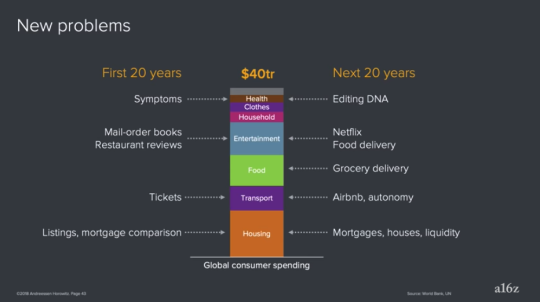
    Above is a screenshot from a presentation about the future of tech that Benedict Evans gave last week at venture capital firm a16z’s annual conference. And below is a video of the talk. If you can’t see it, click here.

    [youtube https://www.youtube.com/watch?v=RF5VIwDYIJk&w=560&h=315]

    The talk is positioned as “the end of the beginning.” In other words, here is where the internet and smartphones have taken us, but that’s just the beginning. Quote: “We used to do apartment listings [online] and now Opendoor will buy your home.”

    It’s only 24 minutes and well worth a watch.

  • Shortage of cities

    Joe Cortright of City Observatory recently looked at “the myth of revealed preference for [the] suburbs.” In it, he cites the work of Jonathan Levine, who is the author of a 2006 book called, Zoned Out: Regulation, Markets, and Choices in Transportation and Metropolitan Land-Use.

    There’s an argument out there that, on average, people prefer the suburbs to urban neighborhoods because, well, more people in the US live in auto-oriented neighborhoods compared to urban ones. What Levine wanted to figure out was whether this was truly a result of consumer preference or simply a lack of urban neighborhoods – or a “shortage of cities” as Cortright calls it.

    To do this Levine examined two cities with very different urban fabrics: Boston and Atlanta. The idea was to take a city with lots of urban neighborhoods (Boston) and compare it to one with relatively few (Atlanta). 

    For his comparison, he classified all of the neighborhoods in both cities on a scale according to how urban they were. “A” meant very urban. And “E” meant sprawling/exurban. He then went out and interviewed residents, asking them about both the kind of housing they would ideally like to live in and how happy they were with their current housing. 

    What Levine discovered, among other things, was that in Boston – where about half of all housing fell into the top 3 most urban categories – about 83% of people with a strong preference for urban neighborhoods were also living in one. Whereas in Atlanta, just 48% of people with a strong for urban neighborhoods were living in one.

    Put differently, the study suggests that in cities with fewer urban neighborhoods, it is more difficult for people with a preference for that housing type to find and live in it, which makes intuitive sense. The spread between preference and reality widens, once again suggesting that this could be about supply rather than an issue of demand.

    Anecdotally, I have seen this phenomenon play out here in Toronto. I often hear people talk about the neighborhoods that they would ideally like to live in, if only they could find a reasonably priced home. (Low supply leads to upward pressure on pricing.) How aligned would you say you are with your ideal level of urban-ness? 

    For more on Levine’s work, head over to City Observatory.

  • US cities with the most corporate HQs

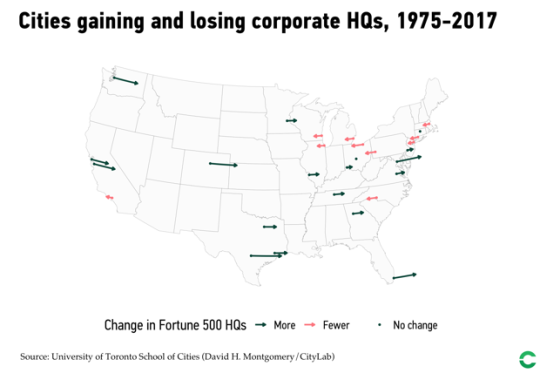
    The University of Toronto School of Cities recently looked at the changing economic geography of Fortune 500 companies across the US from 1975 to 2017. Here is a diagram of the results taken from CityLab:

    New York sits at the top with 70 corporate headquarters as of 2017. But the San Francisco Bay Area is now the second largest center with 35 headquarters – a testament to tech.

    The study does, however, omit service firms, as these weren’t tracked in Fortune’s list back in 1975.

    Also noteworthy is the specialization that has taken place across specific cities and regions. Here is another excerpt from CityLab:

    America’s headquarters geography reflects the substantial variation and specialization of the U.S. economy. New York leads in finance and business services, consumer services, and goods and materials. But Houston leads in energy, San Jose in tech, and Chicago in retail and wholesale. Chicago also ranks second in consumer services, and goods and materials, and Dallas takes third in energy. Other cities like Nashville and Minneapolis take third in consumer services, and goods and materials, respectively.

    The full article can be found, here.

  • Average price of a new condo in Toronto is now above $1,000 psf

    Urbanation released its Q3-2018 condo market results for the Greater Toronto Area earlier this month. 

    Here are a few highlights:

    – The unsold inventory of new condos in development is currently 33% below the 10-year average of 14,806 units.

    – Year-to-date sales of new condominiums decreased to 14,055 units from 25,839 units (same period last year). 2017 was a record year.

    – The average price per square foot for new project launches in Q3-2018 was $1,044 psf. This is the first time the average has broken the $1,000 psf mark. 

    – This is a significant price increase from last year and it is being driven by low supply, stable demand, and rising development/construction costs (my opinion).

    – The average unit size for project launches in Q3-2018 was 714 sf.

    – The average opening quarter absorption rate remains above 55%. It has been this way since Q1-2016.

    For the full press release, click here.

  • One year anniversary of the King Street Transit Pilot

    I had dinner tonight on King Street and I was reminded that this week marks the one year anniversary of the King Street Transit Pilot here in Toronto.

    The pilot has certainly had its share of controversy, but the improvements to both transit reliability and ridership are clear. Average travel times (in each direction) have increased by as much as 7 minutes on the route.

    Here’s the latest data from July and August of this year. Steve Munro can also tell you everything you ever wanted to know about the King streetcar.

    As our city continues to grow, many are naturally concerned about the ability of our infrastructure to handle the additional demands. Where will all the cars go?

    But the reality is that we will never be able to accommodate everybody driving around in their own car. Which is why we have to rely on transit and solutions like the King Street Transit Pilot.

    What’s your opinion of the pilot now that it has been in place for a year? I almost forget what it was like before we had it.