Daily insights for city builders, delivered every morning at 6 AM ET. I’m Brandon Donnelly — a Toronto-based real estate developer and founder of Globizen. I’ve been writing here since 2013.

  • China has a lot of people

    Matt Daniels over at The Pudding recently visualized the world’s population in this spiky 3D map. You need to take a look. Better on desktop.

    The data is from 2015, but you can also compare it to and show the change from 1990.

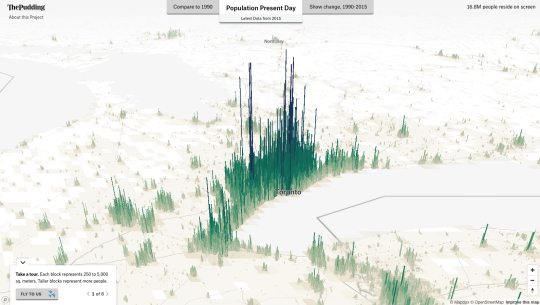
    Here is the Greater Toronto and Hamilton region (16.8 million people reside in this screen grab):

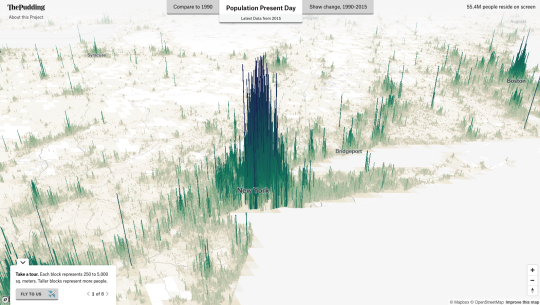
    Here is the New York City region (55.4 million people reside in this screen grab):

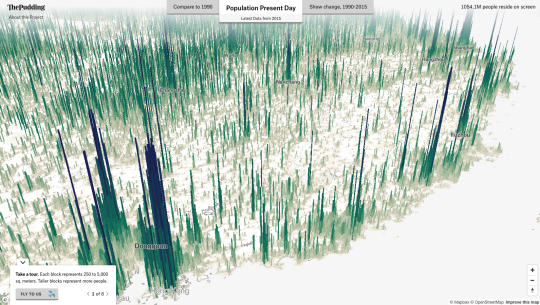
    And here is China (1.054 billion people reside in this screen grab):

    I tried to capture both Shanghai and Hong Kong in this image. Guangzhou, Hong Kong, and Shenzhen are currently in the mist of forming a 40 million-person megalopolis.

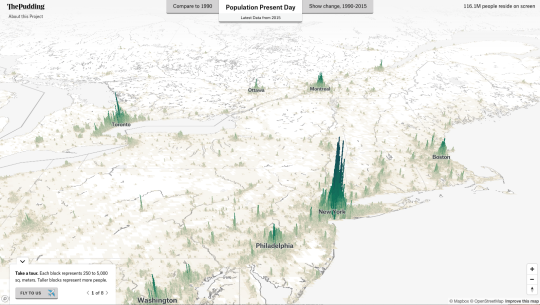
    If we pan back over to the northeastern United States and Central Canada – keeping the same scale as the above image from China – it looks like this:

    These last two images say a lot. 

  • Project Profile: Coal Drops Yard

    A new retail district called, Coal Drops Yard, opened this week in King’s Cross, London. The architecture is by Heatherwick Studio and the project is absolutely stunning. I love the idea of taking the roofs of the existing buildings and delaminating them to create the new spaces. It is a good example of old meets something new and cool. Here is a short video that I think many of you will enjoy. If you can’t see it below, click here.

    [youtube https://www.youtube.com/watch?v=iLUGxPP0iNw&w=560&h=315]

    Image: Heatherwick Studio

  • Plus atelier

    This morning I went through some of the floor plans for King Toronto, which are now up on BuzzBuzzHome. In case you’re wondering, they are currently showing an average price of $1604 per square foot.

    Here is a 1 bedroom + atelier:

    And here is a 2 bedroom + atelier:

    Right away you’ll probably notice a few things. 

    There are no dens in these plans. They have been replaced with ateliers, which sounds cool. I want my own atelier where I make things. But it may also be a clever way to get around calling them studies or nooks.

    A lot of people in the industry have been commenting on how they’ve included the exterior living space in the calculation of total area. That seems logical to me, especially for a project like this where the terraces form such an integral part of the architecture.

    The other thing I noticed is that the buildings are, actually, being referred to as mountains. This has been part of the project’s design narrative since the beginning. So I like the consistency. The above plans are for suites within the “east mountain.” 

    But what I wanted to ask all of you today is whether you find the addition of a 3D plan helpful. It’s obviously not new, but it is still fairly uncommon, at least in this market. Do you think it’s worth it?

  • Buy land, Chip. Buy land.

    Bloomberg Businessweek just published a longish article about Vancouver and the Chinese capital that fuels it. It’s called, The City That Had Too Much Money

    Most of you are already familiar with this narrative, but here’s an excerpt that talks about the city’s economic base and its apparent dependency on foreign capital:

    Change will be difficult and fraught. Vancouver has been closely connected to Asia since the late 19th century, when the first Chinese laborers arrived to help build the trans-Canada railway, and the city is proud of its record of integrating immigrants. Also, beyond real estate, Vancouver’s economic base is shallow. It’s not the business capital of western Canada—that’s Calgary—and it has few major corporate headquarters or large-scale manufacturing operations. “Asian capital has kept this economy alive, end of story,” says Ron Shon, a Chinese-Canadian venture capitalist who arrived as a teenager in the late 1960s. “You can see it in every aspect of our lives.”

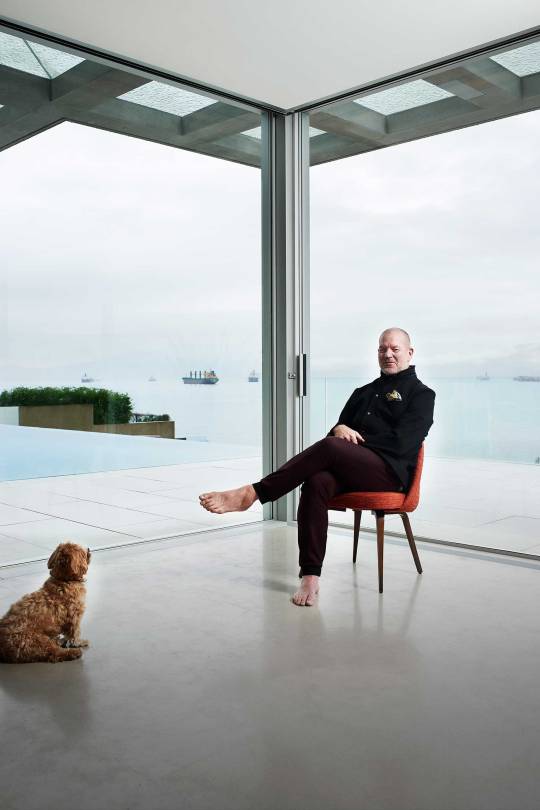
    One of the things I found particularly interesting were Chip Wilson’s comments around what is going on. Chip is the founder of Lululemon and is largely credited with pioneering the current “athleisure” trend.

    Yet as Wilson explains, sitting in his office on the top floor of a century-old warehouse, these days he’s as interested in bricks and mortar as in quick-drying fabrics. “The global capital flowing out of China across the world, you’d have to be an idiot not to acknowledge it,” he says. “You know, we could just be at the cusp of that.”

    To profit from the deluge, he’s been buying up land all over town, especially in False Creek Flats, a derelict industrial area that’s slated for redevelopment. He estimates that about a third of his holdings are now in real estate. British Columbia’s current government may succeed in slowing inflows temporarily, Wilson says, but China’s boom has created many multimillionaires who need a place to put their money. “So where do you go if you’re Chinese? Sydney, maybe. But nowhere, probably, is more friendly than Vancouver.” One way or another, he says, those funds will find their way to Canada.

    That’s why, Wilson says, whenever he returns from a trip to Asia, his first thought is simple: “Buy land, Chip. Buy land.”

    For the full article, click here.

    Image: Jens Kristian Balle/The Forbes Collection/Contour/Getty Images (via Bloomberg)

  • The tallest residential building in the world

    Earlier this month, Extell Development Company announced the launch of sales for its Central Park Tower – which it is calling “the definitive New York skyscraper”, as well as the tallest residential building in the world. 

    The project is located on Billionaire’s Row in NYC and it will be 1,550 feet tall when completed. That puts it well into supertall territory.

    According to Curbed, the smallest apartments start at 1,435 sf and the largest will be an estate in the sky at around 17,500 sf. 

    The projected sellout for the project is, or at least was, $4 billion back in 2017. That will set all sorts of records upon completion. At the time of the above filing, the average price was pegged at $7,106 per square foot.

    If you’d like to read up on the project’s capital stack, you can do that here. And for those of us who are used to having to pre-sell condos before digging, you may find it interesting to know that this project started construction in 2014.

    I wonder how much a parking spot costs (assuming there is even parking).

  • Policies for the leisure state

    image

    Andrew Kortina and Namrata Patel recently published an intriguing essay called, Kinky Labor Supply and the Attention Tax.

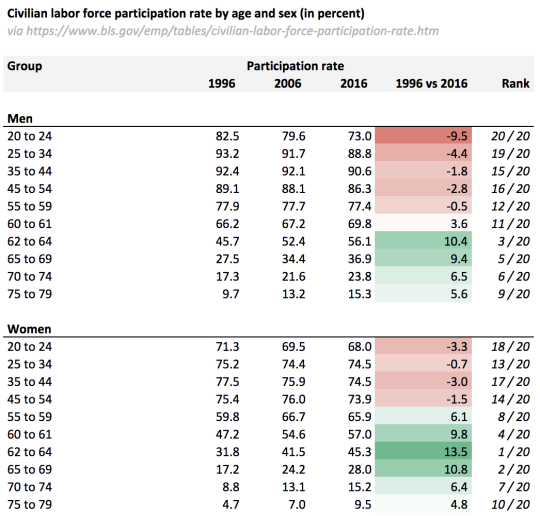
    They begin by talking about declining labor force participation rates, particularly among young men. Remember that the participation rate is distinct from the unemployment rate. Here is a chart from the essay:
    image

    Participation is down for young people, but up for older people. This is perhaps signaling that older demographics still need to work in order to maintain certain needs and/or a particular lifestyle.

    The possible explanations for this declining rate among young people are interesting. The authors argue that it is a combination of the declining cost of media entertainment content and the amplification of social status signaling, among other things.

    The declining cost of online content has meant that this form of leisure activity has become incredibly cheap, if not entirely free (beyond the mostly fixed cost of an internet connection). So there’s always something enjoyable to do.

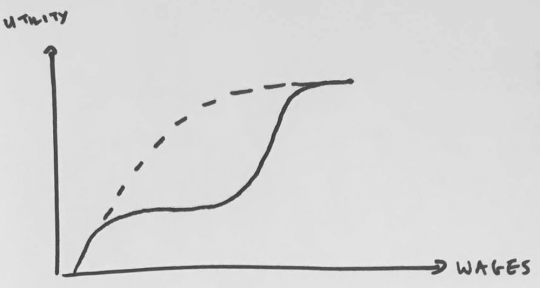
    At the same time, the authors argue that once people make enough money to satisfy basic needs, there becomes a tradeoff between trying to make more money and simply spending more time on leisure.

    Historically, the motivator to make more money has been arguably associated with social status signalling through conspicuous consumption. But with the advent of social media, we are all now signaling globally, instead of just locally.

    Due to increased competition, the argument is that people are now feeling demotivated by all the conspicuous consumption that they see online. It is simply too difficult to compete. The Gini coefficient is too high.

    So why not just spent more time on leisure?

    One potential policy implication is that raising the minimum wage wouldn’t be enough to spur increased labor force participation. Labor isn’t responding in the same way to wage increases. There would need to be a much more significant increase in income for that to happen – hence the “kinky labor supply curve.”

    One view of the status quo is that media companies are aggregating human attention and selling it at a discount–far below minimum wage–to advertisers in a massive arbitrage on human capital. So, the state could set the price of an hour of human attention at the minimum wage rate, and charge media companies 12% (the federal income tax rate on minimum wage) of that wage rate for each hour of human attention they consume.

    One possible solution is an attention tax. But their takeaway is that this lost productivity will more than likely be made up for with technology, which could ultimately translate into something we are already seeing: increased inequality.

    Check out the essay here. It’s an interesting read.

  • Lyft announces subscription plan

    Last week, Lyft announced a new subscription plan

    It costs $299 every 30 days and you get 30 rides included (up to $15 each). So it represents a possible 1/3 discount on rides. If you go over the 30 rides per month or over $15 on any one ride, you simply pay the difference. Though as a subscriber, you get 5% off additional rides.

    Subscriptions are good for business. They can be like an annuity. And I suspect that with the above model, there will be unutilized rides every month that the company is just able to bank. You can’t carryover rides with this plan.

    But moreover, Lyft’s “All-Access Plan” is designed to help you ditch your car. Trade your car payment for a ride subscription plan. So if the numbers didn’t quite work for you before, maybe they do now. Depending on the situation, I can certainly see this plan being cost effective.

    But as ride hailing/sharing continues to nibble away at public transportation and personal vehicle ownership, what will this mean for cities?

  • Decline of children in some, but not all, parts of Chicago

    The Institute for Housing Studies at DePaul University recently published this overview of the “socioeconomic factors affecting demand for housing in Chicago.”

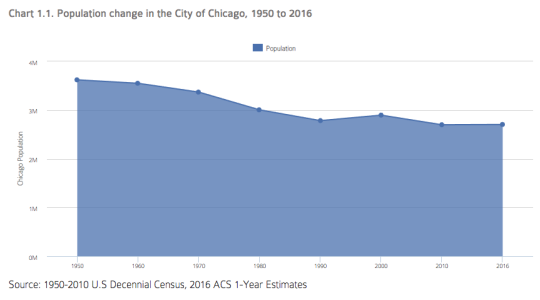
    Here is the change in population in the City of Chicago from 1950 to 2016:

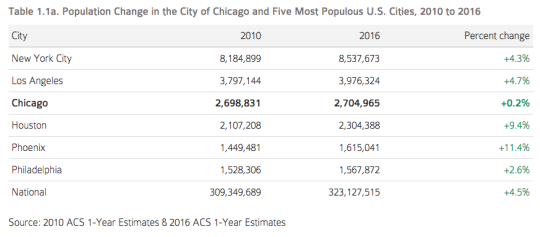
    And here is a comparison between Chicago and the five biggest cities in the US. Note the “sun and sprawl” phenomenon. Also note that the list below is for city proper boundaries.

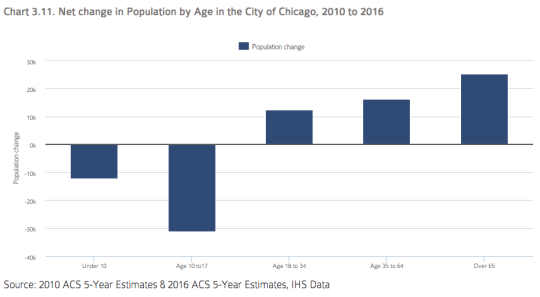
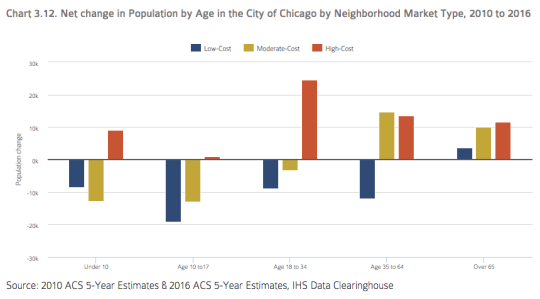
    One particularly interesting set of stats is the decline of children (population under the age of 18) in the city:

    Since 2010, the city has lost over 40,000 children and teenagers. 

    But, if you break it down by neighborhood market type, it is the low-cost and moderate-cost neighborhoods that lost the population. The high-cost neighborhoods were up.

    The study posits that the old trend of moving to the suburbs after you have kids may not be for everyone – provided, of course, that you have the means. And it goes beyond Chicago. DC is predicting a 25% increase in K-12 students within the District.

    For the rest of the charts, click here.

  • Toronto vs. Boston

    I worked late this evening, which is pretty typical these days. After I got home, I flipped on the Raptors vs. Celtics and sat down to write something about cities, as is the case every day.

    But the game was too close and too good to resist. The Raptors turned things around in Q3 and ultimately went on to spank the Celtics with a 10-0 run in the last few minutes of the game. It was sweet, particularly because Toronto and Boston are likely to end up at the top of the eastern conference this season.

    So needless to say, I spent more time watching basketball and less time writing about cities. But that’s okay because I am pretty excited about this year’s Raptors. Here are a few Kawhi Leonard highlights.

  • BIG’s IQON in Quito

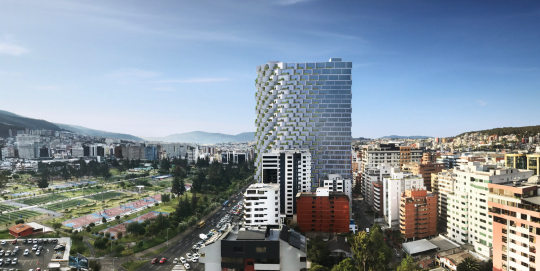
    BIG just announced its first project in South America. It is a 33 storey residential building in Quito, Ecuador. When completed, it will be the tallest building in the city. The developer is Uribe and Schwarzkopf

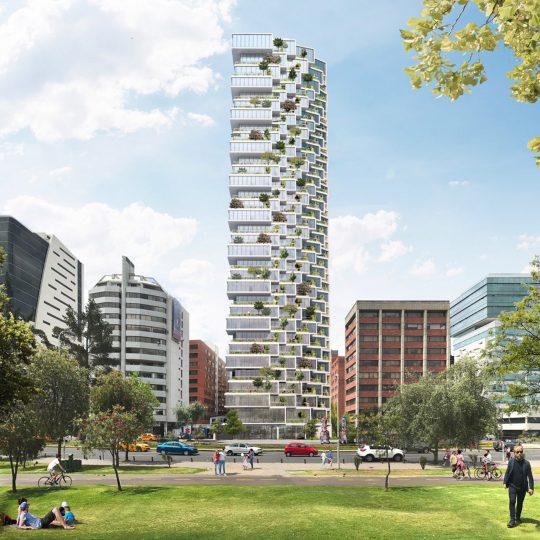
    Here are a couple of other images:

    The building is made up of “concrete boxes” that, when rotated, create terraces for the apartments. On one corner of the building the apartments are “through-units”, meaning they have two exposures. In this case, it is north and south.

    While different, we are starting to see some similarities across BIG’s projects, which isn’t meant as a criticism. I am thinking of Telus Sky, Vancouver House, and even KING Toronto. 

    They are, at least partially, about expressing the individual apartments and creating opportunities for outdoor spaces. This also serves to break down the overall scale of the building.

    What do you think of the project?

    Images: BIG