Daily insights for city builders, delivered every morning at 6 AM ET. I’m Brandon Donnelly — a Toronto-based real estate developer and founder of Globizen. I’ve been writing here since 2013.

  • HQ2 isn’t coming to Toronto

    So I was wrong. Amazon didn’t pick Toronto for HQ2. It instead picked Crystal City, Virginia (Washington) and Long Island City, NY (New York City). More on that, here, in the NY Times. Confession: My prognostication was at least partially about trying to create a self-fulfilling prophecy.

    In any event, it’s interesting to consider the locations that they did pick – as well as the fact that they ended up picking multiple cities. This was not part of their RFP. Though, many have convincingly argued that this process was over before it even began. HQ2 was always going to end up on the east coast, near one of Bezos’ homes.

    Nevertheless, urbanists such as Aaron Renn took the announcement as a direct repudiation of the American heartland. He believed that Amazon would be far more cost conscious in their decision making and ultimately elect for a lower cost locale in the middle of the country. Instead, the coastal hegemony won out. 

    Joe Cortright of City Observatory correctly predicted that Amazon would, for a few reasons, parlay their HQ2 search into multiple smaller locations (HQ2, HQ3, and so on). One of the reasons for this is that it gives the company more leverage when it comes negotiating subsidies on a go-forward basis. If NYC doesn’t want our next round of hires, we’ll take them to Washington.

    Looking at the locations, one of the first things I noticed is that both are just outside of their respective “downtowns” (across a body of water), as well as adjacent or on the way to an international airport. Crystal City is across the street from DCA and Long Island City is a 15 minute drive from LGA. Both are situated on top of higher order transit. Makes sense to me.

    Now, who wants HQ4?
  • Tech and the North American office market

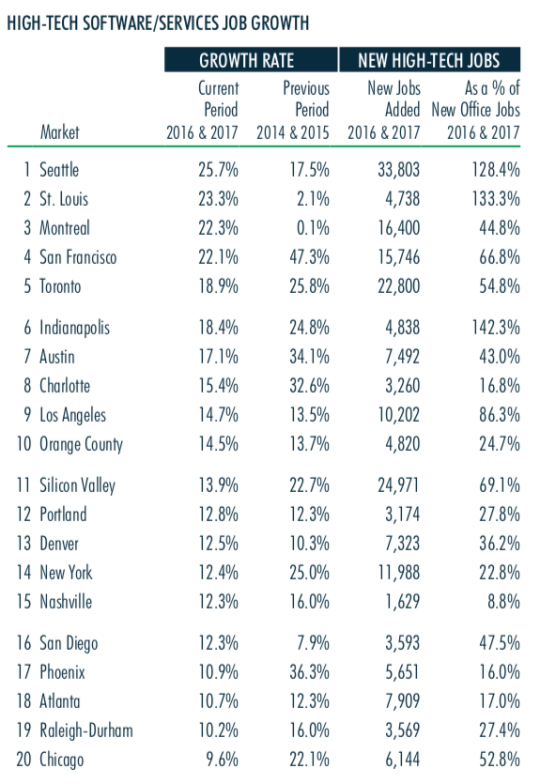
    CBRE recently published this report looking at the impact of the “high-tech software/services industry” on the North American office market. 

    Here are a few highlights:

    – Since 2010, tech has created ~1.1 million jobs in the US at an annual growth rate that is 3x the national average.

    – Seattle currently has the fastest tech job growth in North America. This is the first time in 7 years that San Francisco hasn’t been at the top of their list.

    – Silicon Valley, Toronto, New York, and Los Angeles all added more than 10,000 tech jobs from 2016 to 2017.

    – The biggest “momentum markets”, relying on 2016 and 2017 data, are Montreal, St. Louis, and Seattle.

    – Over the past two years (Q2-2016 to Q2-2018), Atlanta, Los Angeles, Orange County, Seattle, and Portland have all seen double-digit rent growth.

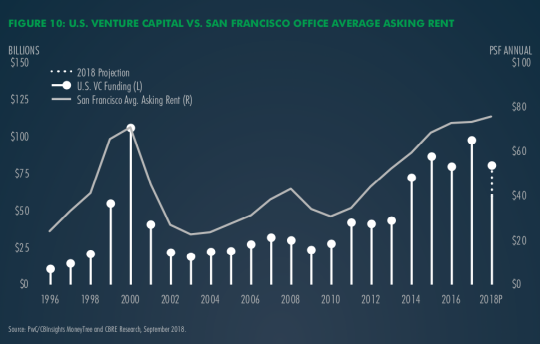
    One figure that also stood out for me was this one here showing the relationship between US venture capital investment and the average asking rent for office space in San Francisco.

    If you’d like to download the full report, click here. You’ll need to sign up for an account with CBRE, but it’s free to do that.

  • BREAKFAST unveils Brixel Mirror

    BREAKFAST, a design and engineering studio out of Brooklyn, recently unveiled something that they call Brixels. 

    A Brixel is a variable-sized brick that is controlled by software and can act as a pixel in artwork, building facades, and other kinds of installations. 

    Below is a video of their first installation, called Brixel Mirror. It is a 19 foot wide by 6 foot tall installation compromised of 540 Brixels. If you can’t see it below, click here.

    [youtube https://www.youtube.com/watch?v=Z-5cVpWhp30&w=560&h=315]

    While extremely cool, you may be wondering how applicable this might be to real world uses. But kinetic architecture isn’t a foreign concept and I am sure we’ll be seeing more of it.

  • Project Profile: New Central Library, Calgary

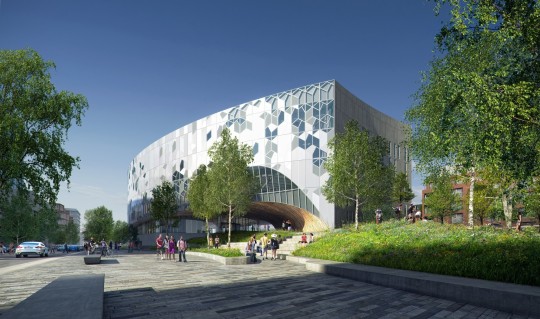
    The City of Calgary opened up its New Central Library this past week on November 1st, 2018, after a five-year construction process. 

    Designed by Snøhetta (design architect) with Dialog (architect of record) and Entuitive (structural engineer), the building was previously named one of “the 12 most anticipated buildings of 2018″ and one that will surely serve as a landmark for the city.

    One of the most interesting things about this project, for me, is how it both gives back and integrates with the broader urban fabric. 

    It is both a library and public plaza, and it sits atop the city’s busiest LRT line. About 40% of the site area is taken up by tracks (and probably setback), which means that the structural system of the building was forced into 12m (~40 foot) clear spans (done in concrete). It is the first time in the city’s history that an active LRT line has ever been encased and built over.

    It is a magnificent building and reason enough to visit Calgary, if you aren’t already there. I am hoping to get out there and photograph this project sometime soon.

    Images: Snøhetta and Entuitive 

  • Flights per day

    I recently wrote about this visual essay – showing the world’s population – from The Pudding.

    They have some great essays. So I went exploring today. 

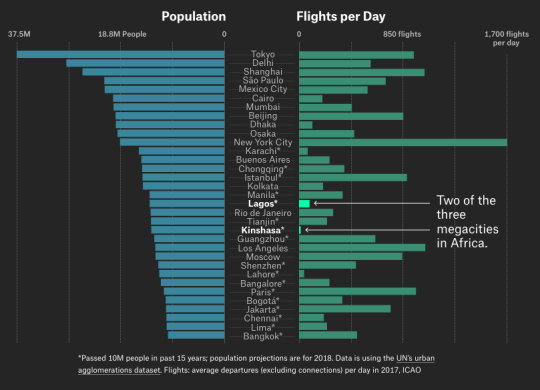
    Here is one that looks at the phenomenon of “poor-country urbanization” by way of the number of flights per day from a city.

    The argument is that a low number of daily flights means that the city, despite perhaps having a large number of people, is actually quite disconnected from the global economy.

    Typically, people moving from rural areas to urban areas has tended to translate into rising incomes. It has lifted people out of poverty.

    But today we’re seeing examples of poor urbanization, where the migration is less about opportunity and more about necessity.

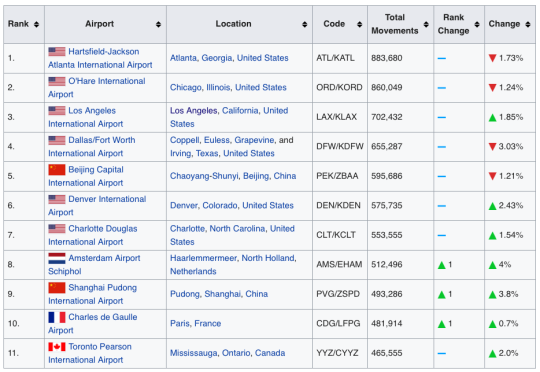
    While maybe crude, this measuring stick of flights per day piqued my curiosity. So here are some preliminary figures from the Airports Council International for 2017:

    The primary example mentioned in the essay is that of Kinshasa, which is the capital of the DRC. 

    It has a population of around 13 million people, but only 13 departing flights per day. (I’m assuming its “total movements” would be higher.)

    Based on the above list, ATL has ~2,461 total movements per day (defined as an aircraft either landing or taking-off). And YYZ has ~1,275 movements per day.

  • San Francisco’s tax for the homeless

    Proposition C will be on San Francisco’s ballots this November 6th, 2018. 

    If approved by voters, the following additional taxes would be levied on businesses in order to create a dedicated fund to both support and prevent homelessness in the city:

    For businesses that pay a gross receipts tax, an additional tax of 0.175 percent to 0.690 percent on those gross revenues in San Francisco over $50 million;

    For businesses that pay the administrative office tax, an additional tax of 1.5 percent of their payroll expense in San Francisco.

    Marc Benioff – the founder of Salesforce (which happens to be the city’s largest employer) – has emerged as the lead supporter of Prop C. Between personal and corporate funds, he has contributed almost $8 million to getting this passed.

    But other billionaires in the Bay Area, such as Jack Dorsey of Twitter, have taken a different position, instead siding with Mayor London Breed, who does not support Prop C. 

    If you’re interested in this topic, the New Yorker has a piece called, The Battle of the Big-Tech Titans Over San Francisco’s Tax for the Homeless

  • World’s most diverse city-region

    For those of you who aren’t going to be in Toronto next week, you can stop reading now and check back tomorrow. For the rest of you, next week is The Future Cities Canada Summit, which will be taking place from November 7 – 9. Full schedule, here.

    Day 1 equals the Urban Land Institute Symposium 2018, which is all about Toronto urbanism. The tagline is: “Explore the urban frontiers of North America’s fastest growing, and the world’s most diverse city-region.” 

    A big part of day 1 will be bus tours around the city. And one of those tours is going to be focused on Toronto’s laneways. I am a speaker on that tour and the bus will be stopping at Junction House to talk about the laneway houses that we plan to release as part of the project.

    But there’s much more to this summit than just laneway housing.

  • Transit tech lab launches in NYC

    image

    Earlier this month, the Metropolitan Transportation Authority (MTA) and the Partnership for New York City launched a new vertical accelerator dedicated to public transit. The mission is to make the city a global leader in this space.

    Applications are open until November 30, 2018 and they are looking for early and growth stage companies that address one or both of the following challenges:

    1. How can we better predict subway incident impacts and serve customers?
    2. How can we make buses faster and more efficient?

    Selected companies will go through an 8-week accelerator and, at the end of it, the most promising companies will partner with the MTA on a 12-month pilot. So it is an opportunity to potentially test your product(s) on the largest transit authority in the US.

    If you’d like to apply, you can do that here.

    Photo by Tim Gouw on Unsplash

  • The five rules of wealth creation

    Jamaican-Canadian billionaire, Michael Lee-Chin, was in ROB Magazine last week talking about how he grew up, how he got into the investment industry, and how he thinks about wealth creation.

    I met Michael once back in 2009 thanks to an introduction by my father. And at that meeting I remember him explaining the five rules of wealth creation. It’s his formula and he’s been practicing it since 1978.

    Everybody who creates wealth does five things: They own a few high-quality businesses. They make sure they really understand those businesses. They make sure those few businesses are in strong, long-term-growth industries. They use other people’s money to invest in them. And they vow to hold them as long as they remain great businesses.

    That’s consistency. And he’s a pretty consistent guy. The other quote I would like to share from the article is this one here:

    Outside wealth is created when there’s a difference between perception and reality, when there are inefficiencies, and when there’s a lack of equity capital flowing into the country, sector or company.

    This is something that we have talked about before on the blog. The real value creation happens when you believe in and you’re right about something that most people think is wrong.

    As Michael says in the article, you have to be willing to swim upstream, because floating downstream is far too easy and will only get you to the same place as everyone else.

  • A moral compass for autonomous vehicles

    One of the challenges that self-driving vehicles present is not about technology per se, it is about ethics. The typical example scenario is this one: If a pedestrian were to step out in front of an autonomous vehicle illegally, should the car be programmed to hit the pedestrian or veer off the road at the risk of potentially harming its passengers?

    I believe that self-driving vehicles will ultimately result in fewer accidents. Statistically they will be safer. But self-driving vehicles, particularly early on, are going to get a lot of attention when they do get into accidents, even if they are still safer as a whole. And that’s because they will make for good headlines.

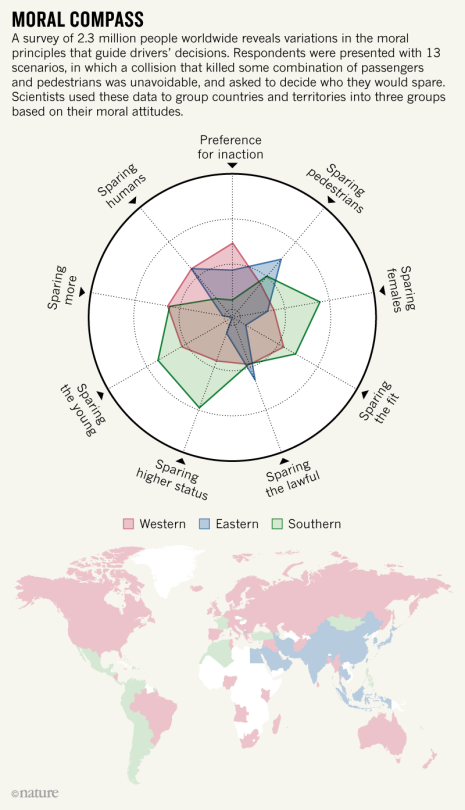
    Safety and statistics aside, in turns out that the answer to the above moral question could depend on where you’re from. Nature recently published what they are calling the largest ever survey of “machine ethics.” And out of this survey they discovered some pretty distinct regional variations across the 130 different countries that responded.

    The responses were able to be grouped into 3 main buckets: Western, Eastern, and Southern. Here is the moral compass that was published in Nature:

    And here are a few examples. In North America and in some European countries where Christianity has historically dominated, there was a preference to sacrifice older lives for younger ones. So that would guide how one might program the car for the case in which a pedestrian steps out in front.

    In countries with strong government institutions, such as Japan and Finland, people were more likely to say that the pedestrian – who, remember, stepped out onto the road illegally – should be hit. Whereas countries with a high level of income inequality, often chose to kill poorer people in order to save richer people. Colombia, for example, responded this way.

    Also interesting is the ethical paradox that this discussion raises. Throughout the survey, many people responded by saying that, in our example here, the pedestrian should be saved at the expense of the passengers. But they also responded by saying that they would never ever buy a car that would do this. Their safety comes first in the buying decision. And I can see that.

    There’s an argument that these are fairly low probability scenarios. I mean, the last time you swerved your car, you probably weren’t driving on the edge of a cliff where any deviation from the path meant you would tumble to your death. But I still think that these are infinitely interesting questions that will need to be answered. And perhaps the answer will depend on which city you’re in.