Daily insights for city builders, delivered every morning at 6 AM ET. I’m Brandon Donnelly — a Toronto-based real estate developer and founder of Globizen. I’ve been writing here since 2013.

  • Tallest buildings completed in 2018

    image

    The Council on Tall Buildings and Urban Habitat (CTBUH) recently published their annual study looking at all of the 200+ meter tall buildings completed over the last year.

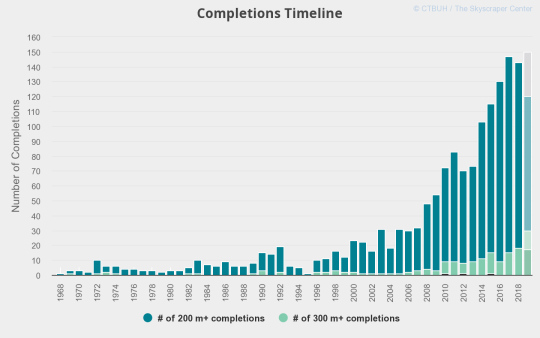
    143 were completed around the world. The all-time record was 147, which was in 2017. Last year, 18 “supertalls” were also completed. A supertall building is generally defined as having a height of 300m or more.

    The tallest building completed in 2018 was China Zun in Beijing. Pictured above. It is 527.7m tall (to tip), but the occupied height is 513.5m. 

    It was designed by Kohn Pedersen Fox Associates and looks like a Chinese finger trap. All iconic buildings deserve an endearing nickname, right?

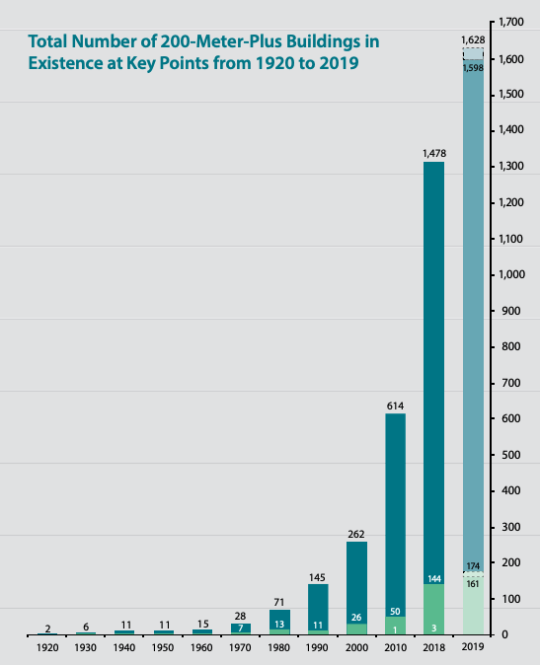
    Below are a few interesting charts from the report. The first is the total number of tall buildings over 200m from 1920 to 2019. At whatever point they chose in the 1920s, there were only 2. Things sure changed starting in the 1980s.
    image

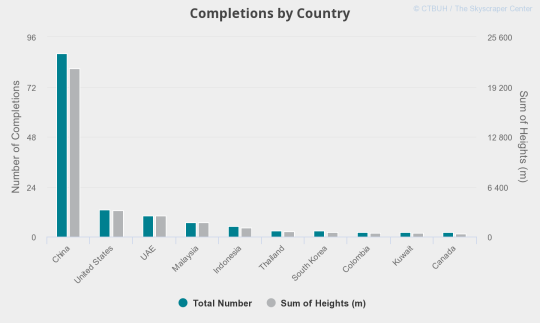
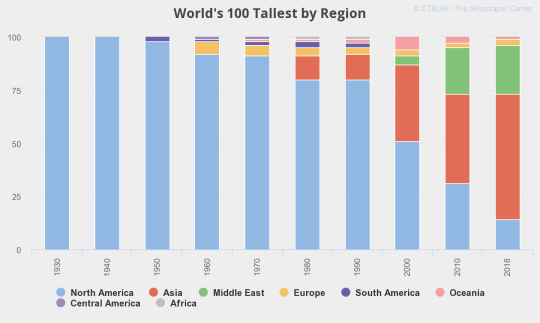
    That exponential growth happens to coincide with tall building growth in Asia and in particular China. The next few charts show (1) the handover from North America to Asia; (2) completions per year (broken down by talls and supertalls); and (3) completions by China, I mean country, last year.
    imageimageimage

    The full 2018 year in review report can be found here.

    Image: CTBUH

  • Real estate startup Knock raises $400 million

    I have been writing about the real estate startup Opendoor for many years here on the blog. Another promising startup in this space is Knock, and today it was announced that they just raised a $400 million Series B round (led by Foundry Group).

    They share some similarities with Opendoor, but they are also different in that their focus is on home trade-ins. They tell you what your current home is worth, help you find a new home, and then coordinate “a seamless swap.” For more on how they work, go here.

    One of the ways in which they are similar to Opendoor is that they front the cash for new home purchases. In the case of Opendoor, they buy your home with the plan of selling it in the future. And with Knock, they buy your home with the understanding that your old home will get sold.

    It is certainly a more capital intensive model compared to the way that home sales are handled today. But many investors are clearly betting that it is exactly what is needed to change the status quo. 

    (Credit to Jeremiah Shamess for sharing the above news with me today.)

  • Are you happy with where you live?

    This past weekend I saw a few people reacting on Twitter to this article by Wendell Cox talking about how Canadian families are being denied their preferred housing choice: the detached single family home.

    The fact that the article is by Wendell Cox should tell you everything you need to know. But essentially the argument is that misguided planning policies are driving up the cost of housing and that we should, instead, be encouraging unfettered sprawl.

    There’s lots to discuss here, but the first thought that actually came to mind was: “How would this article sound if we replaced all of the references to housing with references to cars?” In case you too are wondering that, this is how the first paragraph would read:

    A new poll by Sotheby’s International Realty suggests substantial disappointment among Canada’s young urban families, unable to afford to purchase the types of [cars] that they prefer. The poll determined that young urban households in Canada strongly prefer [Aston Martins], but they are often “motivated by (financial) necessity to purchases [sic] [cars], especially [BMWs], they do not prefer.“

    The article is clearly one-sided. I don’t disagree that there are people who – all things being equal – would prefer to raise a family in a ground-related single family home. Backyards serve a purpose, as do large basements equipped with beer fridges.

    But all things are not equal. And there also people who value walkability, a reasonable commute, and the kind of urban amenities that come along with being in a dense city. I am one of those people.

    Photo by Adrien Olichon on Unsplash

  • The disappearing urban advantage

    The New York Times has a recent article up talking about the disappearing “urban advantage” for low-skilled workers. It is based on the work of MIT economist David Autor.

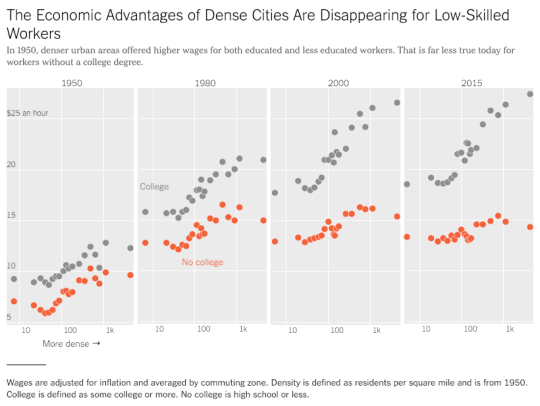
    Here is a chart from the article plotting wages against population density from 1950 to 2015:

    image

    The clear takeaway is that dense urban centers remain a place where wealth is created – but you probably need a college degree.

    The economic advantages of dense cities for those without one appears to be disappearing. The labor market has diverged.

    Interestingly enough, David’s research also suggests that college graduates may be starting to abstain from the suburbs – even when they have kids.

    And that’s because the returns to being in the city are so great.

    For the full NY Times article, click here

  • Dendrochronology of U.S. immigration

    I can’t remember where I found it, but I recently stumbled upon this video simulating the dendrochronology of U.S. immigration from 1830 to 2015. 

    It is part of an ongoing project by Pedro Cruz, John Wihbey, Avni Ghael, and Felipe Shibuya, and is supported by Northeastern University.

    As its name suggests, the video (and broader study) uses the metaphor of a tree (and its growth rings) to explain historical immigration to the U.S. 

    If you can’t see the video below, click here.

    [vimeo 276140430 w=640 h=280]

  • The geography of gyms

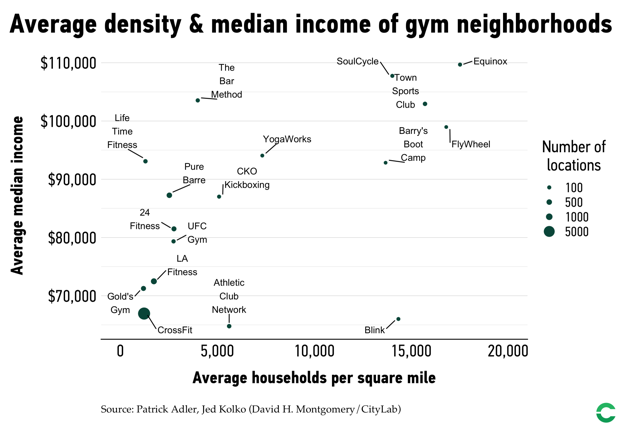
    Richard Florida and Patrick Adler recently looked at the geography of gyms across the United States. They analyzed 17 different fitness chains, over 10,000 gyms, and nearly 5,000 zip codes. Full article over here at CityLab.

    image

    The findings probably won’t surprise you, but it’s still interesting to see some of the data. Gyms and fitness studios tend to concentrate themselves in affluent neighborhoods with a high number of college graduates.

    The median household income of the average zip code with a gym or fitness studio is $72,720. This is compared to $56,694 for all zip codes. And when it comes to zip codes with an Equinox, SoulCycle, The Bar Method, or Town Sports Clubs, the median income jumps to over $100,000.

    Above is from the second post in the two part series they are doing on “the geography of fitness.” For the first one, click here.

  • The next 15 megacities

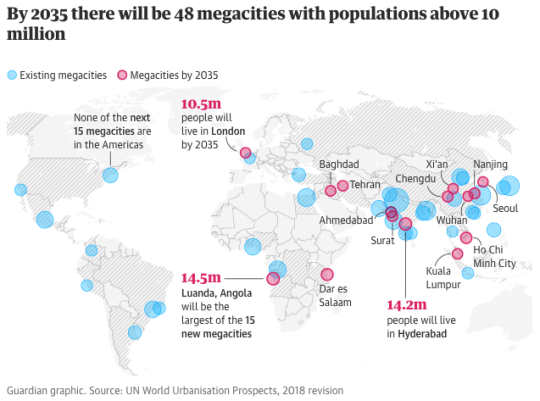
    The Guardian is running a series right now called: The next 15 megacities. A megacity is typically (but loosely) defined as a city (or metropolitan area) with a population of at least 10 million people. 

    By 2035, another 15 cities are expected to become megacities according to the United Nations. Hence the above series. None of these new entrants will be in the Americas. And only one – London – is anticipated to be in the West.

    The first city in their series is Baghdad. The second is Dar es Salaam. And the third, and latest, is Tehran. They are such interesting reads.

    I have said this before on the blog, but the pace of growth in many of these cities is astounding. Dar es Salaam – one of the fastest growing cities in the world – is adding about half a million people ever year.

    For the full megacities series, click here.

  • Mobility at CES

    CES is underway right now in Las Vegas. About 200,000 people are in attendance. 

    Since tech and mobility are today closely intertwined, the show has become an important platform for the automative industry.

    Here is a video showcasing BMW’s new iNext concept (expected by 2021):

    [youtube https://www.youtube.com/watch?v=x9-f3cALABk&w=560&h=315]

    It is based on level 3 autonomy, which means the car will do mostly everything, but you need to be ready to take over at any time.

    The video is interesting because it begins to show you what becomes possible when you no longer need to pay attention to the road. It is a bit like flying (but hopefully more enjoyable). 

    And here is a video of Bell’s new urban air taxi, which is called Nexus (expected by the mid-2020s):

    [youtube https://www.youtube.com/watch?v=1o4d8N-A1G8&w=560&h=315]

    This is the company’s first concept. But they’ve been working with Uber since 2017 to develop a network of flying taxis for cities.

    Finally, flying cars.

  • To invest or not invest

    We used Uber to get pretty much everywhere when we were in Rio de Janeiro. For reasons of convenience, cost, and safety, it just made the most sense. I can tell you that it felt a lot more valuable in place where you don’t speak the language and you’re acutely aware of being in the wrong place at the wrong time.

    And since Uber is going public later this year (along with Lyft), it got me thinking about whether or not it is a stock that I would want to own. Are they destined for monopoly profits? Do they have a defensible business model? How powerful are their network effects? Having first-mover advantage doesn’t guarantee anything.

    My initial thoughts are that the network effects for their core offering – single rides – don’t feel that strong. Sure you need a critical mass of drivers so you’re not waiting around too long, but at a certain point the response time is likely good enough. Rides are a commodity.

    This arguably changes as you get into services like Uber Pool and Uber Commute, because more users on the network in close proximity to you can mean lower costs and higher service levels. But is there any sort of lock-in effect?

    Many passengers and drivers seem to “multi-tenant.” In other words, many (or maybe most) people have multiple ridesharing apps installed on their phone and they will switch back and forth when it makes sense to do so. I do that when prices are surging. And drivers appear to be doing the same based on the Uber and Lyft emblems in their cars.

    For a long time, Uber was the only show in town here in Toronto. Hailo only lasted about two years or so. But as soon as Lyft entered the market, both companies moved to aggressively discount their rates, and that is still going on to this day. This suggests certain things to me.

    Among other things, it is a reminder that the demand for (commoditized) transportation services is highly elastic. We are price sensitive. We will use whatever is cheaper. So one way to win is to obviously create a cost structure advantage. Hence the current autonomous vehicles “arms race.” 

    Lyft is also trying to establish itself as a multimodal transportation solution. (When are scooters coming to Toronto?) Perhaps that will make them less of a commodity. But again, how defensible is that approach? I suppose the market will tell us what it thinks later this year.

  • iPhone as a Service

    At the beginning of this year – January 2nd to be exact – Apple revised its earnings guidance, downward. It was the first time in 15 years that the company had to do this. 

    Tim Cook’s letter to shareholders, which can be found here, focuses a lot on China and its “economic deceleration.” But M.G. Siegler of 500ish Words believes that a greater pivot could be underway. His piece can be found here. It’s a good read.

    Firstly, Apple’s current growth period is probably over. And secondly, the company is likely going to need to diversify away from high margin hardware/software sales and continue to grow its Services business (something that Microsoft has, ironically, already done).

    Here is an excerpt from M.G. Siegler’s essay (Apple’s Precarious and Pivotal 2019):

    The iPhone has simply been too good of a business. And it’s hard to see what tops it. Certainly in the near term. If Services is to carry Apple in the future, it will likely be only after years of relatively stagnant iPhone revenue growth mixed with a rising overall market. In other words, time and the broader world will have to catch up. And then Apple can have their “Microsoft Moment” — a services-based resurrection of growth.

    As Tim points out in his letter, most of Apple’s Services revenue is tied to its installed base, as opposed to current period sales (also: less exposure to China). Last quarter that number was $10.8 billion – a new record.

    So what we may see in the near future is the end of outright phone purchases and instead some sort of iPhone as a Service (or iPaaS). Pay Apple every month in perpetuity; always have the latest iPhone.

    Of course, Apple has many other irons in the fire. Apple Watch has turned out to be a big business and the company is said to have 2,700 “core employees” working on its autonomous driving project. 

    Maybe some of these businesses will also end up as Services.