Daily insights for city builders, delivered every morning at 6 AM ET. I’m Brandon Donnelly — a Toronto-based real estate developer and founder of Globizen. I’ve been writing here since 2013.

  • It’s only getting harder to underwrite new rental housing

    December 3, 2025 · View original


    The vast majority of new purpose-built rental housing in Canada relies on CMHC-insured loans to make them financially feasible. In 2024, CMHC estimated that their construction financing programs backed an estimated 88% of new rental starts across the country.

    But anyone in the industry will tell you that the terms in which these loans are made available to developers are constantly changing. And I think it’s pretty clear that many of the changes being made are intended to push, maybe force, developers into building some percentage of affordable homes as part of their projects.

    At the political narrative level, this makes sense: Canada needs more affordable housing. But it’s important to remember that homes pegged to below-market rents are not financially feasible to build on their own. So, unless equivalent subsidies are being somehow provided, the remaining market-rate homes will be forced to shoulder the additional costs.

    We talk about this a lot on the blog (see inclusionary zoning posts), and I don’t see it as an equitable solution. But there’s also the problem of it further choking off new housing supply. And my sense is that that’s exactly what is happening. It’s only getting harder to underwrite new rental housing — certainly in cities like Toronto.

    This will have the opposite effect on overall affordability. It also increases the probability that my supply predictions will prove roughly correct. I can’t see a world where new rental supply is able to step up and fill the gap being left by new condominiums, a large portion of which was serving as new rental housing.

    Toronto is on a path toward a severe housing shortage, and it’s very hard for the private sector to do much about it in the current market environment. When that will change remains to be seen.

    Cover photo by Darren Richardson on Unsplash

  • The $1.3 billion secret: How Nobu turned restaurants into a real estate empire

    December 2, 2025 · View original


    The Financial Times published an article (paywall) over the weekend about the Nobu Hospitality Group.

    It stated that they have some 50 restaurants, 40 hotels, and 20 residential projects (i.e. branded residences) either open or in development around the world. One of the first of these branded residences was here in Toronto. And as of July 2024, which was a major liquidity event for the company, it was valued at US$1.3 billion.

    According to group CEO Trevor Horwell, their approach always starts with a restaurant: “It’s an upside-down business model where the restaurant is the social engine. If we believe a Nobu restaurant can become a genuine social hub for locals, then the hotel and residences can follow.”

    I like this business model because as we talked about a year ago on the blog, “everything is branded.” Knight Frank out of the UK estimates that the number of branded residences around the world is going to go from 611 this year to around 1,020 by 2030. So it seems destined to become a bigger part of our business.

    But the other reason I’m drawn to it is because it’s a good business to be in. If you own a brand that has value, you can do licensing deals all around the world — which is what Nobu is doing — and not take on the same equity risk that developers typically take on. It’s capital-light.

    However, the trade-off risk is that you’re dependent on the continued attractiveness of your brand. If Robert De Niro ceases to remain involved and/or Nobu just loses some of its cachet over time, then the business won’t do as well. But that’s true of any hospitality-type business, or any brand for that matter.

    Cover photo by Tamas Pap on Unsplash

  • Tehran’s water crisis: the cruel lesson for every megacity

    December 1, 2025 · View original


    Science:

    > Since at least 2008, scientists have warned that unchecked groundwater pumping for the city and for agriculture was rapidly draining [Iran’s] aquifers. The overuse did not just deplete underground reserves—it destroyed them, as the land compressed and sank irreversibly. One recent study found that Iran’s central plateau, where most of the country’s aquifers are located, is sinking by more than 35 centimeters each year. As a result, the aquifers lose about 1.7 billion cubic meters of water annually as the ground is permanently crushed, leaving no space for underground water storage to recover, says Darío Solano, a geoscientist at the National Autonomous University of Mexico, who was not involved with the study.

    Some of the largest cities in the world, including São Paulo, Mexico City, Cape Town, Bangalore, and Tehran, are today facing critical water shortages. In the case of Tehran, the situation is so dire that Iranian president Masoud Pezeshkian has publicly said that the country now has no choice but to move its capital from Tehran to the southern part of the country:

    > Amid a deepening ecological crisis and acute water shortage, Tehran can no longer remain the capital of Iran, the country’s president has said.

    > The situation in Tehran is the result of “a perfect storm of climate change and corruption,” says Michael Rubin, a political analyst at the American Enterprise Institute.

    > “We no longer have a choice,” said Iranian president Masoud Pezeshkian during a speech on Thursday.

    This will be expensive, and it won’t solve all of the country’s problems, but forcing a bunch of people out of the city will help to relieve some of the localized pressures. Tehran has a population of nearly 10 million, and the metro region is estimated at over 14 million, making it the second largest city in the Middle East.

    Of course, there’s a city-building lesson in all of this: If you’re at this stage of capitulation, it means you’re too late. Water scarcity is about physical scarcity, but it’s generally also a failure of governance, infrastructure, and demand management. Proactive adaptation is always cheaper, easier, and safer than waiting until the last minute to adopt desperate measures.

    Cover photo by Behnam Norouzi on Unsplash

  • Harnessing the missing middle moment

    November 30, 2025 · View original


    On Friday, Craig Race Architecture hosted its annual holiday dinner at Barberian’s Steak House. It was a great evening and I really appreciate the invite, especially considering that we’re not yet clients. Thank you, Craig. I’m also not sure I had ever been to Barberian’s before. That probably makes me a bad Torontonian.

    Because of their work and because of the current market, the dinner has also become a kind of gathering for missing middle developers. I felt like the odd one out not having a sixplex + laneway suite built or under construction.

    What’s interesting about the current environment is that it’s pushing developers — both big and small — towards missing middle housing. Smaller developers are doing it because the barriers to entry are lower, and meaningful progress has been made on improving the development economics (the no HST and development charges are crucial). And bigger developers are doing it because larger projects simply don’t work right now, or the absorption risk is perceived as too great.

    But here’s the thing: as soon as the market turns, there’s once again going to be a natural inclination to scale up. On Friday, I heard many developers say, “I’m dealing with the same amount of bullshit that I used to deal with on my larger projects.”

    For example, I was told of an instance where a client wanted to keep the facade of their house and build a sixplex behind it. The facade had heritage and sentimental value. But because the removal of HST on rental housing only applies to new construction, keeping the facade would have made it a renovation. And so they had no choice but to demolish everything. (Of course, developers will also play the opposite game and keep one wall so as to not be deemed new construction in other instances.)

    What all of this stuff means is that as soon as the conditions allow for it, developers are going to want to increase their return on bullshit. In the meantime, though, this city has an industry chomping at the bit to build more missing middle housing. We should do everything we can to harness that.

  • The two ways to buy land: Then vs. now

    November 29, 2025 · View original


    Way back when everyone wanted to buy development land, my friend Jeremiah Shamess of Colliers used to always tell me that the only way to do this was to either (1) pay the most or (2) believe in something that others don’t. This — making non-consensus bets — is something I like to talk about a lot on this blog, but what did that mean back then?

    Well, when sites were seeing dozens of offers and the market was hyper-competitive, you really had to work to find any sort of overlooked value. Maybe it was an assembly. Maybe it was a density opportunity that others were missing. Or maybe it was a rail setback that the market felt would neuter the site, but that you had a solution for. Whatever the case, believing in something different was hard work.

    Today, things are a lot different. The consensus bet would be to not buy development land in the first place, and the non-consensus bet would be to buy. But instead of having to believe in unique unlocks for a site, it’s obvious that the greater obstacle is believing that the market will be there to absorb your space. And if it is there, at what price?

    Nobody really knows, and that’s what makes it non-consensus. But as always, non-consensus bets are where the greatest opportunities exist. That was true when the market was booming, and it remains true today.

    Cover photo by Alfan Ziyyadan on Unsplash

  • From 10 free hours to zero marginal cost

    November 28, 2025 · View original


    The first time I ever used dial-up internet was sometime in the 1990s. Some of you will remember that a company called CompuServe used to mail out floppy disks with “10 free hours.” And I still remember the feeling of amazement the first time I tried it. Suddenly, I could chat with people from around the world. Remember a/s/l? It was so enthralling that those 10 free hours certainly didn’t last very long.

    Fast forward to more recent times, and I got that exact same feeling of amazement when I started diving into crypto. The first time I created a wallet, logged into to a service (using only the wallet), and then transferred funds around, I thought to myself, “Wow, this is a fundamental shift in how the world works.” A lightbulb went off. And I still feel this way about crypto, which is why I remain long ETH.

    But now I’m also excited about AI (along with the rest of the world). With every new model release, it gets that much more impressive. Last week I wrote about Gemini 3 and, since then, I decided to cancel my ChatGPT subscription and move all my activity over to it. I’m sure that a better model will get released before we know it, but for right now I’m having a lot of fun creating just about everything.

    Here’s a cartoon isometric of Toronto that I prompted to include “landmarks” and the day’s weather.

    Here’s a photo of a woman standing in the middle of a street in Tokyo wearing a trench coat and holding an umbrella. My prompt also asked it to make it look like a “grainy digital photo.”

    And here’s a knolling shot (new word I just learned) featuring the gear of a global citizen (or globizen if you will). I prompted each of the objects, down to the white panel on the Blue Jays hat.

    It’s not perfect. Text remains an issue. If you look closely at the front of the passports or the text on the Fujifilm camera, you’ll see that it’s AI. But it’s only a matter of time before this goes away. These kinds of images used to require a lot of time and effort. Now I can create them with one hand on my phone while I’m eating a bowl of cereal and having a morning coffee. There’s zero marginal cost.

    Thank goodness I’ve got more than 10 hours of usage.

  • Waymo surpasses 1 million monthly rides in California

    November 27, 2025 · View original


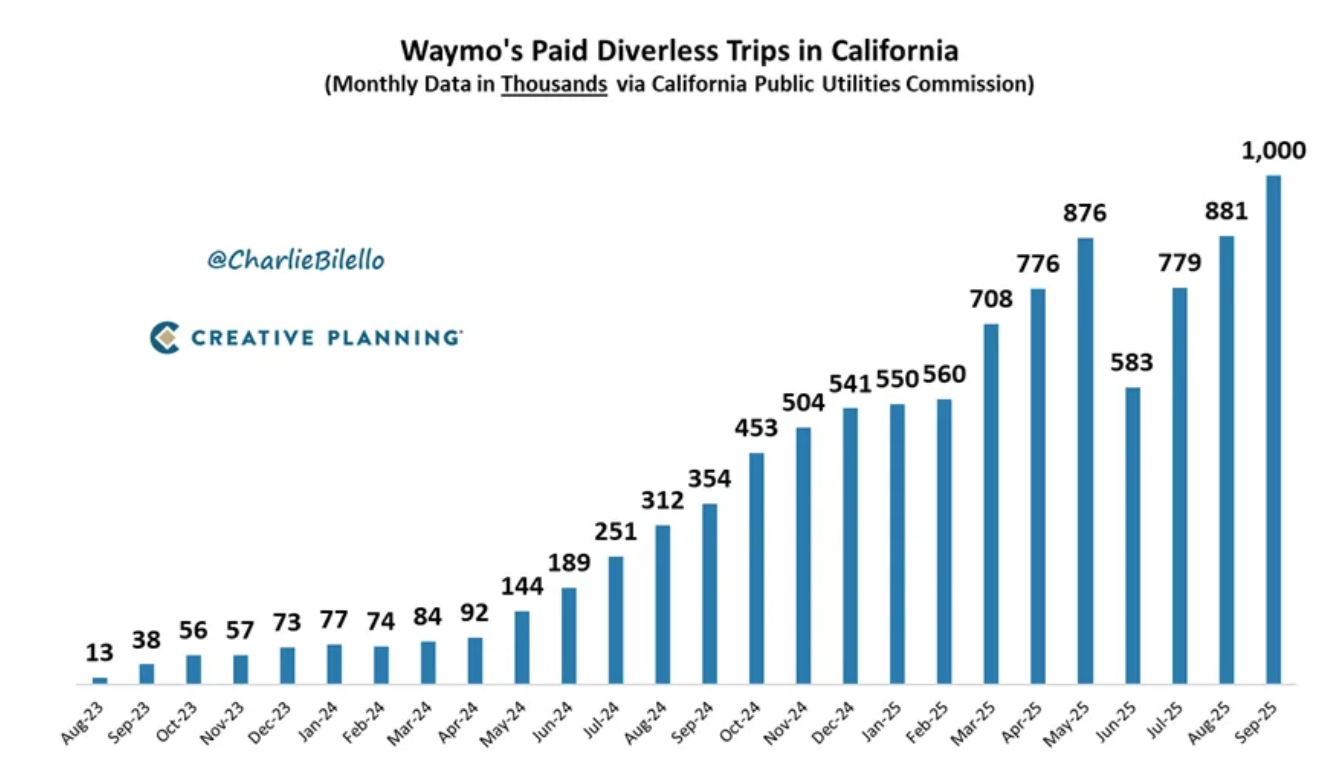
    September 2025 was a milestone month for Waymo in California: It reached 1,000,000 paid driverless rides. This represents a year-over-year increase of ~182%, which is a pretty good sign that the technology works and that customers like it.

    (Note: The dramatic falloff in rides in June 2025 was because of anti-ICE protests and vandalism taking place in Los Angeles and San Francisco. The company decided to temporarily suspend operations.)

    This is still a small fraction of the traditional ride-hailing market, though. According to the California Public Utilities Commission, Uber and Lyft combined complete somewhere around 300-320 million passenger trips per year in the state. That averages out to roughly 25-27 million trips per month for context.

    Still, the writing is on the wall. AV usage is growing rapidly and I think it’s only a matter of time until it supplants traditional ride-hailing, and perhaps even car ownership.

    Chart via Charlie Bilello

  • Thinking makes it so

    November 26, 2025 · View original


    There is a great quote in Shakespeare’s Hamlet: “There is nothing either good or bad, but thinking makes it so.”

    The point of this quote is to argue that the universe is fundamentally neutral. When an event happens, it is neither good nor bad; the label is determined by the judgment we ultimately bring to it.

    Take snow, for instance.

    Here in Toronto, I find that when it snows, people tend to look at it as a bad event. They think of the traffic that will ensue and the work that will be required to clear out walkways and driveways. But I love snow (maybe because I don’t have a driveway). Snow is good. As an avid snowboarder, it gets me excited for the winter season.

    And right now I can tell you that I’m praying to the snow gods for a dumping or two in Northern Utah. The entire Mountain West region is off to a slow start this season and has had to delay resort openings. My judgment tells me this is “bad.”

    Now, let’s consider the real estate development market.

    The prevailing narrative right now is that it’s bad. But Hamlet would say that only thinking makes it so. An alternative way to think about the market is that it’s presenting a generational buying opportunity.

    Like snow, I would call that a good thing.

  • The irony of the Stahl House: A “low-cost” prototype lists for $25 million

    November 25, 2025 · View original


    The Stahl House — also known as Case Study House #22 — is up for sale in Los Angeles.

    Even if you don’t know this house by name, I’m sure you’ve seen Julius Shulman’s iconic photograph from 1960 showing two women sitting in a corner of the house. It is widely credited with turning the house into one of the city’s most recognizable landmarks.

    Buck and Carlotta Stahl are the original owners. They purchased the steep lot for US$13,000 in 1954 (equal to about $157,000 today). This was a large sum of money at the time, especially for a lot that was thought to be unbuildable by many architects.

    Designed by architect Pierre Koenig, the house was built as part of Arts & Architecture magazine’s Case Study program, hence the name. The intent of the program was to come up with templated responses for an expected housing shortage following the Great Depression and World War II.

    When the program launched, it stated that “each house must be capable of duplication and in no sense be an individual performance,” and that “the overall program will be general enough to be of practical assistance to the average American in search of a home in which he can afford to live.”

    Sound familiar?

    The program also secured material donations from the building industry in an effort to make the prototypes as low-cost and repeatable as possible. Ironically, the house became the exact opposite: It became a singular icon of Los Angeles, used in movies, for fashion shoots, and as a general backdrop for a modernist city.

    And today, after 65 years of stewardship under the original owners, the house is on the market for US$25,000,000. This works out to nearly US$11,400 per square foot of interior space.

    When I first saw the list price I immediately thought to myself, “Interesting, I wonder how much of this price is being attributed to the real estate and how much of it is being attributed to its status as an icon and piece of art.”

    I don’t know the LA market very well, so I asked Gemini 3. What it told me is that comparable high-end homes in this area with pools and luxury views often trade for around $2,000 psf. That would put this real estate at around $4.4 million.

    If this is accurate (correct me if I’m wrong, LA people), it means that something like 80% of its list price is being derived from its “brand.” Not bad for a case study house built with low-cost subsidized materials.

    The other possible consideration is that people really like to photograph and film this house. And so there’s also a potential income stream associated with buying it. Assuming that continues (and AI doesn’t replace the need for physical shoot locations), then we’d also have to capitalize this income.

    In this case, the house would have three value components to it: real estate value, art/brand value, and rental income value derived from movies and shoots. Is that equal to $25 million? I don’t know, but the market should tell us soon enough.

    Cover photo by Julius Shulman

  • The self-driving paradox: walkable cities or super-sprawl?

    November 24, 2025 · View original


    Fred Wilson chose the perfect quote by William Gibson, here, to describe the current status of self-driving cars: “The future is already here — it’s just not very evenly distributed.” That’s how it feels right now.

    Waymo isn’t in Toronto yet, but they are expanding rapidly throughout the US and elsewhere. Last week they announced fully autonomous driving in five new cities: Miami, Dallas, Houston, San Antonio, and Orlando. Autonomy is here, as we have talked about many times. There’s no longer a question.

    But what’s interesting is that we’re at the point in the hype cycle where expectations are not as inflated as they were a number of years ago (at least that’s the way it appears to me). Years ago, everyone in real estate was talking about how it would disrupt parking requirements and reshape the landscape of our cities.

    So when does this happen?

    Fred ended his post by saying that “the downstream effects of this technology and behavior change are going to be profound.” But he doesn’t get into what these changes might be. Let’s do a reminder of that now. Some of the most commonly believed consequences are as follows:

    – Cars consume a vast amount of real estate and also spend the vast majority of their lives just sitting around idle. Switching to a “mobility-as-a-service” model will require dramatically less parking. This is going to force landlords to repurpose the parking they already have and it’s going to encourage developers to build new buildings with reduced parking, or no parking at all. That will be good for housing affordability. – However, the autonomous vehicles will need to park and corral somewhere at some point. My guess is that we will see something akin to rail yards today. This would be a good use for some of our excess parking, though this use won’t require nearly as much. I would also imagine that many of the cars will leave the most valuable and dense parts of a city during off-peak periods. – At the same time, it’s not clear what the winning business model for AVs will be. Will it be a Waymo-like model where the ride-hailing company owns and operates all of the cars? Will it be a Tesla Robotaxi model where individuals own the cars and put them out to work? In this case, maybe the Robotaxis just go back to people’s individual garages. Or will Uber remain the dominant platform? Meaning, an asset-light model that aggregates customer demand remains the highest-value component of the stack. Personally, I can’t see Tesla’s Robotaxi model being very lucrative for individual owners, so I’m inclined to look toward Waymo and Uber. – Street parking will be replaced by a proliferation of pick-up/drop-off zones. This urban design problem will need to be solved as we dramatically increase the number of people getting in and out of AVs on busy urban streets. – In the mid-1990s, Italian physicist Cesare Marchetti remarked that, all throughout history, humans have tended to cap their commute times at about 60 minutes per day. Something like a half hour each way. This became known as Marchetti’s Constant. What this has meant is that as new technologies (streetcars, cars, and so on) allowed us to move faster within that 60 minutes, humans have tended to sprawl further outward. Will AVs do the same, and could they actually break Marchetti’s Constant? – As we all know, the key difference with AVs is that we will no longer need to pay attention to our commute. We could sit in an AV and sleep, work, watch a movie, or do whatever else we’d like. One can think of it like a mobile office or mobile living room. This should, in theory, make commuting long distances a lot more enjoyable and encourage even greater “super sprawl.” – The counterforce to this phenomenon is that if more people are willing to commute long distances in an AV, we will see demand greatly outstrip supply on our roads. In other words, traffic congestion in large cities will get even worse. I think this will force more/most cities to adopt congestion pricing. Politically, it will finally become acceptable, because now we’ll be able to use “the machines” as our scapegoat. They’re overrunning our cities! Ironically, this means that we won’t adopt the thing that makes driving a lot better until we all stop driving.

    So where do these opposing forces ultimately net out? Well, my view (and bias) is that human-scaled walkable communities will always have value. We are social animals. I also think that the experience within our cities will improve dramatically. Pedestrian safety will increase (the data already supports this) and far less space will be dedicated to cars. Good.

    At the same time, I think that reducing commute friction will encourage an exurban explosion. Like the technologies that came before AVs, it’s going to empower humans to further decentralize. What this will do is exacerbate the divide between our urban cores and our suburban and exurban fringes.

    Of course, this is just me surmising. I don’t really know. But AVs are here, and I think it’s time we get back to discussing and planning for the second and third-order effects of this technology.