Daily insights for city builders, delivered every morning at 6 AM ET. I’m Brandon Donnelly — a Toronto-based real estate developer and founder of Globizen. I’ve been writing here since 2013.

  • Eliminating single-family zoning

    There is something happening in many North American cities right now. We are starting to question the supremacy of zoning for only single-family homes.

    This past summer, the state of Oregon passed policy requiring cities of 25,000 people or more to allow duplexes, triplexes, and fourplexes within their single-family home neighborhoods. Minneapolis is poised to do something similar with its Minneapolis 2040 plan (though it has been contentious). And, of course, here in Toronto we recently rolled out laneway suites all across the city. Small scale multi-family dwellings are also already permissible in some areas (though few are being built).

    Some are calling this a YIMBY movement. But however you want to define it, it’s an acknowledgement that, if the goal is to built up instead of out, perhaps it’s time we look at the parts of our cities with the lowest population densities. I would also add that following my recent post on Paris vs. Vancouver, many seemed to gravitate (in the comments) toward the Parisian model — even if it did result in over 50,000 people per square kilometer. Density, it would appear, is okay.

    While positive, it remains to be seen whether these policy changes will result in a meaningful increase in housing supply. And a lot of that will come down to the details. As I have said before on the blog, the math can be challenging on these sorts of smaller projects, which is why you have smart people proposing things like an “inverse density” rule to help encourage more smaller scale development.

    But as the saying goes, sometimes you need to crawl before you can walk. And, if nothing else, there’s certainly symbolic value to what seems to be taking hold across North America right now.

  • Penthouse lighting at the Massey Tower

    I am a big fan of lights on buildings. Here is a photo of the Massey Tower (by MOD Developments and Hariri Pontarini Architects) that I quickly took on my walk home from the office this evening:

    It’s not a very good photo and it’s not doing the project justice. So here’s another shot of the mechanical penthouse lighting from their Instagram.

    I’ve been noticing this lighting for a while now, and every time I see it I think to myself, “That’s really well done.” It’s simple, elegant, and it reinforces the overall architectural intent of the building.

    We are entering that time of the year, at least here in Toronto, where most of us will leave work and it will already be dark out. So the lighting on our buildings and in our public spaces can serve a particularly important function.

    Lighting can, of course, be done poorly. And we do need to be mindful of migratory birds during the spring and fall. Artificial light disorients them at night.

    But we all know how important lighting is to our interior spaces. The same is true for our urban spaces.

  • Applications to US business schools are declining

    Applications to American business schools, including MBA programs, have fallen for five straight years according to this recent WSJ article.

    Compared to last year, business school applications to US schools are down about 9.1%; whereas they have been rising in other parts of the world. If you look at the change in applications from international students, the drop is even more significant — about 13.7%.

    Here are two charts from the WSJ:

    There are a couple of possible explanations for this. Tech is/has been hot. I would imagine that space has been absorbing many people who would have historically gone to do an MBA.

    But perhaps more significantly, stricter immigration policies are making it harder for international students to come to the US. At the same time, top tier alternatives are emerging around the world, such as in China.

    China exports more business school students than any other country and they are by far the largest international student base in the US. But the numbers are coming down. At the peak in 2015, the US issued nearly 275,000 student visas to people from China. By 2017, that number had more than halved to 112,817.

    Out of curiosity, I decided to look up the class profile for the most recent Rotman MBA cohort (my alma mater). 70% of the class was born outside of Canada. That’s not surprising.

    Charts: WSJ

  • Qantas pilots new 20 hour ultra long haul flight from New York to Sydney

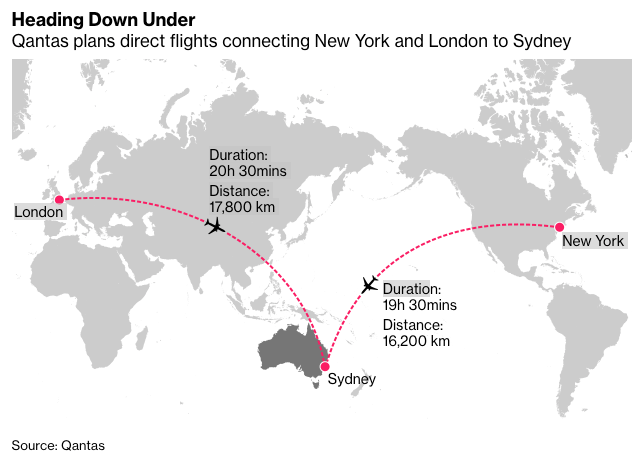
    Over the weekend, Qantas Airways set a new record with a nonstop ultra long haul flight from New York to Sydney. At a distance of 16,200 kilometers and a duration of 19 and a half hours, this is now the world’s longest flight. Though, this was still a test voyage. It remains to be seen whether this will be a commercially viable route. The company also plans to offer a similar ultra long haul from London.

    It’s fascinating to think about the logistics that go into a flight like this. The flight took off with its fuel tanks maxed out at 101 tons. But according to Wired, the loss factor on each additional ton of fuel is about 60% simply because of the additional weight. In other words, most of the incremental fuel to get all the way to Sydney just gets cannibalized by the heavier load. Wow. That doesn’t feel all that sustainable.

    Similarly, every ten passengers roughly equates to one ton (200 pounds per person). So there’s a balancing act between reducing weight (optimizing fuel consumption) and maximizing revenue (adding lots of people). There’s also a question of how best to price discriminate across economy, premium economy, and first class.

    Initially these ultra long haul flights were imagined to be flying hotels, where people could sleep, workout, and do all sorts of other things while they traveled halfway around the world. But the economics didn’t work. Too much wasted space on non-revenue generating items.

    The other interesting thing about these ultra long haul flights is how much work goes into passenger comfort, specifically around our body’s natural rhythms. Angus Whitley of Bloomberg was onboard this maiden voyage and he talks about how the food they served — spiced with things like chili and lime — was designed to fire up your clock when you shouldn’t be sleeping.

    And this isn’t new a feature of ultra long hauls. Qantas already employs things like hot chocolate laced with tryptophan in order to help people sleep onboard. I’m not great at sleeping on planes, generally because I don’t fit in the seats very well. But maybe it’s because I’ve been passing on the hot chocolate.

    Image: Qantas via Bloomberg

  • Ground breaking at Junction House

    This morning was the official ground breaking ceremony at Junction House. It was a beautiful sunny day and our FOREVER mural proved to be the perfect — albeit ironic — backdrop for our photos. Photos from the event will be released next week.

    Junction House is a project that we have been working on since 2016. Development doesn’t happen overnight. So it’s important to celebrate these milestones — both for the team and for future residents of Junction House.

    A big thank you to everyone who came out. We’re all looking forward to the next phase of the project: construction.

  • A 17.6 square meter apartment in Taipei

    Dezeen recently announced its 2019 interior award winners and this 17.6 square meter (~190 square foot) flat in Taipei was selected for “small interior of the year.” Designed by the Taiwanese studio A Little Design, the space features a 3.4m ceiling height and a queen-size sleeping loft. The design is very well done.

    But as I was looking through the photos, I couldn’t help but think, “This is about the size of a parking spot in Toronto.” Typically, the minimum dimensions for a parking space are 2.6m wide by 5.6m long. If either side is obstructed or the drive aisle is substandard, these dimensions need to be increased.

    So we’re not far off.

    Some of you will interpret this to mean that the apartment is too small; whereas some of you will interpret this to mean that the spaces we dedicate to cars are too big. It’s a matter of perspective. But what is clear is that there is a market for small urban spaces. Here are some other examples from São Paulo, Beirut, and Moscow.

    Photo: Hey! Cheese

  • Rules for location data

    The CEO of Foursquare — Jeff Glueck — published an interesting op-ed in the New York Times today, calling on Congress to regulate the location data industry. Currently, there are no formal rules in place.

    In case you’re not aware, Foursquare is one of the largest independent companies operating in this space. I have written about them many times before on the blog.

    Here’s an excerpt from Jeff’s op-ed explaining why this matters:

    But location data can also be abused. Bounty hunters were able to buy the current location of a cellphone for $300, Vice reported, because telecom companies sold the real-time location of phones to shady companies. And apps that track location data may turn around and sell that data, revealing someone’s every movement — whether it is to a retail store, an abortion clinic or a gay bar. Bloomberg Businessweek recently reported on a company with thousands of cameras selling car locations to debt collectors and others; there is no “opt-in” involved, and it’s illegal in all states to cover your license plate.

    I am writing about this today because I think it’s relevant to city building. Location data is inherently spatial. It is how we exist in cities. So it shouldn’t come as a surprise to any of you that this is valuable information — hence why it is being abused.

    Here we have a company advocating for more, not less, regulation. They, of course, want it to be sensible. But I still think it says things about the current location data environment. To learn about the specifics of what Jeff is proposing, click here.

  • A small site solution: Inverse Density

    My recent post about minimum project sizes triggered some great follow-up discussions over email. Today, I learned about a Master Plan that was recently completed for Little Havana, Miami by the urban design and planning firm Plusurbia.

    In it, they try to address some of the problems that I described in my post through something they call “Inverse Density.” Given the tendencies toward larger projects, they are proposing to incentivize the development of smaller and underused lots with more density.

    The idea being that if you can encourage more smaller scale development, you can actually help to protect the character of a place. In 2017, the National Trust for Historic Preservation declared the neighborhood a national treasure.

    Here’s a screenshot from the plan:

    What you are seeing here is existing vs. proposed policies. The proposed scenarios both result in higher densities, even though the lots are smaller. Alongside this, they are proposing to get rid of parking minimums for lots less than 7,500 sf.

    It’s an intriguing idea and I’m glad they shared it with me. If you’d like to download a copy of the full Little Havana Master Plan, click here.

  • New mural coming to Yonge + St. Clair

    A new mural is underway at Yonge + St. Clair by the Toronto-based street artist birdO (aka Jerry Rugg). He started over the weekend and should be finished by next week, depending on the weather. Here is what it looks like so far:

    If you’d like to take a look in person, head on over to 1 St. Clair Avenue East. It’s the building at the southeast corner of the intersection. And if you’d like to learn more about birdO, here’s a short film about some of his work in Detroit. It’s really well done.

    If you can’t see the video above, click here.

  • Paris and Vancouver population densities compared

    In this January 2018 report from the Fraser Institute, they pegged the average population density of Paris to be about 21,067 inhabitants per square kilometer (2014 population year). It is the second densest city in their report after Hong Kong, but the densest in Europe. By comparison, Vancouver sits at around 5,493 inhabitants per square kilometer (2016 population year).

    Now, these are of course city averages. Some neighborhoods will be higher and some will be lower. According to a January 2018 study by Alasdair Rae — who is a works in the Department of Urban Studies and Planning at the University of Sheffield — these are the most densely populated square kilometers across Europe (or at least within the 39 countries that he looked at).

    Paris, once again, comes in near the top with a peak density somewhere around 52,218 inhabitants per 1km square. The square in question is in the neighborhood of Goutte D’Or. And the only square within the study to come in denser is one from the L’Hospitalet de Llobegrat in Greater Barcelona (53,119 inhabitants per square kilometer).

    Now let’s take a look at how these sorts of densities actually manifest themselves. Below is an aerial capture from Google Maps showing a section of Goutte D’Or in Paris. The buildings are all pretty much 7 storeys (mid-rise), but the blocks are mostly filled in. Lots of interior courtyard apartments. This is one way to get to over 50,000 people per square kilometer.

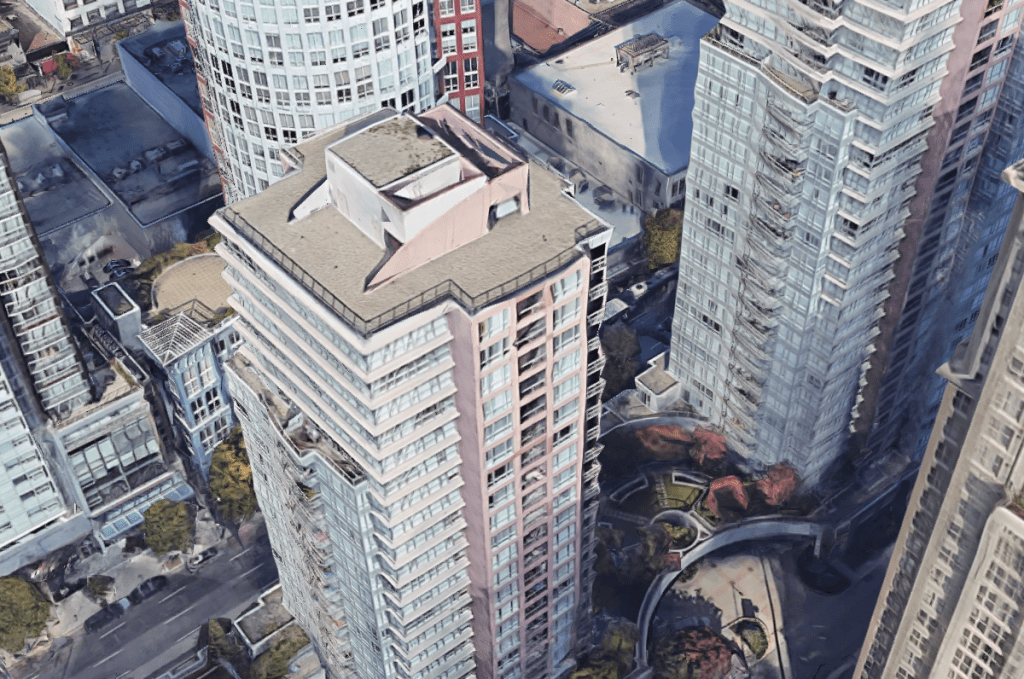
    Returning to Vancouver as a point of comparison, below is an aerial capture from downtown Vancouver at exactly the same scale as the Paris capture. I couldn’t find a density map of downtown, but it’s probably safe to assume that it’s greater than 5,493 and a lot less than 52,218 residents per square kilometer.

    What you see here is typical Vancouverism. Lots of slender point towers, careful tower positioning and spacing, and generally low podiums. It is a perfect demonstration that height and density do not necessarily correlate. It is possible to have low buildings and high density, which is something that Europe obviously does very well.

    But here’s the important question: In which of these two examples would you rather live? Please leave a comment below.