
Daily insights for city builders, delivered every morning at 6 AM ET. I’m Brandon Donnelly — a Toronto-based real estate developer and founder of Globizen. I’ve been writing here since 2013.

  • Toronto Regional Real Estate Board releases housing market statistics for April 2020

    The Wall Street Journal reported today that the median home price across the United States rose 8% year-over-year in March to $280,600. One explanation for this is that while, yes, demand did drop off, so too did supply and that has led to a shortage of available housing. The other possible explanation is that these March deals were papered earlier in the year (or late last year) when most of us were blissfully unaware of what was about to happen and so the real impact of this pandemic isn’t yet showing up in these numbers.

    Let’s drill down.

    The Toronto Regional Real Estate Board also released numbers today, but for the month of April. Not surprisingly, residential resales across the region are down by 67% compared to April 2019. The number of listings is also down by a similar amount (-64.1%). Overall though, pricing remained relatively flat (0.1% increase). And by overall I mean for all housing types and for all areas of the region. There are larger variances within specific areas and for certain types. See below.

    Drilling down even further, my friend and agent Christopher Bibby noted in his monthly newsletter over the weekend that transaction volumes in the central (resale) condominium market are down some 85-90%. So the market is effectively at a standstill. Those who do not need to sell or move are justifiably deciding not to right now. But just as Warren Buffet got on stage over the weekend — with some great flowy hair, I might add — and told us in Times New Roman never to bet against America, I am not about to bet against Toronto. This too shall pass.
  • A YouTube channel about simple living and small homes

    I just subscribed to Kirsten Dirksen’s YouTube channel. She makes videos about simple living, self-sufficiency, and small homes, among other things. She has nearly 1.3 million subscribers and her videos have almost 500 million views. I think many of you will really enjoy her channel.

    The above video is about an apartment in Lapa, Lisbon that was renovated by architect João Gameiro. Originally constructed in 1819, the top floor space had been pretty badly neglected. João renovated it by striking, what seems to me like, the right balance between old and new.

    Some of the other homes featured on her channel include a laneway house in Toronto, a tiny floating home in Berlin, and an off the grid cabin in Joshua Tree.

  • The case for being a generalist

    As many of you know, I am huge of Malcolm Gladwell. And one of the things that he has popularized through his writing is this idea that we all need to spend at least 10,000 hours specializing on someting in order to become truly exceptional at it. The Beatles did this because of all the time they spent playing music. Bill Gates did this because he was fortunate enough to have access to a computer at an early age. And Tiger Woods did this because his father gave him clubs as a toddler and got him to start practicing the game of golf. But is this truly the rule or the exception?

    In this recent TEDx Talk by David Epstein (embedded above), he argues that we’re actually ignoring one of the less intuitive but more common journeys. For every Tiger Woods, there are many Roger Federers. For every success story that hyperspecialized at an early age, there are countless examples of dilettantes who dabbled — and perhaps struggled — across different fields, only to find their true passion later in life. And so while it may seem like they’re not making progress, or even falling behind in the short term, this may not be the case in the long term.

    All of this reminded me of a post I wrote early last year about finding meaning in life and business. In it, I cited an article from New York Times Magazine recounting the outcomes of Harvard Business School graduates — some of which went on to be happy and wildly successful, and some of which ended up miserable after school. The takeaway here was that non-linear paths, experimentation, and a bit of struggle along the way, is nothing to be ashamed about. In fact, it may be exactly what is needed in order to prepare for today’s increasingly complex and wicked world.

  • New Yorkers are actually pretty healthy

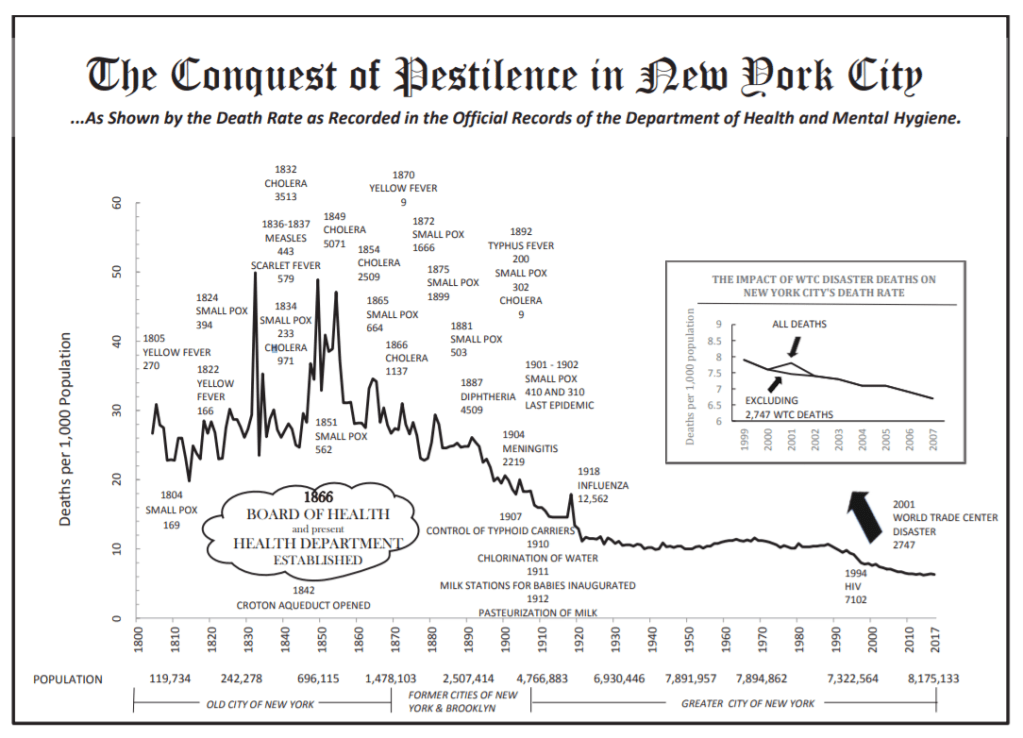
    Nicole Gelinas’ recent piece in CityLab is a good reminder that — despite all of the debates around COVID-19 and urban density — New York City is actually a really healthy place to live. Part of this obviously has to do with the city’s investments in public health. But the biggest factor, Nicole argues, is the city’s transit network. Six million people move around New York City each day without a car. That translates into a meaningfully lower traffic fatality rate. New York State’s rate is about 4.8 per 100,000, whereas Florida’s is 14.7 deaths per 100,000. Taking transit (and having an urban morphology that supports taking transit) also brings along with it other benefits, such as increased walking. And I have to believe that is an important factor. The obesity rate in New York City is thought to be about 22%, compared to a shocking 42% for the country. All of this rolls up into a life expectancy of about 81.2 years for New Yorkers, as of 2017. This is compared to 78.6 years for the US as a whole.

    For more on the health of New Yorkers, check out this 2017 Summary of Vital Statistics. (It’s the source of the above chart.)

  • Examining the solar potential of cities

    The MIT Senseable City Lab recently asked: How does urban morphology affect the solar potential of cities? If you assume that transparent photovoltaic cells are on the way and that building facades are soon going to become a place where we generate solar energy, then this is actually a pretty interesting question. Are some built environments naturally better suited than others?

    To answer this question, they looked at the “urban surfaces” of ten cities, including New York, Singapore, Toronto (pictured above), Hong Kong, Paris, as well as others. These surfaces included roofs, facades, and ground planes.

    What they, not surprisingly, discovered is that you need a lot of exposed facades to get the numbers up. And so the cities that come out on top in terms of annual solar irradiation are cities like New York and Singapore. They have a lot of tall buildings, but they also fluctuate in height, giving greater exposure to the facades.

    All of this is potentially relevant because — if building facades become a big deal for solar — it could start to inform how we plan our cities. In fact, I would go so far as to bet that, over the long-term, solar energy will have a greater impact on urban morphologies than this current pandemic.

    Image: MIT Senseable City Lab

  • Exposure tracing APIs to be released May 1

    The “contact tracing” API that Apple and Google are working on and that I wrote about earlier this month is set to be released on May 1. Given all the concerns around privacy, it’s now being referred to as “exposure tracing.” The idea, here, is to emphasize that it is being designed to trace the coronavirus and not individuals.

    To be clear, we’re talking about APIs, and so third party apps will need to be built on top of this tech before we can start downloading anything to our phones. But I am sure that will happen very soon and I will gladly opt in.

    It’s also worth mentioning that this entire concept of smartphone exposure tracing only works when Apple and Google cooperate. Whatever apps ultimately get built need to work across both platforms, otherwise there would be far too many gaps in the network. So this — along with the focus on privacy — has become a bit of good PR for “big tech.”

    The smart people working on exposure tracing over at Oxford University seem to think that (alongside other interventions) we could stop this virus with only about 60% of the population using an exposure tracing app. (They ran models with a pretend city of 1 million people.) But even at 50% penetration, they believe it could make a meaningful contribution.

    These are numbers I think we could easily get to in major cities. Overall, I suspect it could also make people feel a lot more comfortable about going out. And going out is what’s going to be required as we gradually reopen the global economy. How many of you think you will opt in to something like this once it becomes available?

  • Brutalist wine warehouse for sale near Bordeaux

    I am sure that many of you have been eagerly waiting for an old Brutalist wine warehouse to come on the market near Bordeaux, and so here is a listing from Espaces Atypiques. The site is over 1 hectare. The ground floor is about 2,000 square meters. And the central atrium space is some 25m tall. It’s listed for €550,000 and I reckon it needs a bit of work.

    I don’t know where exactly it’s located in Saint-Émilion, France (nor have I ever been) and I can’t vouch for the condition of the existing building in any way shape or form, but I do think it would be a lot of fun to turn a Brutalist structure like this into a hotel, restaurant, and creative event space. Public gathering space(s) in the atrium; private rooms along the perimeter.

    Image: Espaces Atypiques

  • Cities and contagion

    The Penn Institute for Urban Research has just launched a new initiative called, Cities and Contagion: Lessons from COVID-19. The inaugural piece is a special edition of its Urban Link publication. But going forward, the initiative is planned to include not only publications, but a resource library, convenings (online and offline, when appropriate), and research projects. The objective is to bring together experts from different disciplines to discuss the impacts of this pandemic on cities, as well as the possible responses going forward. You can find the first set of articles, here. Some of the contributions include, “Agglomeration economies are not going away” (Jessie Handbury) and, “There’s no substitute for cities” (Richard Voith and Susan Wachter). The titles alone should give you a taste of what you can expect from this first publication.

    Photo by Patrick Mueller on Unsplash

  • Bill Gates on the first modern pandemic

    https://twitter.com/donnelly_b/status/1252086026887192576?s=20

    After watching the docuseries, Inside Bill’s Brain, I couldn’t help but think that the work he and Melinda are doing isn’t getting nearly enough exposure. Here they are working tirelessly to eradicate global diseases, like polio, and find new ways to combat climate change. And yet relatively little was done after Bill went on stage five years ago and warned us that a global pandemic could strike at any time. Why? Probably because most of us thought it wouldn’t happen to us in the developed world.

    But obviously it did happen and along with that Bill has emerged as a level-headed voice of reason. He is calm, serious, and matter of fact about what we know, what we don’t know, and what is going to need to happen for us to make it to the other side of this. In his latest long-form blog post (which is also available for download as a PDF), he calls our current situation “the first modern pandemic”, as well as Pandemic I. That should signal to you that he continues to believe there will be others.

    In it, he summarizes the innovation that will need to happen into five categories: treatments, vaccines, testing, contact tracing, and policies for opening up. Among many other things, he gets into the realities (and timelines) of developing an effective vaccine for the world, as well as the shortcomings of the contact tracing tech that many companies, including Apple and Google, are currently building. I would encourage all of you to have a read.

  • The global gym market and gyms per capita

    Many of us are now working out from home. The Financial Times just reported that Peloton experienced its highest level of participation last week. Some 23,000 people tuned in for one of its streamed classes. Naturally, anything that was possible to go online has gone online.

    I’ve never really been a class guy, but I’ve been a regular at a gym since high school and it’s one of the things I’m most looking forward to getting back to as things subside. For many, the gym is a kind of third place. Though I would imagine it’s not the best place to hangout during a pandemic.

    According to FT, the fitness industry was among the first to suffer in the UK (~£5.1bn industry), showing signs of decline even before any government lockdown. The UK also had one of the most profitable fitness industries in Europe. Here’s an interesting chart comparing gym penetration to revenue per club.

    It’s interesting to note some of the outliers. Latin America has low penetration and low average revenue per club. And parts of Asia — notably Hong Kong and China — have relatively high average revenue per club, but still have fairly low penetration percentages. Do only rich people go to the gym in Hong Kong?

    This chart maybe makes it seem like nobody in Latin America is working out. But if you, instead, look at the number of fitness clubs in each country, the data looks vastly different. In this case, there are two very clear outliers: the United States and Brazil. (The below chart is from Statista and is based on 2017 data.)

    But Brazil also happens to be the most populous country in Latin America with around 209 million people. So let’s consider this chart on a per capita basis against, oh I don’t know, the US (~328 million), the UK (~67 million), and Canada (~38 million). Once again, the ranking switches. Brazil and Canada now come out on top with around 16 fitness clubs per 100,000 people. (I guess we’re just as body conscious as the Brazilians.) This is in comparison to 12 per for the US and 10 per for the UK.

    So what does this all mean for our post-COVID-19 world? Who knows. But I’ll sure as hell be at the gym.