Daily insights for city builders, delivered every morning at 6 AM ET. I’m Brandon Donnelly — a Toronto-based real estate developer and founder of Globizen. I’ve been writing here since 2013.
One, the home you live in was likely built by a person or company that was trying to make a profit.
Two, when your home was being developed and built, it probably upset a bunch of people. Both because something new was coming and because construction can be annoying.
Three, your home was built using materials and construction techniques that were readily available at the time. Some of those materials and techniques may no longer be practical.
Four, when your home was complete, somebody probably thought, “boy, they don’t build them like they used to.”
Five, the need for new housing doesn’t stop just because you now have a home.
In the world of planning and community building there is a hierarchy of places that is often referred to as first, second, and third places. As many of you probably know, first place is your home. Second place is where you work. And third places are where you commonly spend your time outside of the first two places. This could be a coffee shop, gym, barber shop, bar, or some other social anchor that serves to connect you with other people. In fact, you probably have multiple third places.
Some have argued that online communities have started to fill the role of third place. And it is true that social networks have used what works offline in order to build and grow their communities online. So in some ways, the internet has brought third places into our first place. Similarly, lockdown has brought our second place into our first place. And now everyone is debating to what extent we even needed these other places. Aren’t Zoom and TikTok enough?
Nope.
For those who don’t have a second place — such as, for example, freelancers — it is common to rely more heavily on third places, which then become pseudo second places. Why is that? Isn’t a first place enough? Because it’s an opportunity to get out and be around other humans. Cities are built around these other places. It’s where, in the words of Jerry Seinfeld, we “coagulate together.” And I just don’t see that changing. Do you?
MAD Architects recently completed its first project in the United States at 8600 Wilshire Boulevard in Beverly Hills. It’s interesting (and beautiful) in that it was designed to resemble a village of gabled residences sitting on top of a green hillside.
The green hillside is actually a three-storey concrete podium that is covered in what is said to be the largest living walls in the country. The gabled houses on top are wood-frame construction and were assembled to create an open-air courtyard in the middle of the site. Eighteen residences in total. Prices starting from USD 3.7 million (as of May 2019).
At five storeys, I suppose you would call this a mid-rise building. The site area is about 25,700 square feet and the building area is not even 48,000 square feet, according to ArchDaily. So the overall density on the site is actually remarkably low. At least compared to what we’re accustomed to building in Toronto. It might be dense for Beverly Hills.
I would love to see the development math for a site like this. After I got over the architecture, the first thing I thought was, “you could never build a mid-rise building like this in Toronto.” I suspect it’s also not obvious in Los Angeles. And you probably need “starting from 3.7 million” in order for it to pencil.
I was speaking to some friends in New York City over the weekend and they said to me, “you know what Brandon, we don’t really go out at night anymore. It doesn’t feel safe. There are homeless people everywhere and they’ve started to get very aggressive, particularly against Asians.”
They live in a good neighborhood in Manhattan.
I was somewhat surprised to hear this, but at the same time, I don’t think for one minute think that New York City is dead. But some do, including James Altucher. James moved to Florida because of the pandemic and recently penned an article in the NY Post called, “New York City is dead forever.”
That didn’t sit well with Jerry Seinfeld and so this morning he published a rebuttal op-ed piece in the New York Times. It has been making the rounds online today with people responding from both sides of the fence. Richard Florida responded with this tweet thread.
If you’re a regular reader of this blog, you’ll know where I sit on this topic. I love technology, but sitting at home all day going from Zoom meeting to Zoom meeting is not the kind of life I aspire to live. I agree with Jerry. There’s no energy. In fact, it sucks the energy right out of me.
With that, I’ll leave you with some more words from Jerry Seinfeld:
There’s some other stupid thing in the article about “bandwidth” and how New York is over because everybody will “remote everything.” Guess what: Everyone hates to do this. Everyone. Hates.
You know why? There’s no energy.
Energy, attitude and personality cannot be “remoted” through even the best fiber optic lines. That’s the whole reason many of us moved to New York in the first place.
You ever wonder why Silicon Valley even exists? I have always wondered, why do these people all live and work in that location? They have all this insane technology; why don’t they all just spread out wherever they want to be and connect with their devices? Because it doesn’t work, that’s why.
Real, live, inspiring human energy exists when we coagulate together in crazy places like New York City. Feeling sorry for yourself because you can’t go to the theater for a while is not the essential element of character that made New York the brilliant diamond of activity it will one day be again.
The above photo was taken on Lake Couchiching (off Lake Simcoe) with a DJI Mavic Mini.
Here is the before straight from the drone.
And here is the after with my Lightroom edits. I then cropped it to a 4×5 aspect ratio because wide landscape photos don’t show well on Instagram.
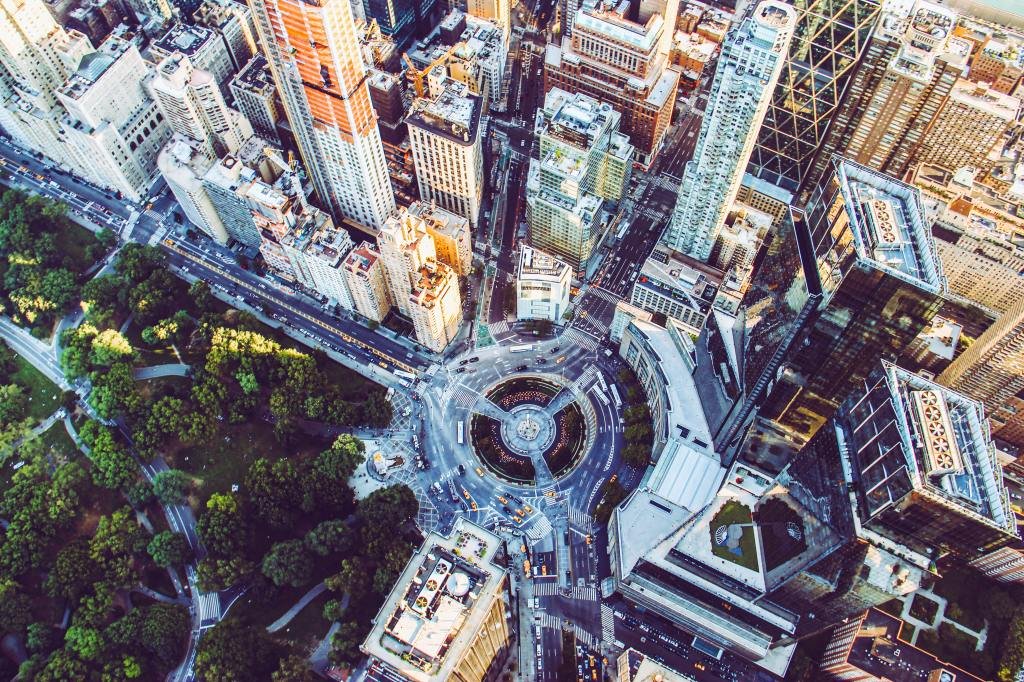
For me, this scene is a reminder to remain bullish on cities. Take people out of the city. Put them on boats in the middle of a large lake. And they’ll still find a way to cluster together.
Real estate, as they say, is a local business. Every market has its local nuances. For example, once of the first things that Studio Gang asked us when we started working together was, “does Toronto do PT?” What they were referring to was post-tensioned concrete and our answer was, “not really.” There are certainly examples of localized applications within buildings (such as for a specific transfer slab) and there are examples of buildings that have used it throughout (see Pier 27 Tower below — it’s how they managed to get such deep balconies). But for the most part, it’s not widely used and it’s certainly not as common as it is in markets such as New York. This subtle difference has an impact on how you design, which is why Studio Gang asked it from the outset.
Despite some of these local differences, there is a criticism out there that we have descended upon a kind of bland global design sensibility. No matter where you’re building, every building now looks the same, which, at the end of the day, was kind of the point of the International Style of architecture. One design approach applied universally. This recent article by Edwin Heathcote takes things even further by saying that our interiors have also been sterilized to look more or less the same as a result of “digital aesthetic seepage.” The article is called, “The curse of the Airbnb aesthetic.”
One the one hand, there is something inevitable about this outcome. We — including our supply chains — have become more interconnected than ever. And because of the high cost of labor, the way we build today is centered around as much factory automation as possible. Minimize what needs to be done on site. And given that I would expect more, rather than less, automation going forward, one has to assume that this trend is destined to continue. At the same time, local places matter and one of the reasons why so many of us love to travel is that we want to see places that are different than our own. I for one don’t want that to change.
I was “on site” this morning for the installation of the helical piers for my laneway suite (that will be the topic of a separate post). More often than not, I’m in the office. But I like going on site because, well, building things is fun. One of the things that I find interesting about being on site, though, is that my preferred method of communication always seems to change. When I’m in the office, I have a bias toward emails. That is the case for two reasons: 1) I’m usually focusing on something and I find that calls can be disruptive, and 2) emails can be a highly efficient way to communicate. Tell me what you need (in the shortest email possible) and I’ll try and respond as succinctly as I can. However, when I’m on site, all of a sudden I don’t want to do emails. I would rather talk on the phone. That becomes the most direct way to deal with things. I am mentioning this because communication is paramount. And many of us have different preferences for how we like to do it. Knowing those preferences can be helpful when you’re trying to get things done.
First, I read Bloomberg Green’s daily newsletter (Nathaniel Bullard) and came across the following statistic. In 2001, the world installed 290 megawatts of solar generating capacity. This year, the world is likely to install more than 100 gigawatts of solar — that’s 350x more per year than we were installing 19 years ago. You can also see how things have changed by looking at the above chart showing wind and solar asset financing per year.
Second, I read about Fred Wilson’s SunPower Solar system and how, since May, he has been able to satisfy 91.5% of his home’s electrical needs via solar (this includes an electric vehicle). In fact, during the month of May when temperatures were a bit cooler, he had a surplus. He was producing more than he was consuming, and so he was selling that excess production back into the grid. It wasn’t until the summer months and higher AC usage that he started having a shortfall.
Now I don’t know where his house is located or what its roof looks like, but it is interesting to consider both the macro and micro scale. 91.5% signals to me that it shouldn’t be much longer before many people and many homes no longer need to draw any power from the grid. That’s going to be a game changer.
The United States and the United Kingdom recently published some official statistics on the impacts that this pandemic has had on ecommerce. The above chart is from Benedict Evans and he has some more over here. It’s worth a click through. What is clear is that lockdown forced a whole bunch of adoption and accelerated trends that were already underway. More people turned to shopping online. The UK went from 20% ecommerce penetration to over 30%. And the US went from 17% to about 22%. What is also clear is that grocery has demonstrated to be exceptionally resilient. Most physical retailers saw a decline in sales during lockdown. Grocery proved to be a notable exception. But what is unclear is how much of this adoption will actually stick. The UK is reporting monthly (as opposed to quarterly for the US) and already you can see signs of a possible reversion. My guess is that — provided we don’t see another major lockdown — there will be a meaningful reversion before the trend line resumes its march.
What is your position on outdoor space in multi-family buildings? (Assume you're in the market to buy or rent a new place and assume there's a cost to outdoor space.)
Over the years, I have written a few times about the great balcony debate. It’s a discussion that comes up time and time again as those of us in the building industry go through the process of designing new residential buildings. One the one hand there are the arguments that balconies don’t really get used all that much and that they are bad for the environment (thermal bridging through the slabs). And on the other hand there’s the argument that, regardless of whether or not they actually get used, they form an important part of the buying/renting decision. Usually the former is made by architects and engineers and the latter is made by sales and marketing teams.
Back in 2016, I remarked that I was starting to see more Juliet balconies across Toronto (could have been some sort of bias at work — like when you’re shopping for a new car and then all you can see is that new car). Regardless, there are countless examples of architects and developers omitting balconies and finding creative ways to connect inside and out. But given that this pandemic has forced us to reconsider and reallocate how we use space in our cities, it’s probably worth revisiting the great balcony debate. Has COVID-19 changed how we view outdoor space? And if so, will it last?
I’ve decided to start with a Twitter survey (see above tweet) and then either do a long-form article or a series of posts on the topic. If you have any thoughts that you would like to share (ideally before I write), please leave a comment below or on Twitter.