Daily insights for city builders, delivered every morning at 6 AM ET. I’m Brandon Donnelly — a Toronto-based real estate developer and founder of Globizen. I’ve been writing here since 2013.

  • Super-prime property transactions in the first half of 2020

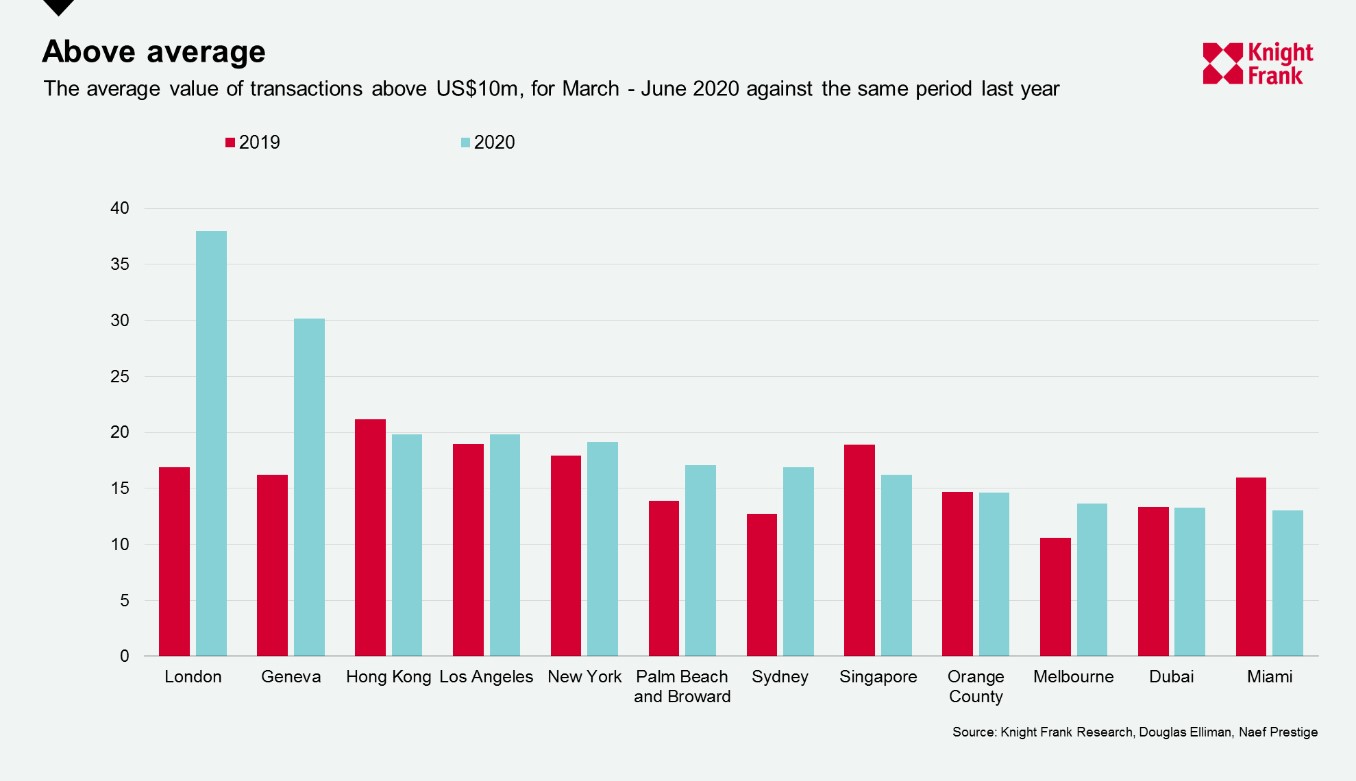
    This is a chart from Knight Frank showing the average value of “super-prime” residential real estate transactions in 12 global markets between March and June 2020, and versus the same period last year.

    Knight Frank classifies super-prime real estate as having a value greater than US$10 million and ultra-prime real estate as having a value greater than US$25 million.

    In this particular chart, London takes the top spot with an average super-prime transaction value of US$38 million. This is a big jump compared to 2019 where the average value was US$16.9 million.

    Typically it is Hong Kong that takes the top spot in this ranking, but this year it fell to third. Still, Hong Kong had the highest number of transactions with 60 super-prime sales taking place in the first half of 2020. This is down from 155 in the first half of 2019.

    Overall, Knight Frank recorded 281 super-prime transactions across these 12 cities in the first half of this year. This is, not surprisingly, a decline compared to last year, which saw 594 transactions over this same time period.

    But all things being considered and given some of these price increases, the super-prime market is certainly holding its own.

    Chart: Knight Frank

  • The Map: Geometry vs. geography

    A friend of mine sent me this video today in a brief email that basically said, “you’re gonna love it.” Naturally he was right. It’s great. The 10-minute video is about how creative agency Work & Co rethought and redesigned New York City’s subway map for today’s digital age. Rather than a static map, which is historically how all cities have communicated their transit networks, they created a digital map that changes both as you interact with and as the network itself changes (closures, time of day, etc.). This means that they no longer had to make certain design compromises. They no longer had to choose between geometry (clarity of representation) and geography (accuracy of representation). The system does both.

  • Coming soon

    onedelisle.com / #onedelisle

  • A mismatch of expectations

    Seth Godin’s blog post this morning, called “I hate this restaurant,” is really excellent. I would encourage you all to read it. In it, he talks about a mismatch of expectations. More specifically, he gives the example of somebody going to a restaurant and not liking what’s on offer, and therefore being upset. It’s not that the food was bad or that the restaurant has failed, it’s just that the person didn’t get what they were expecting. There’s a mismatch. And this, of course, happens all over the place and not just in restaurants. In his view, this failure is caused by a few different factors that ultimately result in us — the people that are involved in everything from the arts to business — having to make a decision about the kind of operation we would like to run. Below is an excerpt of those things. For the full post, click here.

    This failure comes from a few contributing factors, all amplified by our culture:

    First, you can’t know if you’re going to like an experience until you experience it. All you know is your understanding of what was on offer. And because there are so many choices and there’s so much noise, we rarely take the time to actually read the label, or we get carried away by the coming attractions, or we just don’t care enough to pay attention until we’re already involved.

    [And marketers are complicit, because in the face of too much noise, they hype what’s on offer and overpromise…]

    Second, because many people are afraid. They’re afraid of the new and even more than that, afraid of change. Most people in our culture would like to be entertained not transformed, lectured at instead of learning.

    Third, the double-edged sword of giving everyone a microphone means that we’ve amplified the voices of dissent at the same time we’ve given people a chance to speak up about their desires. This means that mass culture is far more divisive than it ever was before, and it also means that bubbles of interest are more likely to be served.

    And so the fork in the road:

    You can either turn your operation into a cross between McDonald’s and Disney, selling the regular kind, pandering to the middle, putting everything in exactly the category they hoped for and challenging no expectations…

    Or you can do the incredibly hard work of transgressing genres, challenging expectations and seeking out the few people who want to experience something that matters, instead of something that’s merely safe.

  • The WRLDCTY 2020 Virtual Festival

    This Thursday is the launch of a brand new city event called the WRLDCTY Virtual Festival (vowels, clearly, suck). Presented by Vancouver-based Resonance Consultancy, the “host cities” are New York, London, Hong Kong, Los Angeles, and Toronto.

    The idea is to bring together thought leaders and city lovers from all around the world on a virtual platform for three days. The speakers include people like Richard Florida, Bjarke Ingels, and Dan Doctoroff.

    The other thing they’re doing is offering up over 20 virtual urban experiences. Think yoga on Santa Monica Pier, burlesque in Brooklyn, and graffiti art tours in Toronto. It’s clearly no substitute for actual travel, but this is the best we’ve got right now and we’re all trying to adapt.

    A general admission ticket is free, but some of the headline events require a pro pass and if you’d like to do some virtual networking and chat with other guests in the “Community Center,” you’ll also need that same pass. Here’s the full agenda.

    Photo by veeterzy on Unsplash

  • Billionaire wealth in China grew by 1146% over the last decade

    UBS and PwC’s recent report on billionaire wealth highlights some interesting trends about the global economy and global wealth.

    • Billionaire wealth in mainland China is now second to only the United States, having grown by about 1146% from 2009 to 2020, compared to 170% in the US. As of the middle of this year, it was sitting at about USD 1.7 trillion in China, compared to USD 3.6 trillion in the US.
    • Hong Kong remains a force with only 1,105 square kilometers of land (not all of which is developable). Billionaire wealth grew by about 208% to USD 356 billion over the same time period as above. That puts it ahead of the United Kingdom, Canada, and Brazil in total dollars.
    • About half of all billionaires seem to have a significant amount of their wealth invested in real estate. Somewhere between 21-40% of their net worth.
    • At the same time, the report identifies the real estate industry as having the fewest number of “innovators & disruptors.” Only 17% of billionaires (whose wealth is primarily derived from real estate) are classified in this way. The report calls out the sector as being “especially slow to embrace technology to boost efficiency.”
    • Perhaps the most interesting takeaway is that, even within the rarified billionaire community, tech is driving polarization. For most of the last decade, the sector didn’t matter all that much. The rich were getting richer. Now it’s more so the tech rich. And COVID-19 seems to be accelerating this trend.

    This is not to say that I think people are particularly worried about billionaires who maybe aren’t getting as rich as they used to. That’s like complaining about being too good looking. But it is clear that tech is driving a bunch of macro shifts in the global economy and this is just another example of that playing out.

    Image: UBS and PwC

  • Wuhan as tourist destination

    Seeing people out at bars and at amusements parks in this WSJ video about Wuhan, China is a little odd given that in this part of the world we are decisively in our second wave. But that is what is happening. In fact, the title of the video is, “Wuhan, Former Pandemic Center, Emerges as Tourist Hot Spot.”

    Over a recent public holiday, the city saw nearly 19 million tourists — the most of any Chinese city. And while tourist revenues are still thought to be down by some 30%, Chinese people are seemingly feeling confident enough to get back out and do things.

    Based on what the WSJ is reporting, this seems to be supported by a few things. International travel isn’t happening, so it’s becoming a boon for local tourism, which is not that dissimilar from what’s happening in other countries. (Domestic air travel is rebounding faster than international travel when you look at flight volumes across major airlines.)

    At the same time, Wuhan implemented what sounds like some pretty extensive testing, which is in turn supported by a national healthcare platform that presumably makes contact tracing easier. These things seem to have given people the confidence to go out again. And I don’t doubt that the same will eventually happen in the rest of the world.

  • Everything you need in just 16 square meters

    This ArchDaily interview with Gary Chang about nano-scaled architecture is worth a read. Gary Chang is founder of the Hong Kong-based Edge Design Institute and is a pioneer in the world of compact living and small-scale architecture.

    In fact, many of you have probably seen where he lives. His place has been widely publicized over the years. Dubbed the Domestic Transformer, Gary has been living in the same 32 square meter apartment in Hong Kong for over 40 years and has been using it as a kind of laboratory for his design work.

    Depending on where you live, 344 square feet may not seem like a lot. But this is Hong Kong. And in Hong Kong even this is apparently on the large side for some locals. In his ArchDaily interview, Gary talks about the rise of “nano-homes” in Hong Kong — everything you need, including a wine fridge, in only 16-18 square meters.

    Of course, to do this, you kind of have to reconsider how you think about space. Gary refers to it along the lines of time-based space planning. Instead of just focusing on raw space, he focuses on activities and functionality over time.

    “Over the years, I have been more focused into the notion of time rather than the physical space itself, and in this latest model M-2007 (calling it the Domestic Transformer, the year the first episode of the movie of Transformer was launched), I simply explore a time-based system of living in this apartment; instead of me moving from one room to another in the traditional sense, the apartment transforms for me for different functions. I basically utilize the entire home all the time, a great departure from the conventional definition of a home such as the system in Japan in nLDK (n denotes the number of bedrooms, L for Living Room, D for Dining Room and K for Kitchen).“

    For the full interview, click here.

  • Were the Victorians better city builders?

    A team of researchers at UCL recently surveyed 2,500 households across the UK to see how the design of their homes and neighborhoods has impacted their experience during lockdown (May to June 2020).

    Perhaps most notably, the report, called Home Comforts, found that people living in housing built in the last 10 years were more likely to feel uncomfortable during lockdown (1 in 5), compared to those living in homes built before 1919 (1 in 7).

    On top of this, people living in Victorian era housing were more likely to say that their neighborhoods were meeting their everyday needs, which seems to translate into convenient access to basic amenities (5 to 10 minute walk).

    So what does this tell us?

    That people want more ornament and clearly defined Zoom-friendly rooms? That the Victorians were better at city and community building? Or maybe that Londoners living in low-rise pre-1919 housing are generally well-established and have the ability to afford more conveniences? It’s likely a bunch of different things.

    There’s no denying that the way we build our homes and our neighborhoods has, for better or for worse, changed over the last 100 years. But let’s not forget that it’s easy to romanticize the past and the things we used to do. I’m sure it wasn’t puppy dogs and ice cream for all of the Victorians.

  • Smarter, simpler, happier

    https://twitter.com/donnelly_b/status/1316229179369828357?s=20

    A good friend of mine in Philadelphia just recommended a new book to me by Diana Lind called, Brave New Home: Our Future in Smarter, Simpler, Happier Housing. I haven’t read it yet, so I can’t in good conscience recommend it to you all or comment with any sort of precision.

    But the New York Times seems to think that Diana has convincingly argued that the single-family home is at least partially to blame for a whole host of our societal challenges — everything from economic inequality to loneliness.

    This is, of course, not an entirely new narrative. But it is perhaps a timely read given that we are living through a period of time where loneliness seems to be on the rise and people are allegedly fleeing our urban centers in search of space and distance.