Daily insights for city builders, delivered every morning at 6 AM ET. I’m Brandon Donnelly — a Toronto-based real estate developer and founder of Globizen. I’ve been writing here since 2013.

  • The internet is no longer American

    This is the topic of Benedict Evan’s latest blog post, which is all about the internet, regulation, and the rise of China, as well as other countries. The internet is now deeply ingrained in everyday life. As of 2017, about 40% of Americans had met their partners online. We do everything online. But 80-90% of the world’s internet users are now outside of the US. There are more smartphone users in China than in the US and western Europe combined. And venture capital dollars have started to diversify away from just the US (see above chart). All of this — but mostly Tiktok — has Americans questioning how best to handle and how best to regulate.

    Here’s an excerpt from Benedict’s post:

    Both of these are captured in Tiktok. This is the first time that Americans have really had to deal with their teenagers using a form of mass media that isn’t created in their country by people who mostly share their values. It’s from somewhere else. That’s compounded by the fact that the ‘somewhere else’ is China, with all of the political and geopolitical issues that come with that, but I’d suggest that the core, structural issue is that it’s foreign. This is, of course, a problem that the rest of the world has been wrestling with since 1994, but it comes as something of a shock in Washington DC. There’s an old joke that war is how God teaches Americans geography – now it’s regulation.

    For the full post, click here.

    Image/facts: Benedict Evans
  • Extell Development to build $2 billion ski resort near Park City

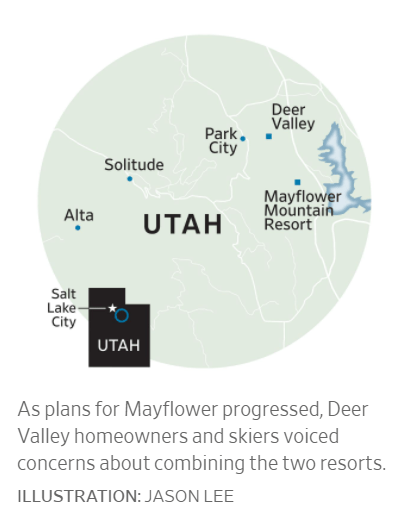
    New York-based Extell Development is, according to this recent WSJ article, in the midst of trying to build a $2 billion full-service ski and snowboard resort near Park City, Utah. It would be the first new resort in the United States in about four decades. These things are, clearly, difficult to get approved, and the fundamentals are, arguably, not all that great. In the early 1990s, the US had about 546 ski and snowboard resorts across the country. As of the 2018-2019 season that number had dropped to 476, according to the WSJ. People are skiing less than they used it, it would seem.

    To be a bit more precise on its location, the proposed resort, which is currently called Mayflower Mountain Resort, is to be located next to Deer Valley Resort. And there’s even a plan floating around to possibly merge the two resorts. That’s apparently what the county planners want. I’m not all that familiar with Deer Valley because they don’t allow my kind there (snowboarders). But it’s an exclusive resort with a country-club kind of feel (or so I’m told). So it shouldn’t come as a surprise that the proposed merger doesn’t seem to be getting a lot of traction with the patrons of Deer Valley.

    But here’s the interesting thing about the Mayflower site. It’s generally controlled (to what extent, I don’t exactly know) by an entity called The Military Installation Development Authority. And this entity has the power to do things like issue bonds and grant certain land-use approvals. This means that there may be an angle to streamline the approvals process (i.e. make this project actually feasible) and to leverage things like tax increment financing (TIF) in order to fund the project.

    Supposedly a new mountain resort has been on the books for this site for some 30 years. Could now finally be the time? If they allow my kind, you can count me in.

    Image: WSJ

  • The resilient city and road pricing

    Joe Berridge’s recent opinion piece in the Globe and Mail is a good reminder — in the face of a whole lot of uncertainty — about the resiliency of our cities.

    Those previous decades saw a surge of people and jobs locating downtown, with consequent escalation in rents and prices of offices and housing. Why? Partly demographic, as the well-educated children of the baby boom reached adulthood, and partly lifestyle and work style. Young people go to big cities not just to work and live, but for sex, style, money and power. For ambition and anonymity. And for risk. All in the petri dish of downtown density. These drives have always been as powerful as their subsequent search for suburban security and community.

    The structure of the modern megalopolis is not an accident – the dramatic rise of tech employment, two-earner families, the decline of manufacturing, the later date of marriage, smaller households, lifestyle consumerism, teamwork cultures, serial re-education and training – none of these societal trends looks to be diminished by COVID-19. All of them seem to prefer high-density, high-interaction environments.

    For those of us in Toronto, it’s also important to remember just how quickly this city region was growing pre-COVID-19. That is unlikely to change on the other side of this.

    But Berridge does also point out some of the potential fallouts from this pandemic. The economics of urban transit, for example, could remain a problem for quite some time. This will strain public purses. (Car usage rebounded quickly, but transit ridership has not.)

    We are also likely to see increased traffic congestion as a result of people eschewing transit (and probably a bunch of other factors). Like Berridge, I am a supporter of road/congestion pricing, and have been writing about that on this blog for many years.

    The best things to tax/price are things that are generally viewed as bad and where demand is largely inelastic. That is, even if you increase the price, many or most people will probably still do it anyway. Think of things like smoking.

    Up until now, Toronto hasn’t had the moxie to make difficult (political) decisions like this one. Perhaps this pandemic will leave us no other choice.

  • Emotion vs. rationality

    In life and business I find that we are often faced with decisions that pit emotion against rationality. What I mean by this is that maybe your ego is telling you to do something. And maybe, as a matter of principle, you know with certainty that you’re right. But when you take a step back and think about how that principled decision might play out, you realize that it is probably not the right life or business decision.

    In the case of the real estate development business, you might realize that it is not the right decision for the project. And that’s really the key question to be asking yourself in this business. What is most beneficial for the project? It is not about what’s most beneficial for my ego.

    Of course, taking emotion out of the equation can sometimes be difficult. Maybe you feel like you’re losing if you give in and don’t follow what you think is right. But the truth is that if emotion and rationality don’t line up, then you’re likely going to have to pick a side. And if you make a bad or the wrong business decision, then you’re definitely losing, even if your ego might feel a little better.

  • The paneláks of Prague

    At the beginning of this year (which seems like eons ago), I wrote about a CityLab series that Feargus O’Sullivan was doing on the vernacular home designs of a handful of European cities. Cities like London and Berlin.

    Well, after a brief pause, that series is back in the form of a CityLab “storythread.” It’s now called, “The Iconic Home Designs That Define Our Global Cities.” In it, he explores the various floor plans, housing typologies, and tenures that you might find around the world. Everywhere from from Singapore to Reykjavik.

    The most recent article is all about Prague’s communist-era apartments. Apparently people call these paneláks because they were initially built using some sort of collection of prefabricated panels. They were a quick and dirty housing solution for a city and country that were rapidly urbanizing starting in the late 1950s. (See, prefab works.)

    But what I find most interesting about the story of these paneláks is how their reputation seems to have changed and evolved over time. They proved to be a far more adaptable form of housing than you might initially think, going from written off and ready for demolition, in some cases, to then becoming a form of aspirational housing.

    Part of this allegedly had to do with a handover from state ownership to private ownership, which maybe goes to show you that architecture and design, alone, aren’t enough when it comes to housing innovation. You really need to consider the whole picture.

    But regardless, it is clear to me that tastes do change, and housing is no exception. Renewal is an integral part of urban life. And one generation’s trash might be another generation’s treasure.

    Photo by Jakub Matyáš on Unsplash

  • Creating and making things

    The construction process can be a pain in the ass. It’s messy. It’s inefficient. It’s always filled with surprises. And you could argue, as many have before, that every job is really a custom job — a kind of prototype. But at the same time, there is something so deeply satisfying about seeing a building come to life. Part of that satisfaction no doubt comes from the fact that it usually takes years and years to get to the point in which you’re digging holes, pouring concrete, and framing out spaces. It’s almost as if we don’t want things to get built. It’s a feeling of “finally.” But perhaps the bigger part of this satisfaction stems from the fact that building is creating and making something new. It’s about imagining what something could be and then going out and doing everything you can to make that a reality. Some people won’t like what you’re trying to build. But they might when it’s finished. And it is almost certainly not going to be an easy process. But it’s a fulfilling one. Few things are as rewarding as creating and making something new.

  • Tech and New York City

    Tech:NYC has just launched a new podcast called Talk:NYC. The first episode is with venture capitalist and blogger Fred Wilson. (Though, it should be noted that Fred and his wife, Joanne, are also involved in the real estate development space.) In this episode, Julie Samuels and Fred Wilson talk about why he came to New York, how to manage through a downturn, where working spaces are going, and why the magic of New York is still there — among a bunch of other things. Click here if you can’t see the embedded podcast below.

    https://soundcloud.com/user-212806065/talknycep01fredwilson
  • Ikea launches new digital influencer campaign in Tokyo

    Social media, as we all know, isn’t all that real. Photos are cropped, edited, and distorted all the time. But that’s kind of how things work these days and it’s not just on social media. Back in 2014, it was revealed that about 75% of Ikea’s catalogues were made up of computer generated images. It’s simply a lot faster to do that than stage a bunch of spaces for photoshoots. Fast forward six years and Ikea is now taking it a step further by integrating “digital influencers” into their ads. Here’s what that looks like:

    This particular campaign was done to promote a new store in Tokyo’s Harajuku district. And it features a popular digital influencer known as Imma. This is my first foray into the world of digital influencers, but Imma is apparently popular enough to have some 265,000 followers on Instagram. What I have just learned is that a real human is first photographed and filmed for all of this content. Imma’s digital head is then transplanted onto said content. That’s how these digital influencers are created.

    It all feels very Japanese to me. It also feels a bit like the starting premise of a great Black Mirror episode. But on the other hand, is it really all that different from the highly doctored content that already graces the internet?

  • New York City makes outdoor dining permanent

    New York City just made its “Open Restaurants” program permanent. Originally set to expire at the end of the October, the al fresco dining program — which allows restaurants to use sidewalks and curb lanes adjacent to their business — is now being thought of as something that will permanently reshape public space in the city.

    Along with this announcement, the City also provided clarity on how heating and enclosures may be used throughout the winter months. Electrical heaters can be used anywhere. But propane heaters can only be used on sidewalks and you’ll need to get a permit from the fire department. Prior to this announcement, there was an outright ban on propane heaters.

    Tents and other enclosures are now permitted, but at least 50% of the side walls needs to remain open for ventilation. Otherwise it gets classified as indoor dining and those rules would then apply. However, fully enclosed structures, such as cool looking Instagrammable domes, are allowed for individual parties provided there’s “adequate ventilation.” Whatever that means.

    This is yet another example of how COVID-19 is forcing us to reconsider the way we think about and use public space within our cities — perhaps forever. And in this particular case, it’ll be interesting to see to what extent cities embrace dining outside in the winter. Some of us already do it when we, for example, après ski. Could the same thing work in our cities?

    Photo by Aleks Marinkovic on Unsplash

  • Latest artist collaboration: Juanita Lee-Garcia x Slate Asset Management x Junction House

    Today I’m excited to announce the latest artist collaboration at Junction House. (For a background on the others, click here.) Bogota-born, Toronto-based Juanita Lee-Garcia has created a series of hand-cut collage panels for the construction hoarding at Junction House (the background color is the project’s signature electric blue color).

    In this installation, Lee-Garcia uses repetition and image repurposing to investigate the limits and the potential of decor in consumer culture. Her work uses simple gestures such as slicing, inserting, folding, and layering to build these new and abstract forms. They are intended to feel both fresh and unfamiliar, as well as comforting — perhaps because of some of their cultural associations.

    We love these sorts of collaborations because we want every single one of our development projects to be more than just a new building. We want it to be a catalyst for positive city building change. So the next time you’re in the Junction, I would encourage you to stop by 2720 Dundas Street West and take in Juanita’s work. Limited edition prints of the panels are also available on her website.