Daily insights for city builders, delivered every morning at 6 AM ET. I’m Brandon Donnelly — a Toronto-based real estate developer and founder of Globizen. I’ve been writing here since 2013.

  • Districts versus spines

    I was recently having a discussion on Twitter about midrise buildings and architect Dermot Sweeny raised the important distinction between creating “spines” and creating “districts.”

    What he was referring to with “spines” was the way in which Toronto is intensifying its “Avenues” with midrise buildings. It is a kind of linear form of intensification which almost always means that each building must transition in some way to the low-rise housing that typically abuts our Avenues. This is far less relevant in districts.

    We have started to increase housing supply in our “Neighborhoods” through things like laneway houses and garden suites, but in most cases, we are arguably not creating urban districts.

    This is of course a touchy subject. But I think it’s an important discussion to be having for a number reasons:

    • Increasing housing supply is a good thing
    • Angular planes and other transition measures make housing more expensive
    • Urban places are, I would argue, better defined through districts rather than spines
    • Mixed-use (employment) becomes more viable with districts
    • Transit infrastructure is better utilized with radial density around its stations

    Can you think of any others?

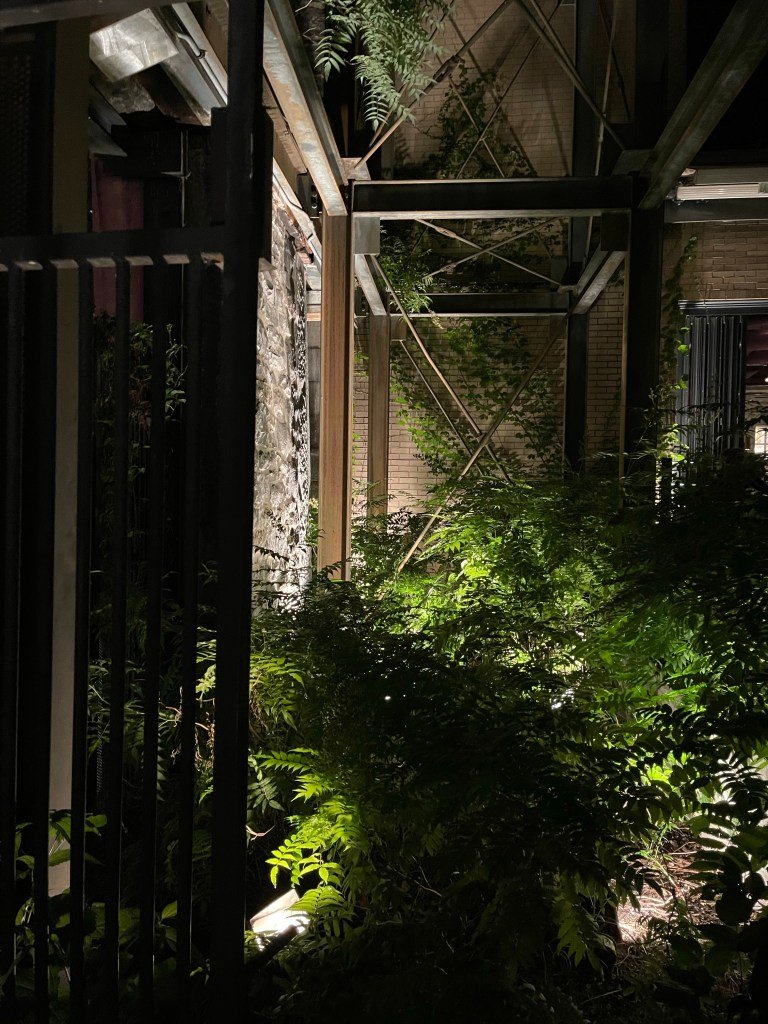
    Photo: Old Montrêal (Shot on iPhone)

  • Façadism in Montréal

    These are photos from the terrace of a restaurant in Old Montreal called Boris Bistro. It’s not new — it’s been around since 1999 — but that doesn’t change the fact that its outdoor space is absolutely magical.

    The terrace sits behind an old stone facade on McGill Street that is held up with a three-storey steel structure. Hello façadism! I have tried to figure out the vintage of the original building through a cursory look online, but I came up with nothing. (Drop it in comment section below if you happen to know.)

    What we were told at the restaurant was that the original building burnt down, leaving just the facade and then an open space behind it. The size of the trees on the terrace do suggest that it’s been this way for a long time.

    There’s an office building beside it that looks to be of a 90s vintage (465 McGill Street) and this open space was apparently a place for office workers to go smoke. But now the ground floor of the office building and the terrace function as one large contiguous space.

    The result is what you see above. Magic.

    Montréal has been city building for a lot longer than Toronto. Some 400 years depending on how you calculate it. This history has created one of the most beautiful built environments anywhere in the world.

  • Unnecessarily confusing communication from the CDC

    I saw a headline yesterday that the CDC was now reporting that vaccinated people can spread COVID just as easily as unvaccinated people. I then thought to myself, “this is not a good headline if you’re trying to encourage people to get vaccinated.”

    What I guess this is saying is that vaccinated people who end up contracting COVID (“breakthrough” cases) have similar viral loads to people who are unvaccinated. So it makes sense that they would then be able to transmit the virus to others.

    But the more important point remains that vaccinated people are less likely to spread the virus to others because they are less likely to actually get it in the first place.

    Yes, the vaccines are not 100% effective. But supposedly the latest hospital data suggests that vaccines remain 87% effective at preventing hospitalization. This, of course, means that some vaccinated people will still get sick and that, yes, they might transmit it to others.

    But for the vast majority of people that shouldn’t be the case.

    Update: My point is that clear and consistent messaging is important.

  • Province reveals vision for new Ontario Place

    Plans to redevelop Ontario Place (here in Toronto) have been in the works for many years, even before it closed in 2012. Supposedly it was losing over $20 million a year at that time. It had obviously lost its relevance.

    Back in 2010 (or thereabouts) I was actually part of a team that responded to an RFP to redevelop the waterfront lands. In fact, I was the human who physically submitted the proposal. I was still patiently waiting to hear back about whether or not we were selected, but based on today’s news I’m going to assume we didn’t get it.

    This morning, the Ontario government announced the following vision (architecture by Diamond Schmitt):

    The team also includes Austrian resort developer Therme, Quebec-based recreation firm Écorécréo, and US-based concert company Live Nation. The proposal itself includes a new outdoor “adventure park”, an indoor spa and waterpark, and a year-round concert venue. Premier Ford has also made it clear that there will be no casino, no residential, and that none of the land will be sold to the private sector.

    That’s essentially all I know about the proposal.

    Water features, palm trees, and a new beach all sound great to me. I just hope that (1) something actually happens and that (2) it is truly remarkable.

  • First ever virtual shoe try-on activation

    Earlier this month Snapchat announced the acquisition of Vertebrae, which is a 50-person company that allows brands to create and manage 3D versions of their products. Why does this potentially matter? Because Snapchat is already doing stuff like this:

    (If you can’t see the embedded video, click here.)

    This was a recent partnership with Gucci that Snapchat is calling the first ever “virtual shoe try-on activation.” The way it worked for the nearly 19 million people that it reached was pretty simple. Point the Snapchat camera at your feet. Try on a bunch of new Gucci shoes. Buy by tapping “shop now.”

    As we all consider what it will mean to go shopping in the future — and what kind of real estate will be most valuable — this kind of innovation strikes me as being a very big deal.

  • Cost of the Olympic Games, 1960-2021

    There are many reasons why one might want to host the Olympics. Brand building is certainly one. Making some kind of profit is another. But the direct economic benefits aren’t always clear. Embedded above are two recent charts from the WSJ outlining 1) the cost of the Olympic Games over the years (the exact numbers are likely debatable) and 2) some of the overruns that host cities have seen. Montreal stands out as an unfortunate outlier with cost overruns exceeding 700%. And Tokyo stands out as being the most expensive games ever. As I understand it, the economics are challenging in the best of times. So one can only imagine what kind of dent the Tokyo Olympics might leave behind.

  • The numerical impacts of inclusionary zoning

    Our cost consultant, Finnegan Marshall, gave our team a presentation today on what’s happening with construction costs in Toronto and across Canada. I’ve said this before, but hard costs are no joke right now.

    One of the areas that they focused on was the impact that inclusionary zoning is likely to have on development economics here in Toronto. To illustrate the point, a sample high-rise condominium pro forma was used. Think something in the 30-35 storey range.

    Assuming a requirement of 10% affordable (the policy details are still TBD), there is going to be a real cost to development pro formas that will need to be somehow paid for.

    One school of thought is that land prices will simply adjust downward. In this case, the landowner would be the one paying. I don’t think this will be the case (land prices tend to be sticky), but if they were to adjust downward, it would need to drop by $44 per square foot buildable to maintain the project’s margins in this example. (That’s $13.2 million on a 300,000 sf project.)

    If, on the other hand, the price of the remaining market rate condominium suites were to increase to offset the cost of the affordable component, they would need to increase by $91 per square foot. This translates, in the above example, into a sticker price increase of approximately $60,000 per suite.

    These numbers are, of course, not exact. That is not the point of this post. Every project is different. But hopefully it gives you an idea of some of the levers that will invariably need to be pulled when inclusionary zoning comes into force.

    My sense is that this latter scenario is more likely to happen. I have yet to see land prices adjust downward in the face of rising costs. So all of this is likely to be bad for broad-based affordability, but good if you want to be bullish on market rate home prices.

  • DDG Partners + GS Invest = Azur

    Last week I wrote about a project in New York by DDG Partners called 100 Franklin. If you missed it, go here.

    I didn’t, however, say much about the developer. Though at the time I was wondering why their website was no longer up.

    DDG Partners is a firm that I have written about several times over the years. They are a firm that I have always admired because of 1) their commitment to design and 2) their vertically-integrated approach to development. They do things like design, construction, and asset management all in-house.

    So I was interested to learn that back in May they announced a merger with French real estate firm, GS Invest. Prior to the union, GS had a portfolio of more than 3 million square feet across Europe. The new investment and development company is called Azur.

    Also interesting is the fact that Azur has started making proptech investments. Their first investment is in a company called Whiterock AI.

    For more about Azur, click here.

  • A new agricultural frontier in Canada and Russia

    Last year over the holidays, I attended a virtual wine tasting event that was put on by one of our partners. It was with a vineyard / winemaker in Spain and so it was evening for us and some ungodly hour for him.

    At the end of the tasting — which was exceptional, by the way — I asked him what he thought about the Niagara region. Some of you may know that I love to support local Ontario wines. His response was hilarious and something along the lines of: “When we think of Niagara wines, we think of a part of the world that shouldn’t produce wine but somehow does.”

    Ouch.

    This was maybe the case before. But I think the region, vines, and industry have all matured. We also have some exceptional winemakers, some of which have come from the Old World because our startup-y wine region affords them far more creative freedom.

    But you might also argue that things are changing because our climate is changing. The Financial Times recently published an interesting “big read” about how agricultural production and crop types are shifting around the world in the face of climate temperatures.

    It turns out that wine grapes are a pretty good leading indicator. A canary in the coal mine if you will. Because climate matters a great deal if you’re trying to make exceptional wines. And if you’ve been harvesting a particular thing at a certain time for the last 5 decades and you’re now doing it several weeks earlier, it might be a sign that something is changing.

    It also turns out that two countries, in particular, stand to disproportionately benefit from this shifting agricultural landscape: Canada and Russia. As temperatures change, a new agricultural frontier is going to be created. And it is expected that more than 50% of this land will be in these two countries. See image at the top of this post.

    Of course, there’s a flipside to this change. Countries on the other end of the spectrum with marginal growing climates and/or low production yields, could be severely impacted by higher temperatures. So perhaps it is a good idea to stay on top of what’s happening in the world of wine. Might I recommend something from Niagara?

    Image: FT

  • Construction is messy

    The typical way to build buildings is through a design-bid-build approach. The way this works is that you first design stuff and create drawings. You then ask people to price the stuff that you have drawn. And then you proceed to build what is on the drawings and what has been priced.

    There are a number of possible risks with this approach. For one, the design/drawing phase is sometimes/often done in isolation without a lot of feedback from the contractor and/or subcontractors. So you might be designing and drawing things that aren’t all that feasible or constructible. Pre-construction involvement helps address this.

    Another risk is that you’re buying what is on the drawings. So if the drawings suck or aren’t properly coordinated, then you are likely opening yourself up to a barrage of change orders and lots of additional costs.

    In theory, it all sounds fine. Here are my drawings and specifications. Give me a price. And then let’s build. But as many or most of you will know, it’s generally never that simple or easy. Though it will, of course, depend on the type and complexity of the project.

    Another consideration is the kind of contract you enter with your constructor. Is it a cost-plus contract, where the constructor simply charges a percentage on top of whatever the costs end up being, or is it some kind of lump sum or guaranteed maximum price (GMP) contract?

    While I was in architecture school I decided to take a class on construction delivery methods. The instructor was, in my mind, your quintessential construction person. He was built like a brick shithouse and he never minced words. He also had a voice that sounded like a subwoofer.

    I wouldn’t say I’m an expert, but I do remember him hammering home two points. One, GMP actually stands for guaranteed minimum price. This is forever imprinted in my mind. You’re never going to pay less and you’re almost certainly not going to pay the “maximum” number. You will end up getting change ordered and paying more.

    Two, lump sum and at-risk contracts create a very different relationship between owner/developer and constructor. In his words, it is adversarial.

    Because if I’m a constructor and I’ve promised a specific number, I’m likely going to do a few things. I am going to inflate the numbers to make sure my profit margin is protected throughout the project. And if my profit margin gets squeezed, which it likely will, I’m going to look for other ways to make money.

    Personally, I side towards cost-plus and construction management arrangements. I don’t want an adversarial relationship. I want a partnership where there’s as much alignment as possible around a common set of project goals. Let’s ride or die together.

    Similarly, when it comes to the actual procurement and delivery methods, I find that we are often using more integrated approaches as opposed to cut and dry design-bid-build approaches. You want the competitive pricing that comes with bidding, but you also want collaboration. It’s about striking that right balance.

    The construction process is a messy one. These are just some of my thoughts this morning. If any of you have any insights, I would, of course, welcome them in the comment section below.