
I can think of at least a dozen buildings in Toronto that use some form of a parking stacker system. And I am seeing firsthand how they are becoming more popular and more commonplace as a result of space constraints, rising costs, and a bunch of other factors. Below is an example of a system that allows you to (almost) triple the number of cars that can be accommodated on a given footprint. However, it does require higher floor-to-ceiling heights and a pit. If you can’t see the video below, click here.
Category: Urbanism
-
We are hiring
We are looking to hire a Project Coordinator to join the Development team here at Slate Asset Management in our Toronto office.
This is an ideal position for someone who is passionate about development and cities; who wants to be part of an entrepreneurial and growing team; and who is able to be hands on and take ownership over what they do.
The Project Coordinator would work closely with the full Development team and support all aspects of project delivery from acquisition to exit/stabilization. Eventually, we want this person to lead a portfolio of their own development projects.
We’re looking for someone with the following skills and characteristics:
- Demonstrated passion for city building, design, and urban affairs
- Experience in real estate and/or development
- Understanding of planning & land use policies, development finance, and design & construction (though, the right attitude and work ethic goes a long way)
- High energy, with the ability to thrive in a fast-paced entrepreneurial environment while at the same time being extremely detail oriented
- Strong communication skills, both written and verbal (well-reasoned opinions are crucial)
- Proficiency in Excel, SketchUp, CAD/Revit and other relevant software considered an asset
- Degree(s) in related field(s)
If you’re interested after reading all of this, please send your resume and cover letter to brandon@slateam.com. Your short cover letter should include why you want to work at Slate, as well as your favorite recent development project (it can be anywhere in the world but make sure to include why).
Alongside this, we would like to see a link/URL that helps us get to know you better. This could be your Twitter or Instagram, a personal blog, a portfolio, or something else that represents who you are. If you don’t have any of these, well then you’ll have to get creative.
Thanks for your interest.
-
The world’s cities by 2030
This UN report (2018) on urbanization trends is a fascinating way to understand how our world is growing and changing. So today’s post is about some of my takeaways. If you have others, feel free to add them to the comment section below.
But first, some definitions.
The UN report considers 3 ways to measure the size of a city, all of which we have used before on this blog. The first is the “city proper.” That is the current administrative boundary of a city. The second is the “urban agglomeration” area, which is a city’s contiguous built-up area. And the third is the “metropolitan area,” which is the approximate area of economic and social interconnectedness.

Above is what these 3 boundaries might look like for Toronto (which is the example they use in their report). About the only one that isn’t debatable is the “city proper” boundary; but it really doesn’t capture the full extent of a city. Wherever possible, the UN report relies on the city’s urban agglomeration area. They also define a “megacity” as a city of over 10 million people.
The largest city in the world is currently Tokyo. However, from 2018 to 2030 it is expected to decline by almost 900,000 people. Whereas, the city in 2nd position — Delhi — is expected to add more than 10 million inhabitants during this same time period. By 2030, these are expected to be the largest cities in the world:

Most current megacities are located in what the UN refers to as the “Global South.” And 9 out of the 10 cities projected to become megacities by 2030 are located in developing countries. The one exception is London. Though all regions in the world are becoming more urban, the real population growth is happening in Asia and Africa.

Most cities — 59% of cities with 500,000 or more people — are at risk of at least one natural disaster. And 3 megacities — namely Manila, Osaka, and Tokyo — are high risk for 3 or more types of natural disaster.

Going through the report’s data charts, it’s also interesting to note that Toronto is not projected to become a megacity by 2030. However, the Toronto area already represents over 20% of Canada’s entire urban population.
In the United States, Chicago’s urban agglomeration is projected to continuing growing and does come close to megacity status by 2030. The Miami region is similarly expected to grow and is actually right on top of Toronto in terms of population. But the fastest growing regions are, of course, expected to be the city’s that can more easily sprawl (Las Vegas, Phoenix, and so on).
Bogotá, Colombia is already a megacity and is expected to add almost 2 million people by 2030. It currently represents about 26.5% of the country’s entire urban population. São Paulo remains one of the top 10 largest cities in the world and is similarly projected to add over 2 million people in the same time period, but to a much larger base.
In Europe, it’s London, Paris, and Moscow, with the latter two already in possession of megacity status.
Now quantity isn’t everything. Despite not ranking in the top 10 in terms of population, both New York and London are widely considered to be the world’s preeminent global cities. At the same time, we do know that the size of a city does create certain socioeconomic benefits. Urban agglomerations create agglomeration economies.
If you’d like to download a copy of the World’s Cities in 2018 (United Nations), click here.
Charts/Maps: United Nations
-
The Joker Stairs
Confession: I haven’t seen the new Joker movie. But it looks quite good and I’ll probably watch it once it becomes available through Apple TV.
I have, however, been reading about all the photographic attention that is now being paid to the “Joker Stairs” that feature prominently in the movie. These are a long set of stairs that connect W 167th Street from Anderson Ave down to Shakespeare Ave in the Bronx. I had no idea the area was so hilly. (Click here for Google Street View.)
Two things immediately struck me about this.
One, these are a perfunctory set of stairs that were previously not given much attention until they were showcased in a movie and ultimately imbued with new symbolism. Put differently, the stairs didn’t change; the cultural context did. This is patently obvious, but it shows that architecture and urbanism are, at the end of the day, symbols.
Two, people, and more specifically local residents, are very grumpy about this new tourist attraction in the Bronx. The sense is that it’s disrespectful. Here is a place where people live and it is being transformed into a backdrop for Instagram photos and internet memes. The message: Leave our neighborhood alone.
I understand where this feeling is coming from. But I am also curious as to the point in which something like this becomes disrespectful. I live in the St. Lawrence area of Toronto, which is home to one of the most photographed buildings in the city: The Gooderham Building. On most days, the median in front of it is filled with tourists, photographers, and Manfrotto tripods.
Now, is this disrespectful to my neighborhood? It certainly doesn’t bother me. But might this be a different situation? Is the difference that the symbol some of us hold for the Bronx is one of grit and decay? Coincidentally, this is something that has been no doubt heightened by the movies.
-
Eliminating single-family zoning
There is something happening in many North American cities right now. We are starting to question the supremacy of zoning for only single-family homes.
This past summer, the state of Oregon passed policy requiring cities of 25,000 people or more to allow duplexes, triplexes, and fourplexes within their single-family home neighborhoods. Minneapolis is poised to do something similar with its Minneapolis 2040 plan (though it has been contentious). And, of course, here in Toronto we recently rolled out laneway suites all across the city. Small scale multi-family dwellings are also already permissible in some areas (though few are being built).
Some are calling this a YIMBY movement. But however you want to define it, it’s an acknowledgement that, if the goal is to built up instead of out, perhaps it’s time we look at the parts of our cities with the lowest population densities. I would also add that following my recent post on Paris vs. Vancouver, many seemed to gravitate (in the comments) toward the Parisian model — even if it did result in over 50,000 people per square kilometer. Density, it would appear, is okay.
While positive, it remains to be seen whether these policy changes will result in a meaningful increase in housing supply. And a lot of that will come down to the details. As I have said before on the blog, the math can be challenging on these sorts of smaller projects, which is why you have smart people proposing things like an “inverse density” rule to help encourage more smaller scale development.
But as the saying goes, sometimes you need to crawl before you can walk. And, if nothing else, there’s certainly symbolic value to what seems to be taking hold across North America right now.
-
Rules for location data
The CEO of Foursquare — Jeff Glueck — published an interesting op-ed in the New York Times today, calling on Congress to regulate the location data industry. Currently, there are no formal rules in place.
In case you’re not aware, Foursquare is one of the largest independent companies operating in this space. I have written about them many times before on the blog.
Here’s an excerpt from Jeff’s op-ed explaining why this matters:
But location data can also be abused. Bounty hunters were able to buy the current location of a cellphone for $300, Vice reported, because telecom companies sold the real-time location of phones to shady companies. And apps that track location data may turn around and sell that data, revealing someone’s every movement — whether it is to a retail store, an abortion clinic or a gay bar. Bloomberg Businessweek recently reported on a company with thousands of cameras selling car locations to debt collectors and others; there is no “opt-in” involved, and it’s illegal in all states to cover your license plate.
I am writing about this today because I think it’s relevant to city building. Location data is inherently spatial. It is how we exist in cities. So it shouldn’t come as a surprise to any of you that this is valuable information — hence why it is being abused.
Here we have a company advocating for more, not less, regulation. They, of course, want it to be sensible. But I still think it says things about the current location data environment. To learn about the specifics of what Jeff is proposing, click here.
-
New mural coming to Yonge + St. Clair
A new mural is underway at Yonge + St. Clair by the Toronto-based street artist birdO (aka Jerry Rugg). He started over the weekend and should be finished by next week, depending on the weather. Here is what it looks like so far:

If you’d like to take a look in person, head on over to 1 St. Clair Avenue East. It’s the building at the southeast corner of the intersection. And if you’d like to learn more about birdO, here’s a short film about some of his work in Detroit. It’s really well done.
If you can’t see the video above, click here.
-
Paris and Vancouver population densities compared
In this January 2018 report from the Fraser Institute, they pegged the average population density of Paris to be about 21,067 inhabitants per square kilometer (2014 population year). It is the second densest city in their report after Hong Kong, but the densest in Europe. By comparison, Vancouver sits at around 5,493 inhabitants per square kilometer (2016 population year).
Now, these are of course city averages. Some neighborhoods will be higher and some will be lower. According to a January 2018 study by Alasdair Rae — who is a works in the Department of Urban Studies and Planning at the University of Sheffield — these are the most densely populated square kilometers across Europe (or at least within the 39 countries that he looked at).
Paris, once again, comes in near the top with a peak density somewhere around 52,218 inhabitants per 1km square. The square in question is in the neighborhood of Goutte D’Or. And the only square within the study to come in denser is one from the L’Hospitalet de Llobegrat in Greater Barcelona (53,119 inhabitants per square kilometer).
Now let’s take a look at how these sorts of densities actually manifest themselves. Below is an aerial capture from Google Maps showing a section of Goutte D’Or in Paris. The buildings are all pretty much 7 storeys (mid-rise), but the blocks are mostly filled in. Lots of interior courtyard apartments. This is one way to get to over 50,000 people per square kilometer.
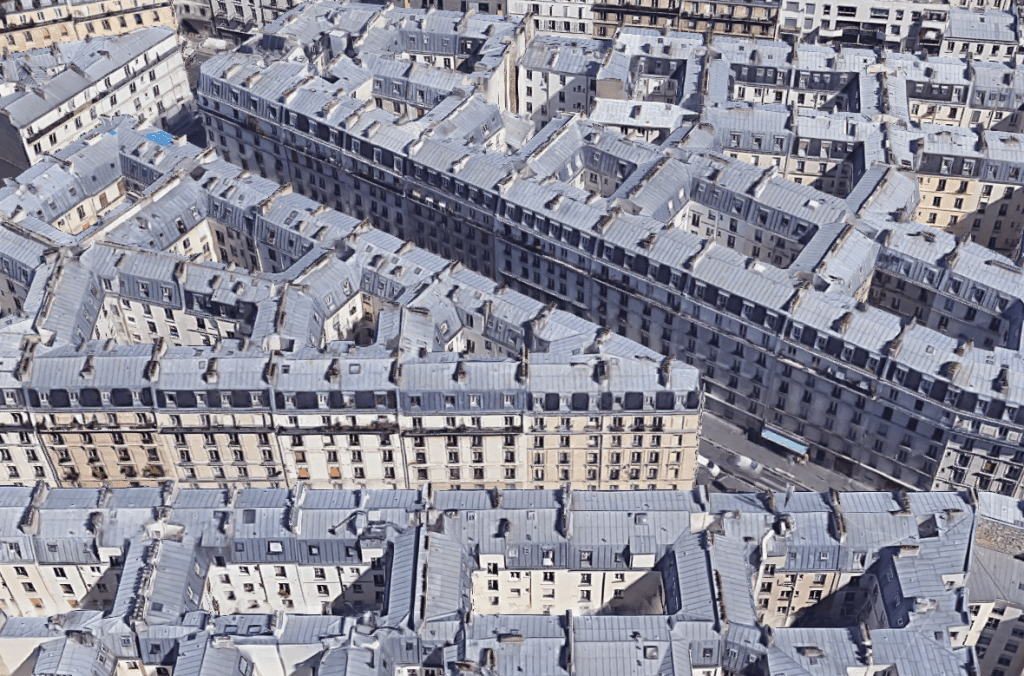
Returning to Vancouver as a point of comparison, below is an aerial capture from downtown Vancouver at exactly the same scale as the Paris capture. I couldn’t find a density map of downtown, but it’s probably safe to assume that it’s greater than 5,493 and a lot less than 52,218 residents per square kilometer.
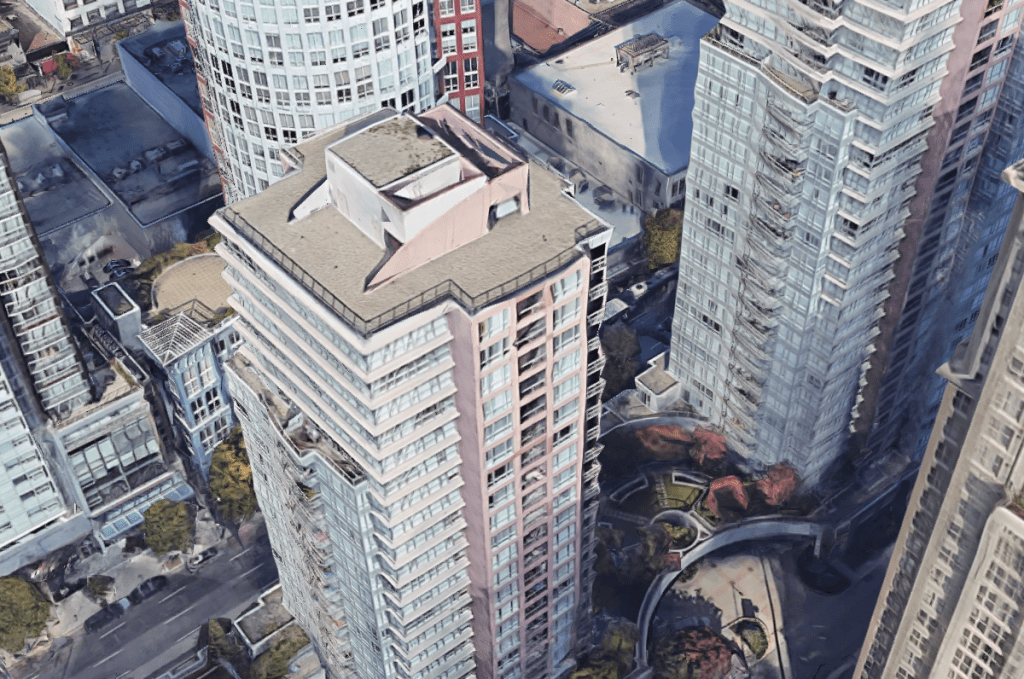
What you see here is typical Vancouverism. Lots of slender point towers, careful tower positioning and spacing, and generally low podiums. It is a perfect demonstration that height and density do not necessarily correlate. It is possible to have low buildings and high density, which is something that Europe obviously does very well.
But here’s the important question: In which of these two examples would you rather live? Please leave a comment below.
-
Minimum project size — how small is too small?

Many, or perhaps most, developers I know have a minimum project size that they will work on. That’s why you’ll hear people say, “No, that project is too small. I need at least X square feet or Y number of units.” Given that smaller scale development such as laneway housing and “the missing middle” are so in vogue today, I thought I would discuss some of the reasons why scale matters.
But first, it’s worth mentioning that “laneway suites,” as we have structured them here in Toronto, are intended to be built by individual homeowners and not by developers. The lots can’t be severed and most lots will yield less than 1,000 square feet. So this is a bit of a unique circumstance. As most of you know, I am a big supporter of this initiative.
When you get into larger developer-led projects, it’s a different ball game. For one, it’s hard to even find sites. And good luck if you need to deal with multiple owners as part of an assembly. Most landowners have pricing expectations that do not even remotely align with “missing middle” level densities.
But assuming you’ve been able to find land at a reasonable price, you still have to contend with the fact that projects have a lot of fixed costs, as well as diseconomies of scale. In other words, there are schedule, cost, and resourcing considerations that won’t change no matter how big or small you go. It’s still going to take this long and cost this much, and you’re still going to need a set of humans to manage it through.
This can then create a situation where there’s not enough margin for error. The project is simply too small to absorb any shocks, such as an unforeseen delay or an unforeseen groundwater concern that is now adding millions to your project budget. There’s a lot of risk with development and it’s prudent to have contingency room. That’s harder to do with smaller projects.
The other problem developers run into with smaller projects is that the construction subtrades also tend to think of them as smaller projects. They have their own set of fixed costs and margins to worry about. So unless you happen to catch them with an opening in their schedule, you run the risk of them telling you they’re too busy or them giving you a stinky price, which is just another way of them saying they don’t want the job.
On top of all this, there’s minimum project size inflation. If capital is not a constraint, there’s a tendency to want to do bigger projects (see above). And because the cost of everything keeps going up, it’s simultaneously getting harder and harder to make smaller projects pencil; unless you, maybe, go ultra luxury and ultra exclusive. But that’s kind of the opposite goal of this whole “missing middle” movement, is it not?
Photo by JOHN TOWNER on Unsplash
-
The Central Arizona Project
Phoenix is the 5th largest city in the United States. It has a city proper population of about 1.6 million people and a metro area population of close to 5 million. It is also one of the fastest growing cities in the US.
But being the desert city that it is, its population consumes more water than its natural aquifers can support. Which is why there is something called the Central Arizona Project (CAP).
Approved in 1968, the CAP diverts water from the Colorado River into the state of Arizona. The system is 336 miles (or 541 km) and it runs from Lake Havasu to Tucson, via Phoenix.
Here is an aerial image of the canal from Wikipedia Commons:

And here is a system map from CAP:

Today, it is the single largest water source (and consumer of power) in Arizona, serving about 80% of the state’s population. This obviously makes it invaluable. It delivers on average about 1.5 million acre-feet of water per year. (Acre-foot = Acre of area x one foot in depth.)
I was reading about this project today and I found it fascinating. Maybe some of you will too.