Daily insights for city builders, delivered every morning at 6 AM ET. I’m Brandon Donnelly — a Toronto-based real estate developer and founder of Globizen. I’ve been writing here since 2013.
We were having pizza at Davanza’s the other night and I started flipping through one of those real estate magazines that you find scattered around places like Park City.
Now, more often than not, when I come across a house listed for tens of millions of dollars, I usually look at it and think to myself, “okay, I know this is a really expensive home and it is likely that someone will want to buy it, but I objectively don’t like it.”
However, as I was flipping through the magazine, I came across this listing and instead thought, “hey, this is actually a really cool house.”
Designed by Wallace Cunningham, the 8,000 sf home features a cascading roof line that looks like an “S” in plan. (It also seems like all of the interior spaces were laid out in service of this plan design, which, depending on your own architectural proclivities, could be considered either a perfectly fine thing or an arbitrary thing.)
The Prohibition on the Purchase of Residential Property by Non-Canadians Act — which came into effect in January of this year and bans foreigners from buying residential real estate in the country for two years — is weird.
We can debate whether banning foreigners from buying residential real estate is really helpful for housing affordability and if it’s the most impactful place to focus our attention (and we have talked about this many times before), but the part that is particularly odd is this feature here:
…the law’s definition of residential property includes land that is zoned for residential use or mixed use, which covers huge swaths of commercial land across the country. As well, an entity is deemed foreign if a non-Canadian owns a minimum of 3 per cent of the entity.
What this means is that the following scenario is now technically a problem (not actual legal advice!):
You own a commercial property with zero homes
You have long-term commercial leases in place that also generally preclude you from building new homes in the foreseeable future
The zoning of your property allows for residential uses (which you like having in your back pocket)
And your cousin from Italy owns 3% of the entity that owns the real estate
This is a scenario where residential homes do not exist and they are unlikely to exist any time soon. It seems clear cut, but I suppose one could argue that it’s exceedingly onerous to try and figure out which sites are soft sites and could actually be developed with new residential. And so if you have the potential to build and then own residential, you should be regulated as if you might ultimately own some of it one day.
But even here, I don’t know why we would want to restrict the supply side of the housing equation. If you’re a developer in Canada where housing is known to be kind of expensive and you want to build more of it for Canadians, isn’t that a good thing? And isn’t it also a good thing if we can get some non-Canadians to help pay for these new homes?
Michael Beach used to have a YouTube channel where he “looked at Google Maps a lot.” Meaning, he would pan around various cities and comment on their planning and overall built form. Technically the channel still exists, but he stopped making new videos a few years ago. Here is one where he talks about Dubai being “an absolute mess” (3.8 million views) and here is one where he looks at North York (in Toronto) and asks: “why is it here?”
The most important point from his North York video is that it illustrates the deep divide that exists in Toronto (and other North American cities) between single-family “Neighbourhoods” (a defined planning term) and higher-density transit nodes, where things like tall buildings are allowed to go.
In the case of North York, this contrast is perhaps at its most stark. Even the street network is designed to stop these two urban forms from commingling with each other too much. There are ring roads that surround the transit-oriented density, and separate, more suburban streets on the other side of it:
This contrast is why there are so many people talking about the “missing middle.” And I’m sure that if you started asking random people on the street, most would agree that it would be nice if we could build more moderately-scaled housing. You know, like those buildings you see in Paris.
The problem: Where should it go? Some people would probably suggest the left side of the above ring road. Just don’t build as tall, okay? But this kind of land is already a scarce commodity in a city like Toronto. We need these tall buildings because most of the city is codified to look like the right side of the above ring road.
So if we have any chance of actually finding the missing middle, it is going to need to happen here, on the right side. Some progress has been made, not just in Toronto but across North America, with accessory dwellings (laneway suites). But it’s not going to be enough.
This was simply a first step. It was us finding a solution to, “how can we add some more housing here without changing the look and feel and character of these residential streets in any way?” But even this small and incremental change has proven to be exceedingly controversial. People still react to new laneway suites like this:
If you’re a homeowner that decides to create a new rental home at the rear of your property, you might be viewed as greedy. You are creating something (a home) that someone needs, and you intend to make a small margin on the transaction. It’s like making and selling bread for a small margin, except that selling delicious bread to people is typically viewed in a positive light. On the other hand, ensuring that the value of your house remains as high as possible is generally good practice here. Greed doesn’t factor in this way because, you know, single-family homes.
There is no surprise why the missing middle is missing. It is missing because we have decided that we want it to be. But hey, $2,145 per month seems like a very reasonable price for a 2-bedroom house.
There’s lots of data out there to suggest that there is a correlation between urban density and housing unaffordability. Take Hong Kong. It is very dense, and also one of the most expensive housing markets in the world. But I think the real question is: does urban density actually cause housing unaffordability, or do the two simply tend to be correlated when you plot a country’s biggest cities?
One the one hand, there are factors that do drive up home prices when you build more densely. Building a reinforced-concrete high-rise is always going to be more expensive on a per square foot basis than building a wood-framed bungalow. But of course, the former also uses land a lot more efficiently, which is what you need to do in big and supply-constrained cities.
Michael Lewyn’s view (credit to Robert Wright for sending me the article) is that density is incorrectly used as a scapegoat to fight compact development. It does not actually cause higher rents. One counter example he gives is that of Manhattan, which went from 2.3 million people in 1910 to just under 1.7 million in 2020. In other words, it got less dense, while at the same time its rents grew exponentially.
Like most important city matters, the answer is complicated. But this is an interesting topic that I think we should spend more time on here.
Architectural Digest has just published the perfect article for gratuitous self-promotion. It is a list of “the 12 best design districts around the world”, and it includes The Junction, here in Toronto:
Located in a tree-lined historic area of the city, The Junction gets its name for its past as the heart of the Canadian Pacific Railway. Mix with locals on the main drag of Dundas West at boutiques including the minimalist homeware store Mjolk and modern stationery shop Take Note. A short 20-minute walk from this charming retail center, the Museum of Contemporary Art is worthy of a stop in too. (Current exhibitions include a site-specific commission by artist Sarah Badr and Seeing the Invisible, an augmented reality experience in the museum’s Jerusalem Botanical Gardens.) Then take a tipple at The Junction Brewery, which serves local craft beers within an Art Deco building that offers a glimpse of the neighborhood’s rich history.
Early on in high school, I used to come downtown to primarily do two things: skateboard and walk Queen Street. This was the street. It was weird and artsy and we loved it. And so we would start at University Ave and walk west for as long as the street was interesting.
For a period of time, it felt like things kind of fell off after Spadina Ave. So we would often stop there. But then west of Spadina started getting cool and interesting too.
Years later in 2004, the Drake Hotel would open up on what felt like a far off location on Queen Street. And then seemingly overnight, all of Queen Street was cool. Parkdale had a taco place with absurdly long lines and loud hip-hop music, and cool started moving up Ossington Ave, presumably because Queen had run out of space.
Of course, neighborhoods have cycles. Before it was the Drake Hotel, it was Small’s Hotel. And when it opened in 1890, it was located in one of the wealthiest areas of Toronto. Then the area became a lot less wealthy, and eventually the hotel became a flophouse, before once again becoming cool again. These are the cycles.
There is no doubt that Queen Street remains one of the greatest streets in Toronto. But in my mind, 2018 was a turning point. This is when when the Museum of Contemporary Art (MOCA) left Queen and moved to the Junction Triangle (or the Lower Junction, or just the Junction, depending on what you prefer to call it).
This to me didn’t signal that Queen had in any way peaked. Far from it. But I think it did solidify the Junction as one of Toronto’s next cool and artsy neighborhoods. And now here we are with Architectural Digest calling it one of the best in the world.
It would be hard for me to be more biased. But I’m a big fan of the Junction. And I am really looking forward to erecting our placemaking art later this year. It is one of the things that our team is most proud of, and we proposed it simply because we thought it would be cool and interesting. That’s important.
Each year in March, Knight Frank publishes something called, The Wealth Report, which typically includes things like its Prime International Residential Index (PIRI) and a general overview of what ultra high-net-worth individuals (UHNWIs) are up to with their money.
(An UHNWI is typically defined as someone with a net worth greater than $30 million. And as of last year, there were nearly 400,000 of them around the world, with Hong Kong being the city with the most.)
In anticipation of this year’s report, Knight Frank has just published the key findings of an “Attitudes Survey.” This is them talking with and surveying private bankers, wealth advisors and family offices about some of the key themes for 2023.
Here are a few of my takeaways:
Globally, about 1/3 of UHNWI wealth is allocated to primary and secondary homes. This is expected. Generally the richer you become, the more your net worth gets diversified away from your primary residence. It is also worth noting that of this 1/3 allocation, more than a quarter is being held outside of their country of residence. This outside-of-country-of-residence percentage is highest for UHNWIs in the Middle East (41%).
The average UHNWI owns 4.2 homes around the world, with UHNWIs in Asia owning the most: an average of five homes. This is the kind of stat that might provide motivation for a foreign buyer ban, but I continue to believe that there are other bigger drivers impacting housing affordability/supply across our global cities.
About 15% of UHNWIs said that they want to purchase a residential property this year (2023). This is down from 21% last year. Inline with bullet point number one, the greatest appetite/stated intent is coming from the Middle East. (Related article: The new Gulf sovereign wealth fund boom)
Real estate was identified as the top investment opportunity. About 1/3 of UHNWIs want to invest in real estate — either directly or indirectly — in 2023. And the top asset classes are: healthcare, logistics/industrial, office, multi-family rental apartments, and hotels. It is interesting to see office in the top three. A positive sign that it is maybe being viewed as an oversold opportunity.
Finally, environmental sustainability is being increasingly considered by UHNWIs when it comes to investment properties: 57% are considering energy source(s), 33% are considering opportunities for refurbishment, and 30% are considering the materials used/the embodied carbon footprint inherent to the asset.
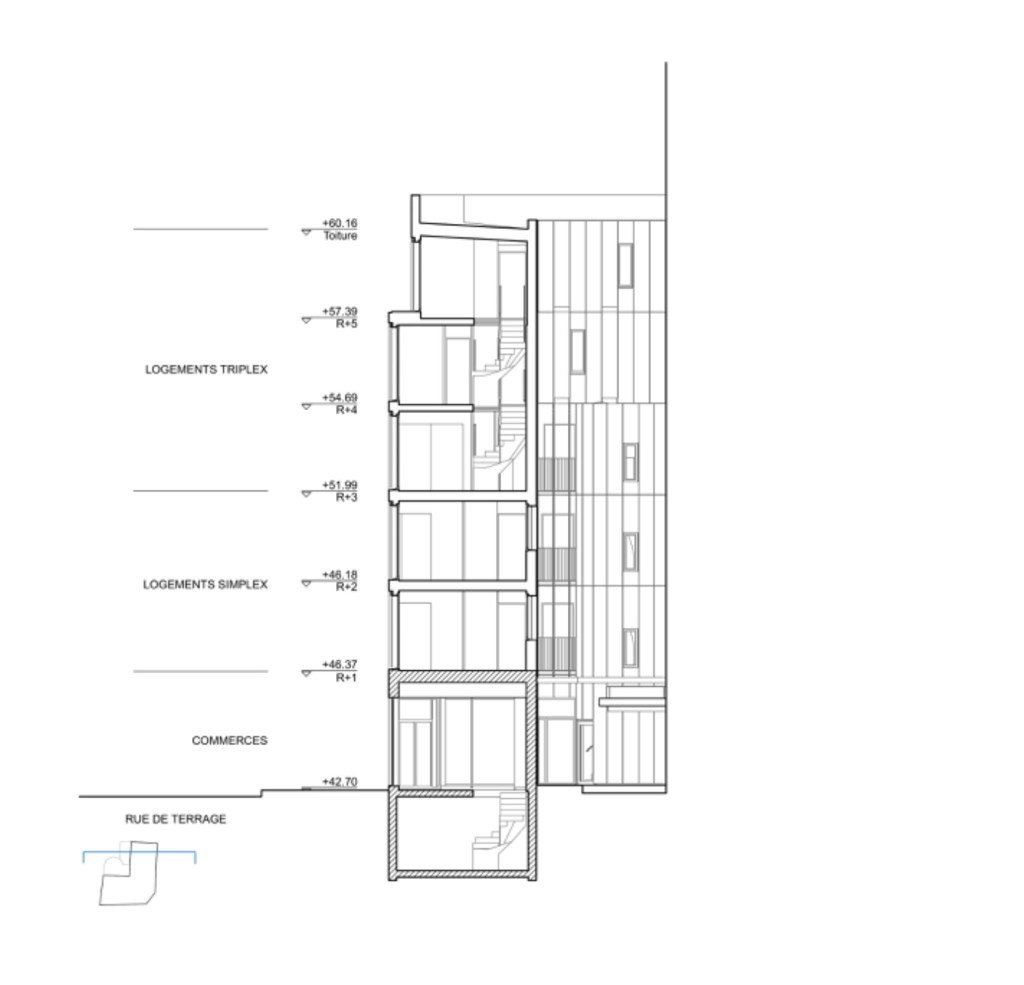
But here’s where things get really remarkable: the area of this corner site is less than 100 m2 (~1,000 sf), the construction budget was €940,000 (excluding VAT), and almost the entire structure was built out of cross-laminated timber. So overall, this is an incredibly sustainable build: it uses land and services efficiently and it uses low-carbon materials.
At this point, you should now be wondering, “why can’t we just do this everywhere?” And this would be the right question.
Lloyd correctly points out in his article that one of the things that makes this building feasible is that it only has one exit stair (as well as no elevator). Typically you need two means of egress, which can serve as a real barrier to smaller builds like this one here.
But in this case, and this is part of the argument, the building is small enough that, should a fire or emergency happen, occupants could be rescued through their windows. So technically there are still two ways of getting out.
In this year’s predictions, I mentioned that we would see “supportive building code changes”, which would help to encourage more infill housing. Exiting is one of the changes I had in mind when I wrote the post. So here’s hoping that policy makers are reading this blog, looking to projects like this one in Paris, and recognizing the benefits.
Talking about exit stairs may not be as exciting and seemingly impactful as something like a foreign buyer ban, but I promise you that removing the many barriers to building this scale of housing would ultimately bring more benefit to our cities.
Here is an interactive map, created by the Robert Redford Conservancy for Southern California Sustainability, showing the approximately 1,573,777,062 square feet of industrial space that can be found in Los Angeles, Riverside, and San Bernardino.
The map allows you to zoom in on specific parcels to see things like site area, warehouse size, and year built. You can also play around with different map radii to create a rollup of warehouse space within a specific area, which includes an estimate of daily truck traffic and CO2 produced.
The Guardian also used this data to create the following chart, which is helpful in showing the dominance of certain cities, as well as how much of this industrial space has been built since 2010:
The point of this interactive map, this data, and the accompanying articles is to highlight just how disruptive all of this new industrial space is to these southern California communities and to the environment in general. But I think it is also an important reminder that, whether we like it or not, our online activities have real-world physical implications.
Online shopping requires warehouses and logistics. Online food delivery requires (ghost) kitchens. And online activity, in general, requires the storage of unprecedented amounts of data. All of these “back-end spaces” take up room, even if they’re mostly easy to ignore when we’re just looking at our phones.
This is our new “phygital” world and, yes, it is changing the landscape of our cities. Now our task is to figure out how to do this in a way that respects communities and respects the environment.
The delegates insisted on one hand that “housing is for living not speculation”, but on the other, emphasised the critical importance of real estate to China’s economic growth.
In other words, things are complicated. We want housing to be affordable to more people, but at the same time, we recognize that housing appreciation is kind of useful for overall economic growth. So we’re a bit conflicted. And that may be why we tend to take contradictory actions.
Canada’s new foreign buyer ban came into effect on January 1 of this year. And for the next 2 years, it prohibits companies and people who are not Canadian citizens or permanent residents from acquiring non-recreational, residential property in Canada. (What is the definition of non-recreational?)
While this may sound good to some — finally, more homes for Canadians — we’re talking about a relatively small portion of the market, which is likely why there’s also little evidence that any of our foreign buyer taxes have been all that effective.
It’s really hard to imagine this one working much better. But it certainly sounds like something.
The central bank tightening and interest rate hikes that we saw last year will come to an end in the first quarter of 2023 as inflation gets under control. This will ultimately lead to a recession but my sense is that it will be more mild than severe. For this reason, I don’t think anyone should expect ultra-low rates to return in the short-term.
Much of the real estate sector went on pause in the second half of 2022. But ultimately this reset to a more balanced market is going to be necessarily painful for some. And I think we will see that pain play out in the first half of the year. This will obviously be bad for some, but it will create opportunities for others.
Construction costs tempered in the second half of 2022 and started to show some evidence of price softening. I think we will see more of this in 2023, which will be healthy for the market. Cost management over the last few years has been a meat grinder for the development industry.
Pre-construction condominium sales for well-located projects will return in a more fulsome way by the spring. This will be driven by buyers now having clarity around where interest rates will be hanging out in the short-term and, in the case of Canada’s largest cities, by record-high immigration levels.
For the tertiary/fringe housing markets that saw big run ups in pricing during the pandemic, I unfortunately think it will take many years for prices to fully rebound. The price increases we saw in these submarkets were of course a result of low rates, but it was also driven by a view on urban decentralization that in my view did not actually materialize.
The desire to add more housing to single-family neighborhoods will continue to pick up steam across North America. How exactly this plays out will be market specific, but in Toronto I expect to see new planning policies put in place, as well as supportive building code changes.
Public transit ridership will remain below pre-pandemic levels throughout 2023. This will continue to exacerbate public finances.
Autonomous taxis will grow rapidly this year. Companies, such as Cruise, will expand into a number of new US markets and, at some point during the year, I will take my very first ride in an autonomous vehicle.
2023 will be a big year for augmented reality and “phygital” goods. Last year I thought Apple would release a new product in this space. That didn’t happen, but it will this year. At the same time, we will see more companies releasing products that blur the lines between our online and offline worlds (hence “phygital”). This will include NFTs and other crypto-related things that will start to operate more seamlessly in the background of consumer-facing products/services.
I continue to be bullish on Ethereum and I think it will overtake Bitcoin in terms of market cap in the next 2-3 years. But I was very wrong about Solana last year. And now I am struggling with its value proposition. Today, layer 2 chains such as Polygon feel more likely to win out. Broadly speaking, I suspect 2023 will be a positive year for crypto, but not a record-setting one.
In summary, I think we are going to see more pain at the beginning of 2023, but that on the other side of it will be healthier and more balanced markets. This means that we can look forward to the end of the year feeling much better than it does right now. All of this said, please keep in mind that I’m often wrong and that nothing in this post should be construed as actual advice.