Daily insights for city builders, delivered every morning at 6 AM ET. I’m Brandon Donnelly — a Toronto-based real estate developer and founder of Globizen. I’ve been writing here since 2013.

Category: Paris

  • How a Napoleonic wine tax created Paris’s favorite swim spot

    June 23, 2026 · View original


    Paris is experiencing a heatwave at the moment and so my social feeds are naturally filled with people dressed as Spider-Man jumping into the Canal Saint-Martin. First and foremost, it’s great to see so many people swimming in an urban body of water. I think this is quickly becoming table stakes for cities, which is why, last year, Globizen became a signatory to the Swimmable Cities Alliance.

    Though, to be fair, many or most urban bodies of water, including the Canal Saint-Martin, are clean sometimes, and less clean at other times. It depends on the precipitation levels and whether any combined sewers have backed up. But today, it’s clean and Parisians are enjoying themselves.

    Now, here’s a quick history lesson. The Canal Saint-Martin was initially constructed as a freshwater solution to poor drinking water and overall sanitation concerns in the centre of Paris. Napoleon I ordered the construction of the 4.6 km canal connecting the Canal de l’Ourcq to the River Seine in 1802 and funded it with a new wine tax (of course). Construction lasted until 1825.

    By the 1860s, Napoleon III and his urban planner, Baron Haussmann, had started their large-scale overhaul of Paris, and Haussmann viewed the canal as an inconvenient feature getting in the way of his preferred urban design. So he buried nearly half of the canal underneath a massive, vaulted brick tunnel. This continues to exist today, and one of these days I’d love to do a boat tour through it.

    By the 1960s, boat traffic had dwindled on the canal and urban planners at the time proposed what urban planners at the time proposed, which was to fill it all in and create a four-lane highway. As I understand it, the French equivalent of Jane Jacobs wasn’t there to stop such a project from going ahead; it was instead simply an issue of finances.

    Whatever the case, it gave the canal and surrounding area the opportunity to transform from a gritty industrial relic into the trendy Parisian bobo district that it is today. Like many aspects of the modern city, utility and industry are giving way to leisure and lifestyle. This would have been impossible to predict at the start of the 19th century, and it could have very easily turned out differently.


    Cover photo via Wikipedia

  • The Atlas of Greater Paris

    May 16, 2026 · View original


    Occasionally, writing a daily blog has its perks.

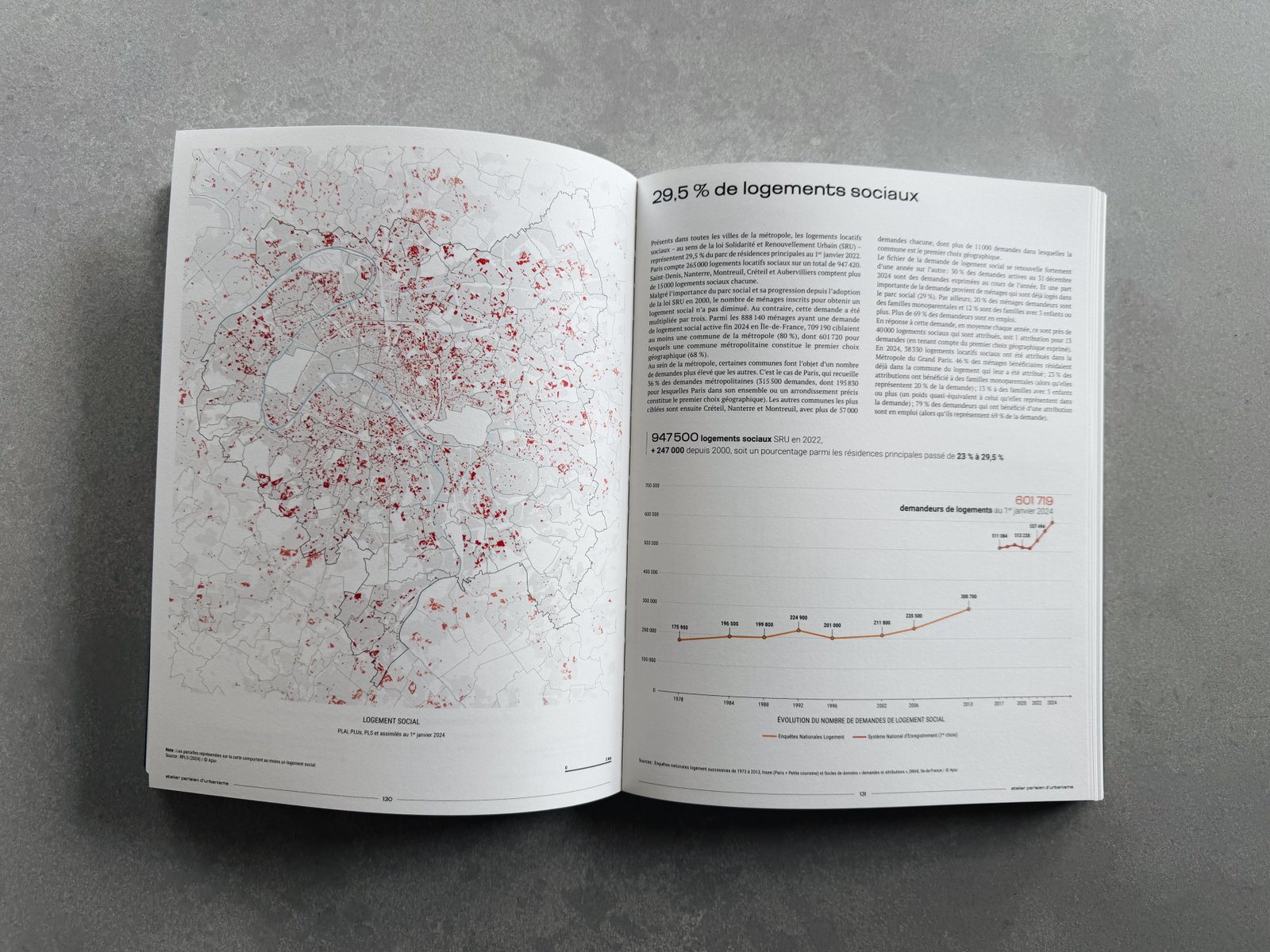
    Last month I wrote a post called “The radical transformation of Greater Paris” and, in it, I mentioned that Apur (a French non-profit focused on urbanism that I follow) had just published a new book called Atlas de la Métropole du Grand Paris.

    I also mentioned that I hadn’t been able to find a shop that would ship to Toronto, but that if anyone happens to be in Paris, it’s available in bookstores over there. Volume is apparently a great store for people who like the kind of things we talk about on this blog.

    Following the post, I got an email from Ryan Taylor at Parcel Economics who more or less said, “Hey, I’m leaving for Paris soon. Want me to grab you a copy of the book? I’ve learned a lot from your blog over the years and thought I would offer.”

    Now I have the book:

    Ryan, thanks for transporting what is a fairly substantial book across the Atlantic. If any of you are in need of a land economist, reach out to Ryan and the folks at Parcel Economics. He’s both a nice and smart guy.

    Enjoy the long weekend, everyone.

  • Paris has really small garbage rooms

    May 9, 2026 · View original


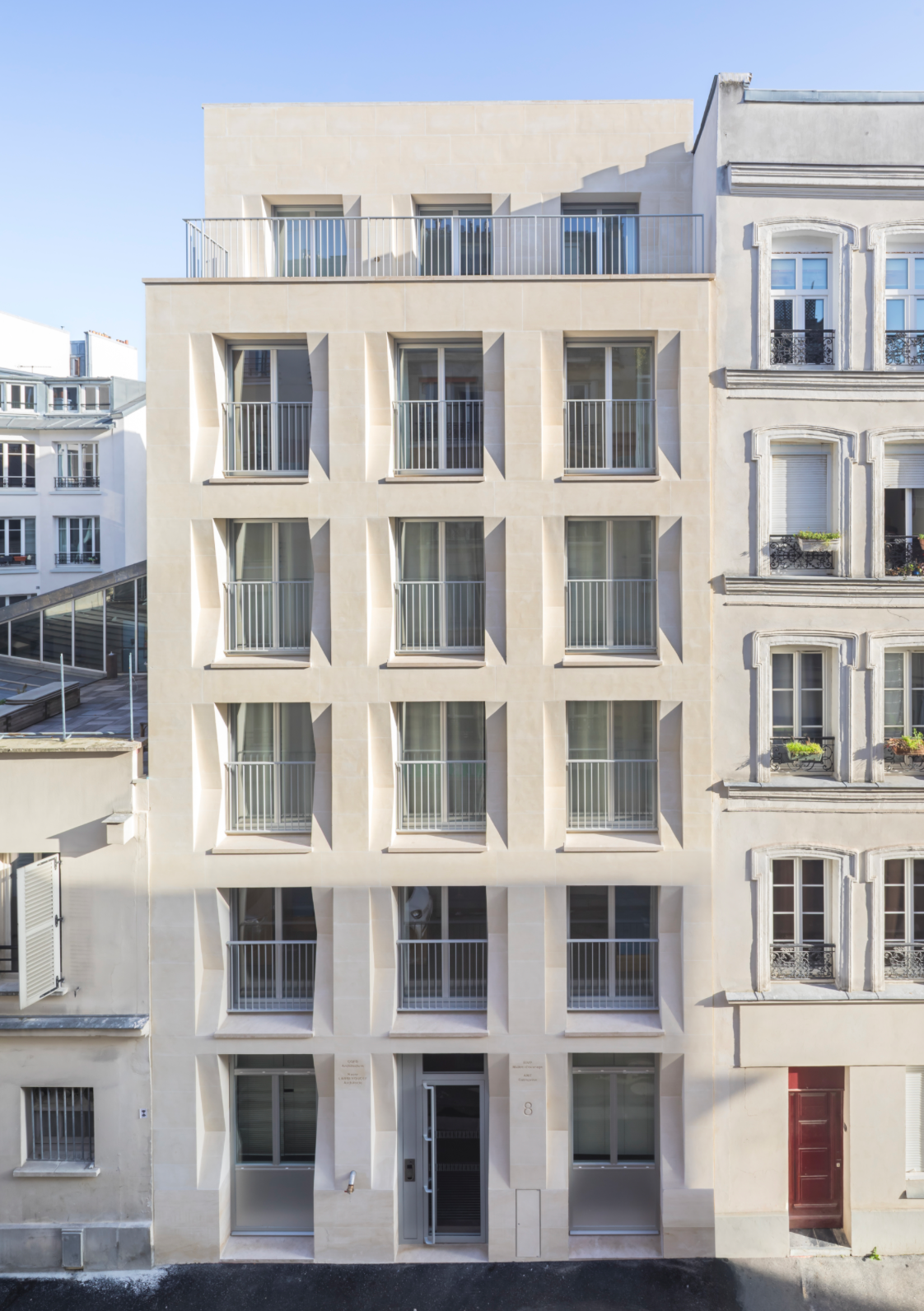
    In today’s episode of “this social housing project in Paris looks better than most market-rate housing elsewhere,” we’re looking at a recently completed boarding house in the 17e by CQFD Architecture.

    The project has 6 storeys, a total area of 690 m2, 19 units, and a hard cost budget that was approximately €2.6 million (excluding tax). At this number, their hard costs work out to ~€3,768 per m2, ~€350 per ft2, or ~C$563 per ft2. So this was not a cheap build. Here’s what it looks like:

    When I first saw the project, I thought the total area would be larger than it is. At 690 m2, it’s basically the size of a multiplex project here in Toronto. Except here in Paris, they’ve gone vertical and they’ve managed to fit 19 studio apartments, plus amenity space.

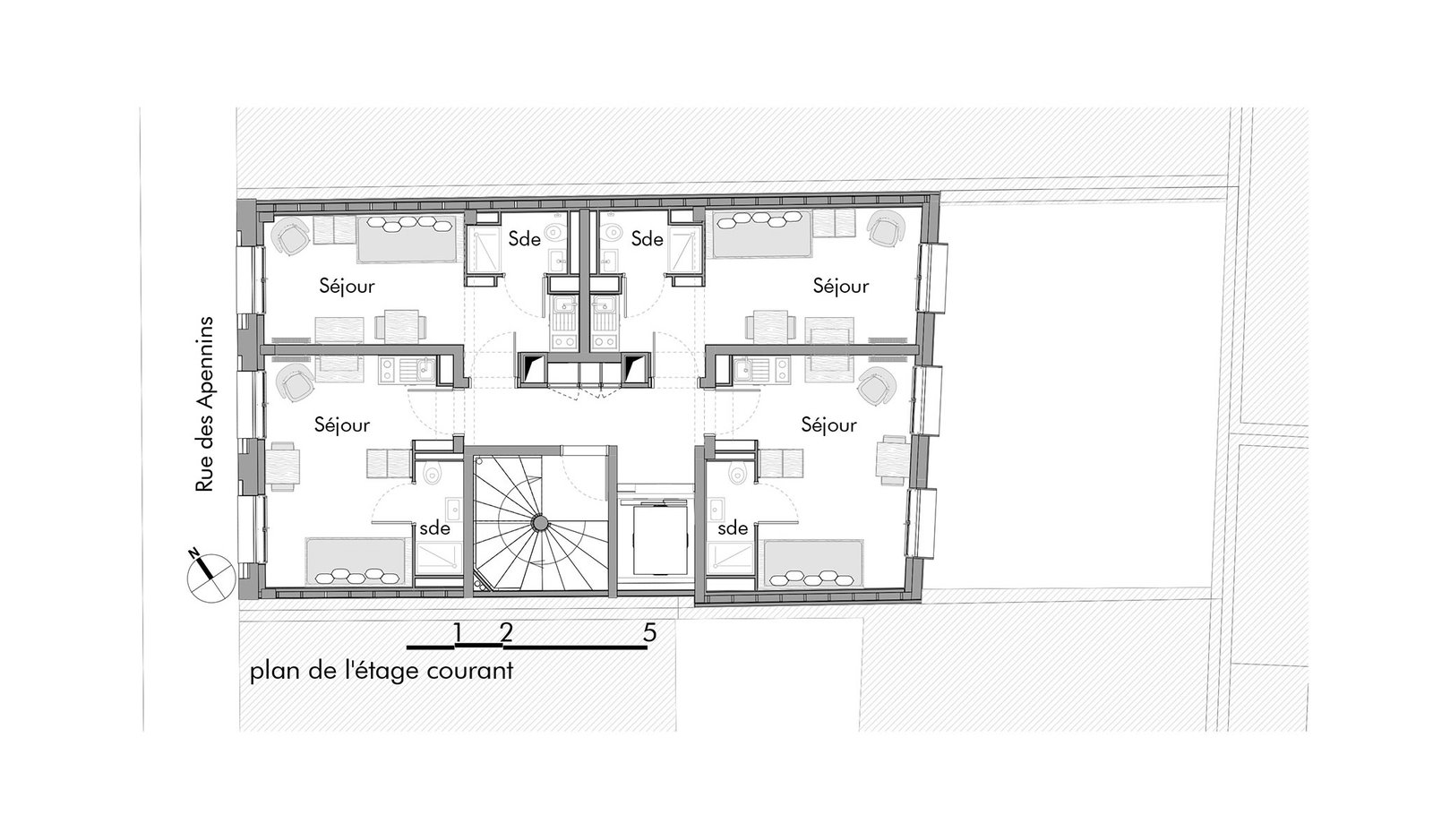
    All of this is possible when you consider the efficiency of each floor plate. The typical floor includes 4 apartments, one stair, one elevator, and a short corridor. Add in a second exit stair and all of this blows up.

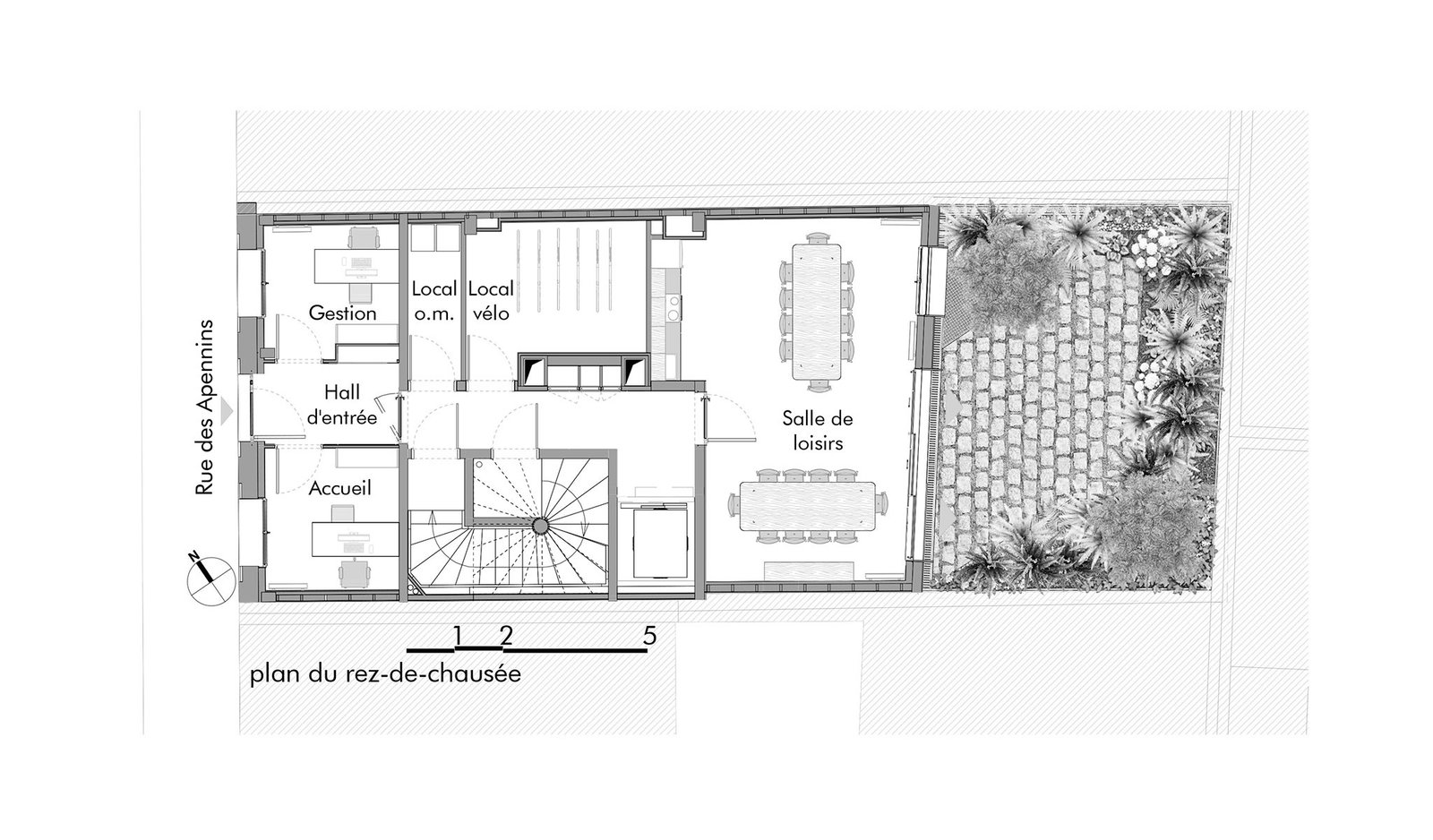
    Also interesting is the efficiency of the ground floor. There’s an entrance hall, management office, bike room, recreation room, outdoor garden, and a teeny tiny garbage room (“local O.M.” on the plan). As I understand it, this is all that’s required for refuse because of how frequently it’s picked up.

    If this were in Toronto, we’d probably need a dozen bins, meaning that the bike room and/or recreation room would need to shrink down.

    I love dissecting plans and dimensions from different cities because it shows you the invisible hand of building codes, planning policies, and cultural norms. We get accustomed to certain conventions and then we assume that it’s simply the way that things must be done.

    But the rules we have are simply the rules that somebody decided to create. As Steve Jobs once said, “Everything around you that you call life was made up by people that were no smarter than you.” This implies that everything can be questioned and ultimately changed when there’s a better solution.


    Photos from CQFD Architecture

    Floor plans from Metalocus

  • The movable icon of Paris

    April 27, 2026 · View original


    Movable chairs have been a feature of Parisian parks since the 18th century. Chairs are more comfortable than benches, and movable ones allow you to direct yourself toward the sun, cluster in groups, or just situate yourself so that you can prop your legs up and read a book.

    Now, here’s a brief story of how this came to be.

    At the outset of this innovation, park chairs weren’t free. If you wanted a bench upgrade, you had to pay. Private concessionaires would rent them out to visitors (like umbrellas at a beach), maintain them, and presumably ensure that things were kept generally tidy around the grounds.

    Then, around 1923, the iconic green Sénat chair was designed by the Ateliers de la Ville de Paris. If you’ve ever been to Paris, you know this chair (see cover photo). It comes in only three models: chair, armchair, and recliner, all of which are green. RAL 6013 green, to be exact.

    Eventually, the Sénat chair was imposed as the Parisian park chair. By 1955, it was the only possible option that could be rented out by concessionaires in places like the Jardin du Luxembourg. This set the stage for it to become one of the most recognizable symbols of the city.

    But due to the popularity of these chairs and the fact that people would rather not have to pay to sit in a park, it was decided in 1974 that the chairs should be free, and they were bought from the concessionaires.

    In 2002, Frédéric Sofia designed an offshoot of the chair called the “Luxembourg.” The Luxembourg is made of aluminum, as opposed to steel, and is therefore lighter. It’s also available for sale to the general public, whereas the Sénat chair is exclusively for city parks.

    The result of this centuries-long tradition is an iconic symbol for the city and an established culture of employing movable chairs in public spaces. A humble movable chair may not seem like a big deal, but in the world of public spaces, it is.

    Try to incorporate movable chairs into a park or public space today and, invariably, someone will tell you that it can’t or shouldn’t be done. They will say the chairs will be stolen, vandalized, and/or weaponized by hooligans. Perhaps not.

    Today, there are some 4,500 movable chairs in the Jardin du Luxembourg alone. Paris shows us that it can be done.


    Cover photo by Brigi Harkányi on Unsplash

  • Most people don’t want Paris, they want a city that looks like Paris

    April 11, 2026 · View original


    I recently came across this tweet by Patrick Collison, the CEO of Stripe, where he argues that the YIMBY movement “employs an inadvertently dishonest sleight-of-hand” when it promises “Paris-scale density” only to ultimately deliver something quite different in cities.

    In the post, he shares a fairly banal mid-rise development that looks nothing like Paris, and then says that if we’re talking about Paris-style building, he’d be all for it, and likely voters would be too. His point seems to be that if only we made developments more beautiful, fewer people would oppose them.

    I had to read the tweet a few times to make sure I was understanding it correctly because the “Paris-scale density” language was throwing me off. Paris is not a medium-density city. It’s a high-density city and generally considered to be the highest-density city in Europe. Is this the Paris promise?

    I don’t actually think most people want Paris; they want a city that looks like Paris, and that’s because they ignore most of its urban ingredients and only focus on the two most obvious things: (1) its outward architectural expressions and (2) its modest building heights.

    Paris-scale density is single-stair buildings with minimal setbacks and stepbacks, dark light wells, tiny 130-square-foot studios in the penthouse, no parking minimums, and area population densities that can exceed 50,000 people per km2. Is this what most voters want, provided they look pretty?

    For the purposes of this post, let’s just run with the argument that urban environments people broadly feel are beautiful would elicit less NIMBY opposition. Just build Paris-like buildings. Unfortunately, I also don’t think the answer is as simple as this.

    As Sam Deutsch of Better Cities points out, this runs counter to NIMBY history. Let’s not forget that the Paris everyone visits today was vehemently opposed during the time of its initial development and that the city’s most iconic structure was called a hateful column of bolted sheet metal, among other things.

    Beautiful buildings and great places are, of course, fundamental to cities. But even then, expect turbulence along the way.


    Cover photo by Deniz Bireroglu on Unsplash

  • The radical transformation of Greater Paris

    April 4, 2026 · View original


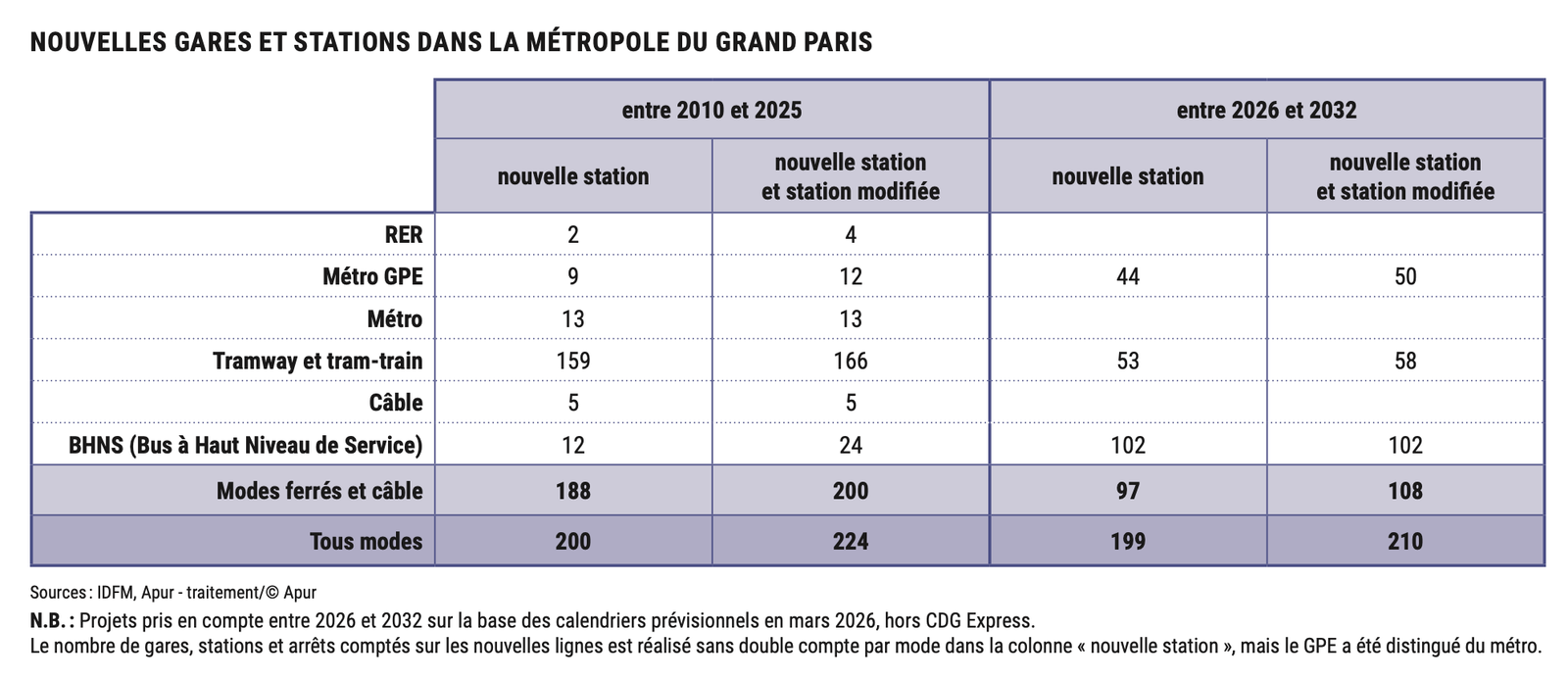
    Between 2010 and 2025, the Métropole du Grand Paris added nearly 160 kilometres of new or extended transit lines and opened 200 new transit stations across the region. These numbers include all modes of transport, including RER, metro, tram, cable cars, and BRT. On top of this, a further 199 new stations are scheduled to open between 2026 and 2032 (a shorter time period), meaning there’s an argument to be made that Paris is getting better and faster at delivering transit.

    Imagine that.

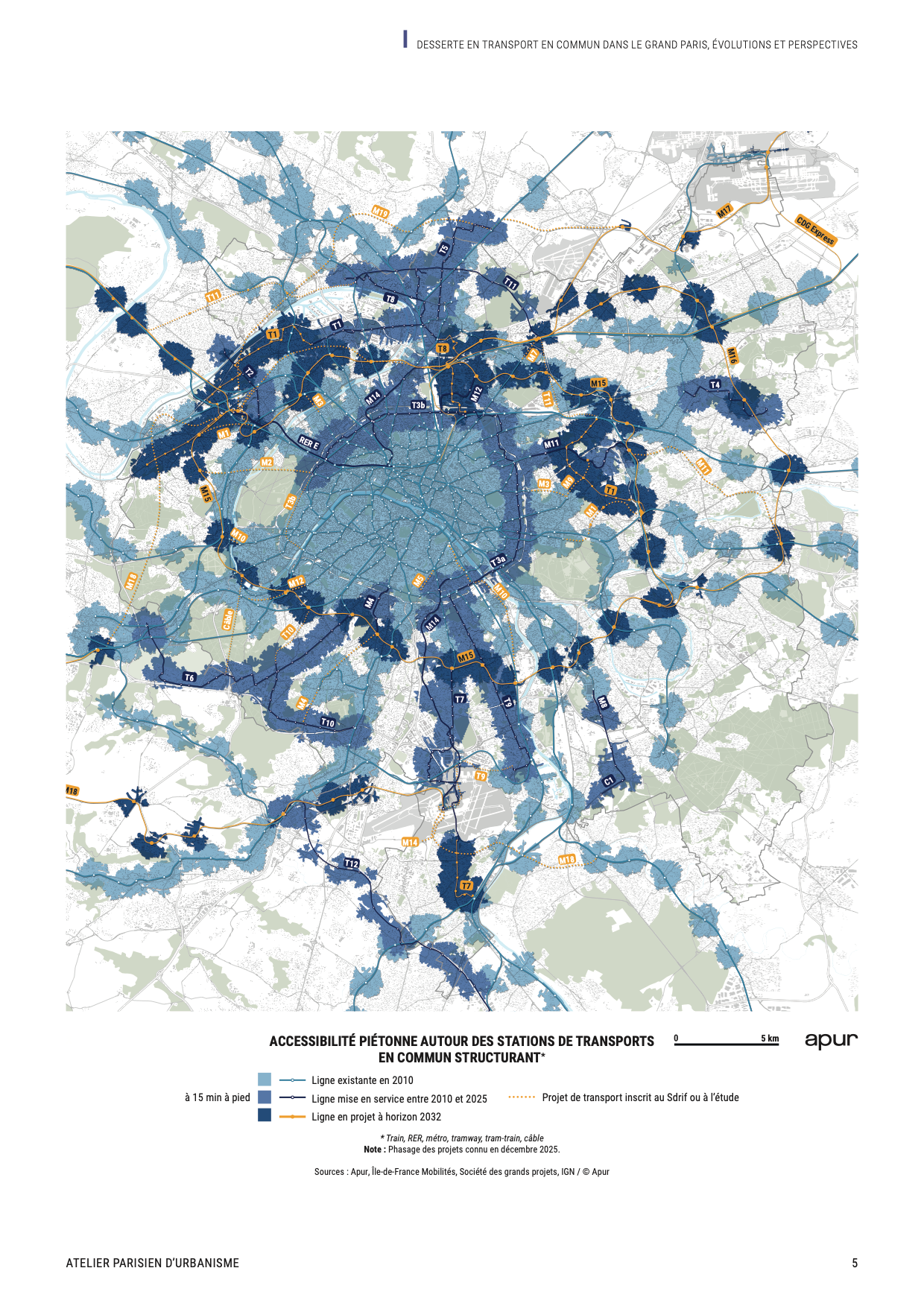
    This, as we have talked about before, is a remarkable achievement and one that is reshaping the Métropole — particularly outside of Paris proper. Take a look. Here’s a recent study and map from Apur that shows how these completed and upcoming lines have impacted, and are expected to impact, transit access in the region:

    The coloured areas represent access to transit within a 15-minute walk (assuming you’re able to walk at a reasonable 4 km/hr). The lightest blue areas are lines/catchment areas that existed in 2010. The medium blue represents lines/areas that came online between 2010 and 2025. And the darkest blue represents lines/areas that are scheduled to come online between 2026 and 2032.

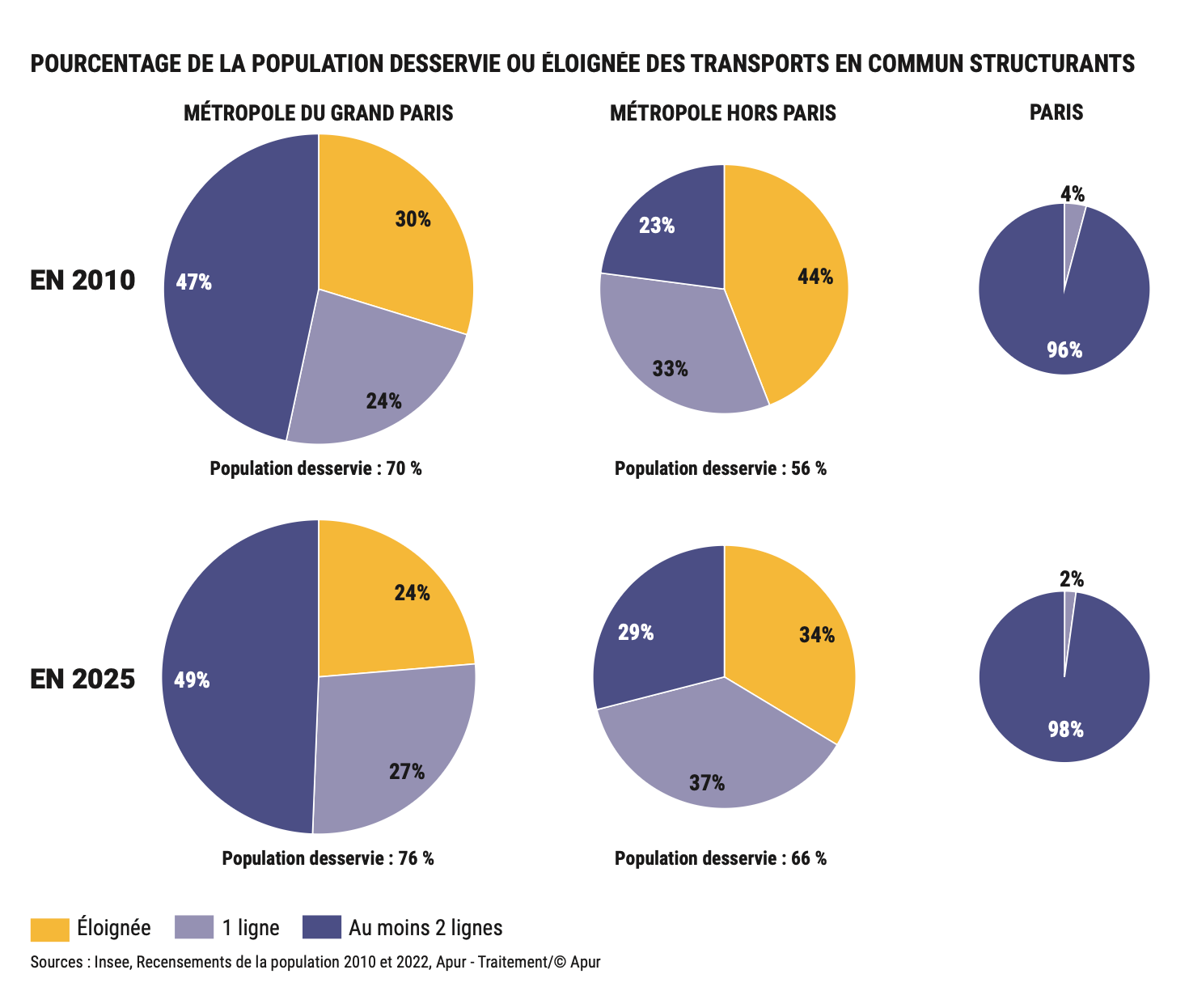
    If you’re familiar with Paris, you’ll be able to tell that the majority of the recent transit expansion has happened outside of the boundaries of Paris. This is important because prior to 2010, all of Paris was already well-served by transit (seriously, 100% of the population was/is within walking distance of at least one transit line).

    However, this is not the case in the rest of the Métropole. In 2010, about 56% of the population (outside of Paris proper) had access to at least one line, with 23% having access to two. As of 2025, this number has increased to 66%. And by 2032, with the opening of the lines currently underway, it is expected that 80% of the population within the entire Métropole will be transit-connected.

    It’s hard to overstate the importance of these changes. The Paris region has long been criticized for the divide that exists between its historic centre and its surrounding suburbs and cities. Historically, this has been a socio-economic divide, and a built form divide. But this divide is now being erased. New infrastructure is stitching the region together, tightening its geography, and encouraging the development of new economic centres.

    Forget the Paris you know. The growth and change are now happening along its edges. Welcome to the new Greater Paris Metropolis.

    P.S. To commemorate the 10th anniversary of the Métropole du Grand Paris (created on January 1, 2016), Apur recently published a book called Atlas de la Métropole du Grand Paris. I haven’t been able to find a site that will ship to Toronto, but if you’re in Paris, you can order or pick one up at the following bookstores.


    Cover photo by Ally Griffin on Unsplash

    Maps and charts from Apur

  • In Paris, the bike beat the car

    March 15, 2026 · View original


    Within a week, Paris will know, with near certainty, who its next mayor will be. (The first round of results will be announced this evening.) The two frontrunners are Emmanuel Grégoire (on the left) and Rachida Dati (on the right). Grégoire is the status quo vote, and Dati is the “I want change” vote.

    From a city-building standpoint, one of the ways that this is being presented is as a battle between bikes and cars. Not surprisingly, the current mobility approach has been criticized for creating a divide between wealthier residents in transit-rich central Paris (where only about a quarter of households own a car) and residents in the more car-oriented suburbs.

    Because after 12 years under Mayor Anne Hidalgo it’s pretty clear that “the bike beat the car in Paris.” From 2002 to 2023, car traffic fell by more than half, dedicated cycle lanes expanded sixfold, and today, bike trips outnumber car trips by more than 2 to 1 in the city.

    As an outsider to the city, I can only read about what’s going on, but what I find interesting is that this particular mobility issue doesn’t appear to be as political as the headlines might suggest.

    In fact:

    > Dati has softened her initial criticism of popular cycle lanes and instead focused on concerns over dirty streets. > > “We’re not fighting an ideological battle on [transportation] issues,” Dati told news agency Reuters while greeting shoppers in northern Paris. “We just want things to be organised.”

    And:

    > She [Dati] has promised not to reverse the left’s flagship policy of transforming a once traffic-clogged dual carriageway into a car-free pedestrian walkway along the banks of the Seine, but will renovate those pedestrian spaces.

    Correct me if I’m wrong, but what this tells me is that Parisians actually like the city’s transition away from the car. I’m reminded of last summer in Paris when I was in an Uber and the driver surprised me by saying that these mobility changes needed to be done — bikes are a more efficient form of urban transport and they have greatly reduced pollution within the city.

    General public sentiment also seems to reflect my anecdotal evidence. A recent Keolis-IFOP survey found that more than one in two French people (~56%) would like to see cars play a smaller role in the cities of tomorrow. Importantly, this response also seems to transcend geography and socio-economic divides. The same sentiment is found in Paris and in rural areas.

    This month’s mayoral election will certainly tell us something about Parisian preferences for the status quo versus change. But I’m always encouraged when issues can become less about ideology and more about whether we are accomplishing productive objectives based on, you know, facts and information.


    Cover photo by Irina Nakonechnaya on Unsplash

  • France opens its seventh urban cable car line

    February 2, 2026 · View original


    I was surprised to learn this week (I should have already been aware) that France operates seven urban cable cars (or gondolas). Its first was built in Grenoble, at the foot of the Alps, in 1934, and its latest opened in December 2025 in the country’s capital region.

    Called Câble 1 (or C1), this latest line is 4.5 kilometres long, carries 11,000 passengers per day in 105 gondolas, and connects Villeneuve-Saint-Georges to the Métro Line 8 in Créteil (a southeastern suburb of Paris). The total trip takes 18 minutes, compared to an estimated time of 40 minutes by bus or car.

    Importantly, the project only cost €138 million, or about €30.6 million per km, which is about 10-15% of what a subway might have cost based on data from the Grand Paris Express. Estimates for the latter were over €1 billion, meaning it would have likely been a non-starter.

    Gondolas are most commonly used to navigate mountainous terrain, but they’re increasingly being used in urban settings to stitch together isolated communities. Forty minutes to eighteen minutes is a significant quality-of-life upgrade. I think more cities should be considering cable cars as a possible mobility solution.


    Cover photo via Région Île-de-France / Aymeric Guillonneau

  • Paris is not a medium-density city

    October 9, 2025 · View original


    Earlier in the week, I came across this tweet about Paris: “Haussmann cracked the code on what makes a beautiful medium-density city. Why is it then that we can’t replicate this all around the world? Genuine question.” This is a topic that is near and dear to this blog, so I thought we should discuss it.

    But before we can answer this question, I think it’s important to ask whether it’s even fair to call Paris a medium-density city. Paris is generally considered to be the densest city in Europe. Most sources peg Paris proper (inside the Boulevard Périphérique) at around 21,000 people per km². However, there are areas that reach over 50,000 people per km², which is dense enough to rival any big megalopolis. So, from my perspective, I would not classify Paris as medium density.

    It’s a high-density city.

    The primary reason why this feature is so often overlooked is likely because the buildings aren’t very tall. People see mid-rise buildings of 6–8 storeys and automatically assume that these must translate into some form of a medium-density city. But this is the height–density fallacy. The two do not necessarily correlate. Paris is an example of a high-density city with mid-rise buildings. But I also can think of many low-density cities with high-rise buildings.

    Another reason I suspect Paris’s high urban density is often missed is that it’s also a highly livable and loved city. It doesn’t feel that dense (even if living spaces are compact and expensive). The term density can also carry negative connotations for some. Paris, high density? It can’t be. But that just helps to prove the point that density is good. You can’t have urban vibrancy without it.

    All of this gets at one part of the answer to our original question. Paris is not more widely replicated because building height is only one aspect of the Parisian model. Paris is not mid-rise buildings transitioning down to single-family houses. Paris is not mid-rise buildings in only designated areas. Paris is mid-rise buildings everywhere — and at very high densities.

    Not every city is prepared to do that. But if you truly want to emulate Paris, then that’s what it will take.

  • A few observations about Paris (second edition)

    September 15, 2025 · View original


    Our time in Paris has come to an end. It’s time to get back to the greatest city in the world (Toronto). As has become customary around here, I’d like to summarize some of my anecdotal observations from the trip. Here goes:

    – The first one is an obvious one. Paris has transformed itself into a cycling city. Bold planning moves have explicitly prioritized biking, and you can feel it everywhere you go, including outside of the Périphérique. Young and old, families and individuals, everyone seems to cycle in Paris. In parallel to this, it feels like there has been a noticeable reduction in vehicular traffic. Many of the smaller streets around Paris almost feel like they’ve been pedestrianized. But in fact, it’s just because there are so few cars. – Because of this change, I asked an Uber driver this past week if traffic has gotten worse and if it has generally gotten harder to drive in Paris. His response was absolutely. So I then asked him how Parisians generally feel about all of the changes and all of the new cycling lanes. The first part of his answer didn’t surprise me. He said people who live in Paris love it because it’s now easier to get around and they don’t need to own a car. It’s more efficient. But people who drive into the city or pass through it don’t like it. Fair. However, as somebody who drives for a living, the second part of his answer did surprise me. He said, the changes needed to be done — bikes are a more efficient form of transport and they have greatly reduced pollution within the city. I thought this was quite an enlightened and selfless response. – The geography of Paris is changing. Parisians used to think of their city as only existing within the boundaries of the Boulevard Périphérique. (This is technically the boundary of Paris proper, but there is also the Métropole du Grand Paris, which encompasses the greater urban region.) New investments in transit, new developments, and pioneering urbanists are changing this mental model. A New Paris has arrived. And its modal split seems to be skewed toward non-car forms of mobility, to the point that younger Parisians don’t even seem to bother getting a driver’s license. – Anecdotally, I also noticed a big uptick in running, in the number of gyms/fitness studios in the city, and in the number of people walking around in athleisure wear. I view this as North American culture creeping in. Historically, my understanding is that running — and getting sweaty in public — was considered a bit of a faux pas. But at one point this week, I saw a parade of people running in and out of a Drip and doing laps down a busy street filled with cafés. Clearly, attitudes have changed. – Paris is, of course, well known for its cafés and terraces. But I would like to emphasize how beneficial these spaces are for the city. Every terrace comes equipped with a large awning that extends out into the street and creates a kind of outdoor room. These rooms then fill up with an endless supply of people facing outward, adding life, conversation, and eyes on the street. It’s a wonderful way to create urban vibrancy, and you really feel the difference on streets where they don’t exist. More cities need to figure out how to replicate this simple formula. – Food is different in Paris (and in Europe more broadly). There is real concern over the quality of ingredients and what we put in our bodies. We touched on this briefly, here. The difference is that you feel as if you can eat whatever you want, and the end result is that you feel satisfied, not gross. You also don’t feel as if you’ve just ingested a sodium bomb. – On this trip, Bianca and I spent a lot of time exploring the 9ème, 10ème (where we were staying), and 11ème arrondissements, with regular trips south to Le Marais. We’ve now been to Paris enough that we’re starting to figure out which areas we like the most. (If you have a favorite area, please leave it in the comments section below.) – Finally, I would like to end by saying that the trains in Paris are something they should be proud of. When we come to Paris, we always take the train into the city and, on this trip, we took the metro on a number of occasions to get out to places like Pantin and Boulogne. Not once did we wait more than a minute or two for a train. In fact, even during off-peak times, the maximum headway between trains seemed to be 4 minutes. With this at your doorstep, and with all the new cycling infrastructure that has been introduced, I guess it’s no wonder that many Parisians couldn’t care less about driving.

    Until next time, Paris.