Daily insights for city builders, delivered every morning at 6 AM ET. I’m Brandon Donnelly — a Toronto-based real estate developer and founder of Globizen. I’ve been writing here since 2013.

Category: New York

  • New York and Toronto population densities compared

    Today I came across this Reddit talking about how few census tracts there are in the United States with a population density greater than 150,000 people per square mile. 

    Basically, there’s a bunch in New York, one in San Francisco (Tenderloin), and one in Chicago that doesn’t really count because it’s an unusually small tract. Most other American cities don’t even come close.

    Looking at this New York Times mapping of the 2010 US census data, it turns out there are neighborhoods in NYC that go well beyond 150,000 people per square mile. Here’s one census tract (#154) at just over 200,000 ppsm:
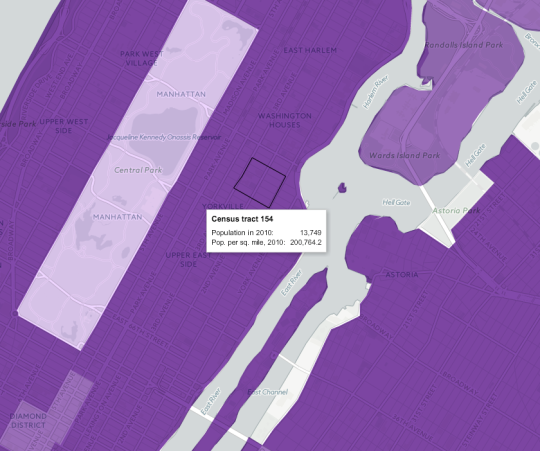
    If you convert 200,764 into the globally accepted standard for measuring distances and areas, you get approximately 77,515 people per square kilometer. Pretty dense.

    As a comparison, I thought I would see how this number stacks up against what is commonly referred to as the densest neighborhood in Canada: St. James Town

    If you pull up that geographic code in the 2011 Canadian census data (#5350065.00 in case you’re that nerdy), you’ll see a map boundary that looks like this:
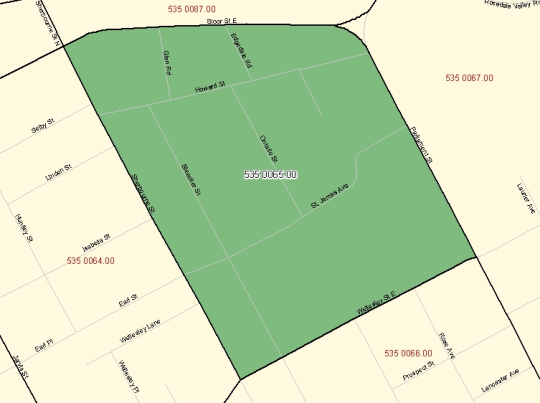
    And you’ll also find a 2011 population density of approximately 60,915 people per square kilometer. Also pretty dense – though the population did decline from 2006.

    Now obviously St. Jamestown is only one example. The rest of the city is, by and large, far less dense. But maybe when our 2016 census data gets released next year, we’ll find that we’ve become even denser. I suspect we will.
  • The tech ecosystem in Toronto (and New York)

    Tech Toronto recently published a new study called, How Technology Is Changing Toronto Employment

    They estimate that there are over 400,000 tech jobs in Toronto, out of a total of 2.7 million people employed. That number includes tech people working for non-tech companies, and tech and non-tech people working for tech companies. So tech jobs are thought to represent about 15% of the city’s employment.

    Within this 400,000 or so jobs, an estimated 93,000 people are self-employed (23% of tech jobs). And the belief is that there are around 2,500 to 4,100 active “startups.”

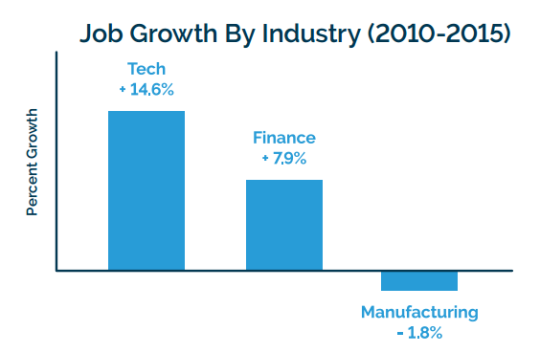
    Zooming out, it is also one of the fastest growing industries in the city:

    image

    To try and put this into perspective, a similar report for New York – published in 2014 – reported 291,000 tech jobs out of 4.27 million people employed. I was a bit surprised by these numbers, but the Toronto report seems to have been modeled after the New York one. So presumably they use similar methodologies.

    Of course, there’s the big question of quality over quantity. There’s a certainly a difference, in terms of impact to the economy, between a back office tech job and fast growing startup that will eventually reach the coveted $1 billion valuation number and create thousands of new jobs.

    Obviously every city is hoping for the latter.

  • Off to New York

    I’m packing and getting ready to leave for New York right now. I’ll be there for both Canada Day and Independence Day. My out of office message has been activated.

    I have a lot going on at the moment (which I’ll soon be able to share on this blog) and so I’m looking forward to getting out of the city and disconnecting a little. (I’ll, of course, still be blogging.) I’m generally not very good at down time. I like to keep busy and I like to work a lot. 

    But every now and then my body tells me that I should do otherwise. I also notice that I start getting decision fatigue. I am sure many of you probably feel this way as well. So I said no to a lot of things this week and I have very few things planned for New York. I’m content with that.

    A big city is probably not what comes to mind when many of you think of down time. But one of my favorite things to do is just wander around a city, look at buildings, and absorb it all. In some ways that feels like a luxury because most of the time I’m too busy rushing around. 

    But who knows, maybe I’ll end up on a beach somewhere. That’s the sort of thing that can happen when you don’t have much in the calendar. Either way, I’m off to New York for some rest and relaxation. Talk tomorrow.

  • How much market share are New York’s yellow cabs losing to Uber?

    Todd W. Schneider recently mined data from the New York City Taxi & Limousine Commission to create a chart summarizing yellow taxi, Uber, and Lyft usage

    The data only runs up until January 2016, but here’s what he found:

    “…yellow taxis provided 60,000 fewer trips per day in January 2016 compared to one year earlier, while Uber provided 70,000 more trips per day over the same time horizon.”

    The Uber data only begins in 2015, but you can still see how quickly it is growing and how yellow taxis are losing market share. Five years ago, yellow taxis were reaching over 500,000 trips per day (a pretty amazing number) and in January of this year they were at about 350,000 trips per day. 

    It also appears that Lyft is struggling to gain traction.

    image

    What’s also great about Todd’s blog post is that he has set it up so that his chart will automatically update as new data becomes available. So if you’re interested in this topic, you should bookmark his post.

  • WeWork launches first co-living space in New York

    I’ve written about co-living spaces before – here and probably elsewhere on this blog.

    Well this morning, WeWork (the co-working startup currently valued at a cool $16 billion) unveiled its inaugural co-living space on New York’s Wall Street. It’s called WeLive and Vanity Fair describes it as “Soho House meets Airbnb meets a tricked-out Restoration Hardware storeroom, but for the Slack Set.” 

    Got it?

    Ultimately, this location at 110 Wall Street will have 600 fully furnished WeLive apartments, but they’re coming online in tranches. This first release includes 200 units. Here’s a bit of information on pricing from Fast Company:

    “There are 200 units available—ranging from $1,375 per person in shared apartments to $2,000 for an individual studio—all with the option of either a month-by-month or yearly lease (a $125 monthly fee covers amenities). The apartments are about 450 square feet on average, with the largest units topping out at 1,000 square feet (one-bedroom apartments in the area, by comparison, range in prices from about $2,850 for 451 square feet to $3,500 for 700 square feet). Each apartment comes fully furnished, minimally decorated, and set up with cable and Internet at move-in.”

    But this is not just about price. The WeLive concept is about creating a strong sense of community within the building. Every floor, for instance, has some sort of common area to foster interaction – a space for yoga classes, a laundry room with a big pool table, and so on.

    I am interested in seeing how this concept pans out because I’ve had discussions before with people in the industry about how condos/apartments might be programmed to feel a bit more like hotels. Years ago, I even spoke to a major European company about trying to pioneer a model like this.

    Because there’s something very social about being in a hotel – something that I really like. You can walk down to the lobby bar by yourself and you never know who you might meet. That’s not really the case in many multi-family buildings.

    Now, part of that might have to do with the fact that people tend to be more open when they travel. But maybe WeLive can help create that kind of social interaction within the apartment building. I think that would be a positive thing.

  • VIA 57WEST in New York starts renting apartments

    image

    Bjarke Ingels’ West 57th Street project in New York (developed by The Durst Organization) has just started renting apartments (March 1). 

    Since I’m in the rental business, I thought it would be worthwhile to take a look at the rents – though I tend to obsess over all buildings and not just rental ones.

    Firstly, the project has a total of 709 apartments and 178 different unit types because of the architectural variations in the building. Of these units, 142 of them (20%) have been designated as affordable and were offered up via a lottery to people who fall within certain incomes ranges. 

    Here are the affordable rents via 6sqft.com:

    image

    I don’t know the exact numbers, but Curbed New York speculated – based on what was seen at other buildings on the west side – that the total number of applicants for these 142 units may have reached over 100,000!

    For the market-rate units, the average monthly rents are as follows (via Curbed NY):

    • Studio: $2,770
    • One-bedroom: $3,880
    • Two-bedroom: $6,500
    • Three-bedroom: $11,000
    • Four-bedroom: $16,500

    I wasn’t able to find average unit sizes (to calculate per square foot rents), but I estimate the overall average unit size to be around 1,000 square feet. 

    940,000 sf (total gross floor area)45,000 sf of retail x 0.80 efficiency (lower than average because of the shape of the building) / 709 units = approximately 1,000 sf of rentable area per unit. That’s just my rough guess based on what I could find online.

    Based on the Curbed comment section though, there are certainly some smaller units:

    image

    If anyone has any additional figures, please share them in the comments below. I think there are a few subscribers to this blog who are involved in the project.

    Image from via57west.com

  • 50% of New York City’s population is estimated to be single. Here’s what that means for housing.

    Here in Toronto there’s a push for more family-sized apartments. That’s what the planners want to hear.

    Because the city has been trying to encourage developers to build more of them for years, but the challenge has always been that they didn’t sell or that they took a long time to sell. The market wasn’t ready.

    But as I discussed earlier this week, that is starting to change. I think Toronto is reaching a tipping point where low-rise housing has simply become too expensive and people are starting to look to alternatives, mostly at the mid-rise scale.

    It’s interesting though that something of the opposite appears to be happening in New York. I don’t know enough about the New York new construction market to really comment on overall unit mixes and sizes, but there definitely seems to be a push to create more affordable micro-units.

    Curbed published this last October:

    “…a report currently under public review, called Zoning for Quality and Affordability, recommends relaxing density caps and eliminating the 400-square-foot minimum for studio apartments, thereby creating more housing for single people. Almost 50 percent of the city’s population is estimated to be single, but only seven percent of the housing stock is studios.”

    And just recently, New York completed its first all-micro-unit apartment building called Carmel Place. Rents start at $2,650 per month for a 265 square foot apartment. 

    As a point of reference, that works out to be $10 per square foot per month and more than 3x the highest rents you could reasonably achieve in the more desirable areas of Toronto, today.

    The model suite is 302 square feet and looks like this:

    All of the above photos are via Curbed.

  • Timeline of tall buildings completed in New York since 1908

    The Council on Tall Buildings and Urban Habitat recently published an interesting report called, New York: The Ultimate Skyscraper Laboratory.

    The money shot is this image here:

    It is a timeline of all tall buildings (over 100 meters) completed in New York since 1908 when the Singer Building was completed. At the time, but only for a year, that was the tallest building in the world.

    The gray bars represent the total number of buildings completed each year. And the colored dots represent specific completed buildings and their asset class (office, residential, mixed-use, hotel, and so on). It’s interesting to see the dips. During World War II, high-rise construction basically stopped.

    Check out the full report if you’d like to see a bigger version of the graph.

  • Fred Wilson on where the New York tech ecosystem is heading

    Venture capitalist Fred Wilson is the poster boy for the New York tech industry. And this morning he posted an interesting video on his blog of a recent talk he did at Google NYC.

    At the 4:50 mark he begins talking about the evolution of the tech sector in New York and how it became what is probably the second most active startup hub in the United States.

    Given yesterday’s post on talent and the recent CityAge conference I participated in, I thought this video would make a great follow-up. There’s talk of lifestyle, diversity, gender equality, and talent within cities.

    Fred is heavily involved in growing and improving computer science education in New York, which is a perfect example of how cities can better leverage the people and talent they already have – as opposed to just focusing on bringing in new talent. Coding is a valuable skill to possess.

    I also found it interesting that Fred ended up in New York precisely because his wife wanted to live in New York. And that had a lot to do with all of the things you can do in the city, outside of work.

    If you can’t see the video below, click here.

    [youtube https://www.youtube.com/watch?v=_fZCrasNIfQ?rel=0&w=560&h=315]

  • The world’s top 23 financial centres (after London and New York, of course)

    The 2015 edition of The Global Financial Centres Index (GFCI) was just released last month. It is often used as one of the sources for ranking financial centres.

    The index – which is now in its 18th edition – is created using two main ingredients. The first is an analysis of 5 broad areas of competitiveness: 1) business environment, 2) financial sector development, 3) infrastructure, 4) human capital, and 5) reputational & general factors. And the second is an online survey given to financial services professionals. The 2015 edition includes responses from 3,194 professionals.

    Below are the top 25 financial centres in the world according to the GFCI (the full list has 84 cities).

    image

    Here are a couple of things to note from this year’s index: 

    London has overtaken New York for the top spot – but both remain more or less at parity if you dig into the numbers. 

    Dublin is performing particularly well in Western Europe.

    The leading centre in Eastern Europe is Warsaw (38th), with Istanbul just behind it.

    Toronto is now second in North America, only to New York.

    Sao Paulo remains the top Latin American centre.

    And, Los Angeles (49th) and Liechtenstein (60th) join as new entrants this year.

    If you’d like to see the full report and ranking, click here.