
Tech:NYC has just launched a new podcast called Talk:NYC. The first episode is with venture capitalist and blogger Fred Wilson. (Though, it should be noted that Fred and his wife, Joanne, are also involved in the real estate development space.) In this episode, Julie Samuels and Fred Wilson talk about why he came to New York, how to manage through a downturn, where working spaces are going, and why the magic of New York is still there — among a bunch of other things. Click here if you can’t see the embedded podcast below.
Category: New York
-
New York City makes outdoor dining permanent
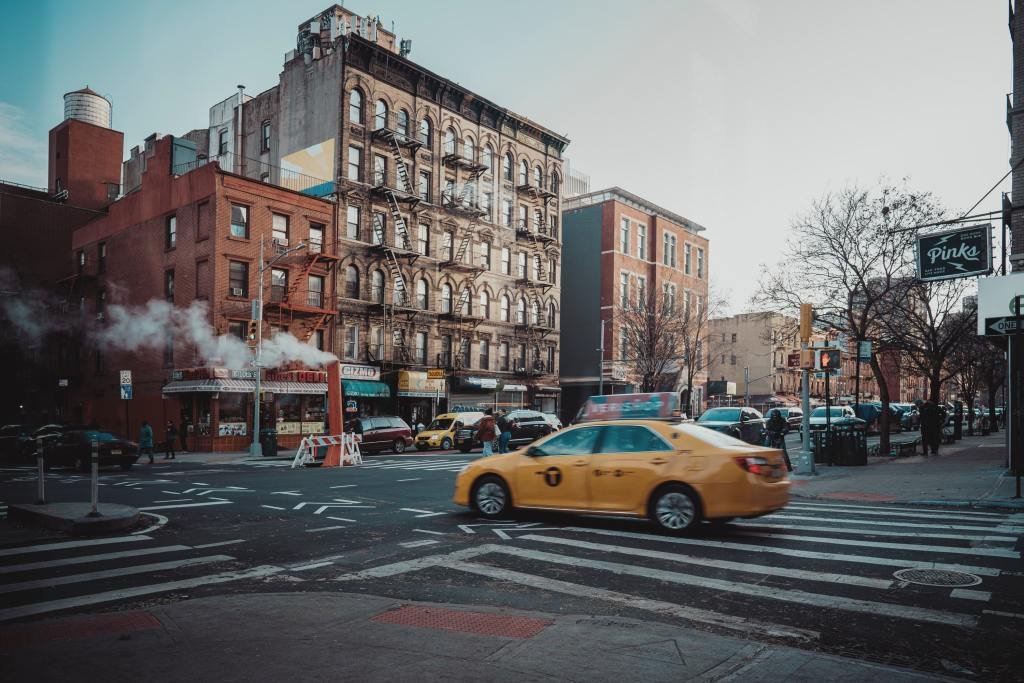
New York City just made its “Open Restaurants” program permanent. Originally set to expire at the end of the October, the al fresco dining program — which allows restaurants to use sidewalks and curb lanes adjacent to their business — is now being thought of as something that will permanently reshape public space in the city.
Along with this announcement, the City also provided clarity on how heating and enclosures may be used throughout the winter months. Electrical heaters can be used anywhere. But propane heaters can only be used on sidewalks and you’ll need to get a permit from the fire department. Prior to this announcement, there was an outright ban on propane heaters.
Tents and other enclosures are now permitted, but at least 50% of the side walls needs to remain open for ventilation. Otherwise it gets classified as indoor dining and those rules would then apply. However, fully enclosed structures, such as cool looking Instagrammable domes, are allowed for individual parties provided there’s “adequate ventilation.” Whatever that means.
This is yet another example of how COVID-19 is forcing us to reconsider the way we think about and use public space within our cities — perhaps forever. And in this particular case, it’ll be interesting to see to what extent cities embrace dining outside in the winter. Some of us already do it when we, for example, après ski. Could the same thing work in our cities?
Photo by Aleks Marinkovic on Unsplash
-
New York City isn’t dead
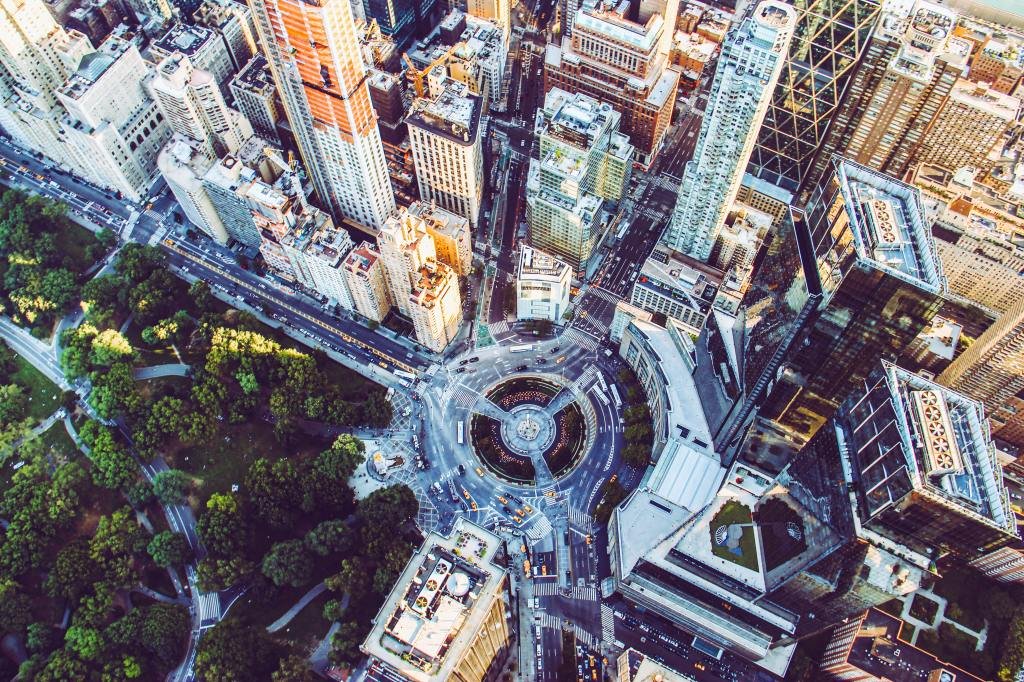
I was speaking to some friends in New York City over the weekend and they said to me, “you know what Brandon, we don’t really go out at night anymore. It doesn’t feel safe. There are homeless people everywhere and they’ve started to get very aggressive, particularly against Asians.”
They live in a good neighborhood in Manhattan.
I was somewhat surprised to hear this, but at the same time, I don’t think for one minute think that New York City is dead. But some do, including James Altucher. James moved to Florida because of the pandemic and recently penned an article in the NY Post called, “New York City is dead forever.”
That didn’t sit well with Jerry Seinfeld and so this morning he published a rebuttal op-ed piece in the New York Times. It has been making the rounds online today with people responding from both sides of the fence. Richard Florida responded with this tweet thread.
If you’re a regular reader of this blog, you’ll know where I sit on this topic. I love technology, but sitting at home all day going from Zoom meeting to Zoom meeting is not the kind of life I aspire to live. I agree with Jerry. There’s no energy. In fact, it sucks the energy right out of me.
With that, I’ll leave you with some more words from Jerry Seinfeld:
There’s some other stupid thing in the article about “bandwidth” and how New York is over because everybody will “remote everything.” Guess what: Everyone hates to do this. Everyone. Hates.
You know why? There’s no energy.
Energy, attitude and personality cannot be “remoted” through even the best fiber optic lines. That’s the whole reason many of us moved to New York in the first place.
You ever wonder why Silicon Valley even exists? I have always wondered, why do these people all live and work in that location? They have all this insane technology; why don’t they all just spread out wherever they want to be and connect with their devices? Because it doesn’t work, that’s why.
Real, live, inspiring human energy exists when we coagulate together in crazy places like New York City. Feeling sorry for yourself because you can’t go to the theater for a while is not the essential element of character that made New York the brilliant diamond of activity it will one day be again.
Photo by Florian Wehde on Unsplash
-
New York City is budgeting $30.8 billion in property tax collections
According to the WSJ, New York City is budgeting to collect $30.8 billion in property taxes for fiscal year 2021. These tax bills will go out on June 1 and payments will start becoming due on July 1, which is the start of the city’s fiscal year. Here’s how the collections break down across houses, apartments, and commercial properties:

Overall — and despite the fact that values have softened in the wake of COVID-19 — this year’s property tax budget represents a 5.7% increase over FY2020. The reason for this is that each year the city completes its annual assessments on January 5. And so according to the city’s January numbers, everything is just fine.
Supposedly this January 5 date is usually non-negotiable. A lawyer is quoted in the Journal article saying that under normal circumstances, if your house were to burn down on January 6, you would still have to pay all of your taxes for the upcoming fiscal year.
Time will tell if this time is different. But it is interesting, though not surprising, to note just how significant property taxes are to New York City’s overall tax collections. They represent a little more half of all taxes collected.
-
New Yorkers are actually pretty healthy
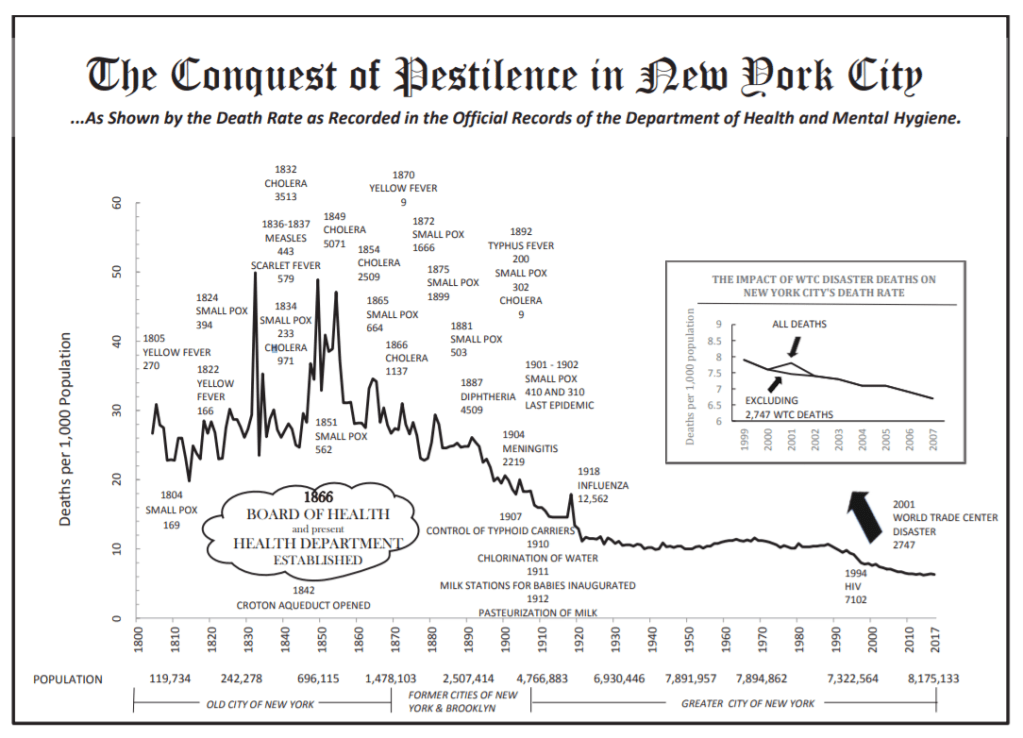
Nicole Gelinas’ recent piece in CityLab is a good reminder that — despite all of the debates around COVID-19 and urban density — New York City is actually a really healthy place to live. Part of this obviously has to do with the city’s investments in public health. But the biggest factor, Nicole argues, is the city’s transit network. Six million people move around New York City each day without a car. That translates into a meaningfully lower traffic fatality rate. New York State’s rate is about 4.8 per 100,000, whereas Florida’s is 14.7 deaths per 100,000. Taking transit (and having an urban morphology that supports taking transit) also brings along with it other benefits, such as increased walking. And I have to believe that is an important factor. The obesity rate in New York City is thought to be about 22%, compared to a shocking 42% for the country. All of this rolls up into a life expectancy of about 81.2 years for New Yorkers, as of 2017. This is compared to 78.6 years for the US as a whole.
For more on the health of New Yorkers, check out this 2017 Summary of Vital Statistics. (It’s the source of the above chart.)
-
$27 million worth of condos in New York
This week it was reported that a South American family has bought and closed on ~$27 million worth of residential condos at Waterline Square in Manhattan. Apparently they went into contract (after the online showings) and closed on the same day, which I suppose you can do when it’s an all-cash deal like this was. The agent, Maria Velazquez, didn’t disclose who the family was, but apparently they’re from Peru and they wanted a safe place to park their money during this pandemic. Uncertain times usually create buying opportunities, and it sounds like the family did get a bit of a bulk discount here. But it’s also interesting to see where capital is flowing right now and what is perceived as a safe haven. Residential real estate in one of the world’s preeminent global cities probably won’t come as a surprise to any of you.
-
Number of condo units built in New York City between 2009 and 2019
A decade of ultra luxury condos. The New York Times published this story over the weekend talking about how the luxury condo boom of the 2010s transformed New York City, and in particular Brooklyn.
Below are two tables from the article: (1) The number of units built between 2009 and 2019 across the five boroughs and the city’s top neighborhoods, and (2) the neighborhoods with the highest median sale price increase.
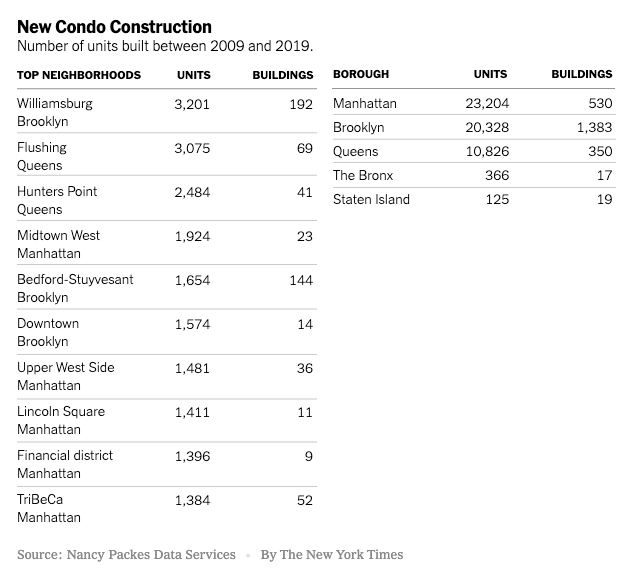
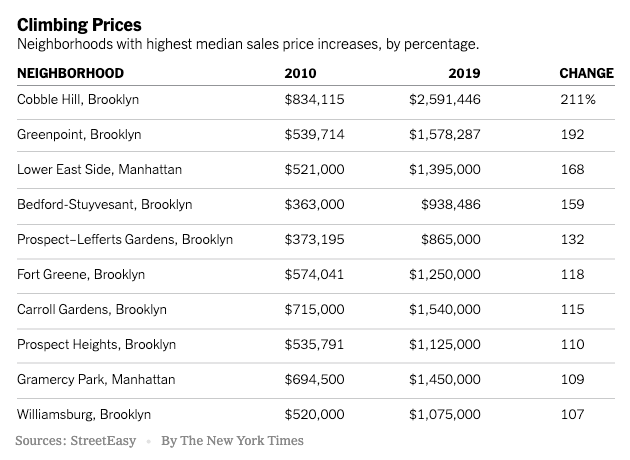
The overarching theme is that New York built too many “super-high-end condos” geared toward global capital flows. According to one developer interviewed for the article (Gary Barnett of Extell Development), it was unprecedented.
Apparently, the problem segment remains the $5 million to $10 million market. There’s simply too much inventory, and that has developers both delaying launches and going with much smaller (and hence more affordable) unit mixes.
One stat that stood out for me was the new condo premium over resales. In 2011, the average sale price of a new condo in the city was about $1.15 million, which represented about a 9% premium over resale pricing.
While it is typical to see a premium over resales (the same is true in Toronto), the average price of a new condo in 2019 rose to $3.77 million, representing a 118% premium over resales.
For the rest of the article, click here.
-
Gentrification in New York, San Francisco, and Chicago is not as it would seem

Matthew L. Schuerman has a new book out called, Newcomers: Gentrification and Its Discontents. I haven’t read it. But in it, he argues that “gentrification is all around us.” Hence the title. Will Stancil has an interesting rebuttal to this position as part of his book review in the Washington Monthly. Here’s an excerpt:
Schuerman settles on what he admits is a simple definition of gentrification: the process by which a neighborhood goes from having below-average to above-average incomes for its region. But he never really applies it. While he frequently asserts or implies that gentrification is exploding across cities, he doesn’t say how many neighborhoods actually meet his definition.
As a demographic researcher, I decided to check. Using U.S. Census data, I looked at the share of people in New York, San Francisco, and Chicago living in places that met Schuerman’s definition of having gentrified between 2000 and 2016. In New York, it’s 3.1 percent of residents. In San Francisco, the number is 4.4 percent. In Chicago, it’s 4.8 percent. Needless to say, this does not represent a vast swath. Although the numbers might increase if the time frame were extended, change at a generational pace is far less disruptive than change that takes place over a few years. Using Newcomers’ own definition, the story of urban America is not a tidal wave of gentrification but creeping racial and economic transition.
In fact, this aligns with the growing academic consensus that gentrification is much rarer than is commonly believed. This year alone, there have been no fewer than three national studies into the prevalence and location of gentrifying neighborhoods. (Disclosure: I authored one of these studies, for the University of Minnesota.) Despite using very different methods, all three studies roughly appear to agree that about 10 percent of neighborhoods in metro areas were gentrifying. Research has also tended to show that no matter how you measure gentrification in the urban core, it’s almost always more common to find neighborhoods afflicted by intensifying poverty. Out of the fifty biggest American regions, forty-four have core cities where the population in poverty has grown faster than the overall population since 2000. The only exceptions are New York City, Los Angeles, D.C., New Orleans, Atlanta, and Providence.
This issue of concentrated poverty has come up before on the blog through posts like this one about Detroit. The data is pretty clear: The number of high poverty Census tracts in the US is increasing faster than the number of gentrifying Census tracts (i.e. Census tracts that are becoming wealthier).
So could it be that the problem isn’t actually gentrification? It is that, paradoxically, gentrification isn’t happening enough and more broadly, and that it is leading to rising inequality across our cities. That strikes me as being the greater issue.
Photo by Hardik Pandya on Unsplash
-
Qantas pilots new 20 hour ultra long haul flight from New York to Sydney
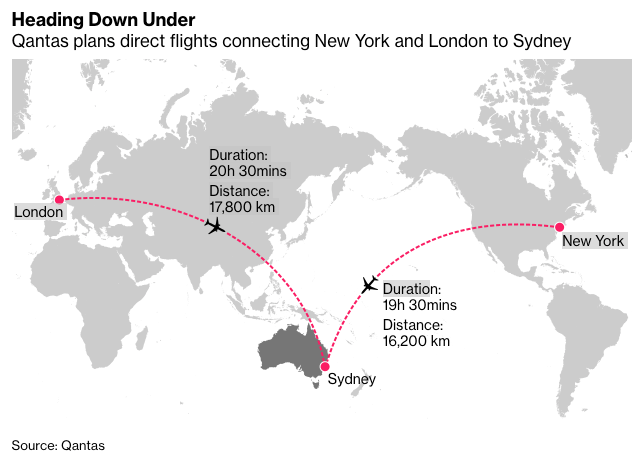
Over the weekend, Qantas Airways set a new record with a nonstop ultra long haul flight from New York to Sydney. At a distance of 16,200 kilometers and a duration of 19 and a half hours, this is now the world’s longest flight. Though, this was still a test voyage. It remains to be seen whether this will be a commercially viable route. The company also plans to offer a similar ultra long haul from London.
It’s fascinating to think about the logistics that go into a flight like this. The flight took off with its fuel tanks maxed out at 101 tons. But according to Wired, the loss factor on each additional ton of fuel is about 60% simply because of the additional weight. In other words, most of the incremental fuel to get all the way to Sydney just gets cannibalized by the heavier load. Wow. That doesn’t feel all that sustainable.
Similarly, every ten passengers roughly equates to one ton (200 pounds per person). So there’s a balancing act between reducing weight (optimizing fuel consumption) and maximizing revenue (adding lots of people). There’s also a question of how best to price discriminate across economy, premium economy, and first class.
Initially these ultra long haul flights were imagined to be flying hotels, where people could sleep, workout, and do all sorts of other things while they traveled halfway around the world. But the economics didn’t work. Too much wasted space on non-revenue generating items.
The other interesting thing about these ultra long haul flights is how much work goes into passenger comfort, specifically around our body’s natural rhythms. Angus Whitley of Bloomberg was onboard this maiden voyage and he talks about how the food they served — spiced with things like chili and lime — was designed to fire up your clock when you shouldn’t be sleeping.
And this isn’t new a feature of ultra long hauls. Qantas already employs things like hot chocolate laced with tryptophan in order to help people sleep onboard. I’m not great at sleeping on planes, generally because I don’t fit in the seats very well. But maybe it’s because I’ve been passing on the hot chocolate.
Image: Qantas via Bloomberg