Daily insights for city builders, delivered every morning at 6 AM ET. I’m Brandon Donnelly — a Toronto-based real estate developer and founder of Globizen. I’ve been writing here since 2013.

Category: Montréal

  • Montréal’s winter cycling retention ratio

    Montréal had its first snowstorm of the season this week, and if you look on X, you’ll find images and videos like these:

    What’s remarkable is the number of people who, at least from these tweets, continue to cycle in the winter. In fact, in the above video, there looks to be more bikes on the road than cars. Plowed lanes certainly help!

    According to the city of Montréal, about 80% of the network is maintained for year-round use (717 km of its 900 km network). But I’m sure that there are a lot of people who still can’t imagine anyone wanting to cycle in these conditions. So what is the actual winter usage?

    Thankfully, Montréal has bike counters. 55 of them to be exact. And all of the data can be viewed, here. The busiest location is Saint Denis and Rue des Carrières. This falls within their Réseau Express Vélo (REV) network, which is a series of protected lanes intended to do what the name suggests.

    The daily average for this counter is currently 4,403 riders, but the summer peak looks to be closer to 10,000. And this year, it has seen close to 1.5 million rides in total. This is a significant number. I mean, imagine 1.5 million more car trips on the road.

    Looking at yesterday’s data, the daily count was 1,292. If you very crudely divide this by my 10,000 summer peak estimate, you get to around 13%. And this happens to line up with what seems to be the city’s generally accepted winter cycling retention ratio.

    Not surprisingly, fewer people want to cycle in the winter. But the number is not nothing. If you multiple 1,292 cycling trips by 120 days (roughly December to March), that’s still over 150,000 trips (I know, I didn’t account for weekends). On top of this, the city’s winter cycling retention rate appears to be increasing.

    So just because you may not want to cycle to work in the winter, it doesn’t necessarily mean that others feel the same way.

  • Montreal’s Diverse Metropolis policy has delivered exactly zero affordable homes

    Montreal has a bylaw that came into effect on April 1, 2021 and that requires developers to contribute to the city’s supply of social, affordable, and family housing. (All three of these have their own definition.)

    Developers can meet this requirement in a number of different ways:

    • They can build the social, affordable, and/or family housing
    • They can contribute land or a building
    • Or they can pay cash-in-lieu

    Usually, I think of inclusionary zoning as being the first of these three bullet points: a hard requirement to build a certain amount of non-market housing. That is not an absolute requirement here, and so I see this policy as being IZ lite.

    Since the bylaw came into force, there have been approximately 150 new projects by private developers in Montreal, according to this CBC article. That has resulted in about 7,100 new market-rate homes. At the same time, it has resulted in exactly zero non-market homes.

    From what I can tell from the article, every single developer has opted for option three: pay the cash-in-lieu instead of actually building the housing. Supposedly this has produced about $24.5 million in new fees, which sounds like a lot. But if you divide it by 7,100 homes, it isn’t all that much: just under $3,500 for each new home.

    So what is clear is that this is the least expensive option. That’s why everybody is choosing it. If the fee was significantly higher and it was cheaper to just build the social/affordable/family housing, then every developer would just do that. This is how development pro formas work.

    But at the end of the day, we are still taxing new housing and new home consumers for the purpose of trying to create a smidgen of more affordable housing. And this has never sat well with me, especially considering that there are plenty of other things that we could be doing to make new housing more affordable for everyone.

  • Phase one of Montreal’s REM is now open

    The first phase of Montreal’s new Réseau express métropolitain (or REM) just opened it up. It is a 17 km light-rail line that includes five stations running from Brossard in the south (A1 above) to Gare Centrale in downtown Montreal. Eventually this network — which is distinct from but connected to the city’s existing metro network operated by STM — will span 67 kilometers and have a total of 26 stations. To put this into perspective, Montreal’s current metro totals 69.2 kms. So this is a near doubling.

    As with most big city building projects, Montreal’s REM is being and will continue to be criticized. Back in 2016, the project had an estimated total project cost of $5.9 billion. By 2021, this number had increased to $6.9 billion. Today, who knows what the number will be. But it will be more. The reality is that everything went up, by a lot, over the last five years. During the pandemic, we were seeing 30-40% cost increases on some of our construction line items.

    What’s perhaps most noteworthy about this project is its delivery model. It is being delivered through a partnership with the the Caisse de dépôt et placement du Québec (CDPQ):

    Under the pact, the Caisse’s infrastructure arm is assuming $3.5-billion of the project’s $6.9-billion construction cost while Quebec is committing $1.28-billion and the Canada Infrastructure Bank is providing a $1.28-billion loan. The balance consists of a $295-million payment from Hydro-Québec for the line’s electrification, while the Autorité régionale de transport métropolitain, the transit authority for the Montreal region, is pledging $512-million.

    Provincial and local governments will provide continuing operating subsidies for the REM to make sure the Caisse earns its required return on the project, currently pegged at 8 to 9 per cent. The pension fund manager will get 72 cents for each passenger-kilometre travelled on the light rail system. Without such a subsidy, fares would climb to a level few passengers could afford.

    It’ll be interesting to see how this approach stands the test of time. As I understand it, CDPQ wants to continue building and operating transit in other cities around the world. I don’t know any of the specifics other than what I have read online. But from the outside, things seem to be working. The first phase of the REM broke ground in April 2018, and the opening ceremony was held this month (July 2023). That’s basically warp speed in transit timelines.

    Map: Montreal REM

  • Project Profile: Montréal is really good at missing middle housing

    We often talk about the challenges associated with smaller scale developments on this blog. They are difficult to underwrite, there are diseconomies of scale and, after a certain point, developers typically start to require a certain minimum size. In other words, if you have a big development machine with a lot of fixed costs, you probably don’t want to build even 100-150 homes at a time. You want something like 250-300 homes as a starting point.

    But there is something so great about small infill projects, which is another topic that we like to talk about on this blog. Take, for example, the above 10,940 square foot project at 6001-6009 Rue St-Hubert in Montréal. Designed by L. McComber, the project includes 2 commercial spaces and 8 homes (specifically, 2 studios and 4 multi-level “townhouses”).

    Using rough measurement approximations from Google Maps, the lot looks to be about 15m wide x 26m deep. So the lot itself is somewhere around 4,200 sf, which is effectively a double lot based on the prevailing frontages in the area. According to this rough math, I’m guessing the FSI (floor space index) of this development is somewhere around 2.5x.

    It is certainly a beautiful project, but in my mind the two most noteworthy aspects of this development — at least for this audience — are the following:

    1. The architect essentially acted as the developer. They wanted to build and then own their own office space, and so they now occupy the ground floor of this project. As a partial end-user of the development, this likely means that they underwrote it slightly differently compared to if they were a pure developer.
    2. The project’s circulation space is outside and is largely housed in a central open-air courtyard.

    Here’s what #2 looks like:

    This second point about circulation is an important one because it’s an effective way to reduce hard costs, improve overall efficiency (rentable/saleable divided by gross construction area), and lower long-term operating costs. Of course, exterior stairs/circulation are quite common across Montréal’s walkups. So maybe this isn’t all that novel for them.

    But I still think it’s a perfect reminder that we shouldn’t use climate as an excuse. Montréal is both colder and snowier than Toronto. And just look how they’re building. I would happily live here. Would you?

    Photos: Raphaël Thibodeau via L. McComber

  • Toronto-Montréal should be a 2 hour high-speed train ride

    The Quebec City-Windsor corridor is the most densely populated region in Canada. The last time I checked Wikipedia, it was reported to house about 18 million people, or about half of Canada’s entire population.

    So it is not surprising that there have been numerous high-speed rail studies for this corridor over the decades, as well as studies for other important links in Alberta (Edmonton-Calgary) and other parts of the country.

    And yet, Canada remains the only G7 country without any high-speed rail. Though to be fair, the US doesn’t have all that much either; certainly with respect to the size of its population.

    However, there is some good news. In March of this year, the Government of Canada announced a Request for Expression of Interest related to high frequency rail service between Quebec City and Toronto. More information, over here.

    But from what I have read, it’ll be a faster upgraded service (~200 km/h), but not true high-speed rail (~250-300 km/h). I took the TGV from Marseille to Paris last summer, and this is how fast we were going:

    If we’re going to do this, let’s be the absolute best in the world and not settle for mediocrity.

  • Façadism in Montréal

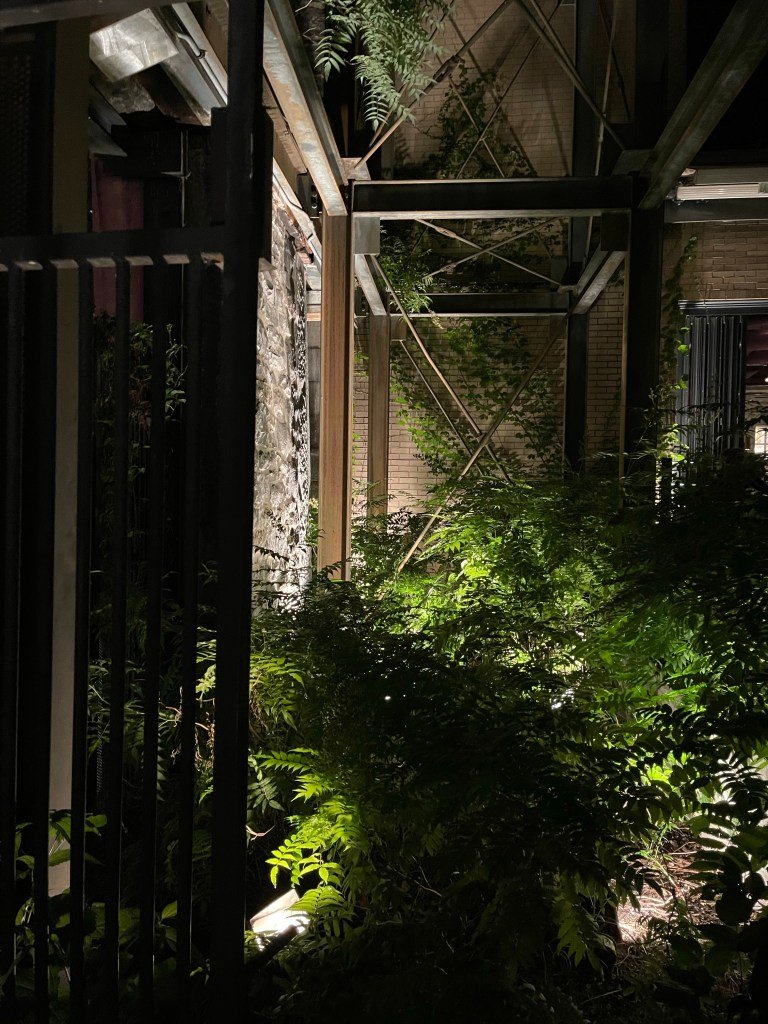
    These are photos from the terrace of a restaurant in Old Montreal called Boris Bistro. It’s not new — it’s been around since 1999 — but that doesn’t change the fact that its outdoor space is absolutely magical.

    The terrace sits behind an old stone facade on McGill Street that is held up with a three-storey steel structure. Hello façadism! I have tried to figure out the vintage of the original building through a cursory look online, but I came up with nothing. (Drop it in comment section below if you happen to know.)

    What we were told at the restaurant was that the original building burnt down, leaving just the facade and then an open space behind it. The size of the trees on the terrace do suggest that it’s been this way for a long time.

    There’s an office building beside it that looks to be of a 90s vintage (465 McGill Street) and this open space was apparently a place for office workers to go smoke. But now the ground floor of the office building and the terrace function as one large contiguous space.

    The result is what you see above. Magic.

    Montréal has been city building for a lot longer than Toronto. Some 400 years depending on how you calculate it. This history has created one of the most beautiful built environments anywhere in the world.

  • The grandeur of Montreal

    I was in Montreal for the long weekend and I decided to take the time off from writing. I don’t do that very often, but it was the right thing to do this past weekend.

    Montreal is one of my favorite cities. I spent quite a bit of time there when I was in my early 20s and I almost ended up at McGill for my undergraduate degree. So I have a soft spot for the place.

    One of my friends once described Montreal to me (and contrasted it against Toronto) by saying that it has grandeur. And I think that is exactly the right word.

    There are so many moments throughout the city where you just feel its impressiveness. It’s almost as if, from the very beginning, the city knew what it was destined to become.

    In contrast to this, urban planner Joe Berridge has, in the past, referred to Toronto as an accidental metropolis. And I think that is a similarly accurate way of describing our city.

    Sometimes in Toronto (or perhaps oftentimes, depending on who you ask), you have to scratch a little beneath the surface to find what makes Toronto a truly great city.

    It’s as if the city didn’t know what it was destined to become, and built accordingly. Things just happened — accidentally.

    Grandeur isn’t usually something that is discussed today in city planning circles. We instead talk about things like angular planes, context and, of course, building height.

    But maybe it’s time we rethink our list of requirements. Maybe it’s time we ask ourselves: “Are we creating a city with grandeur?”

    Image: Drone photo from the top of Mount Royal

  • Project Profile: Golf Exécutif Montréal Clubhouse

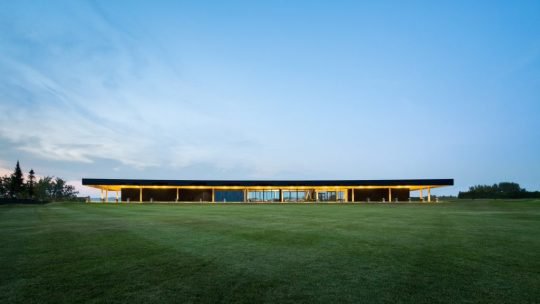
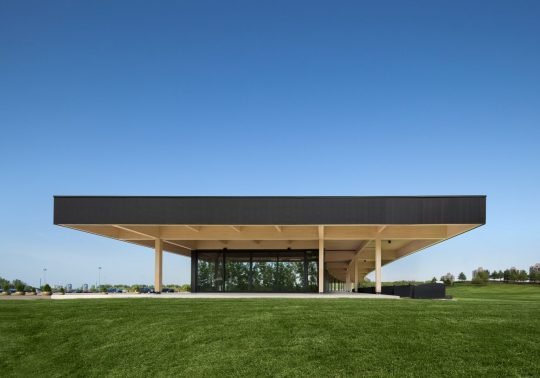
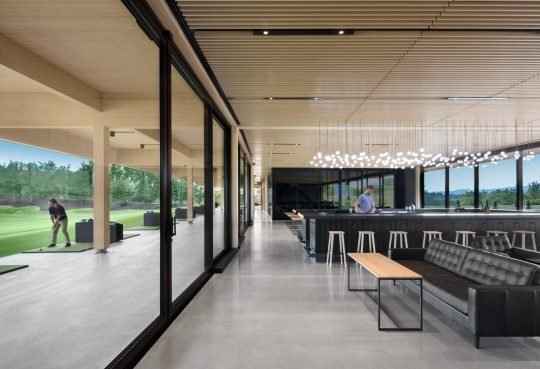
    I’m not a very good golfer (probably because I don’t golf), but this clubhouse in Montréal has me wanting to try my hand at the driving range again. Designed by Architecture49, the clubhouse itself is 855 square meters, but the roof area is around 1,800 square meters – so more than double as a result of the overhangs that protect golfers from poor weather. Black zinc panels and pale wood get me every time.

    Images: Dezeen

  • Fun Friday: How Montreal makes winter awesome

    //player.vimeo.com/video/113321361

    It’s wintertime in Canada and that means people complaining about the cold and/or the fact that in our climate there are certain things that simply can’t (or shouldn’t) be done when it comes to city building.

    But I don’t buy that.

    A great counter example is Igloofest in Montreal. Unless you’re into electronic music (OK, fine, young people call it EDM today), you probably haven’t heard of it. But it’s basically an outdoor dance party on Montreal’s waterfront in the middle of the winter.

    The opening night is tonight and the overnight low is expected to hit -27 degrees celsius. Take a look at the video at the top of this post though (click here if you can’t see it). That’s how many people are going to crowd outside in the cold and dance their hearts out this evening.

    And so whether you’ve got harsh winters or summers, there are always creative ways to make it work for you. You just have to own it.

    If anyone would like to take a trip to Montreal this winter, I promise to stand by my words and dance outside in the cold. Have a great weekend everyone.

  • Les escaliers de Montréal

    Montreal is one of my favorite places on the planet. In fact, if I have one regret in life it’s that I didn’t do my undergrad at McGill University. Living in Montreal as a poor student would have been the best. Though I shouldn’t complain because I did spend quite a bit of time there when I was a poor student.

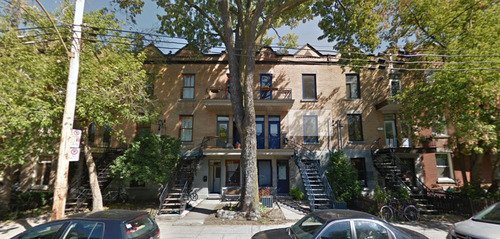
    If you’ve ever been to Montreal, the image at the top of this post will look familiar. The urban landscape of Montreal–at least in the residential areas–is filled with exterior staircases. They’re all over the place. And this always strikes everybody as a bit odd given that it’s a pretty cold and snowy place a lot of the time. Nonetheless, those staircases are quintessentially Montreal.

    Some people think it was done to minimize the amount of interior space that needed to be heated, but I’ve never really gotten a definitive answer. Either way, all those stairs are an interesting byproduct of Montreal’s commitment to one predominant building type: the multiplex. A multiplex is essentially a small apartment building containing a handful of units. They’re usually only around 3 storeys high. And they’re all over the Ville de Montréal.

    To be honest though, I don’t think I’ve ever really explicitly thought about this defining Montreal quality. But then last night I stumbled upon an interesting blog post called “Les escaliers de Montréal vs towers of Toronto." (escaliers = stairs) In it the author talks about how Montreal is essentially this city of multiplexes (with stairs everywhere) and Toronto is this, more modern, city of towers surrounded by single family homes.

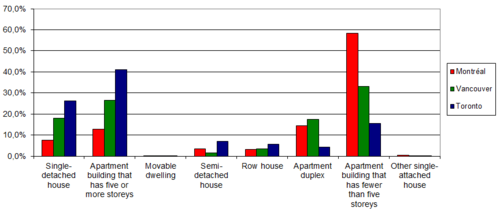
    And here’s the data to back it up:

    When it comes to single-detached houses and apartment buildings taller than 5 storeys, Toronto dominates. But when it comes to apartment buildings less 5 storeys, it’s all Montreal. And if you add in apartment duplexes, you’ve accounted for almost 75% of Montreal’s housing stock. Note: These figures are for the city proper and don’t include any amalgamated suburbs.

    The author’s explanation for this comes down to zoning and timing. Since Montreal is an older city, the belief is that Montreal was simply further along in its evolution when formal land-use planning came into effect and started to order the city. I generally agree with this hypothesis, but I think it’s also worth keeping in mind that, just because a Toronto house might be zoned as single family, doesn’t mean it’s actually begin used as such.

    A lot of the older houses in Toronto have been subdivided into what are effectively illegal multiplexes. Since this is all happening under the radar, nobody really knows what the actual stock of multiplexes might be. Nonetheless, there’s no denying that there are some real differences between the urban fabric of Montreal and Toronto.