Daily insights for city builders, delivered every morning at 6 AM ET. I’m Brandon Donnelly — a Toronto-based real estate developer and founder of Globizen. I’ve been writing here since 2013.

Category: Housing

  • Q4-2019 high-density land report for the Greater Toronto Area

    Bullpen Consulting and Batory Management published their Q4-2019 land insights report for the Greater Toronto Area today. According to the report, there were 36 high-density apartment land transactions in Q4-2019. The average sale price was about $111 per buildable square foot and Bullpen estimates that these future projects — assuming they go condo — will sell for just under $1,000 psf on average.

    But that’s blended across the entire GTA.

    Looking at the core of Toronto (former City of Toronto boundaries), the average price per buildable square foot was about $187, which represents a year-over-year increase of 28%. There’s also a premium for mid-rise sites. Bullpen pegs the average price of a mid-rise site in the City — unzoned but with an active development application — at about $231 pbsf. These numbers will obviously translate into much higher condo/apartment prices.

    If you’d like to download a copy of the report, click here.

  • Systemizing Airbnb

    Wired recently published a long read called, “I stumbled across a huge Airbnb scam that’s taking over London.” Apparently the people who do these sorts of things on the platform (things that are both illegal and questionable) call it “systemizing.” This is the process of trying to create scale. Secure lots of units. Create a bunch of fake/duplicate accounts. And try and maximize revenue.

    This obviously runs counter to Airbnb’s mission of “authentic places”, “community”, and “local hosts.” But as Benedict Evans points out in his latest newsletter, “where there is money and people, there will be scams.” And Airbnb is obviously doing everything it can to quash this kind of activity, especially as it prepares for a possible IPO this year. The company has a policy of zero tolerance.

    Fraud and government regulation are likely to be the two biggest kinks to work out as the company gets ready for public consumption. I am sure an equilibrium will be found; it’s just going to take some time and a few lawyers. It goes to show you just how challenging startups can be when you combine digital (tech) and physical (real estate).

  • Residence and art gallery in one

    I love this article in Designlines Magazine about how Lawrence Blairs (owner of Atomic Design) has setup his 65 square meter one bedroom condo to serve as both a place to live and an art gallery.

    The main living area is equipped with white vinyl screens that pull down to conceal the kitchen and other private areas, and make it feel like a white-walled gallery space. There’s naturally also a projector on the ceiling.

    Supposedly it takes him about 30 minutes to prepare the space before an event. Here is a photo by Arash Moallemi via Designlines:

    You don’t necessarily need a lot of space to do the things that you may want to do. You just need to be creative. Do you think that developers should offer more creative space solutions as part of their standard offering?

  • Labor force and housing units across Silicon Valley

    I don’t love how this WSJ article starts. It seems to place the blame on technology companies for “pumping the west coast full of choking traffic and expensive homes.”

    But I do really like these charts:

    They show the gap between the increase in labor force and the increase in housing supply across the various cities in Silicon Valley.

    The solid line is the percentage increase in labor force since 2010 and the dotted (bottom) line is the percentage increase in housing units since 2010.

    The darker the color, the bigger the gap.

    Many new jobs. Lots of wealth created. Not nearly enough housing. And yes, there have also been a number of negative externalities.

    The full article is definitely worth a read. It’s about Google’s development plans for downtown San Jose.

    Charts: WSJ

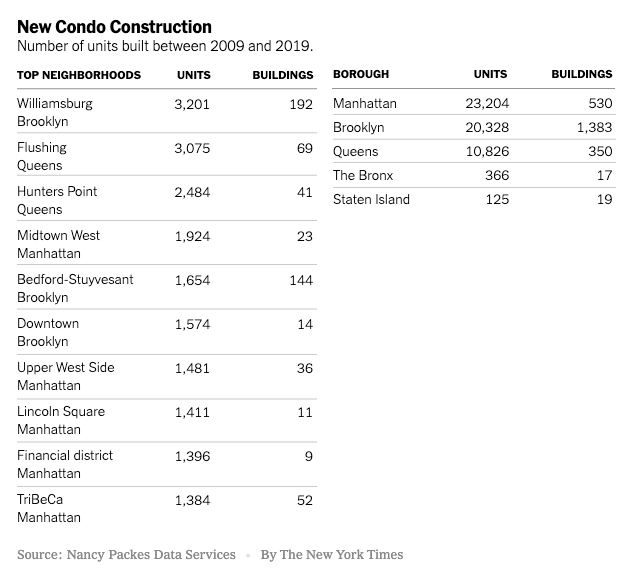
  • Number of condo units built in New York City between 2009 and 2019

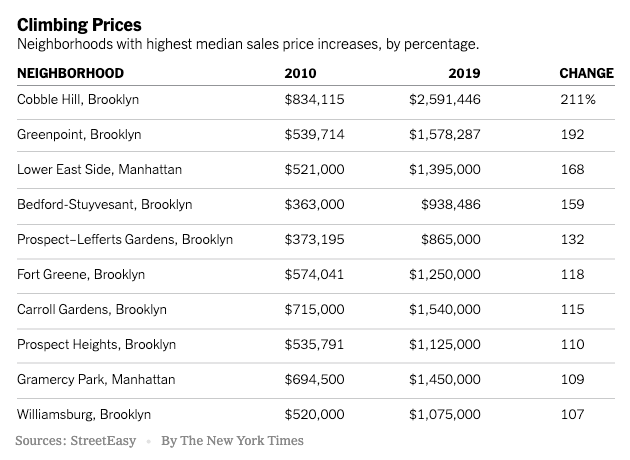
    A decade of ultra luxury condos. The New York Times published this story over the weekend talking about how the luxury condo boom of the 2010s transformed New York City, and in particular Brooklyn.

    Below are two tables from the article: (1) The number of units built between 2009 and 2019 across the five boroughs and the city’s top neighborhoods, and (2) the neighborhoods with the highest median sale price increase.

    The overarching theme is that New York built too many “super-high-end condos” geared toward global capital flows. According to one developer interviewed for the article (Gary Barnett of Extell Development), it was unprecedented.

    Apparently, the problem segment remains the $5 million to $10 million market. There’s simply too much inventory, and that has developers both delaying launches and going with much smaller (and hence more affordable) unit mixes.

    One stat that stood out for me was the new condo premium over resales. In 2011, the average sale price of a new condo in the city was about $1.15 million, which represented about a 9% premium over resale pricing.

    While it is typical to see a premium over resales (the same is true in Toronto), the average price of a new condo in 2019 rose to $3.77 million, representing a 118% premium over resales.

    For the rest of the article, click here.

  • Brutalism is fashionable again, kind of

    I think it’s time to make it official: Brutalism is fashionable again. Okay, kind of. According to this WSJ article, the appreciation for this style of architecture remains nowhere near universal, but the renaissance is certainly continuing. Some Brutalist structures are and have been torn down; while others are being repurposed.

    One recent example is the Balfron Tower in East London (pictured above). Designed by the Hungarian-born architect Ernő Goldfinger and completed in the 1960s as social housing, the tower is currently undergoing a £40 million renovation that will convert it to market-rate housing. Apartments start at £365,000 (USD 472,054) for a 450 square foot one bedroom.

    One notable feature are the “streets in the sky” that separate the building’s circulation (elevator core) from the actual suites. It’s a peculiar way to build and most never consider it today, but it’s very much a hallmark of the Brutalist movement. The idea was to express the building’s various functions — vertical circulation being one of them.

    I guess we just don’t build them like we used to.

    Photo: Walter Homann via the WSJ

  • The most expensive city in the world in which to build

    Using data from Turner & Townsend, Curbed recently reported that the most expensive city in the world in which to build is now San Francisco. On average, it costs USD 417 per square foot. San Francisco is followed by New York ($368 psf), London, Zurich, and Hong Kong. New York took the top spot last year, but San Francisco shot up this year because of, you know, tech.

    This number was calculated using a blend of six different types of construction, everything from apartment high-rise and prestige office to general hospital and warehouse distribution centers.

    Now, I’m not exactly sure what this number includes. But I’m assuming it is only direct construction costs and doesn’t include (contractor) general conditions, land, or any soft costs, which are all significant. Once you add in these other cost inputs, I am sure that you can start to see how things — including the cost of new housing — can quickly escalate.

  • Foster + Partners completes its first residential tower in London

    Foster + Partners has just completed its first residential high-rise in London. It’s a 50 storey building with 299 apartments, called Principal Tower. The tower forms part of a broader mixed-use project — that now houses Amazon UK — called Principal Place. The developers were Concord London and Brookfield Properties.

    Here’s a short 11 minute video from Dezeen talking about the project:

  • The anatomy of density

    Urban environments can be dense in many different ways. This is a topic that we have discussed on several occasions here on the blog. But this working paper by Solly Angel, Patrick Lamson-Hall, and Zeltia Gonzales Blanco — called The Anatomy of Density — is a more scientific way of looking at it. They have come up with six measurable factors that, when combined, define urban density.

    What this means is that cities achieve urban density through different kinds of built form. Hong Kong, for example, gets its density from height, even though only about 4% of its land area is occupied by residential buildings. Dhaka, on the other hand, does it through low building heights and high residential coverage. Homes occupy about 20% of the city’s area. Another dimension is crowding.

    But here’s something that may surprise you. Most cities are actually becoming less densely populated. And, despite our best efforts to encourage more sustainable forms of development, sprawl has continued to outpace densification in the vast majority of the urban agglomerations that were studied as part of this working paper. The wealthier we become, the more space we want to consume.

    Here’s a graph from The Economist that speaks to this trend:

    To download a copy of the working paper, click here.

    Image: The Economist

  • A survey of vacant condo suites in Toronto

    Last year Jaco Joubert set out to estimate the number of condos in Toronto that are potentially sitting vacant. It was a response to the ongoing speculation that too many investor-owned condos are sitting empty across the city and thereby limiting the supply of housing.

    To accomplish this, he photographed 15 different buildings at night (and at different times of the year) and monitored who had their lights on. He then turned these photographs into heat maps and compared the lighting pattern to the floor plans of each building in order to determine the unit demising.

    This month Jaco published his findings. All in all, he estimates that he surveyed some 1,362 units. And of these units, 76 are believed to be vacant (when in doubt he erred on the side of occupied). So a vacancy of 5.6%. Is that more or less than what you were expecting?

    Now, the buildings he “surveyed” are all located downtown and they are all roughly the same vintage. So you could easily argue that these aren’t necessarily representative of the city’s broader condo stock, assuming that’s where you want to take this. Still, an interesting study.