
Daily insights for city builders, delivered every morning at 6 AM ET. I’m Brandon Donnelly — a Toronto-based real estate developer and founder of Globizen. I’ve been writing here since 2013.

Category: Health

  • Sidewalk Labs, Uber, Lime, and the demise of urban density

    Today I am going to talk about 3 things that recently happened and/or that are on my mind.

    Sidewalk Labs pulled out of Toronto. I think this is sad. A lot of people have said that they’re surprised, but not surprised. The official reason is that this unprecedented environment has made it financially infeasible for them to develop the 12-acre site, while still adhering to their core principles. I don’t have any inside knowledge of the situation, but I can’t help but think that this is probably just an opportune excuse. They were getting beat up pretty badly by Toronto on all fronts, even though they had put forward an incredibly ambitious development proposal. As I said before, I can’t imagine many (or any) “conventional” developers coming forward with something like this. The last plan I saw was 1/3 non-residential, and 40% of the residential component was to be priced below market. And never mind all of the other innovations that were being contemplated.

    In other tech news, Uber just led a $170 million investment in Lime (the micromobility scooter company). I think this is smart — both from an overall mobility standpoint and, selfishly, as a shareowner of $UBER. It is being reported that this round of investment values Lime at about $510 million. This is a 79% decline from April 2019 when it raised its last round. So presumably, Uber is getting a pretty good deal here. The bet is that the urban landscape demands multi-modal transportation solutions, everything from bikes and scooters to cars and public transit. There is also an argument to be made that in the short-term, our post-pandemic world is going to gravitate toward individual mobility and away from things like public transit. I’ve heard a few people say that, as we re-open the global economy and try to maintain social distancing, we’re going to face two major mobility bottlenecks: transit and elevators. Sounds like more testing would be a prudent idea.

    Above, I was very careful to say “in the short-term” because I think the narrative that is emerging around the demise of urban density is entirely overblown. Few of us are clamoring to jump back into a mosh pit right now (perhaps a metaphorical mosh pit), but I also don’t believe that we will suddenly look to sprawling Brasilia as a source of urban inspiration. While it is true that “disease did shape architecture in the 20th century” (Alex Bozikovic wrote a good piece on this over the weekend) and that there have been oscillations in terms of how we view urbanity, I also know that this isn’t the first pandemic that our cities have lived through. The Hong Kong flu of 1968 is thought to have killed one million people around the world after, allegedly, emerging in one of the densest cities ever created. Hong Kong’s relationship with Beijing is a tenuous one right now, but it still remains one of the world’s most important global cities.

    Perhaps cities are more resilient than we give them credit for.

    Photo by Touann Gatouillat Vergos on Unsplash
  • New Yorkers are actually pretty healthy

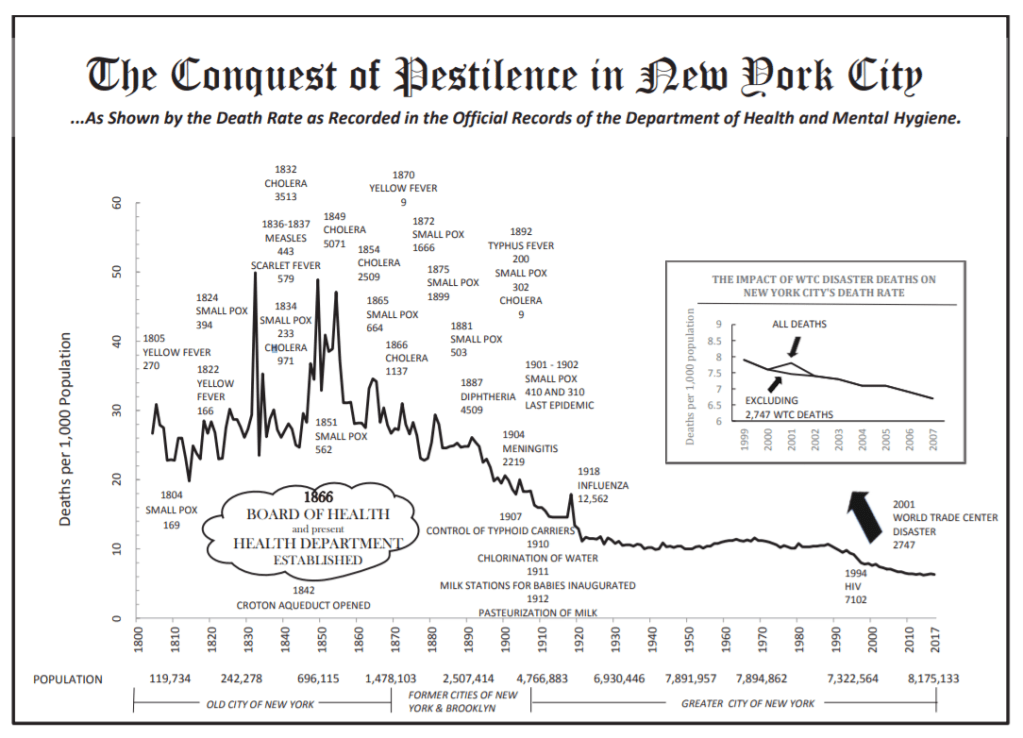
    Nicole Gelinas’ recent piece in CityLab is a good reminder that — despite all of the debates around COVID-19 and urban density — New York City is actually a really healthy place to live. Part of this obviously has to do with the city’s investments in public health. But the biggest factor, Nicole argues, is the city’s transit network. Six million people move around New York City each day without a car. That translates into a meaningfully lower traffic fatality rate. New York State’s rate is about 4.8 per 100,000, whereas Florida’s is 14.7 deaths per 100,000. Taking transit (and having an urban morphology that supports taking transit) also brings along with it other benefits, such as increased walking. And I have to believe that is an important factor. The obesity rate in New York City is thought to be about 22%, compared to a shocking 42% for the country. All of this rolls up into a life expectancy of about 81.2 years for New Yorkers, as of 2017. This is compared to 78.6 years for the US as a whole.

    For more on the health of New Yorkers, check out this 2017 Summary of Vital Statistics. (It’s the source of the above chart.)

  • Exposure tracing APIs to be released May 1

    The “contact tracing” API that Apple and Google are working on and that I wrote about earlier this month is set to be released on May 1. Given all the concerns around privacy, it’s now being referred to as “exposure tracing.” The idea, here, is to emphasize that it is being designed to trace the coronavirus and not individuals.

    To be clear, we’re talking about APIs, and so third party apps will need to be built on top of this tech before we can start downloading anything to our phones. But I am sure that will happen very soon and I will gladly opt in.

    It’s also worth mentioning that this entire concept of smartphone exposure tracing only works when Apple and Google cooperate. Whatever apps ultimately get built need to work across both platforms, otherwise there would be far too many gaps in the network. So this — along with the focus on privacy — has become a bit of good PR for “big tech.”

    The smart people working on exposure tracing over at Oxford University seem to think that (alongside other interventions) we could stop this virus with only about 60% of the population using an exposure tracing app. (They ran models with a pretend city of 1 million people.) But even at 50% penetration, they believe it could make a meaningful contribution.

    These are numbers I think we could easily get to in major cities. Overall, I suspect it could also make people feel a lot more comfortable about going out. And going out is what’s going to be required as we gradually reopen the global economy. How many of you think you will opt in to something like this once it becomes available?

  • Bill Gates on the first modern pandemic

    After watching the docuseries, Inside Bill’s Brain, I couldn’t help but think that the work he and Melinda are doing isn’t getting nearly enough exposure. Here they are working tirelessly to eradicate global diseases, like polio, and find new ways to combat climate change. And yet relatively little was done after Bill went on stage five years ago and warned us that a global pandemic could strike at any time. Why? Probably because most of us thought it wouldn’t happen to us in the developed world.

    But obviously it did happen and along with that Bill has emerged as a level-headed voice of reason. He is calm, serious, and matter of fact about what we know, what we don’t know, and what is going to need to happen for us to make it to the other side of this. In his latest long-form blog post (which is also available for download as a PDF), he calls our current situation “the first modern pandemic”, as well as Pandemic I. That should signal to you that he continues to believe there will be others.

    In it, he summarizes the innovation that will need to happen into five categories: treatments, vaccines, testing, contact tracing, and policies for opening up. Among many other things, he gets into the realities (and timelines) of developing an effective vaccine for the world, as well as the shortcomings of the contact tracing tech that many companies, including Apple and Google, are currently building. I would encourage all of you to have a read.

  • The global gym market and gyms per capita

    Many of us are now working out from home. The Financial Times just reported that Peloton experienced its highest level of participation last week. Some 23,000 people tuned in for one of its streamed classes. Naturally, anything that was possible to go online has gone online.

    I’ve never really been a class guy, but I’ve been a regular at a gym since high school and it’s one of the things I’m most looking forward to getting back to as things subside. For many, the gym is a kind of third place. Though I would imagine it’s not the best place to hangout during a pandemic.

    According to FT, the fitness industry was among the first to suffer in the UK (~£5.1bn industry), showing signs of decline even before any government lockdown. The UK also had one of the most profitable fitness industries in Europe. Here’s an interesting chart comparing gym penetration to revenue per club.

    It’s interesting to note some of the outliers. Latin America has low penetration and low average revenue per club. And parts of Asia — notably Hong Kong and China — have relatively high average revenue per club, but still have fairly low penetration percentages. Do only rich people go to the gym in Hong Kong?

    This chart maybe makes it seem like nobody in Latin America is working out. But if you, instead, look at the number of fitness clubs in each country, the data looks vastly different. In this case, there are two very clear outliers: the United States and Brazil. (The below chart is from Statista and is based on 2017 data.)

    But Brazil also happens to be the most populous country in Latin America with around 209 million people. So let’s consider this chart on a per capita basis against, oh I don’t know, the US (~328 million), the UK (~67 million), and Canada (~38 million). Once again, the ranking switches. Brazil and Canada now come out on top with around 16 fitness clubs per 100,000 people. (I guess we’re just as body conscious as the Brazilians.) This is in comparison to 12 per for the US and 10 per for the UK.

    So what does this all mean for our post-COVID-19 world? Who knows. But I’ll sure as hell be at the gym.

  • How Europe is reopening

    Just over a month ago, as North America was beginning its lockdown, the Europeans were the ones showing us how to stay sane in quarantine through balcony orchestras and viral internet videos. Now we’re looking to them for how best to reopen the economy and minimize the number of fits and starts.

    • This morning Spain recorded its lowest daily death rate from the coronavirus. It is beginning to prepare for a phased relaxation of its lockdown rules. Things will not return to normal overnight. [Financial Times]
    • Spain allowed construction activity and manufacturing to resume this past week. As a reminder, Spain’s strict lockdown started on March 14. [New York Times]
    • Bookstores are open in Venice, but that’s about it. Customers have to enter one at a time, or schedule an appointment. Hotels, restaurants, and cafes remain shuttered. It is believed that at least 1/6th of all Italian restaurants and bars will not survive. Reopening is not happening uniformly across Italy’s 20 regions. [Wall Street Journal]
    • Last week, Denmark became the first country in the Western world to reopen elementary schools. The desks are far apart and teaching outside is being maximized, but some/many are concerned that this is too soon. Are we prioritizing the economy (i.e. free up the parents) over the health of our children? [New York Times]
    • The Czech Republic currently has one of the lowest number of cases on the continent. But hardware stores and bike shops are some of the only nonessential businesses that are allowed to be open. The Easter weekend saw an over 60% increase in year-over-year sales. Biking is something to do right now. [Wall Street Journal]
    • On Monday, the lockdown will be further relaxed by the Czech government. Weddings of up to 10 people will start to be allowed. Gyms are expected to open on May 11, but their change rooms will remain closed. (I’m surprised by this one.) Malls, hotels, and indoor restaurants aren’t expected to reopen until June 8 at the earliest. Should the number of new daily cases exceed 400 going forward, the government has said it will reimpose a lockdown. [Wall Street Journal]
    • The UK is not yet considering a relaxation of its lockdown. As of Sunday, the situation remains “deeply worrying.” The UK currently has the 5th highest national death toll. [Globe and Mail]
    • On April 13, Emmanuel Macron announced that France would begin a phased reopening of its economy — schools and some businesses — starting on May 11. This is a unique approach. He gave a firm date, well into the future. What if this doesn’t make sense when the time comes? Clearly the government felt that the psychological benefits of a firm date outweighed the potential risks. Minimize uncertainty during an uncertain time. [Le Monde]
    • Lots of discussion around the porosity of borders. Logically, there’s a view that unless there’s a common strategy, it’s better to keep borders closed. But what are the economic implications of doing that? [New York Times]

    Photo by Grant Lemons on Unsplash

  • Moovit Public Transit Index

    The Moovit Public Transit Index has been tracking the impact of COVID-19 on public transit usage around the world. Not surprisingly, people are using transit a lot less.

    Above is a chart from Moovit showing usage from January 15, 2020 to April 12, 2020, for a collection of US cities including San Francisco, Chicago, New York, Philadelphia, Seattle, and others. Early March is when usage started to really fall off, with most of the cities now sitting somewhere around 70-75% below January levels.

    For the most part, the cities included in this chart have followed a similar trajectory. But there are a couple of outliers. Philadelphia doesn’t seem to have fallen quite as much as other major US cities (-55.7% as of April 12, 2020). I’m not sure why. San Francisco looks to have “corrected” a lot faster. Perhaps because of an easier/quicker shift to working from home? And then there’s Seattle.

    The first confirmed US case of COVID-19 occurred in the Seattle area on January 21, 2020. Looking at the above chart (and implying causation), that single case appears to have had an immediate impact on transit usage. Over the subsequent three days, ridership dropped to -4%, -8.3% and then to -9.1%. Usage then remained consistently lower relative to all of the other cities in this index.

    Was that it? Did Seattleite’s behaviors really change that quickly? (And yes, I did have to look up the demonym for the fine people of Seattle.)

  • Malcolm Gladwell on the world after COVID19

    [facebook url=”https://www.facebook.com/munkdebates/videos/785234722004262/” /]

    I am a huge fan of Malcolm Gladwell (and not just because he is Canadian and also went to the University of Toronto). Last week he kicked off a new Munk Dialogues series focused on the world after COVID19. (The next Munk Dialogue will be with Fareed Zakaria on Wednesday, April 15 from 8 PM to 9PM Toronto time.)

    In case you’re not familiar with the Munk Debates, they are normally a biannual event held here in Toronto. Their mission is to help people rediscover the “art of public debate” and they do that by convening some of the world’s brightest and most creative thinkers. Right now they are doing that online.

    In this Q&A with Gladwell, they touch on a lot of the topics that we are all debating right now on Zoom calls with our colleagues and friends. When will we get back to “normal?” What will change forever? Is working from home the new normal? Will people still want to go for Mandarin buffet? I won’t spoil it for all of you, but I did want to mention three points that I found myself agreeing with (I guess that is partially spoiling it).

    The first is his analogy to weak link sports such as soccer. Here you’re only as good as your weakest player. This is in contrast to strong link sports such as basketball. In this case, you’re only as good as your best player. If you want to win a championship, you get someone like Kawhi Leonard. Gladwell argues that this pandemic has further exposed us as a complex weak link society. We don’t even have the basic PPE and testing in place to fight this virus.

    The second is about whether this will create a more permanent shift to working from home. I have said before on the blog that I think it’s easy to overreach at a time like this. We might think that everything will change, but we also have short memories. Gladwell takes it a step further and argues that the exact opposite will happen. This pandemic will actually set working from home back a generation. We are going to be so sick of isolating that we will race back to what we had before.

    Finally, I like the point that right now is an opportunity for experimentation. This is true of all crises. It’s a lot easier to question the status quo when the status quo has already been disrupted. And we are seeing this happen at all scales, from people experimenting and learning new things at home to new companies being formed. Hopefully there will also be lasting benefits to our public health systems.

    Anyway, I would encourage to watch the video. If you can’t see it embedded at the top of this post, click here.

  • Apple and Google are building a voluntary contact-tracing network for COVID-19

    Venture capitalist Albert Wenger wrote on his blog today that the road back from COVID-19 could start — as early as May — provided we’re able to get our act together around three essential things: masks, tests, and tracing for everyone. We have all been talking about the importance of these things over the last few weeks, but I think it’s worth mentioning just how quickly some of this is starting to happen.

    Both Apple and Google have announced that they are building a voluntary contact-tracing network. By May, they hope to release a set of APIs that other software developers will be able to build on top of. Bluetooth will be what is used to detect when humans are in close proximity to each other. Eventually, both companies plan to integrate contact tracing right into their operating systems.

    Here’s how it might work:

    Of course, we are also seeing new startups emerge, like this one here called Coronatrace.

    Similar to what Apple and Google have in mind, the app will be a voluntary contact-tracing network. By using it, your phone will begin to log how you move about, something that is already happening today with many of the apps we already use. Should someone test positive for COVID-19 (they would need to update their health status within the app), it would then immediately notify the network and anyone who might have crossed paths with them.

    Obviously it would be far better to simply have a vaccine. But the experts are saying that will take some time — 12 to 18 months? And in the interim, we’re going to need to get the global economy back up and running. Seeing solutions like these being developed makes me hopeful we’ll be able to do that sooner rather than later.