Daily insights for city builders, delivered every morning at 6 AM ET. I’m Brandon Donnelly — a Toronto-based real estate developer and founder of Globizen. I’ve been writing here since 2013.

Category: Economics

  • Canada’s variable geometry map

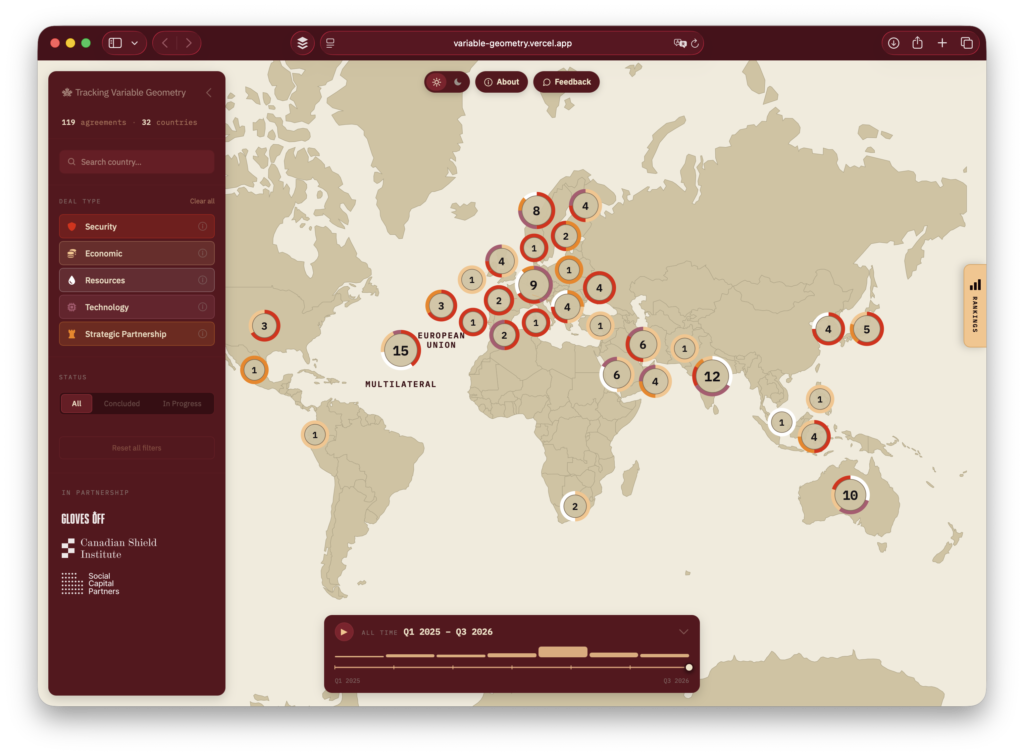
    Here is an interesting map that tracks every important agreement Canada has signed (or is expected to sign) with other countries since March 2025. It is called the Variable Geometry Map, which is in direct response to what Prime Minister Carney outlined in his Davos speech at the beginning of the year: “To help solve global problems, we are pursuing variable geometry. In other words, different coalitions for different issues, based on common values and interests.”

    The agreements are bucketed into five deal types: strategic partnership, economic, security, resources, and technology. They’re all listed in this Google Sheet if you’d like to do an audit. All in all, there are 119 agreements (82 of which have already been signed), spanning 31 countries if you exclude the United States. I like this strategy at a high level, but of course, signing agreements is only one thing. The proof will be in what these ultimately do for Canada.

  • Does design and brand equity sell?

    It is a core belief of mine that design and brand equity create value in real estate. But to what extent is this true? And how much should a developer invest in these things? Is it worth spending a 3-5% licensing fee on a cool brand? Will the price premiums really be there? Here are some ways to think about it.

    One, good design can just mean good taste and, as we talked about yesterday, giving a shit. This doesn’t need to cost any more than bad design; you just have to put in the effort. This is the low-hanging fruit to be seized.

    Two, good design solves problems. And if you’re solving problems that increase returns and development yield, promote sales or leasing velocity, and/or lower operating expenses, then you have tangible value. You can start to figure out the return on your investment, and that helps with decision-making.

    Three, good design can also just mean cool and luxurious materials and details. Here, you’ve got the highest cost of our three options, but it may be important in order to differentiate your offering, drive scarcity value, and create prestige. This one can be harder to evaluate quantitatively.

    All of these approaches ultimately intertwine with the overall brand of a project and of the developer, and that’s the next piece for us to discuss.

    The concept of brand equity has always been fascinating to me because on some level, it’s simply the premium people are willing to pay “for a name” because of the perception they have of that name. It is, by one definition, the “sum of consumers’ thoughts, feelings, and attitudes about your brand that influences their willingness to pay for your product.”

    The challenge with brand equity is that it takes a long time to build, which is one of the reasons developers often borrow it (i.e., license it) from established consumer-facing brands to use on their projects. The other reason is that real estate tends to be local and slow-moving, so it’s objectively difficult to build a global brand.

    Design and brand work together. If you’re developing an Aman Residence, the brand will dictate its standards so you don’t negatively impact the equity it has built up over time. But now we get back to our original question: To what extent does it make sense to invest in design and brand?

    In economics, the definition of a luxury good or superior good is that demand increases more than proportionally as incomes rise. What this effectively means is that when times are good and people are feeling wealthy, they tend to overspend on luxury goods. And when times are not so good, they will often underspend on luxury goods and focus on normal or necessary goods.

    What this means for real estate is that there is an opportunity to capture additional value through investments in design and brand when the overall market supports it. But during downturns, this pricing premium may feel like it disappears. Still, prudent investments in design and brand can lead to selling or leasing when the rest of the market isn’t. Your investments bought liquidity.

    When Steve Jobs launched the original NeXT computer, he overshot the market by a wide margin, and it was a commercial failure. And when he launched the iPhone, critics similarly said it was too expensive. Apple ended up having to lower its initial pricing slightly, but the product turned out to be exactly what consumers wanted.

    Finding the right sweet spot depends on local market conditions and the point you’re at in the development cycle. This involves as much art as it does science. But perhaps the above framework can start to help you think through the options.

  • Canada is uniquely suited to become a global hub for data centres

    Kevin Yin frames the data centre debate eloquently in this recent Globe and Mail article: “The backlash against data centres is understandable. But the answer is not to block construction. It is to design a better bargain.”

    Here are some things we can say about data centres right now:

    • They create relatively few long-term direct jobs (though innovation spillover does exist when they cluster).
    • They are power hungry.
    • They are a core physical engine of the new global economy.
    • They play to Canada’s physical and economic strengths as an energy superpower.

    Meaning, Canada is uniquely suited to become a global hub for data centres and AI infrastructure. Canada has abundant energy, naturally lower cooling costs, geopolitical stability, and deep institutional capital.

    The challenge is that we need to manage the negative externalities. No household, for instance, wants to pay higher energy bills.

    We also need to make sure that there are long-term economic benefits for the country, and that we’re not repeating the old habit of “exporting” our resources to other countries so that they can innovate. That would be a bad deal.

    The world is going to continue to need a lot more data centres, and Canada is in a unique position to lead and have control over its own destiny. Kevin offers a few ideas for what a better bargain might look like, if you’d like to have a read.

  • Do you trust your government?

    This, it turns out, is an important question, because there’s a strong correlation between trust in government and overall prosperity (the above chart is via NZZ). The extreme examples of distrust are somewhat intuitive. If, for example, you don’t believe that your government will uphold property rights, why would you ever want to risk investing in property?

    But it can be even more subtle and insidious:

    Trust is central to both stability and development. If citizens have trust in their system, they will be more likely to push for growth-promoting reforms. Moreover, they will be more confident that politicians will actually implement such reforms, and that sacrifices made today will pay off in the future. If this trust is lost, democracies become unstable, and autocratic tendencies are more likely to prevail. However, trust is also important for the transition from an autocracy geared solely toward the extraction of resources and wealth into a progressive democracy. A politically dominant class that governs autocratically will make concessions voluntarily and refrain from repression only if it trusts that it too will benefit from the institutional changes over the long term, and that it will not later be deprived of all opportunities.

    All of this forms part of the work of economists Daron Acemoglu, Simon Johnson and James A. Robinson, who were awarded the Nobel Prize in Economics earlier this year. Their research explains why wealth is so unevenly distributed across the world. It’s a problem of institutions. But it’s also highly relevant to countries that are already rich.

    Distrust is on the rise in countries like the UK (57%), France, (51%), Germany (49%), and Italy (47%). The outliers among OECD countries are places like Luxembourg and Switzerland. Only 25% of Swiss people express distrust in the government. That’s a good thing for overall prosperity and it shows in their GDP. So how can we be more like the Swiss?

    Radical transparency when it comes to decision making and more of a direct democracy (versus a representative democracy) are two places to start, according to the research. People, it seems, trust their government more when they themselves make more of the decisions.

    Here’s the full NZZ article. It’s an illuminating read.

  • Crypto is really hard to explain, but things are happening

    I was at a dinner recently where the topic of crypto came up. Only two of us at the table were full-on believers, and the rest were generally sceptics. So naturally, the two of us started talking about why we think crypto is important. But in moments like this, it always becomes immediately clear that crypto is really hard to explain in a succinct and compelling way. Like, I don’t know how to do it. Thankfully, venture firm a16z just released their latest State of Crypto report, and so here are a handful of interesting takeaways.

    The number of crypto addresses continues to grow. Currently it’s at an all-time high of approximately 220 million, which roughly mirrors the adoption curve of the internet back in the 90s (log scale). It is, however, important to note that one crypto address does not necessarily correspond to one human being. For example, I have many different crypto addresses. So if you dig a little deeper, you’ll see that their net estimate is somewhere between 30-60 million real human beings transacting using crypto every month. This is the estimated active user base and it continues to grow.

    The number of mobile crypto wallet users is also growing rapidly outside of the US, namely in countries like Nigeria, India, and Argentina. This is the result of a number of factors: population growth, mobile phone adoption, government support, inflation, and many others. I mean, since 2010, the Argentine Peso has lost basically 99% of its value against the USD. So of course you’d rather put your money somewhere else, such as in stablecoins.

    Stablecoins are cryptocurrencies that have their value pegged to something else, such as a fiat currency. Today, they are one of the most popular crypto products and virtually all of them (more than 99%) are pegged to the USD dollar. This is viewed by some as an opportunity to strengthen the dominance of the US dollar at a time when it’s waning (see above). But more importantly, stablecoins already serve two important functions in the market: one, it’s as stable as the US dollar; and two, the cost of sending a stablecoin anywhere in the world is now basically free. Say goodbye to bank wire transfers.

    It’s worth reiterating that a16z is a venture capital firm that is heavily invested in the crypto space. And so reports like this are naturally a form of marketing and a form of lobbying. Still, there’s a lot of great information in here that you can use to form your own opinions about the sector. It may not be succinct, but if you take the time, I think you’ll find it compelling.

  • Rent control and road pricing — economics is the study of choice

    Yesterday’s post tried to pit politics against the realities of how we know cities and economics work. So today, I thought I would share a set of memos from Howard Marks (of Oaktree Capital) titled Economic Reality, Political Reality (which he refers to as an oxymoron), and Shall We Repeal the Laws of Economics?

    In this last one, he specifically talks about things like price gouging (starting with the grocery industry) and apartment rent controls. Each is worth a full read when you have the time, but here I’ll leave you all with a few city building-related thoughts.

    Marks describes economics as the study of choice. And within these choices, there are many complicated moving pieces and second-order consequences. Take, for example, rent control in New York City. What rent control does is stop the free market from being able to freely set rents. The result:

    A person in favor of this arrangement would argue that it maintains affordability and diversity. What it means in purely economic terms is that some people who couldn’t afford to live in New York City if rents were set by free-market forces are able to live there if they’re lucky enough to secure an apartment with regulated rent. But other people who would like to live in New York City and can afford higher rents can’t do so because there are no apartments for them. And lastly, landlords that have apartments that are somehow unregulated can command higher rents than would be the case if additions to the supply of apartments weren’t being discouraged. It’s a matter of personal philosophy whether this is good or bad. But clearly, the laws of economics and the actions of free markets aren’t at work in New York City. Someone in government is making the decisions.

    Much like inclusionary zoning in the case of new housing, the tradeoffs with regulated rents are that you get (1) less overall housing supply and (2) more expensive prices for the people that can pay market rents.

    You could argue, as Marks suggests, that these are acceptable outcomes; but regardless of your opinion, there are real consequences to this policy decision. There’s no such thing as a “free lunch” in economics, and consequently there’s no such thing as no-cost affordable housing. The question is: Who pays?

    Going back to the topic of traffic congestion from yesterday’s post, Toronto’s general reluctance to implement any form of road or congestion pricing is also an economic choice. We have priced our roads so cheaply that demand is always going to outstrip supply. And this is expected. What we are experiencing today is a natural market outcome.

    Targeting bike lanes as part of the problem is meant to counter this by increasing road supply. Less bike lanes means more space for cars, right? But the second-order consequence of this choice is that you push people off their bikes (which take up less road space) and into cars (which take up more road space). So demand is also likely to increase.

    The stark reality of solving traffic congestion is that it will require greater change. It will mean fewer people driving, more people taking transit and biking, and the people who do continue to drive will have to pay more for it.

    Of course, this is not what any politician wants to talk about. As Marks says: “In the world of politics, there can be limitless benefits and something for everyone. But in economics, there are only tradeoffs.” The tradeoff we have decided to make is cheap roads in exchange for crippling traffic congestion.

  • Development charges are an insidious problem

    Here is a recent chart from Mike Moffat showing how much development charges have increased in the City of Toronto from 2009 to today:

    We’ve, of course, seen this before. Back in 2020, I shared an article that developer Urban Capital published where they did a cost comparison between a project they had done in 2005 and a project they were doing in 2020. What they uncovered was that development charges alone had increased by 3,244%! The most of any line item in their pro forma.

    Development charges over the last real estate cycle have been an insidious problem. Meaning, the industry knew they were crazy high, and we were all trying to be vocal about it, but let’s face it — the general public doesn’t have a lot of sympathy for developers complaining about high fees. They are also largely hidden from purchasers and renters. The charges just get lumped in.

    If our industry could figure out how to be more transparent and separate out these charges, much like a sales tax, I think it would go a long way to showing consumers what they’re actually paying when it comes to new housing. And then maybe something positive would happen. Because this is a major reason why new housing has gotten so expensive in this region.

    Can you imagine if property taxes had increased by 3,244% over the last 15 years? I can’t. Because no one would have ever allowed that to happen.

    For better and for worse, the current market is going to serve as a rude awakening for municipalities. We’ve reached the breaking point. The housing market is, as we’ve talked about, in a “state of economic lockdown.” And when people don’t buy new homes, it means developers no longer have the money to pay development charges.

  • Land, development, democracy

    Traffic congestion and a lack of affordable housing are two clearly defined problems facing most, if not all, major cities. We know they exist. We call them crises. And yet, we can’t seem to implement effective solutions, even though we know what they are. Why is that? In her new book, On The Housing Crisis: Land, Development, Democracy, Jerusalem Demsas makes the argument that it is a failure of local democracy. There is a disconnect between what we say we want to happen and what we are actually doing. This resonates with me. In my mind, it’s looking upstream at what is bottlenecking us from making the decisions that will produce better outcomes for our cities. So after reading this conversation with her about the new book, I decided to buy a copy.

    As always, I’ll let you know what I think.

  • Who owns single-family houses in the US

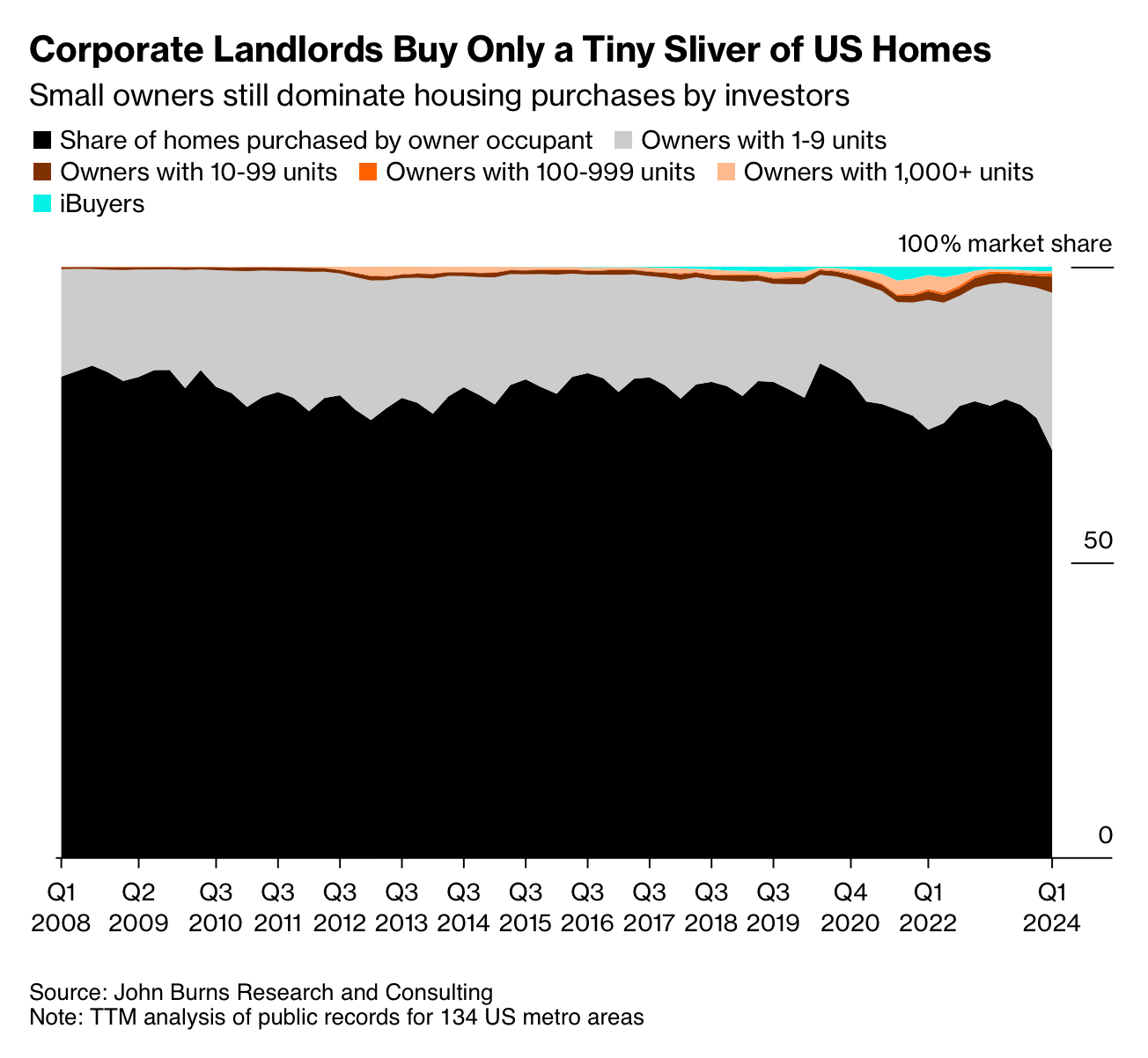
    Here is a chart from a recent Bloomberg article summarizing who owns single-family houses in the US.

    As of Q1-2024, about 69% were owner-occupied, about 26.6% were owned by small landlords (1-9 homes), and the rest were owned by what many are now calling “corporate landlords.”

    The point of this graph was to show that, despite getting a lot of political attention, corporate landlords still own very little. Let’s call it sub 4%, excluding iBuying companies like OpenDoor. So how much of a problem is this, really?

    Smaller landlords control much more of the US market. And at the end of the day, a house owned by a small landlord versus a corporate landlord doesn’t change the supply-demand balance of a market. It still represents an available home.

    The first and more important problem to solve is overall housing supply. Because that does change the supply-demand balance of a market. And once again, there’s no shortage of data to support the finding that increased supply tends to moderate rental growth.

    For the record, I also dislike using the term home to refer to single-family houses. Home is not a housing type. It is simply a place where people live permanently. So whenever I see a title like “US homes,” I get confused, because I don’t actually know what they’re referring to.

    If you read the article, it would appear they’re only talking about single-family houses. But implying that these are the only kind of home feels to me like an anachronism.

  • Ontario Silver Mining Company

    If you hang around Park City long enough, you will come across things with the name Ontario. There’s Ontario Avenue. There’s the Ontario hiking trail at Deer Valley. And I’m sure there are other things.

    As a Canadian, I couldn’t help but wonder why. So today I looked it up. And it turns out that the mining company that first put Park City on the map was the Ontario Silver Mining Company (see above stock certificate).

    Established in 1872, it was a major contributor to Park City’s economy (when it was a mining town) and it is usually credited as the mine that generated the most consistent yield in Utah during the late 19th century.

    Cool, so why was it called Ontario? Well, according to the Park City Museum, the mine was first discovered by prospectors from Canada (though they later sold off their claim to George Hearst for a handsome $30,000).

    I can’t seem to find any info about these Canadians, but the province of Ontario did get its name in 1867, so at least the chronology check outs.

    Image: Park City Museum