
Daily insights for city builders. Published since 2013 by Toronto-based real estate developer Brandon Donnelly.

Subscribe to Brandon Donnelly
>4.2K subscribers

Canada must become a global superpower
The silver lining to the US starting a trade war with Canada and regularly threatening annexation is that it has forced this country out of complacency. Indeed, I'm hard pressed to remember a time, at least in my lifetime, when patriotism and nationalism has united so much of Canada. According to a recent survey by Angus Reid, the percentage of Canadians expressing a "deep emotional attachment" to the country jumped from 49% in December 2024 to 59% in February 2025. And as further evidence of...

The bank robbery capital of the world
Between 1985 and 1995, Los Angeles' retail bank branches were robbed some 17,106 times. In 1992, which was the the city's worst year for robberies, the number was 2,641. This roughly translated into about one bank robbery every 45 minutes of each banking day. All of this, according to this CrimeReads piece by Peter Houlahan, gave Los Angeles the dubious title of "The Bank Robbery Capital of the World" during this time period. So what caused this? Well according to Peter it was facil...
The story behind those pixelated video game mosaics in Paris
If you've ever been to Paris, you've probably noticed the small pixelated art pieces that are scattered all around the city on buildings and various other hard surfaces. Or maybe you haven't seen or noticed them in Paris, but you've seen similarly pixelated mosaics in one of the other 79 cities around the world where they can be found. Or maybe you have no idea what I'm talking about right now. Huh? Here's an example from Bolivia (click here if you can't see...

Canada must become a global superpower
The silver lining to the US starting a trade war with Canada and regularly threatening annexation is that it has forced this country out of complacency. Indeed, I'm hard pressed to remember a time, at least in my lifetime, when patriotism and nationalism has united so much of Canada. According to a recent survey by Angus Reid, the percentage of Canadians expressing a "deep emotional attachment" to the country jumped from 49% in December 2024 to 59% in February 2025. And as further evidence of...

The bank robbery capital of the world
Between 1985 and 1995, Los Angeles' retail bank branches were robbed some 17,106 times. In 1992, which was the the city's worst year for robberies, the number was 2,641. This roughly translated into about one bank robbery every 45 minutes of each banking day. All of this, according to this CrimeReads piece by Peter Houlahan, gave Los Angeles the dubious title of "The Bank Robbery Capital of the World" during this time period. So what caused this? Well according to Peter it was facil...
The story behind those pixelated video game mosaics in Paris
If you've ever been to Paris, you've probably noticed the small pixelated art pieces that are scattered all around the city on buildings and various other hard surfaces. Or maybe you haven't seen or noticed them in Paris, but you've seen similarly pixelated mosaics in one of the other 79 cities around the world where they can be found. Or maybe you have no idea what I'm talking about right now. Huh? Here's an example from Bolivia (click here if you can't see...

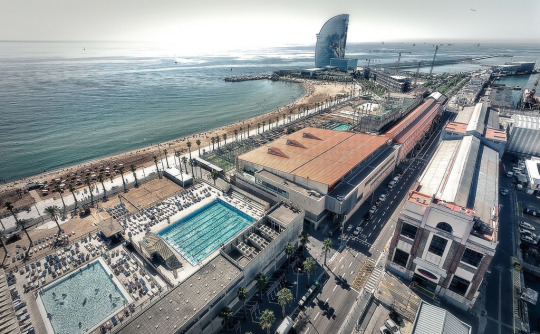
Barcelona is in the midst of dramatically rethinking its urban fabric to address issues around urban mobility and climate change. Initially laid out in this 2014 Urban Mobility Plan for Barcelona, the city is now implementing something it calls superilles (or superblocks in English).
Here’s what it looks like:

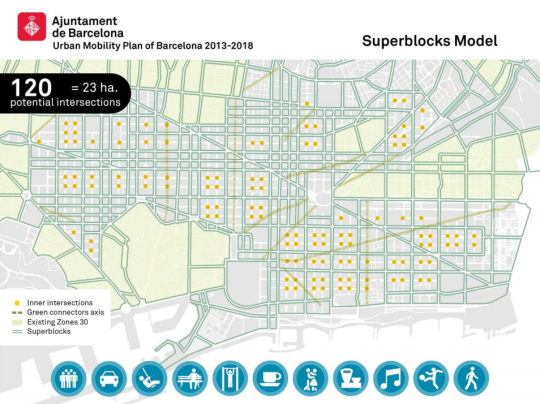
The idea is to concentrate transit and vehicular traffic onto the edge of these new superblocks and then convert the interiors into livable spaces for pedestrians and cyclists. Here’s a description from the Agència d’Ecologia Urbana de Barcelona:
“Superblocks are made up of a grid of basic roads forming a polygon, some 400 by 400 meters, with both interior and exterior components. The interior (intervía) is closed to motorized vehicles and above ground parking, and gives preference to pedestrian traffic in the public space. Though the inner streets are generally reserved for pedestrians, they can be used by residential traffic, services, emergency vehicles, and loading/unloading vehicles under special circumstances. The perimeter, or exterior, of Superblocks is where motorized traffic circulates, and makes up the basic roads.”
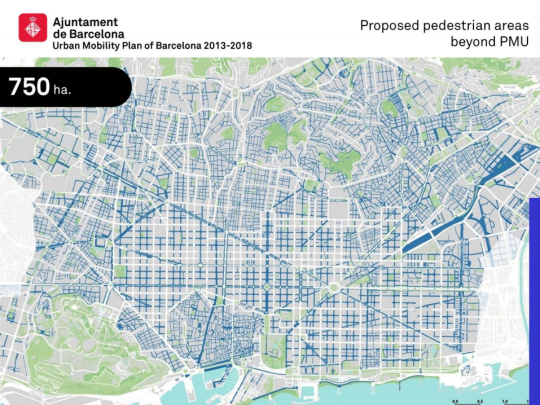
The result is going to be an absolutely radical shift in the amount of public space given to drivers, pedestrians, and cyclists. When their 2014 report was issued, it was estimated that 73% of public space was allocated to cars (versus pedestrians). This plan will completely flip that ratio. With the superblock model, it is estimated that 77% of public space will now be allocated to pedestrians.
Here’s what that is expected to look like…
Before:

After:
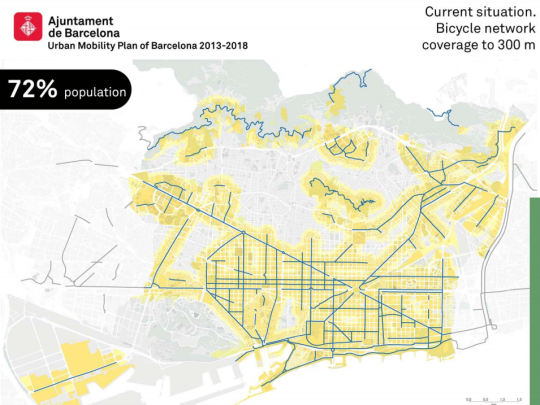
There are also plans to expand the bicycle network to roughly 95% of the city’s population.
Before:
After:

If any of you are from Barcelona, I would love to hear a local perspective on this mobility plan. Were and are there cries of a war on the car?
Images: Top image from Tom Walk (Flickr); Maps from Urban Mobility Plan of Barcelona 2013-2018

Barcelona is in the midst of dramatically rethinking its urban fabric to address issues around urban mobility and climate change. Initially laid out in this 2014 Urban Mobility Plan for Barcelona, the city is now implementing something it calls superilles (or superblocks in English).
Here’s what it looks like:


The idea is to concentrate transit and vehicular traffic onto the edge of these new superblocks and then convert the interiors into livable spaces for pedestrians and cyclists. Here’s a description from the Agència d’Ecologia Urbana de Barcelona:
“Superblocks are made up of a grid of basic roads forming a polygon, some 400 by 400 meters, with both interior and exterior components. The interior (intervía) is closed to motorized vehicles and above ground parking, and gives preference to pedestrian traffic in the public space. Though the inner streets are generally reserved for pedestrians, they can be used by residential traffic, services, emergency vehicles, and loading/unloading vehicles under special circumstances. The perimeter, or exterior, of Superblocks is where motorized traffic circulates, and makes up the basic roads.”
The result is going to be an absolutely radical shift in the amount of public space given to drivers, pedestrians, and cyclists. When their 2014 report was issued, it was estimated that 73% of public space was allocated to cars (versus pedestrians). This plan will completely flip that ratio. With the superblock model, it is estimated that 77% of public space will now be allocated to pedestrians.
Here’s what that is expected to look like…
Before:

After:

There are also plans to expand the bicycle network to roughly 95% of the city’s population.
Before:

After:

If any of you are from Barcelona, I would love to hear a local perspective on this mobility plan. Were and are there cries of a war on the car?
Images: Top image from Tom Walk (Flickr); Maps from Urban Mobility Plan of Barcelona 2013-2018
Share Dialog
Share Dialog
No activity yet