Daily insights for city builders, delivered every morning at 6 AM ET. I’m Brandon Donnelly — a Toronto-based real estate developer and founder of Globizen. I’ve been writing here since 2013.

Author: Brandon Graham Donnelly

  • Immigration to Canada is back

    According to the Globe and Mail, Canada’s census metropolitan areas (or city regions) grew by about 574,000 people for the year ending July 1, 2022. This is the highest number on record (or at least since Statistics Canada started tracking this figure in 2001), which is not entirely surprising given that immigration flows slowed dramatically during the pandemic.

    The other thing that the pandemic did was accelerate a trend of people leaving the biggest city regions for other parts of a province. During this same time period, Vancouver saw a net intraprovincial migration loss of about 14,300 people, Montreal saw about 29,500, and Toronto saw 78,077. But again, this was a trend that was building prior to the pandemic:

    It is perhaps no surprise that these losses follow the order of our largest city regions. And it once again suggests that we are not doing enough when it comes to housing supply/affordability and homes for young families. These intraprovincial losses are not because these city regions aren’t desirable. It’s in fact the exact opposite.

  • A home not a unit

    I dislike the term residential unit.

    It makes a home sound like some sort of widget. When have you ever heard someone say, “unit sweet unit”? Never. And yet this is generally what we use to refer to housing that comes in an apartment form and is not grade-related.

    If you build low-rise houses, you’re a home builder. But anything beyond that, and the home moniker apparently needs to fall away.

    There is, of course, a very good reason for this and it is that we have a longstanding history of not liking apartments. And so this is in all likelihood some sort of carryover of that bias. Surely there’s no way to create a morally-correct home in an apartment. So let’s use a more utilitarian sounding name, like unit.

    I’m sure that I have used the word “unit” countless times on this blog throughout the years. But I am working to remove it from my vocabulary. And now you can all hold me accountable to that.

  • What rich people plan to do with their money in 2023

    Each year in March, Knight Frank publishes something called, The Wealth Report, which typically includes things like its Prime International Residential Index (PIRI) and a general overview of what ultra high-net-worth individuals (UHNWIs) are up to with their money.

    (An UHNWI is typically defined as someone with a net worth greater than $30 million. And as of last year, there were nearly 400,000 of them around the world, with Hong Kong being the city with the most.)

    In anticipation of this year’s report, Knight Frank has just published the key findings of an “Attitudes Survey.” This is them talking with and surveying private bankers, wealth advisors and family offices about some of the key themes for 2023.

    Here are a few of my takeaways:

    • Globally, about 1/3 of UHNWI wealth is allocated to primary and secondary homes. This is expected. Generally the richer you become, the more your net worth gets diversified away from your primary residence. It is also worth noting that of this 1/3 allocation, more than a quarter is being held outside of their country of residence. This outside-of-country-of-residence percentage is highest for UHNWIs in the Middle East (41%).
    • The average UHNWI owns 4.2 homes around the world, with UHNWIs in Asia owning the most: an average of five homes. This is the kind of stat that might provide motivation for a foreign buyer ban, but I continue to believe that there are other bigger drivers impacting housing affordability/supply across our global cities.
    • About 15% of UHNWIs said that they want to purchase a residential property this year (2023). This is down from 21% last year. Inline with bullet point number one, the greatest appetite/stated intent is coming from the Middle East. (Related article: The new Gulf sovereign wealth fund boom)
    • Real estate was identified as the top investment opportunity. About 1/3 of UHNWIs want to invest in real estate — either directly or indirectly — in 2023. And the top asset classes are: healthcare, logistics/industrial, office, multi-family rental apartments, and hotels. It is interesting to see office in the top three. A positive sign that it is maybe being viewed as an oversold opportunity.
    • Finally, environmental sustainability is being increasingly considered by UHNWIs when it comes to investment properties: 57% are considering energy source(s), 33% are considering opportunities for refurbishment, and 30% are considering the materials used/the embodied carbon footprint inherent to the asset.

    For the full findings, click here.

  • Our current public transit problem/opportunity

    Over the past few years, I have been writing about the fall off in public transit ridership that we have seen as a result of the pandemic. Most recently, I mentioned it in my predictions for 2023.

    This topic doesn’t seem to get a lot of air time, but it is a problem. Because the standard way to operate a transit system in North America is at a loss.

    According to this recent WSJ article, the average fare recovery ratio across the US is somewhere around 1/3, with the remaining 2/3 of operating costs being covered by public money.

    (Somehow Japan has figured out a way to make money on rail.)

    During the pandemic, federal aid was disbursed in order to maintain service levels. The MTA in New York, for example, received $15.1 billion. But these aid packages will eventually run out, and ridership has yet to fully return:

    New York’s subway system has regained about two-thirds of its pre-pandemic ridership with about 91 million trips in November, according to the MTA. But that is about 50 million fewer rides than in November 2019. Officials worry usage has stalled out at that level.

    In San Francisco, the Bay Area Rapid Transit, or BART, recorded 3.7 million trips in November—a little more than one-third of the ridership before Covid.

    The obvious answer is likely to be a combination of service cuts and/or more public money. But an even better answer would be to use this opportunity to figure out how to make our transit systems a little more Japanese.

    That is, let’s make them more financially sustainable. And yes, that is going to necessarily involve looking at how we build around and on top of transit.

  • 2 storeys not 12

    I came across this poster — related to this development application — over the weekend:

    And I think it raises a number of important questions:

    • Is 2 storeys appropriate for next to a subway station and next to an existing mid-rise building?
    • Is a mid-rise building truly unprecedented in this context? See below.
    • Are mid-rise homes inappropriate for “residential streets?”
    • How does building height factor into flood plain concerns? Wouldn’t lot coverage be more relevant?
    • And when does a mid-rise become a “high-rise?”

    For more context, here’s the proposal and its immediate surroundings:

    I fully appreciate that there’s little incentive to support new development in a place where you already live — even if you happen to live in a similarly-scaled building across the street. And I am sure that I’ll receive a number of emails following this post.

    But optimizing the use of land around our existing transit stations is one of the best things we can do as city builders.

    Update: I have redacted the contact information on the above poster.

  • Single-exit housing in Paris

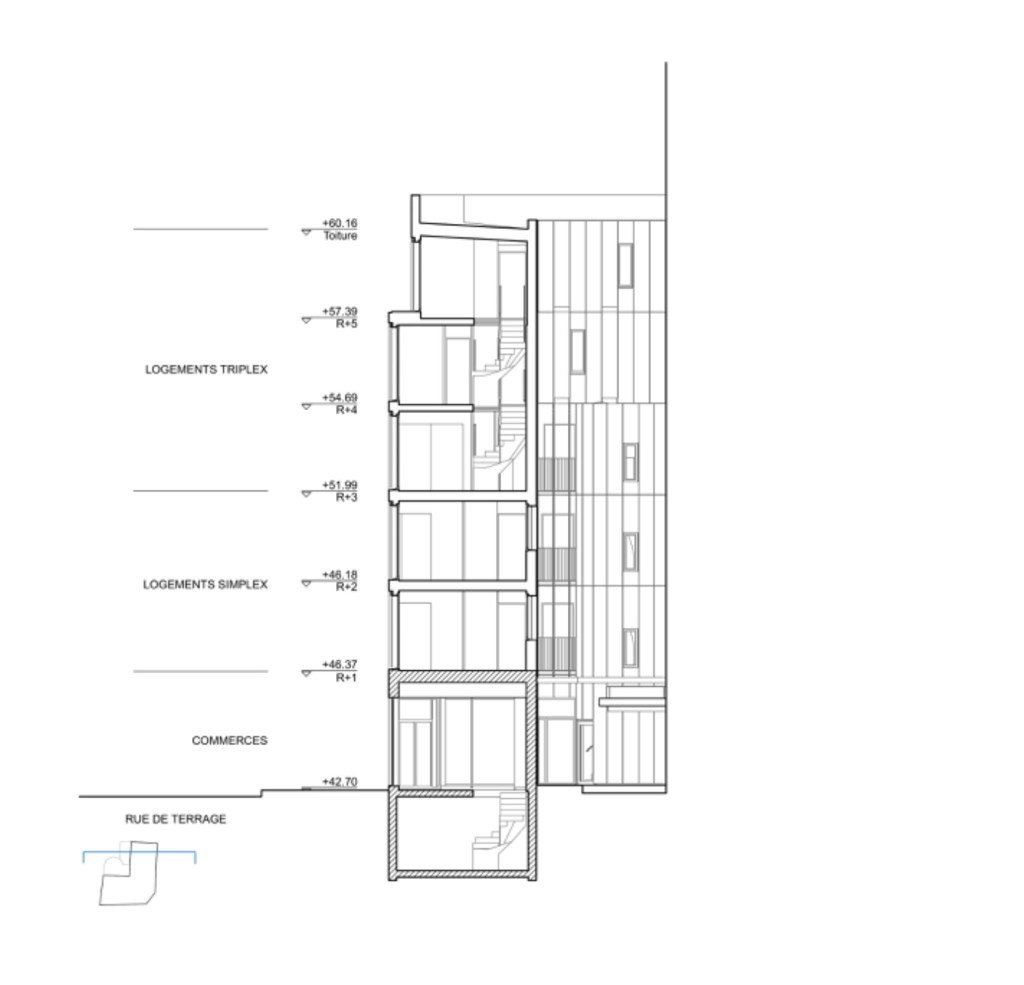
    Lloyd Alter of Treehugger recently wrote about this infill housing project in Paris. Designed by Mobile Architectural Office (MAO), it is a 6-storey building with 6 residential suites (two of which are 3-storey triplex suites) and 1 ground floor non-residential space.

    Building section:

    But here’s where things get really remarkable: the area of this corner site is less than 100 m2 (~1,000 sf), the construction budget was €940,000 (excluding VAT), and almost the entire structure was built out of cross-laminated timber. So overall, this is an incredibly sustainable build: it uses land and services efficiently and it uses low-carbon materials.

    At this point, you should now be wondering, “why can’t we just do this everywhere?” And this would be the right question.

    Lloyd correctly points out in his article that one of the things that makes this building feasible is that it only has one exit stair (as well as no elevator). Typically you need two means of egress, which can serve as a real barrier to smaller builds like this one here.

    But in this case, and this is part of the argument, the building is small enough that, should a fire or emergency happen, occupants could be rescued through their windows. So technically there are still two ways of getting out.

    In this year’s predictions, I mentioned that we would see “supportive building code changes”, which would help to encourage more infill housing. Exiting is one of the changes I had in mind when I wrote the post. So here’s hoping that policy makers are reading this blog, looking to projects like this one in Paris, and recognizing the benefits.

    Talking about exit stairs may not be as exciting and seemingly impactful as something like a foreign buyer ban, but I promise you that removing the many barriers to building this scale of housing would ultimately bring more benefit to our cities.

    P.S. This project is also social rental housing.

    Image: MAO

  • An interactive map of industrial space in southern California

    Here is an interactive map, created by the Robert Redford Conservancy for Southern California Sustainability, showing the approximately 1,573,777,062 square feet of industrial space that can be found in Los Angeles, Riverside, and San Bernardino.

    The map allows you to zoom in on specific parcels to see things like site area, warehouse size, and year built. You can also play around with different map radii to create a rollup of warehouse space within a specific area, which includes an estimate of daily truck traffic and CO2 produced.

    The Guardian also used this data to create the following chart, which is helpful in showing the dominance of certain cities, as well as how much of this industrial space has been built since 2010:

    The point of this interactive map, this data, and the accompanying articles is to highlight just how disruptive all of this new industrial space is to these southern California communities and to the environment in general. But I think it is also an important reminder that, whether we like it or not, our online activities have real-world physical implications.

    Online shopping requires warehouses and logistics. Online food delivery requires (ghost) kitchens. And online activity, in general, requires the storage of unprecedented amounts of data. All of these “back-end spaces” take up room, even if they’re mostly easy to ignore when we’re just looking at our phones.

    This is our new “phygital” world and, yes, it is changing the landscape of our cities. Now our task is to figure out how to do this in a way that respects communities and respects the environment.

  • No more foreign buyers

    Here’s the thing about housing:

    The delegates insisted on one hand that “housing is for living not speculation”, but on the other, emphasised the critical importance of real estate to China’s economic growth.

    In other words, things are complicated. We want housing to be affordable to more people, but at the same time, we recognize that housing appreciation is kind of useful for overall economic growth. So we’re a bit conflicted. And that may be why we tend to take contradictory actions.

    Broadly speaking, the current playbook in Canada seems to be as follows: heavily tax new housing, force those who can afford new market-rate housing to subsidize those who can’t, and then tax/ban foreign buyers.

    Canada’s new foreign buyer ban came into effect on January 1 of this year. And for the next 2 years, it prohibits companies and people who are not Canadian citizens or permanent residents from acquiring non-recreational, residential property in Canada. (What is the definition of non-recreational?)

    While this may sound good to some — finally, more homes for Canadians — we’re talking about a relatively small portion of the market, which is likely why there’s also little evidence that any of our foreign buyer taxes have been all that effective.

    It’s really hard to imagine this one working much better. But it certainly sounds like something.

  • Japan pays people to leave Tokyo

    We have spoken over the years — here, here, and here — about the centralizing and decentralizing forces that play out within our cities. Agglomeration economies, for example, are a centralizing force. There are real economic benefits to people and firms clustering together in cities.

    However, there are also many decentralizing forces. Traffic congestion is one. And of course, the pandemic also proved to be a powerful one for many cities.

    But the fact that we even have cities in the first place should tell you that the centralizing forces do tend to win out over the decentralizing ones. And a perfect example of this is Tokyo. Usually considered to be the largest metropolitan area in the world, Tokyo has about the population of Canada in one city region.

    And here, the centralizing forces are so great — even for families — that the government actually pays people to relocate to places outside of Tokyo’s 23 wards (and its immediately surrounding areas). Previously the maximum figure was ¥300,000 per child (~CA$3,056), but this has now been increased to ¥1 million per child (~CA$10,188).

    A key driver of this is surely Japan’s demographic problem (namely a shrinking and aging population base). But it doesn’t change the fact that lots of people appear drawn to the world’s largest city.

  • Road salt vs. gravel

    It has been mild and wet in Toronto over the last week, but normally at this time of the year, the entire city looks like as if it was just hit by some sort of apocalyptic chalk storm. Everything is white. And that’s because we rely on rock salt and liquid salt brine to keep our roads and sidewalks free of snow and ice. Each winter, the city uses upwards of 130,000 tones of salt to maintain its service levels.

    This is the tool of choice because it is both reasonably effective and cheap. However, the trade-off is that it does horrible things to the environment. It also ruins perfectly good shoes, which should tell you something about what it’s doing to the environment. So it’s a balancing act: Yeah, it’s terrible for the environment, but we want usable roads and sidewalks. People slipping and falling is also a liability problem.

    That said, when I was in Montreal over the weekend, I did notice a greater use of gravel:

    This causes its own set of problems in the spring when it all needs to be tidied up. But in the interim, it did allow me to wear my neon Nike Air Max 90s without the fear of them disintegrating on my feet. Sometimes there’s also no choice. Road salts only work down to a certain temperature and then they become ineffective. So there are lots of examples of cities using sand and/or gravel to improve traction.

    This is not the case in Toronto. We rely on rock salt. And part of the reason for this is that our winter service levels dictate “bare pavement” on highways and arterial roads. Gravel doesn’t get you bare pavement. Salt does. Also, Ontario doesn’t require snow tires, whereas Quebec does. So there is an argument that, because of this, we are all ill-equipped to deal with anything besides bare streets. (Though have you seen our sidewalks and bike lanes?)

    I am not a salt management expert. I opted out of that fascinating elective in University. But in my opinion, the goal should be to use as little rock salt as possible. Maybe that means we need to rethink our service levels and our priorities. And maybe that means we need to do things like mandate winter tires.