
Daily insights for city builders, delivered every morning at 6 AM ET. I’m Brandon Donnelly — a Toronto-based real estate developer and founder of Globizen. I’ve been writing here since 2013.

Author: Brandon Donnelly

  • A child of catastrophe

    It used to be the case that cities had a habit of catching fire and burning down. Toronto had the Great Fires of 1849 and 1904. Chicago had the Great Fire of 1871. And the same can be said about many other cities. In fact, you probably weren’t considered a real city until you had some sort of “Great Fire.” But as Derek Thompson points out in this recent Atlantic article about urban comebacks, disasters have a way of forcing positive change:

    The 21st-century city is the child of catastrophe. The comforts and infrastructure we take for granted were born of age-old afflictions: fire, flood, pestilence. Our tall buildings, our subways, our subterranean conduits, our systems for bringing water in and taking it away, our building codes and public-health regulations—all were forged in the aftermath of urban disasters by civic leaders and citizen visionaries.

    As Charles Dickens famously described, British cities in the early years of the Industrial Revolution were grim and pestilential. London, Birmingham, Manchester, Leeds—they didn’t suffer from individual epidemics so much as from overlapping, never-ending waves of disease: influenza, typhoid, typhus, tuberculosis.

    It’s somewhat unfortunate, but oftentimes we need something to break before any action is taken. There’s a bias toward the status quo. Otherwise, it becomes a question of, “what did we do last time? Well that worked just fine. Let’s do it again.” But hopefully all of this makes you at least a little optimistic about the future. Because history has taught us that when faced with adversity, we don’t typically turn our back on our cities. Rather we turn around and make them better.

    Photo by Tomek Baginski on Unsplash
  • What tribe are you part of?

    This satirical piece in the Beaverton about “biking everywhere” is hilarious because it touches on so many cycling stereotypes:

    “It’s a great way to get around while also staying in shape,” said McFarlen as he biked through a red light. “From tattoo shops to my job at VICE to even the best Banh Mi in the city – I just hop on my bike and I’m there. Why does anyone drive ever? Gross!”

    But the other thing it does is speak to the trade-off between location and transportation costs. Brian McFarlen, the fictional protagonist from the article, is able to bike everywhere (low cost) because he allegedly lives in a central neighborhood (high cost):

    McFarlen, whose parents paid for him to go to film school and has no mortgage, kids, or debt, condemns people who drive in the city. “I hate cars – we should just get rid of all roads and replace them with bike lanes. Isn’t everyone able to live downtown and spend hours of their day biking around the city hitting up all the best micro breweries?”

    I think it’s natural for us humans to form tribes with others that are similar to ourselves. We have two wheels and you all have four wheels. We live in the city and you all don’t. All of these things make us different.

    But there’s certainly something to be said for having a bit of empathy for those outside of our particular tribes.

  • The will to win

    I just finished watching the Raptors beat the Boston Celtics and tie up the series in double overtime, and now it’s quite possible that I may not be able to sleep for the next three days.

    My favorite inbound text of the evening was this one here: “I could run 30km right now. I won’t. But you get it.” I most certainly do.

    There’s something so special about seeing Lowry do things like this:

    It is about refusing to lose and just making things happen. Skill certainly matters, but at the end of the day: how strong is your will to win?

    The Raptors certainly had that tonight.

  • Why we work out

    This recent article by Amanda Mull makes an interesting argument about “Why Americans Really Go to the Gym.” In it she argues that gyms aren’t just about being healthy and looking beautiful. Part of the satisfaction of working out in a collective space is that, among other things, you get to be around people with similar values and you get to prove to others that you are someone with enough self-discipline to stay consistently active. In her words, “proving something to others is often a big part of proving it to yourself, and that’s difficult to do when no one else can see you.” Depending on how you interpret this, it might lead you to believe that we’re all looking for a bit of validation from others. But I think the other way to look at it is that spaces such as gyms and offices aren’t just empty vessels where we come to do our necessary work. They are also social environments that serve some potentially important psychological functions.

    The other thing Mull’s article touches on is the evolution of physical activity:

    In the past 70 years, physical activity in America has transformed from a necessity of daily life into an often-expensive leisure activity, retrofitted into the foundation of people’s identities. As a concept, fitness was a response to the flourishing, sidewalk-free postwar American suburbs and what the fitness pioneer Bonnie Prudden dubbed “the tyranny of the wheel”: Americans went from strollers to school buses to cars, stripping out much of the on-foot transportation that had long characterized life in cities or on farms. “In the ’50s and ’60s, the body became a problem, and exercise developed—it had to develop—because people realized that we were all going to die of heart attacks,” Shelly McKenzie, the author of Getting Physical: The Rise of Fitness Culture in America, told me.

    In short: we had no choice but to create a fitness industry because we systematically removed physical activity from our daily lives. You could argue — as the above excerpt does — that this was largely because of suburbanization and changes in mobility. But I don’t think that’s everything. We also changed the kind of work that a lot of us do and created technologies that allow us to do more without, frankly, moving all that much. Today, doing good work and being productive is often characterized by sitting still for extended periods of time and subsisting on empty calories so that you don’t have to lose focus for very long. Indeed, working out our bodies, and consequently our minds, has become somewhat of a luxury.

  • The grandeur of Montreal

    I was in Montreal for the long weekend and I decided to take the time off from writing. I don’t do that very often, but it was the right thing to do this past weekend.

    Montreal is one of my favorite cities. I spent quite a bit of time there when I was in my early 20s and I almost ended up at McGill for my undergraduate degree. So I have a soft spot for the place.

    One of my friends once described Montreal to me (and contrasted it against Toronto) by saying that it has grandeur. And I think that is exactly the right word.

    There are so many moments throughout the city where you just feel its impressiveness. It’s almost as if, from the very beginning, the city knew what it was destined to become.

    In contrast to this, urban planner Joe Berridge has, in the past, referred to Toronto as an accidental metropolis. And I think that is a similarly accurate way of describing our city.

    Sometimes in Toronto (or perhaps oftentimes, depending on who you ask), you have to scratch a little beneath the surface to find what makes Toronto a truly great city.

    It’s as if the city didn’t know what it was destined to become, and built accordingly. Things just happened — accidentally.

    Grandeur isn’t usually something that is discussed today in city planning circles. We instead talk about things like angular planes, context and, of course, building height.

    But maybe it’s time we rethink our list of requirements. Maybe it’s time we ask ourselves: “Are we creating a city with grandeur?”

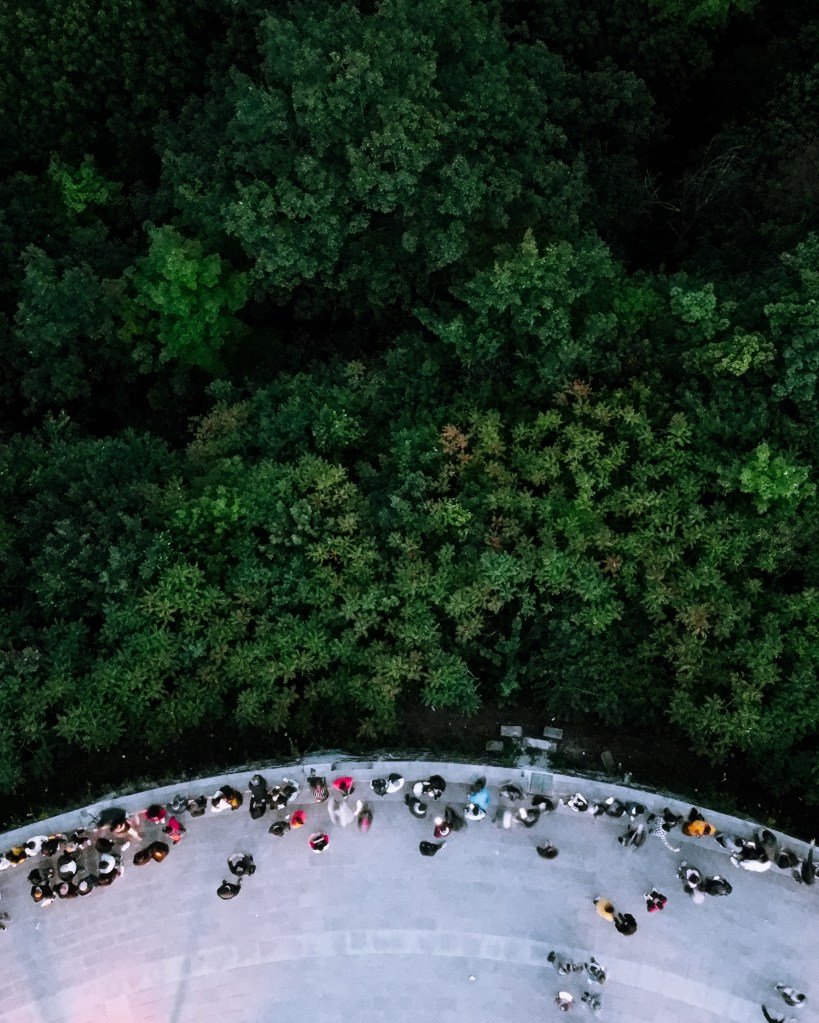
    Image: Drone photo from the top of Mount Royal

  • Facebook signs lease for 730,000 square feet

    Cities are dead. New York City is dead. That’s why it was announced early last month that Facebook has just signed a lease for 730,000 square feet in Vornado’s new Farley Post Office redevelopment in Manhattan. Here’s what I think is a pretty telling remark from Brian Rosenthal of Facebook:

    “So much of what we do is collaborative,” Rosenthal said. “[Software is] like writing a book together where all the plots have to connect and make sense and there are thousands of authors. It’s really hard to do if you’re not co-located in the same space and it’s important to even be able to see each other in the same space.”

    Building a building is done in much the same way. Except I would take it even further and say that it’s like writing individual sentences together. One person starts the sentence (usually the architect), but then the rest of the team enters (engineers and so on) and informs the architect that the words actually need to be changed around.

    After a bunch of back and forth, the sentence is finally complete (for the most part). This is just in time for the editors (construction team) to tell you that the sentences you’ve assembled in fact don’t work at all and that they will cost far too much to print in their current form. So team goes back and, once again, readjusts.

    As you might imagine, this is a lot easier to do when you’re not fiddling with a mute button and fighting against screaming kids in the background.

  • Dixie Outlet Mall launches drive-in movie theater

    Dixie Outlet Mall in Mississauga has just launched a drive-in movie theater that will run for three Saturdays starting on September 12, 2020. Tickets are available for $5 and you have to purchase in advance. It’s first come, first park. And there only 100 parking spots available.

    Here are the event links:

    Sept. 12, 2020

    Sept. 19, 2020

    Sept. 26, 2020

    All of the proceeds from ticket sales will be donated to the New Haven Learning Centre, which is a group that works to positively change the lives of people with autism, and other related disorders. For more information about the Dixie Drive-In, click here.

    And for those of you who are curious, the answer is yes, a minor variance application was required in order to allow this “pop-up.”

  • Chicago’s Winter Dining Challenge

    This has been a summer of cycling, playing tennis (poorly) on Toronto’s public courts, and eating and drinking on sidewalks — sometimes with, get this, no fencing. But winter will arrive in this part of the world at some point and that will mean having to rethink our patios. I’m certain that we’ll be doing everything we can to extend the season this year because we are already seeing that take place in other cities.

    Last month, the City of Chicago launched, in partnership with IDEO, BMO Harris Bank, and the Illinois Restaurant Association, a competition called the Winter Dining Challenge. The goal is exactly what I just described. It’s to solicit creative ideas for how Chicago can make outdoor dining feasible all throughout the winter. (Chicago and Toronto have similar winters.)

    Domes, pods, and heaters are likely to feature in the submissions, which makes me wonder at what point are you basically now considered to be “inside” as opposed to “outside.” Presumably fresh air needs to factor. But I should really reserve judgement until the top ideas are selected. If you’d like to submit an “idea, concept, or startup,” you have until September 7, 2020 at 11:30 PM PT. Here’s the link.

    Photo by Austin Neill on Unsplash

  • Pandemic-era hand sanitizer

    I have been trying (albeit not very hard) to come up with the best way to describe the stinky hand sanitizer that is going around these days. Then today somebody in the office described it as bad tequila and I immediately thought, “yup, that’s exactly it. It’s bad tequila.” See above tweet.

    Turns out, there’s some science behind this stink. Here is an article by Gregory Han from the New York Times that was shared in response to my tweet. And here is the excerpt that explains where this stink comes from:

    “That off-putting smell—sometimes described as rotten garbage or tequila-like—is the natural byproduct of ethanol being made from corn, sugar cane, beets, and other organic sources,” explained Zlotnik. “[Ethyl alcohol] production is highly regulated. It stinks because these new brands—many made by distillers who’ve pivoted from producing drinking alcohol to meet public demand for hand sanitizer—are making and using denatured ethanol. This ethanol costs significantly less than ethanol filtered using activated carbon filtration, which would typically remove almost all contaminants and the malodor with it.”

    Those organic contaminants aren’t the only reason unfiltered and denatured ethanol smells downright foul. According to Zlotnik, denatured ethanol is also intentionally tainted with an unpalatable cocktail of chemicals (denaturants) such as methanol, acetone, methyl ethyl ketone, and denatonium to make it undrinkable. In other words: The base material is intentionally stinky.

    So now you can judge accordingly after you’ve cleansed your hands with rotten garbage tequila.

    On a somewhat related note, Jill Lepore has an interesting piece in this week’s New Yorker about the great indoors, and how quarantine has forced us to spend even more of our time indoors. (Though, that hasn’t been the case for me this summer.) Here’s a snippet:

    The Great Confinement varies by place and by wealth, and, historically, it’s new. “Over several millennia, humans have evolved from an outdoor species into an indoor one,” Allen and Macomber write. Citing E. O. Wilson, they explain, “We evolved in the African savannah’s wide-open expanses, intimate with nature and seeking protection under tree canopies,” and so “our genetic hardwiring, built over millennia, still craves that connection to nature.” To satisfy this craving, photographs of redwoods adorn hospital waiting rooms; you can pop into the Grand Canyon via Zoom. I used to think these dodges were better than nothing, but I’ve changed my mind. Zoom is usually not better than nothing.

  • How different is Tesla’s business model?

    I have a friend who is a big fan of Tesla. And judging by what’s going on with the company’s stock these days, he is not alone. This morning he sent me this article talking about how Tesla has introduced an entirely new business model for the automotive industry. The two key takeaways are as follows. One, Tesla is in many ways a software company. The hardware and software onboard each vehicle are continually getting better and oftentimes these improvements are delivered to their customers for free via over-the-air updates. This is not how the incumbent car companies work. And two, fully electric vehicles are going to crush after-sales revenue by virtue of the fact that electric vehicles simply don’t require the same amount of service. So now you’re in a position where the cars last longer (and apparently depreciate a lot less). This might seem bad for business, but if you can build an ecosystem of energy products and services around said car, then maybe you’ve got a big ass Tesla moat. Maybe. I have no idea what the company should be valued at today, but all of this is interesting to me and I’m fairly certain that the car I have right now will be the last combustion engine vehicle I ever own. Depending on when autonomy arrives, it may also be the last car I ever own.