Daily insights for city builders, delivered every morning at 6 AM ET. I’m Brandon Donnelly — a Toronto-based real estate developer and founder of Globizen. I’ve been writing here since 2013.
Constructed throughout the 1930s, the R.C Harris Water Treatment Plant (pictured above) is the largest water treatment plant in the City of Toronto. It produces over 120,000 million liters of water each year, which represents about 30% of Toronto’s drinking water.
Designed by Scottish architect Thomas Canfield Pomphrey, it is also the city’s largest collection of Art Deco buildings. This makes the complex pretty unique. Because it was designed to be both a critical piece of municipal infrastructure and an architectural icon.
If you’ve ever visited the grounds, you’ll know that the plant is the furthest thing from utilitarian. There’s an opulence to the buildings and an incredible attention to detail, both of which are characteristics of the Art Deco movement. And if you’ve never been, I would encourage you to go.
I recently discovered a company called Hinter (a colleague, who clearly knows me very well, sent it to me). It’s exactly the kind of the company that I would love to start, if only there were 30 hours in a day. They’re a non-traditional hotel in that they work with “iconic architects” to build unique spaces that are distributed and hidden in nature. (They also have a policy of planting 10 new trees for every booking.)
Today’s post is a profile of their Hinterhouse (hh1) by Montréal-based Ménard Dworkind Architecture & Design. The space is located in La Conception, Québec, which is about 15 minutes from Mont-Tremblant. It’s 980 square feet (which is all you really need) and has 2 bedrooms. There’s also a private sauna and outdoor shower in a separate outbuilding. As soon as I saw it, I felt inspired and immediately opened up Realtor.ca to look for available land. Maybe it will do the same for you.
Last week was the Vancouver Real Estate Forum. Benjamin Tal (chief economist at CIBC) opened things up, as he usually does, and he was pretty candid about what might be coming this winter. Here is an excerpt from a recent Globe and Mail article summarizing the event:
“It’s reasonable to assume that the next six months will not be very pretty,” said Mr. Tal. “The honeymoon of the summer is basically over. Now we enter the winter months, and I think the next few months will be much more difficult. We will have a situation where we will clearly see a second wave, and it’s already starting. This second wave will overlap with the flu season, so everybody will be very confused. The fear factor will rise, and that’s something we have to take into account when we look at the trajectory of the economy.”
Indeed, today kind of feels like the official start of the second wave. Here in Toronto, indoor dining, gyms, and a bunch of other things were just shut down for the next 28 days.
But I think the more important takeaway from the article is this one here: the fundamentals around Canadian real estate remain incredibly strong. Another excerpt:
“Let’s visit the market in 2023: I suggest the market will show the same trend we have seen in as 2019. This is a pause, but the fundamentals of the real estate market in Canada are so strong that the demand factor will continue to be there and supply will be limited. I suggest that after a two- to three-year period of some sort of softness, despite the V-shaped recovery that we are seeing, I see continuation of the trend.”
As I’ve said before on the blog, it’s easy to get caught up in shorter-term and ephemeral headlines. But if one can look through some of that to the other side of this health crisis, I think we would all be in a position to make better decisions.
As a general rule, I don’t like making long-term real estate decisions based on what is expected to take place in the next 6 months.
Here’s some data from the Pew Research Center looking at the percentage of young people (18- to 29-year olds) in the US that live with at least one parent. It it based on an analysis of monthly Census Bureau data and is obviously interesting/relevant given that this pandemic seems to have precipitated a number of people moving back home. As of July of this year, 52% of young adults were thought to be living with at least one parent, which is up from 47% back in February.
At first I was surprised to see these numbers as high as they are. But it’s really the 18-24 age bracket that is driving this number up, which makes sense given that a chunk of this demographic is probably in school, not working, and now unable to do much on a campus. Among 25- to 29-year olds, the range is significantly lower, with just over a quarter (26% -> 28%) living with their parent(s).
What I’m curious about now, after seeing this chart, is what is driving some of these regional, ethnic, and gender differences? Why are young midwesterners seemingly less likely to live with a parent compared to those in the northeast? Is it cultural? Economic? Or something else? And is the above an indication that maybe women are more independent than men?
So I just learned that architects Bjarke Ingels and Rut Otero live in a converted Norwegian houseboat in Copenhagen’s harbor. A friend of mine sent me the Architectural Digest article this morning with the caption, “now I want one.” The space is exceedingly cool and interesting, but supposedly the heat and water stop working on occasion. Minor annoyance, I suppose. But in addition to being cool and interesting, there’s also a resiliency argument. Houseboats don’t have to worry about sea level rise, because they just float. (Could this type of floating housing be deployed at scale? Ingels thinks so.) In this case, they also repurposed an existing structure, which is generally more sustainable than building something new. I guess I’ll take one as well.
This is the topic of Benedict Evan’s latest blog post, which is all about the internet, regulation, and the rise of China, as well as other countries. The internet is now deeply ingrained in everyday life. As of 2017, about 40% of Americans had met their partners online. We do everything online. But 80-90% of the world’s internet users are now outside of the US. There are more smartphone users in China than in the US and western Europe combined. And venture capital dollars have started to diversify away from just the US (see above chart). All of this — but mostly Tiktok — has Americans questioning how best to handle and how best to regulate.
Here’s an excerpt from Benedict’s post:
Both of these are captured in Tiktok. This is the first time that Americans have really had to deal with their teenagers using a form of mass media that isn’t created in their country by people who mostly share their values. It’s from somewhere else. That’s compounded by the fact that the ‘somewhere else’ is China, with all of the political and geopolitical issues that come with that, but I’d suggest that the core, structural issue is that it’s foreign. This is, of course, a problem that the rest of the world has been wrestling with since 1994, but it comes as something of a shock in Washington DC. There’s an old joke that war is how God teaches Americans geography – now it’s regulation.
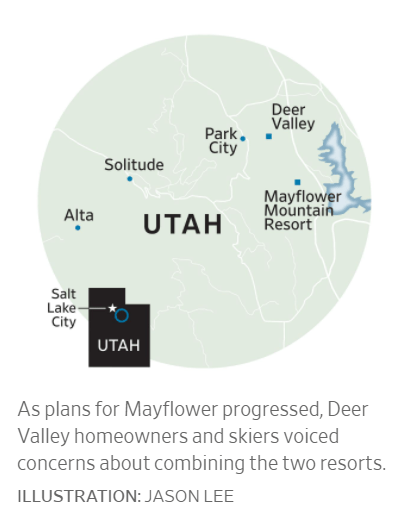
New York-based Extell Development is, according to this recent WSJ article, in the midst of trying to build a $2 billion full-service ski and snowboard resort near Park City, Utah. It would be the first new resort in the United States in about four decades. These things are, clearly, difficult to get approved, and the fundamentals are, arguably, not all that great. In the early 1990s, the US had about 546 ski and snowboard resorts across the country. As of the 2018-2019 season that number had dropped to 476, according to the WSJ. People are skiing less than they used it, it would seem.
To be a bit more precise on its location, the proposed resort, which is currently called Mayflower Mountain Resort, is to be located next to Deer Valley Resort. And there’s even a plan floating around to possibly merge the two resorts. That’s apparently what the county planners want. I’m not all that familiar with Deer Valley because they don’t allow my kind there (snowboarders). But it’s an exclusive resort with a country-club kind of feel (or so I’m told). So it shouldn’t come as a surprise that the proposed merger doesn’t seem to be getting a lot of traction with the patrons of Deer Valley.
But here’s the interesting thing about the Mayflower site. It’s generally controlled (to what extent, I don’t exactly know) by an entity called The Military Installation Development Authority. And this entity has the power to do things like issue bonds and grant certain land-use approvals. This means that there may be an angle to streamline the approvals process (i.e. make this project actually feasible) and to leverage things like tax increment financing (TIF) in order to fund the project.
Supposedly a new mountain resort has been on the books for this site for some 30 years. Could now finally be the time? If they allow my kind, you can count me in.
Those previous decades saw a surge of people and jobs locating downtown, with consequent escalation in rents and prices of offices and housing. Why? Partly demographic, as the well-educated children of the baby boom reached adulthood, and partly lifestyle and work style. Young people go to big cities not just to work and live, but for sex, style, money and power. For ambition and anonymity. And for risk. All in the petri dish of downtown density. These drives have always been as powerful as their subsequent search for suburban security and community.
The structure of the modern megalopolis is not an accident – the dramatic rise of tech employment, two-earner families, the decline of manufacturing, the later date of marriage, smaller households, lifestyle consumerism, teamwork cultures, serial re-education and training – none of these societal trends looks to be diminished by COVID-19. All of them seem to prefer high-density, high-interaction environments.
For those of us in Toronto, it’s also important to remember just how quickly this city region was growing pre-COVID-19. That is unlikely to change on the other side of this.
But Berridge does also point out some of the potential fallouts from this pandemic. The economics of urban transit, for example, could remain a problem for quite some time. This will strain public purses. (Car usage rebounded quickly, but transit ridership has not.)
We are also likely to see increased traffic congestion as a result of people eschewing transit (and probably a bunch of other factors). Like Berridge, I am a supporter of road/congestion pricing, and have been writing about that on this blog for many years.
The best things to tax/price are things that are generally viewed as bad and where demand is largely inelastic. That is, even if you increase the price, many or most people will probably still do it anyway. Think of things like smoking.
Up until now, Toronto hasn’t had the moxie to make difficult (political) decisions like this one. Perhaps this pandemic will leave us no other choice.
In life and business I find that we are often faced with decisions that pit emotion against rationality. What I mean by this is that maybe your ego is telling you to do something. And maybe, as a matter of principle, you know with certainty that you’re right. But when you take a step back and think about how that principled decision might play out, you realize that it is probably not the right life or business decision.
In the case of the real estate development business, you might realize that it is not the right decision for the project. And that’s really the key question to be asking yourself in this business. What is most beneficial for the project? It is not about what’s most beneficial for my ego.
Of course, taking emotion out of the equation can sometimes be difficult. Maybe you feel like you’re losing if you give in and don’t follow what you think is right. But the truth is that if emotion and rationality don’t line up, then you’re likely going to have to pick a side. And if you make a bad or the wrong business decision, then you’re definitely losing, even if your ego might feel a little better.
At the beginning of this year (which seems like eons ago), I wrote about a CityLab series that Feargus O’Sullivan was doing on the vernacular home designs of a handful of European cities. Cities like London and Berlin.
Well, after a brief pause, that series is back in the form of a CityLab “storythread.” It’s now called, “The Iconic Home Designs That Define Our Global Cities.” In it, he explores the various floor plans, housing typologies, and tenures that you might find around the world. Everywhere from from Singapore to Reykjavik.
The most recent article is all about Prague’s communist-era apartments. Apparently people call these paneláks because they were initially built using some sort of collection of prefabricated panels. They were a quick and dirty housing solution for a city and country that were rapidly urbanizing starting in the late 1950s. (See, prefab works.)
But what I find most interesting about the story of these paneláks is how their reputation seems to have changed and evolved over time. They proved to be a far more adaptable form of housing than you might initially think, going from written off and ready for demolition, in some cases, to then becoming a form of aspirational housing.
Part of this allegedly had to do with a handover from state ownership to private ownership, which maybe goes to show you that architecture and design, alone, aren’t enough when it comes to housing innovation. You really need to consider the whole picture.
But regardless, it is clear to me that tastes do change, and housing is no exception. Renewal is an integral part of urban life. And one generation’s trash might be another generation’s treasure.