Daily insights for city builders, delivered every morning at 6 AM ET. I’m Brandon Donnelly — a Toronto-based real estate developer and founder of Globizen. I’ve been writing here since 2013.

Author: Brandon Donnelly

  • Automatic climbing system

    November 22, 2024 · View original


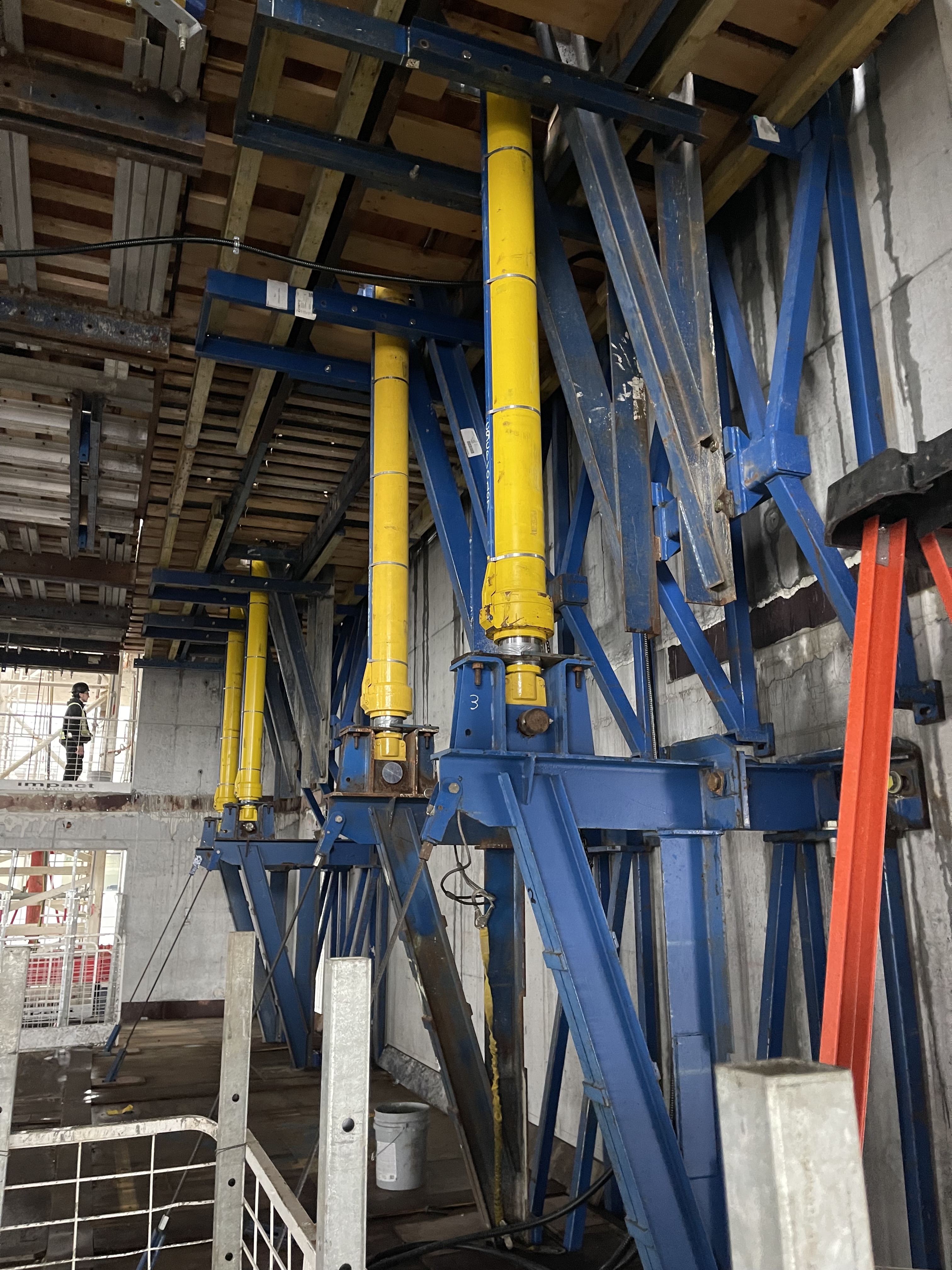
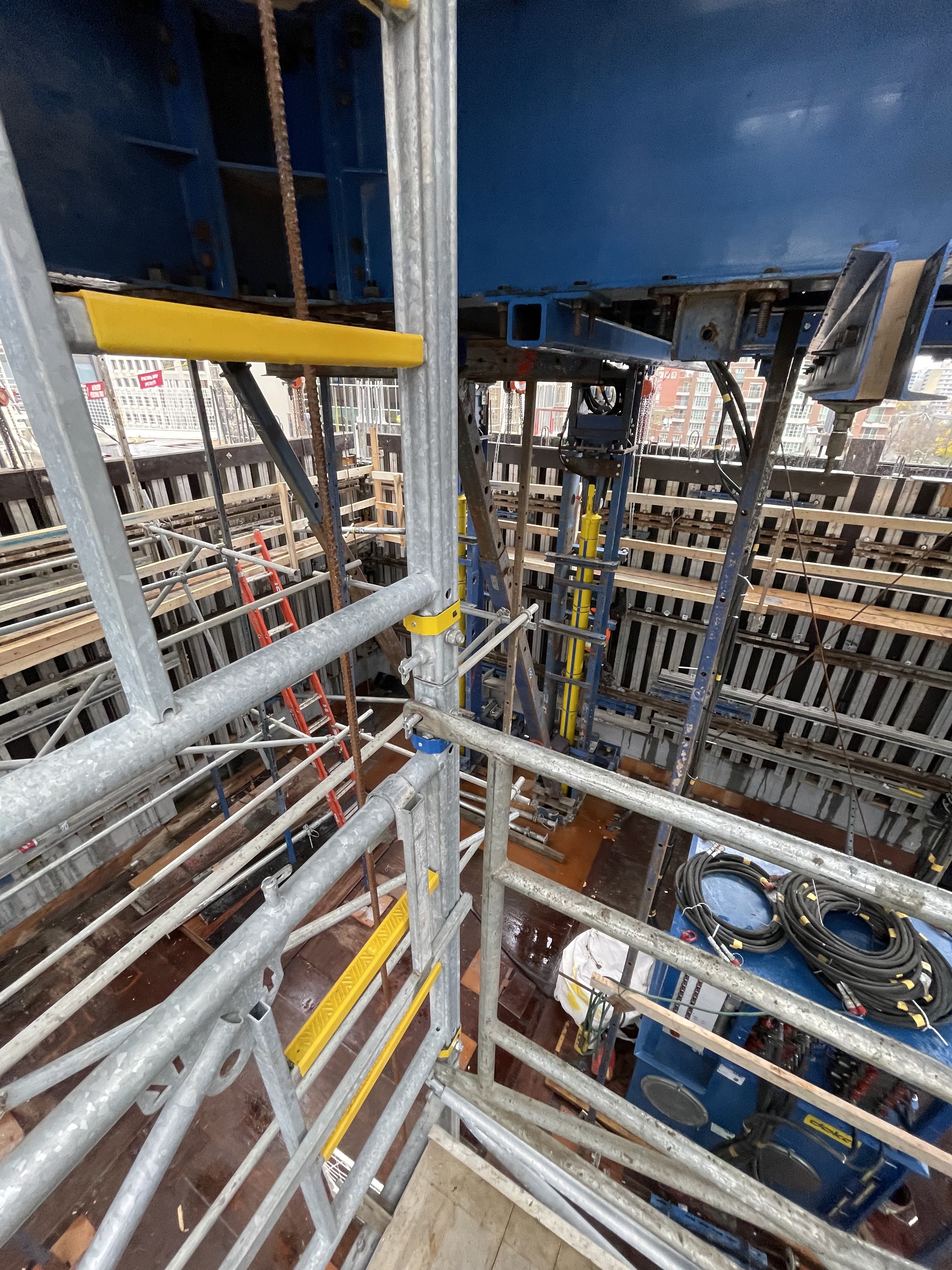
    We’ve spoken before about One Delisle’s fun slab edges. No two floors are the same. The tower is constantly changing as it transforms from a square at its base to a hexadecagon at its top (16-sided shape). But one part of each floor that does repeat is the core (the center of each floor plate that houses the elevators and other essential stuff). And so for this, the site team is now using something known as an automatic climbing system to “jump” the concrete forms between the floors. More specifically, we are using a Doka Super Climber SCP.

    Here’s what that looks like inside the core of the building right now:

    At a high level, the way it works is pretty simple. The system has two levels of brackets that can anchor to the concrete core of the building, below the floor that is currently being poured. The concrete forms are then raised using hydraulics. And once that has happened, the lower brackets “climb” up the building and get reattached at a higher point. If this isn’t clear in your mind, imagine Spiderman climbing up a tall shaft. His arms would represent the upper brackets and his legs would represent the lower brackets. Maybe this isn’t helpful.

    In any event, the point of this system is that it makes construction go faster. So now that the ACS is up and running, the team is looking to bring down our cycle time per floor. Hopefully you’ll notice that the next time you go by One Delisle.

  • I’ve moved onchain

    November 21, 2024 · View original


    When I first started writing this daily blog back in August 2013, I was using Tumblr. I had already been using Tumblr to share random stuff, and so when I decided to venture into longer-form writing, I just adapted what I had already been using. Here’s what I consider to be my first real blog post, which was over 11 years ago.

    But then Tumblr got sold to Yahoo (and became generally less popular) and it started to feel like the wrong place for me to be writing about city building. So I packed up and moved over to WordPress. Here’s my last post on Tumblr, which was some 4 years ago.

    WordPress has been working out just fine for me, but the world is changing and the internet is starting to move from web2 to web3 platforms. So this week, I made the decision to once again pack up and move — this time to Paragraph.xyz. I moved over all of my old posts, my email subscribers, and my domain (brandondonnelly.com).

    A lot of you may not notice much of a difference. If you type in my domain, you’ll find all of my old posts. And all new posts will continue to show up in your inbox every day (I don’t think I can do a weekly digest with Paragraph, which was an option I had with WordPress + Mailchimp). The important part, though, is that the backend is now completely different.

    All of my posts are now stored on a blockchain called Arweave, which is a permanent and fully decentralized protocol. Meaning, if I were to get hit by a bus tomorrow, all of my writing would still live on forever, even if Paragraph goes bankrupt and shuts down. It is now also possible for readers to “collect” my posts just as they would an NFT.

    I don’t know how many people will actually do this and what utility it will serve today, but I think all of this is just the tip of the iceberg. I’m a firm believer in crypto and blockchain technologies, and so it was time to walk the talk with my daily blog for city builders. Change is good. Welcome to brandondonnelly.com 3.0.

    Regularly scheduled programming will resume tomorrow.

  • Average price of a home in the Toronto region increased 13.5% last year

    The Toronto Regional Real Estate Board released its 2020 housing figures this week. And I suspect that the numbers are probably directionally similar for many city regions around the world.

    2020 saw more home sales than 2019 with 95,151 homes changing hands. This represents an 8.4% increase compared to last year. December was also a record month with 7,180 sales — a 65% year-over-year increase!

    The average selling price in the Greater Toronto Area also reached a new record of $929,699. This represents a 13.5% increase compared to last year. Once again, December was a record setting month with an average selling price of $932,222.

    When you look at sales and average prices by home type, the biggest drivers were low-rise homes outside of the city. No surprises here.

    But consider the price spread that now exists between condos and detached homes. In the City of Toronto (“416”), we’re talking about an average price delta of nearly $850k. That would be an expensive home in many other markets.

    Of course, condos tend to be smaller than detached homes. And so different prices per pound. But total price matters a great deal and historically a widening spread has moved many buyers over to the condo market.

    I suspect we will see that happen again this year.

  • Project Profile: Side Gallery Barcelona

    Side Gallery opened up a new 700 square meter exhibition space in Barcelona last month that is worth showcasing. It’s a beautiful space. Designed by Spanish architect Guillermo Santomà, the space sits within an old 19th century factory that used to house an Italian pasta company. It’s minimal and stark white, but the architecture of the former factory still comes through. There’s also a prominent greenhouse featuring flora that is local to South America. Fitting given that the gallery focuses on Latin American design. Have a look.

    I also love these images from the architect, which (I think) use light to completely transform the space.

    All photos via Side Gallery and Guillermo Santomà

  • How much home can you afford?

    Each quarter, HSH.com publishes a report that looks at the annual income required to quality for a residential mortgage in the 50 largest metropolitan areas in the United States. To do this, they look at the median home price for each city and then apply a 28% debt-to-income ratio (principal and interest payments divided by before tax salary). They also assume a 20% down payment and a 30-year fixed-rate mortgage. In their latest report, that comes with an interest rate of 3.15%.

    Below is a chart showing what they consider to be the 10 most affordable and the 10 least affordable metros (chart via the New York Times). I don’t think the cities on this list will necessarily surprise many of you (though I didn’t think Pittsburgh was this affordable), but it is interesting to see it all quantified. It’s also worth thinking about what might happen to these figures as that 3.15% number comes down. Shockingly, the price of highly-levered assets tends to be correlated with financing costs.

  • The most unremarkable streets in Toronto

    Within Toronto’s urban structure you have regular streets and you have things known as “Avenues.” (This is among a bunch of other stuff such as Centres and Employment Areas.) What this Avenue designation does is tell you that it may be a suitable location for a new mid-rise building, which is something that I have written a lot about on this blog. Here in Toronto, this means that you would then need to consult the “Mid-Rise Building Performance Standards.” Indeed, if you dust off these standards and turn to the introduction, you’ll find the following: “The Performance Standards are intended to provide simple, straightforward guidance for those seeking to develop midrise projects on the Avenues.”

    But if you want to find some of the most truly unremarkable streets in this city, you need to look at the arterial roads that didn’t quite make the cut to be an Avenue. I don’t want to generalize, but they are generally exceedingly ugly. You can’t help but feel like Toronto has simply outgrown the low-rise building typologies that, in most cases, still remain on these streets. In some cases, they’re also directly adjacent to a subway station, which is kind of like running a great big movie theater with only a handful of seats inside. Maybe one day they’ll grow up to be Avenues. But don’t hold your breath. So what’s another possible solution? Toronto-based PHAEDRUS Studio has an idea. It’s called the Hi-Lo Hybrid.

    Initially designed for a specific client and a specific site, it also happens to be something that could be deployed all across the city. What they have shown here is a 5 storey infill building on your typical long and narrow Toronto lot. As designed, it could house 4-8 units, as well as some non-residential uses, on a lot that previously only had 1-3 units. It would make a lot of sense for some of the ugly streets that I’m talking about. But let’s be honest: it would be almost impossible to get approved. One of the biggest issues would probably be the adjacency/overlook issue that it generates with the neighboring backyards. It’s probably also too tall.

    One of the main reasons why, I think, laneway suites work and are now permissible as-of-right in Toronto is that they replace existing garages. (ADU’s for the Americans.) They reallocate space that was previously used for cars to humans. And so the incremental height / density is not all that great. They, for the most part, preserve precious neighborhood character. What the Hi-Lo Hybrid proposes is not so incremental. It’s bold. It would be a massive fight. I know that and you know that. But bold is generally what you need when you’re trying to do great things and when you’re trying to shape the future. And so with that, I’ll leave you all with some words from the late American architect, Daniel Burnham.

    “Make no little plans; they have no magic to stir men’s blood and probably themselves will not be realized. Make big plans; aim high in hope and work, remembering that a noble, logical diagram once recorded will never die, but long after we are gone will be a living thing, asserting itself with ever-growing insistency. Remember that our sons and grandsons are going to do things that would stagger us. Let your watchword be order and your beacon beauty.”

  • Photoblog: A cabin in the woods

    Location: Laurentian Mountains, Quebec // Camera: DJI Mavic Mini

  • Indian Institute of Management rethinks plans to demolish Louis Kahn-designed dormitories

    Last month the Indian Institute of Management in Ahmedabad put out an “Expression of Interest” for the design of new student housing at its main campus. In it was the assumption that 14 of its existing dormitories would be demolished and replaced with something new.

    The problem with this assumption is that these dormitories were designed by one of America’s most noteworthy architects: Louis Kahn. And so there was immediate public outcry. Architectural historian William J.R. Curtis — who seems quite fond of real estate developers — had the following to say in this op-ed piece in The Architectural Review:

    Such is the smash-and-grab approach of developers in a world of astronomical land values and real-estate profiteering, especially in Modiland, the heartland of the Gujurat economic ‘model’. The price of everything, the value of nothing, quick returns on loans and investment above anything: such is the virus of neoliberalism as it spreads so quickly, far and wide across the globe. Timeless architecture has no role to play, and preservation is a pesky nuisance that gets in the way of profiteering. The public interest, social values and any long-range sense of history are thrown to the winds.

    The Architectural Review also started a petition to save Kahn’s IIMA’s dormitories. But just like that, the school came forward with an announcement that it had decided to pull its Expression of Interest and that it would go back and deliberate on what to do next. (The dorms were apparently built using “second class bricks” and are currently in a state of extreme disrepair.)

    As a developer and fake architect, I think I have a fairly good appreciation for both perspectives. Restoring old buildings is both difficult and expensive (the two usually go together). But I also grew up studying the work of Kahn. He happened to teach at the University of Pennsylvania until his death, though this was well before my time there.

    I’ve also visited a number of his projects including the Salk Institute for Biological Studies in La Jolla, California and the National Parliament House in Dhaka, Bangladesh. Many credit Kahn with introducing modern architecture to Bangladesh with this project. It has unquestionable cultural significance.

    Some things are worth saving.

  • My 2021 predictions

    Life will feel a lot more normal by spring/summer (Q2). By this time, the various vaccines should be broadly available (at least in the developed world). This is something that never happened during the Spanish Flu. From what I have read, the Spanish Flu lasted about two years and there were four major waves, the second of which was by far the most deadly. Ultimately, a vaccine was never found. It just petered out as people developed immunity. But medicine then was not what it is today, so surely we are destined to do better.

    What happens with working from home is going to be one of the most important outcomes of 2021. Right now it feels like tech vs. commercial real estate. The tech industry has been quick to renounce offices (while many large tech companies continued to lease more space through 2020). And the commercial real estate industry has naturally pointed out that we’re all still going to need physical offices.

    My view is that, yes, people appreciate the flexibility of being able to work remotely, but that we’re greatly exaggerating the extent to which work is going to disperse in the short-term. I think it comes down to three main things. 1) It’s nice being around other humans, both in the office and for those after work drinks. 2) Collaborative and knowledge-intensive endeavors work better when people are in the same room. And 3) corporate politics will encourage people to return to the office. Who do you think is going to get promoted first, the person who Zooms in from the Caribbean for meetings or the person who shows up to the office and grinds it out every day?

    As the world returns to normal, we will, however, see an explosion in global travel. Many will be questioning how Airbnb’s sky-high valuation makes any sort of sense, but it’ll have the right story for what’s going on in the world (some people call these “story stocks”). The reality is that there will be a massive amount of pent up demand that starts to come out as soon as people start to feel safe and governments start to allow people to travel en masse. I’m already looking forward to the 2021-2022 ski season, which I fully expect to be a blockbuster season.

    Because of this, we will see a decline in recreational real estate. The kind that was fulfilling people’s need for local travel during this pandemic. Instead, people will turn their attention to more international experiences and try and make up for lost time. Many will also come to realize that the whole working from home thing didn’t stick as expected and so they’ll start deriving less utility from their property outside of the city. Expect a kind of reversion to the mean when it comes to prices.

    Urban/downtown real estate will strongly rebound in the second half of 2021. As restaurants reopen, as people return to offices, and as urban life in general resumes, we will see an increase in demand for condos/apartments, and probably larger urban spaces given the run-up in prices for single-family homes that many cities saw last year. (A bit more on this point can be found over here.)

    The trends that are being accelerated as a result of this pandemic are not going to stop, though their rate of increase will temper. The apps and platforms that people started using in 2020, perhaps for the first time, have established new habits. People’s credit cards are now on file and it’ll be very easy for those online habits to remain. But the opposing force to all of this will be the strong desire for socializing, travel, and novel experiences. It’ll be the more routine stuff that will continue to live entirely on our phones.

    The restaurant/food industry will bounce back in a slightly different form. Sadly, many businesses will have failed. But we will also see an explosion in new ideas and new concepts, satisfying our demand to be out socializing and trying new things throughout the new roaring twenties. Ghost kitchens and on-demand food delivery companies will continue to disaggregate how some restaurants are setup. Companies like Uber will see their ride-sharing businesses quickly snap back, which will more than offset the decline in food delivery as people resume eating out.

    Public transit ridership probably won’t return to its pre-pandemic levels until at least the fall. Possibly late fall. This is going to be a serious problem for the various levels of government that subsidize virtually all public transit authorities. Many transit networks have seen ridership declines of 70% or so and, if my timing projections are correct, that will have been the case for about a year and a half.

    The migration from high tax states (like California and New York) to low tax states (like Texas and Florida) will continue. This trend was well underway before COVID-19 and so I don’t see it reversing. What is perhaps more interesting to consider is how this dispersion of economic activity will ultimately play out against some of the centralizing/polarizing forces of the global economy. Urban agglomeration economies aren’t going to go away.

    To end, I will say that I think it’s safe to assume that we’re all looking forward to the world getting back to normal, whatever that happens to mean. But ironically, once that happens, I reckon that some of us might look back on this period of time and feel hints of nostalgia. Perhaps you learned a new skill or perhaps you were able to spend more time with love ones. Time and distance may better reveal these silver linings.

    Onward, my friends. What a time to be alive.

  • The case for speculative asset bubbles (and happy new year)

    This is an interesting perspective. It is from Fred Wilson’s annual what-happened-this-past-year post:

    But here is the thing about speculative frenzies – they are generally directionally correct but off in their order of magnitude. And they finance the trend that they are directionally correct about. It may be the case that Tesla’s market capitalization is too high, but that allows Tesla to raise $10bn without diluting more than a few percentage points. And that $10bn will go towards accelerating the conversion of the auto industry from carbon-based fuel to renewable energy. And that is a good thing for society.

    When I first read this my mind immediately went to tulip mania. Was that directionally correct? Did tulip bulbs ultimately rebound and maintain their value over the long-run? I actually don’t know.

    But if you think about the dot-com bubble, that was directionally correct. Sure, infamous “companies” like Pets.com never ended up going anywhere, but the idea of tech and the internet becoming dominant was absolutely right.

    Fast forward twenty years and you can be sure that many people are now buying their pet supplies online, along with pretty much everything else. Sometimes we simply overshoot and get the timing wrong.

    This is perhaps a good thought for all of us to consider as we welcome 2021 and say goodbye to what was one weird and terrible year.

    Being directionally correct means that it’s okay for there to be bumps, mistakes, and speculative frenzies along the way. They are expected. What matters is the path forward.

    Happy new year, everyone.