Daily insights for city builders, delivered every morning at 6 AM ET. I’m Brandon Donnelly — a Toronto-based real estate developer and founder of Globizen. I’ve been writing here since 2013.

Author: Brandon Donnelly

  • A new study on missing middle building codes

    We talk a lot around here about the surprising difficulty of building small-scale apartment buildings. Here’s a post from earlier this year where I outlined a working list of policies, codes, and approaches that would need to change in order to unlock more of this housing type.

    But my list was just that — a list — and the reality is that each individual item can be shockingly complex. To that end, here’s a recent study, published by the Neptis Foundation, called “Ontario Building Code Missing Middle Study: Bridging the gap between houses and high-rises.”

    The authors are Conrad Speckert of Semibold Solutions (who has appeared on this blog in the past) and Jack Keays of Vortex Fire Consulting, and I encourage you to download a free copy. I haven’t gone through it yet, but I will, because we are actively working on projects at this exact scale.

    Enjoy the weekend.


    Cover photo by Danish Prakash

  • Standing inventory is clearing out, but a major condo supply crunch is coming

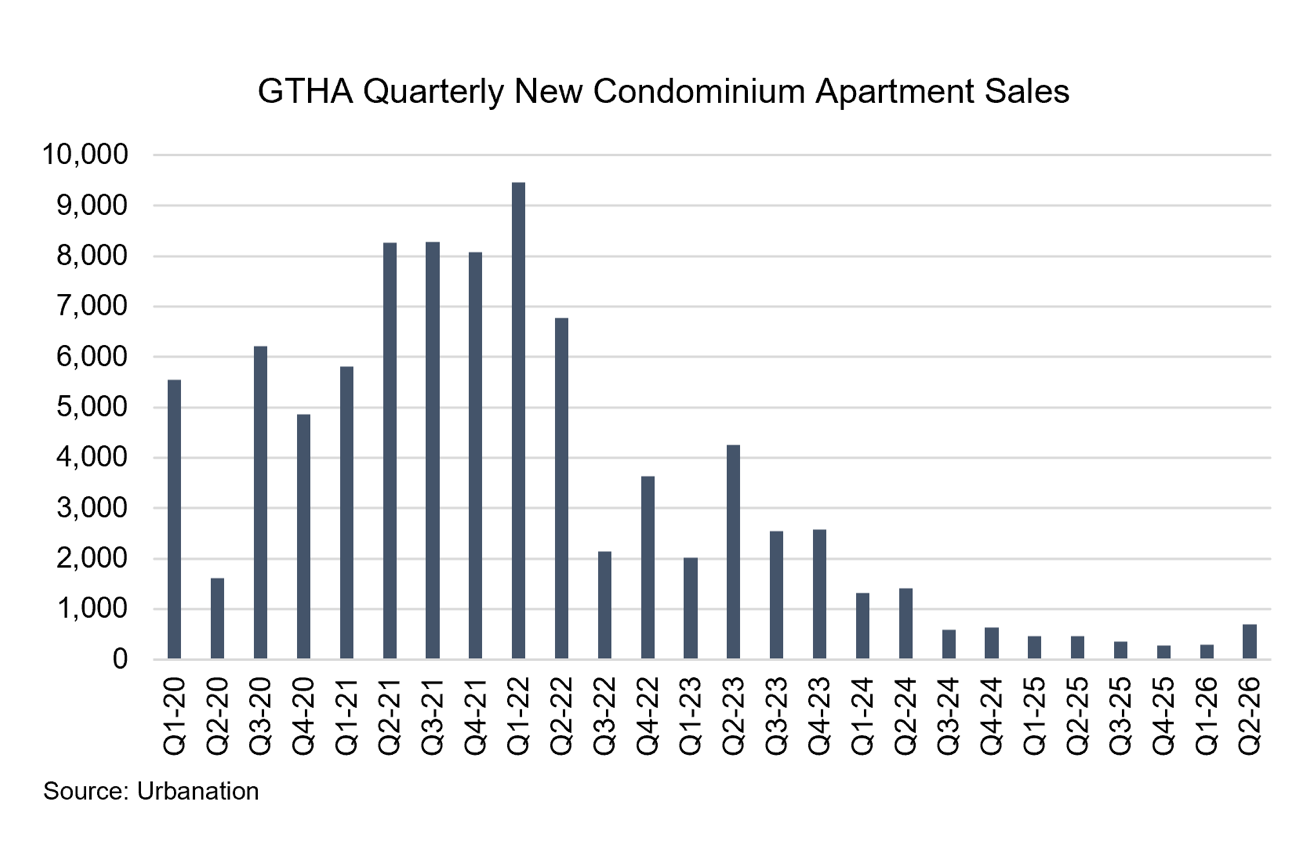
    Urbanation just released its Q2 2026 new condominium sales report for the GTHA (Greater Toronto and Hamilton Area). New condominium apartment sales posted their first year-over-year gain since 2023, with 702 home sales, representing a 52% annual increase. Anecdotally, I will also say that those of us in the industry can feel these winds changing.

    These figures are still well below the 10-year average, but the market is starting to do what it needs to do, and what the new (and cumbersome) HST rebate is intended to do. Standing inventory is getting sold, and I suspect the second half of this year will look even stronger as the industry figures out how to actually paper and administer this rebate.

    Importantly, the rebate is not helping pre-construction sales (though that’s just one factor). Q2 saw just 50 sales. Basically, nothing. This makes sense because the new rebate requires the purchase agreement to be signed before March 31, 2027. That’s not enough time for most pre-sale programs, but it does create a sense of urgency around standing inventory.

    So, what we are seeing today is a new condominium market that has refound price discovery and is starting to clear out already-built standing inventory, but one that is not producing a meaningful amount of new housing starts. As Urbanation says in its release, “condo supply is set to see its largest ever decline in the coming years.”


    Cover photo by Narciso Arellano

    Chart from Urbanation

  • Toronto needs a bold and uncomfortable 21st-century master plan

    Earlier this week, I tweeted that Toronto needs a Haussmann moment where we make some bold and uncomfortable changes in order to set ourselves up to be a dominant 21st-century global city. I mentioned Haussmann because his work is perhaps the most notable, but that is just one example.

    In addition to Haussmann’s renovation of Paris (1853-1870), I was also thinking about the Commissioners’ Plan for New York City (1811), and Ildefons Cerdà’s grid system of octagonal blocks for Barcelona (1859), as well as some more contemporary examples.

    In recent years, Barcelona has revisited its grid system and pioneered a new set of “superblocks” that focus traffic along the periphery and create pedestrian-focused spaces on their interior.

    The common thread among these examples is that they all represent a grand master plan. In the case of Barcelona and New York, it was a plan that served to guide development as the city grew. And in the case of Paris, it was a destructive plan that went back and redid what was deemed to have not been working. (In thinking about this now, it’s probably best that I used Haussmann as the example in my tweet).

    Toronto has never had such a plan. We flirted with the City Beautiful movement at the beginning of the 20th century — a movement intent on beautifying and introducing monumental grandeur to our cities — but, not surprisingly, we ultimately saw it as a superfluous and frivolous spending exercise.

    Instead, Toronto has grown incrementally, becoming what I see as an accidental global city. We are no longer the ultra-conservative, deeply Protestant city that we once were, but at the same time, it’s hard not to feel like we have a grid and public realm that doesn’t reflect the city we have become today.

    Toronto needs a bold master plan. And over the coming weeks, I’ll put some of my ideas to paper. In the meantime, if you have any of your own, please feel free to share them in the comment section below.

  • Uber and Waymo are breaking up

    The writing is always on the wall when aggressive lobbying starts. Here’s the situation. A proposed bill has been put forward that would allow autonomous vehicles to operate in Washington, D.C., updating a prior Autonomous Vehicle Act from 2012. Uber is opposing the bill, arguing that it would displace for-hire human drivers and hand Waymo a de facto monopoly in the District, according to TechCrunch.

    Instead, the company is lobbying for a system that would require robotaxis, like Waymo, to operate on a ride-hailing network that also uses human drivers. This would give consumers the ability to access both. Do I want to make small talk or not?

    Now, Uber’s position in the face of autonomous vehicles has always been that human drivers aren’t going anywhere because it’s simply too expensive to own and operate a fleet of AVs based on peak demand times. The only option is to top up the supply base with human drivers, and this is why the Uber marketplace will always remain essential.

    This narrative was initially supported by a series of announced partnerships, but now there seems to be a growing divide between the companies, and it’s not so clear that Waymo needs Uber as much as Uber would like. Because if Waymo were truly concerned about having human drivers, then the two companies wouldn’t be on opposite sides of the table with this bill. Uber knows this could be existential.

    At the end of the day, Uber disrupted traditional taxis and changed how our cities operate. Autonomous vehicles are set to do the same. Should we feel bad? Monopolies are, of course, bad. But creative destruction is not.


    Cover photo by Dan Gold

  • Home is not a building type

    Home is not where you live, but where they understand you. — Christian Morgenstern

    One of the things that I like to be annoying about on this blog is the fact that “home” is not a building type. I say this because “home” is often shorthand for ground-oriented, single-family housing. For example, someone might say to me, “Do you think you’ll one day buy a home?” And I will be pedantic and say, “But I already own a home.”

    The words we choose, often because of cultural convention, show our biases. When people associate home with low-rise housing, I can only assume it’s because many cities have had a long history of thinking of apartments as disease-breeding tenements. So we oftentimes see low-rise housing as homes, and apartments as something more utilitarian, like a unit.

    But in the end, a home is not a building type; it is a psychological state of belonging. It is where comfort, safety, belonging, and identity hopefully all intersect.

    One of the interesting things that Bianca and I have both noticed since bringing home our daughter, Vivienne, is that our feeling of home has been heightened. There’s additional life within these four walls, and now it is also a place where she is kept safe and protected from the outside world.

    I’m not sure if any of you have experienced this, but we both felt it immediately, and it has us saying to each other on a regular basis, “I love our home.” And you know what? The view looks pretty great from up here.

  • Anything above zero compounds

    I haven’t been riding much this summer (I can’t wait until Vivienne can join us on our bikes!), but I did go for a bike fit over the weekend — something I’ve been meaning to do since I basically got my “new” bike.

    In case any of you are curious/in the market, I went to Racer Sportif at Bloor & Runnymede. Ask for Dennis and tell him you want to see the photo of him on his first-ever bicycle. The west side of Toronto has such a great road biking culture.

    So, it turns out my setup was off. My seat was too low, my seat was too far back, my handlebars were too high, and my stem was about 2 cm too long. These micro-adjustments were all it took for my ride to feel significantly better on the way home.

    Of course, these micro adjustments become even more important on long rides because small things do compound over time. I like thinking of things in this way, and it reminds me of one of Sahil Bloom’s core philosophies: “Anything above zero compounds.”

    The smallest positive changes and actions can have an outsized effect when you play the long game.

    The same is true for city building. It’s easy to focus on big plans and tall towers, but let’s not forget the micro adjustments that are being made every day. A new bike lane here, and a new coffee shop there, all have an impact and add up to something more.

  • Housing complexity does not erase fundamental economic laws

    Business in Vancouver just reported the following breaking news: If you build a lot of new housing, it will become more affordable for people.

    Here’s an excerpt:

    Nearly 24,000 rental units are expected to be delivered in the region over the next two years, adding significant supply and intensifying leasing competition, according to Cushman & Wakefield ULC.

    Record construction completions in 2025 and high deliveries in 2026 are pushing down rent growth and creating tenant-friendly conditions, said a first-quarter report from the firm released in May.

    It could take several years to absorb existing inventory, with meaningful rent growth unlikely to resume until 2028, when longer-term supply constraints could re-emerge if development activity slows and immigration resumes, said the firm.

    This is, of course, the YIMBY argument. Increase housing supply, and housing becomes more affordable.

    But critics will argue that housing supply isn’t the main problem. Indeed, there are surveys that indicate skepticism around the overall housing supply argument. Ask people if producing more widgets will lower the price of widgets, and most agree. Ask people if producing more housing will lower the price of homes, and it’s mixed.

    Housing gets a little more complicated because of investors, speculators, foreign buyers, immigration policies, short-term rentals, and other demand-side factors. And at the end of the day, housing supply adjusts to changes in demand at a snail’s pace. So, from time to time, we will get it wrong. We overbuild at the end of the cycle and underbuild at the beginning of it.

    But none of this means that housing supply isn’t fundamental. Understanding the demand side is important, too. But regardless of where we are in the development cycle, when supply outstrips demand, it is going to create downward pressure on rents and help housing become more affordable. That’s exactly what we’re seeing today.


    Cover photo by Peter Skaronis

  • The case for unlocking more urban housing

    Noah Smith, who is a YIMBY urbanist you may know, has a recent piece on his blog called “The American suburbs are better than you think.” I’ll let you all read it on your own, but he goes after some of the common tropes: the suburbs force long commutes, the suburbs are lonely and isolating, and so on.

    But in the end, he more or less lands where I landed in my recent post, “What do homebuyers and tenants actually want?” And that is, there are certainly lots of people who prefer the suburbs (and that’s fine), but we need to get better at building housing within our cities, too. And until we do, we won’t get a clear sense of consumers’ revealed housing preferences.

    Here’s an excerpt from his post:

    I’ve been a relentless advocate of building more dense, walkable cities in America. Not only would this raise GDP (because of improved clustering effects), but it would let Americans live where they want. The demand for life in cities like NYC exceeds America’s willingness to supply these environments; this raises rents in places like NYC, which pushes a lot of people into the suburbs who don’t want to be there. Forcing those city types into the ‘burbs raises rents for people who like suburbia. Basically, everyone would be happy if America had a few more Manhattans and a lot more Brooklyns.

    As I said in my post, I’m all for giving housing consumers as much choice as possible. But the one thing that neither of us touched on in our posts is the simple fact that, as a general rule, urban living is significantly more environmentally sustainable than suburban living on a per-capita basis.

    This is, of course, one of the points of urban greenbelts. They are meant to curb sprawl and encourage intensification. But if we don’t unlock the right kind and amount of housing through intensification, then we are simply constraining supply across the board. We also know that otherwise, developers and consumers will “leapfrog” urban growth boundaries and continue sprawling.

    As an urbanist and developer, I think of it this way: My job is to do what I can to build more dense, walkable communities and figure out (and advocate for) ways to build more attainable housing — specifically, housing that meets the needs of a wide variety of households. And in doing so, I believe that we will retain a segment of people in the city who might have otherwise moved to the suburbs.


    Cover photo by Ivaldo Hadi

  • Canada got re-traded on the Gordie Howe bridge

    I’m trying to understand the new deal that was negotiated for the opening of the Gordie Howe International Bridge (scheduled for July 27, 2026) between Windsor and Detroit. The headlines read: “Tolls won’t be split with the US until the $6.4 billion of debt is repaid. Net revenues will be split with the US for 15 years.”

    As I understand it, the nuance is that the gross toll revenue won’t be split, but the net proceeds — after expenses like debt service, I hope — will be, for 15 years. This is different from the original deal, which had Canada keeping 100% of everything until it had paid off its $6.4 billion debt balance. Importantly, Canada also had complete authority over toll governance.

    This is objectively a worse deal for Canada and we were bullied into it at the last minute with a classic geopolitical re-trade. But how much worse is it?

    The public messaging is that net profits will likely be close to zero, and maybe even negative, in the early years of operations. So it’s not inconceivable that no payments will be made to the US’s local economic development fund until later years. If this is the case, the impact on Canada’s net present value might be negligible. I haven’t seen any of the math, but it’s possible this was a small price to pay to get the bridge open.

    From what I can glean, the most damaging aspects of this re-trade are the following: first, Canada lost sole authority to set its own tolls and govern the bridge — a bridge that we paid for in full! And second, it demonstrates that, at the present time, the US cannot be trusted to honour its agreements.

    Re-trading, of course, happens all the time in politics and business, and the real estate industry is no different. But I would say that there’s a difference between a bad-faith re-trade and a legitimate risk adjustment. Sometimes new information is discovered or the market changes in the middle of a deal, and one party needs a deal adjustment to be able to proceed.

    At the same time, there are also bad-faith re-trades where one party simply wants to apply any leverage it may have, be a bully, and capitalize on deal fatigue. “Ugh, let’s just get this open!” This is a short-sighted practice because it immediately destroys trust and damages your reputation. It may leave you better off on this one deal, but it makes the next ones that much harder.


    Cover photo by Brad Switzer

  • The last-in first-out rule of real estate land

    During development downturns, at least two things tend to be true.

    One, land on the periphery tends to get hit first and recover last. It’s a kind of “last in, first out” principle. During a market expansion, core areas become expensive first, and then demand “spills over” to the periphery in search of opportunity.

    These areas are, therefore, last (or later) to appreciate and first to fall when the market turns. This also means that they’re last to rebound when the market recovers because, generally speaking, demand will start in the core and then move outward.

    And two, execution becomes critical. If you don’t get your product offering right and execute well, you can’t rely on the tide of the market to carry you. We’re seeing exactly this today.

    It is, as we talk about on this blog, extremely difficult to make new projects work in the current market environment, and so few developers are launching and breaking ground, and many projects are getting cancelled.

    But it’s worth pointing out that there are still some projects moving forward, and that’s because they got their product offering right and they executed well. And maybe they leveraged public grants or incentives to help tip the scales of feasibility.


    Cover photo by Ali Köse