Daily insights for city builders, delivered every morning at 6 AM ET. I’m Brandon Donnelly — a Toronto-based real estate developer and founder of Globizen. I’ve been writing here since 2013.

Author: Brandon Donnelly

  • Living on water

    Phaidon has a new architectural book out that surveys 55 homes, all of which have some sort of connection to water, whether that be an ocean, lake, river, or pool. It’s called Living on Water. I don’t (yet) have a copy, but it looks like the perfect coffee table book for a cottage, summer home, or studio apartment with zero connection to water. Monocle on Design recently interviewed the editor of the book (podcast episode here). So if beautiful homes on the water are your thing, maybe check it, and the book, out.

  • Electric vehicles are mostly leased

    At the beginning of this year, Bloomberg published this article talking about how the vast majority of electric car drivers lease, rather than own, their cars. The stats are as follows: In the US, about 80% of electric battery vehicles and about 55% of plug-in hybrids are leased, whereas only about 30% of all vehicles in the country are leased. 

    It is, however, important to note that the above doesn’t include any data points from Tesla. Since they sell their cars direct to customers, as opposed to through dealers, they have no obligation to publicly release this data. And so apparently they don’t.

    Conventional wisdom suggests that if you plan to drive the same car for an extended period of time – the average age of a car on the road in the US is over 11 years – it makes financial sense to buy. But in this case, people seem to be worried about technological obsolescence and the weak resale market for electric vehicles. This may also speak to the type of customers who are currently buying electric vehicles; they are early adopters and don’t want old cars.

    I’ve also seen someone argue that because some states require a percentage of car sales to be zero electric vehicles, it can be more cost effective for manufacturers to sell/lease them at a loss than pay the penalties or buy the ZEV credits. And with a lease, they at least get parts back at the end of the term. But I honestly don’t know much of a factor this plays.

    I hadn’t thought of this before I stumbled across the Bloomberg article, but it all makes sense to me. I find this reversal in ownership interesting because it tells me that how we consume cars can very easily change, and probably will moving forward.

  • Top US metro areas for VC investment

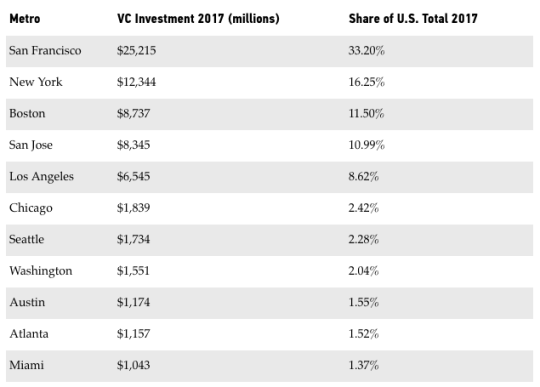
    Below is a list of the US metro areas that saw a billion dollars or more in venture capital investment last year (2017). It is taken from a recent CityLab article by Richard Florida where he talks about the “geographic inequality of high-tech venture capital.”

    image

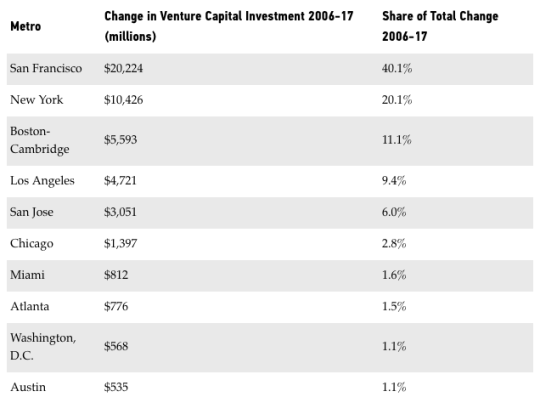
    It’s worth noting that San Francisco – not San Jose (Silicon Valley) – is at the top of the list with nearly 1/3 of the US total last year. It’s also interesting to note that when you look at each metro’s share of the total change from 2006-2017 (the chart below), you get Los Angeles now punching above San Jose. 

    image

    Florida also gets into which economic and demographic variables seem to be associated with higher levels of venture capital investment. For the rest of the article, click here

  • Autonomy, sometimes

    Benedict Evans raises a number of good points and asks a bunch of good questions about the “steps to autonomy” in his recent blog post.

    Right now we’re all talking about autonomous vehicles in terms of their level of autonomy – namely 1 through 5. L1 is some degree of autonomy, but in almost all situations, you still need a human driver. L5 is no human driver needed, ever.

    But as Evans points out, the level of autonomy depends on the place, and it is unlikely – at least initially – that L4 or L5 will mean L4 or L5 in all environments. Here is an excerpt from his post:

    It naturally follows that we will have vehicles that will reliably reach a given level of autonomous capability in some (‘easy’) places before they can do it everywhere. These will have huge safety and economic benefits, so we’ll deploy them – we won’t wait and do nothing at all until we have a perfect L5 car that can drive itself around anywhere from Kathmandu to South Boston. And so, if we call a car even L4, we have to say, well, where are we talking about? We might mean ‘most of this country’. But more probably, it will be L4 in one neighborhood, L3 in another and only L2 in a third – and a car might encounter all three of those on one journey. Put your route into the map and it will tell you if today is an L5 day or not.

    Thinking about the Gartner Hype Cycle, there’s often (always?) a “peak of inflated expectations”, as well as a chasm that new technologies need to cross as they are being adopted.

    Benedict’s article reminded me that we’re probably coming off that peak with autonomous vehicles and about to enter the so-called “trough of disillusionment.” 

    Autonomous vehicles represent a monumental shift in mobility, which will in turn impact our cities. That’s going to seem like an insurmountable challenge – until it doesn’t.

  • The Great Recession only paused suburbanization

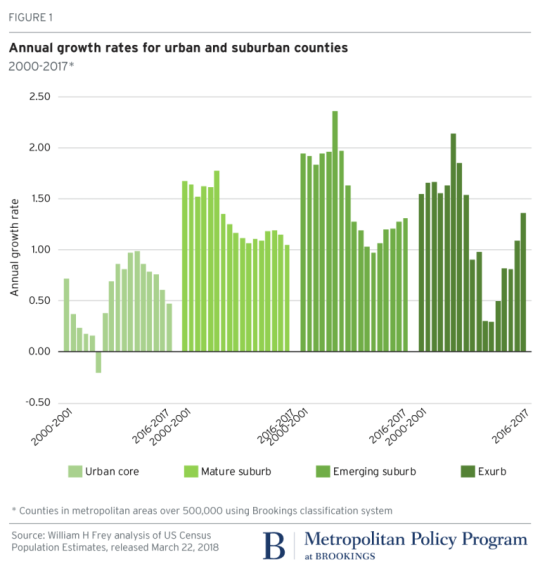
    According to newly released US census data for 2010-2017 – which Brookings analyzed here – the “back to the city” movement appears to have peaked in 2012. (This is something that we’ve looked at before on the blog.)

    Here is a graph from Brookings showing the annual growth rate for urban and suburban counties. Note how growth in the “urban core” peaked in 2012 and how growth in both the “emerging suburb” and “exurb” have increased since then.

    image

    The other finings from Brookings are that growth has slowed in large metropolitan areas (small metro areas and non metro areas, on the other hand are up) and that people are continuing to move from the Snow Belt to the Sun Belt.

    If you look at population gains and losses from 2016-2017 for the 100 largest US metro areas, the only Snow Belt gainers within the top 20 are New York (15th), Columbus (19th), and Boston (20th). Dallas, a Sun Belt city, was first with a gain of 146,000 people.

    So what’s going on? The narrative is that soon as the US economy and housing market recovered from the Great Recession of 2008, the trend lines simply reverted back to business as usual: sun and sprawl.

  • Two new chiefs

    image

    There were some big announcements in the planning world this past week here in the Greater Toronto Area. Gregg Lintern (follow him on Twitter) was named the new chief planner of Toronto (he was previously the acting chief planner following Jennifer Keesmaat’s departure) and Andrew Whittemore (couldn’t find him on Twitter) was named the new chief planner of Mississauga.

    As I went through the articles announcing the above appointments, I couldn’t help but be reminded that this region is at an exciting and pivotal moment in its history. All of the talk is about improving urban mobility (i.e. becoming less dependent on cars); intensifying around transit stations (as well as gently intensifying neighborhoods); making downtown a better place for families; and so on.

    It can be easy to feel defeated in this big bad world of city making. Oftentimes things seem to get reduced to either urban vs. suburban rhetoric or, as if nothing else matters, this one simple question: “But, how tall is the building?” So its nice to know that those at the helm continue to see endless opportunity in this region. I know that I wouldn’t want to be doing what I’m doing anywhere else.

    Photo by mwangi gatheca on Unsplash

  • Future of the American city

    image

    The Knight Foundation has just announced $1 million in support to the Harvard Graduate School of Design for a multi-year, multi-city, and applied research effort that they are calling the Future of the American City. The program will start in Miami and Miami Beach, but the plan is to expand to Boston, Detroit, and Los Angeles.

    As part of this initiative, the GSD will embed faculty and urban researchers into the local community, as well as organize three design studios that will build on each other every year. In the case of Miami and Miami Beach, the 3 themes that will be explored are urban mobility, affordability, and climate change. As you know, these two cities are center ice for the problem of sea level rise.

    This sounds very similar to a design studio that I took at Penn, which was centered around water and housing issues in Bangladesh. It was a multi-year research studio (5 years in this case) and we visited and got paired up with locals in Dhaka during the course of the studio. I think these types of programs are a great way to ground the research in reality. 

    And as a fan of Miami and Miami Beach, I am curious to see what the teams come up with over the next 3 years.

    Photo by Blake Connally on Unsplash

  • First 3D printed home in America

    The video below is a good follow-up to my recent post about the 100 million city and the rapid population growth that we are seeing in some parts of the developing world.

    If you can’t see the embedded video below, click here.

    [youtube https://www.youtube.com/watch?v=SvM7jFZGAec?rel=0&w=560&h=315]

    It’s a video about what is allegedly the “first permitted, 3D-printed home in America” – an 800 square foot home that was built/printed in Austin during SXSW in about 24 hours.

    The project is a partnership between New Story (a non-profit) and ICON (a construction technologies company), and the goal is to pioneer a fast and cheap housing model for the developing world.

    The cost for the above home is said to be about $4,000.

  • What’s the realtor jiu-jitsu move?

    Today’s post is a set of related questions for all of you.

    Fred Wilson has a post up on his blog today called, The Jiu-Jitsu Move. It’s about how people often dismiss new technologies, market entrants, and/or consumer behaviours as silly; whereas the real power move is to embrace and leverage them. That’s what he is calling the jiu-jitsu move.

    He gives a few examples, but for obvious reasons this one stood out to me:

    I spent the day yesterday at a real estate industry event and talked to a lot of agents about the fact that their clients are often more informed than they are these days. I encouraged them to embrace that fact and use it to their advantage and not fear it. It is hard when you have grown up in an industry when your advantage was information and you no longer have that working for you.

    For all the agents (and real estate consumers) who read this blog, I am curious if you agree with the above. Are consumers increasingly more informed than agents? I am sure that many of you will disagree. But if things are really changing, what should the jiu-jitsu move be?

  • Slate closes on $1.14 billion asset portfolio

    Today, the Slate Canadian Real Estate Opportunity Fund I closed on a 6.2 million square foot portfolio that it previously announced it was acquiring from Cominar Real Estate Investment Trust for approximately $1.14 billion.  

    The portfolio includes office, retail, and industrial properties in the GTA, Atlantic Canada, and Western Canada. This brings Slate Asset Management’s total assets under management to over $5 billion.

    Great work team Slate.