Daily insights for city builders, delivered every morning at 6 AM ET. I’m Brandon Donnelly — a Toronto-based real estate developer and founder of Globizen. I’ve been writing here since 2013.

Author: Brandon Donnelly

  • Tech salaries and brain drain

    The Globe and Mail recently ran an article arguing that tech salaries in Toronto are significantly less than those in the US and that it is leading to “alarmingly high rates” of brain drain. The claim is that the average tech salary in 2017 was US$73,000 in Toronto, compared to US$140,000 in the Bay Area or US$129,000 in New York City. 

    However, if you adjust these salaries for each city’s cost of living, the numbers look like this (chart taken from the same article):
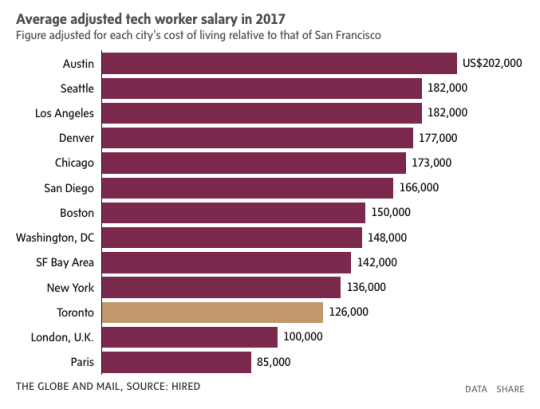
    Now all of a sudden Toronto is lumped together with the Bay Area and New York City. It was adjacent to London even when you didn’t adjust the salaries. As Tobi Lütke – CEO of Shopify – points out in his Twitter rebuttal of the article, housing is the determining factor in this adjustment: “Toronto is a very expensive city, and Austin isn’t.”

    Lütke also points out, in case you’re in the market, that Canadian-based Shopify pays its tech employees well above market, provides stock compensation, and is currently “hiring like crazy”. But perhaps more importantly, he stresses the importance of Canadians building the economy of the country in which they are from. I feel exactly the same way.

  • New School of Cities

    The University of Toronto just announced a new School of Cities. It will begin operations on July 1 of this year (2018) and bring together researchers from various disciplines to address the world’s most critical urban challenges. 

    Insert stat here about the percentage of the population that will live in an urban area by 2050.

    There are more than 220 faculty members across 40 different academic divisions at the University of Toronto who are doing urban-focused work. The School of Cities is intended to bring those minds together.

    So far there are plans for a “global cities summit” and an “urban lab” that will also bring students, faculty, industry, and government together. The intent is for the School to act as a city builder both locally (Greater Toronto Area) and globally.

    This once again goes to show just how important we are all taking urban issues today. But I am sure this blog audience didn’t need to be reminded of that.

    If you would like to sign up for updates from the School of Cities, you can do that here.

    Photo by Jorge Vasconez on Unsplash

  • Less, rather than more, housing

    Earlier this year I wrote about the California housing bill (827) intended to dramatically increase housing supply around transit stations all across the state. Well that bill was rejected last month and the Los Angeles Times wrote this post post-mortem explaining why and how it went wrong. Their argument is that it came down to opposition from low-income residents who feared that an increase in housing supply would lead to greater displacement.

    On a related note, the Official Plan Amendment and Zoning By-law Amendment that would permit laneway suites in Toronto went to Community Council this week. They voted to defer the decision for a month. Only 3 of 13 councillors voted to pass the proposal, despite there being 185 letters of support and only 4 letters of opposition. For more information on what the hell happened, check out this Lanescape post.

  • First day of summer

    Today was the first day of the year that truly felt like summer here in Toronto. It also happens to be my birthday. 

    So I did the only sensible thing one should do on a day like this. I went to a rooftop patio after work, with my family, for two of my favorites: a bowl of spaghetti al limone and a negroni. Simple.

    image

    In other news, Fred Wilson wrote a great post on his blog today about why he loves Canada and why it is an increasingly important place for the tech sector. 

    For those of us who already know that Canada is the greatest country on earth, it’s a noteworthy post not because it is likely to tell you a lot of new things, but because it was written by Fred fucking Wilson.

  • The Cherry Street Lakefilling project

    It’s going to take a generation to build it out, but one of the most exciting revitalization projects in Toronto is going to be the Port Lands area. However, before that can really start happening and new communities can be built, the entire area needs to be flood protected. Currently about 290 hectares (717 acres) in this part of the city are prone to flooding.

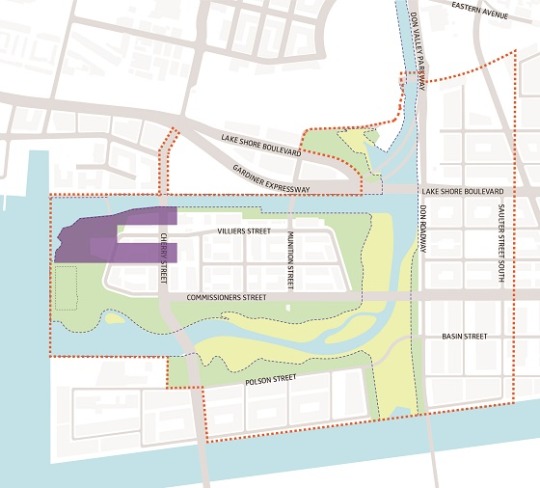
    One component of the flood protection program is the Cherry Street Lakefilling Project. Below is a plan of what that means (from Waterfront Toronto). The area in purple is new land that will be created as part of the process. Supposedly this is important for a few reasons. For one, it will allow the Cherry Street bridge to be relocated, which, in its current location, is creating a pinch point during floods.

    image

    I am mentioning all of this today because I am personally excited about this revitalization project. Hopefully I’ll see it complete in my lifetime. And maybe I’ll be fortunate enough to work on some of the buildings when that time comes. I also really wanted to share the below video with you all, showing the lakefilling in action. I bet many of you aren’t aware that this is happening.

    If you can’t see the video below, click here.

    [youtube https://www.youtube.com/watch?v=C0q_Wvn91zE?rel=0&w=560&h=315]

  • What’s Manhattan worth?

    I like looking at real estate values over longer periods of time because it helps to put things into perspective. 

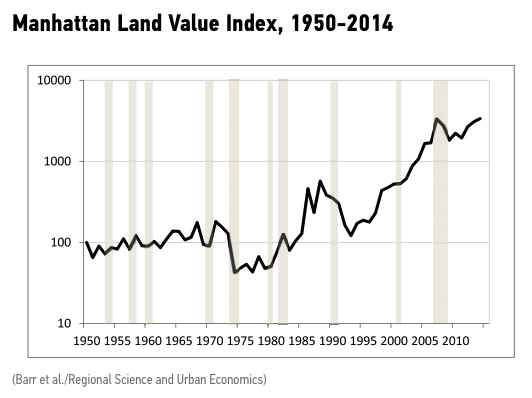
    Below is a land value index for Manhattan running from 1950 to 2014 that was recently created by economists out of Rutgers University.

    image

    The study was also cited in this recent article by Richard Florida.

    Here are some of the highlights from their study:

    We find three major cycles with land values reaching their nadir in 1977, just after the city’s fiscal crisis.

    Since 1993, land prices have risen much faster than population or employment, at an average annual rate of 15.8%.

    We estimate the entire amount of developable land on Manhattan in 2014 was worth approximately $1.74 trillion.

    We estimate the long run return to Manhattan land values [since the island was first inhabited by Dutch settlers in 1626] to be about 6.4%.

    What’s fascinating to me is the accelerated appreciation. The index starts at 100 in 1950, ends up slightly above that by 1993, and then simply takes off.

  • Branding is part of city building

    Below is a good discussion with Aaron Renn about how to brand a city. I fully agree with two of the points he makes: (1) Not enough cities are thinking holistically about this topic and (2) tech startups, bicycle lanes, and craft breweries aren’t going to cut it as a strategy. Every city is focusing on that sort of stuff these days. Zero differentiation. Find something germane to your city and start building on it. If you can’t see the embedded podcast below, click here.

    [soundcloud url=”https://api.soundcloud.com/tracks/436104924″ params=”color=#ff5500&auto_play=false&hide_related=false&show_comments=true&show_user=true&show_reposts=false&show_teaser=true&visual=true” width=”100%” height=”300″ iframe=”true” /]

  • A unique taste in buildings

    image

    A condo developer friend of mine once told me something along the lines of this: “Brandon, I have generally learned over the years that if I like something, it probably means the general public [our purchasers] isn’t going to like it. And that’s because if I like it, there’s probably something unique or quirky about it.”

    When he told me this it made perfect sense to me, because there’s a well documented taste divide that seems to exist between architects and design-types and non-architects and non-design-types (whatever this latter categorization means).

    A few years ago The Architects’ Journal published an article referencing a 1987 study that took a group of students – some architecture students and some non-architecture students – and asked them to rate the attractiveness of a series of photos containing both unfamiliar people and buildings.

    What they discovered was that most people had similar views on the attractiveness of the people. I guess hotness is somewhat universal. But when it came to the buildings, the viewpoints were completely opposite. The architecture students’ favorite buildings were what everyone else disliked the most.

    The conclusion in the article: “Professionals are, empirically, the very worst judges available of what people want or like in the built environment.”

    Photo by Simon Goetz on Unsplash

  • More than a real estate company — a state of consciousness

    Matt Levine’s most recent Money Stuff article is classic Matt Levine. It is both entertaining and informative. This one is on WeWork – the coworking startup that has committed to 14 million square feet of office space around the world and will have $18 billion in rent payments due over the next decade.

    Here is an excerpt:

    WeWork Cos. is a real-estate company with a couple of innovative twists on the model. First, rather than owning its buildings, it rents them: It leases office space from regular real-estate companies, adds … beer? … or whatever, and then subleases the space to tenants at higher rates. And second, rather than being valued like a real-estate company, it gets valued like a hot tech startup — “the sharing economy,” ping-pong tables, etc. — so it can raise gobs of money from SoftBank Group Corp. at a $20 billion valuation without ever getting particularly close to profitability. And look at all these words:

    “Indeed, to assess WeWork by conventional metrics is to miss the point, according to [Chief Executive Officer Adam] Neumann. WeWork isn’t really a real estate company. It’s a state of consciousness, he argues, a generation of interconnected emotionally intelligent entrepreneurs.”

    Really, what sort of multiple would you put on a state of consciousness?

  • Hotel room as shop

    Vipp is a 3rd generation family-owned Danish company that makes everything from kitchens and lighting to prefab homes. But it all started with a pedal-controlled waste bin that Holger Nielsen – a metalworker – crafted for his wife Marie’s salon in 1939.

    I love their design philosophy. It is centered around “fewer but better products” and around lasting function over ephemeral trends.

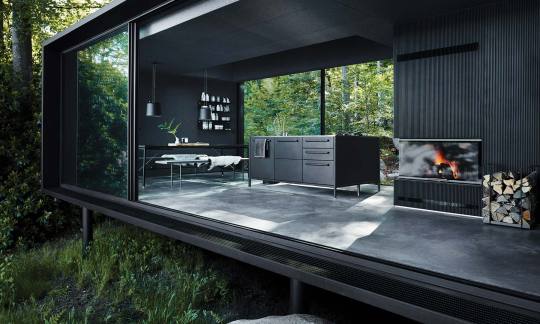
    But equally interesting is what they are doing with their Vipp Hotels. Instead of large hotels, they offer individual rooms in unique locations, such as this 55 square meter design object in the Swedish wilderness (pictured above).

    The rooms they have crafted are, not surprisingly, stunning. And that’s because they are deliberately designed as a tool to showcase their kitchens, bathrooms, bins, and other products. 

    Here is a quote from their CEO taken from a recent Surface article:

    “Traditional retail seems to be losing its power, but what is not losing power is our desire to see or do something interesting. I see our hotels as the experience economy coming alive,” says Kasper Egelund, CEO of Denmark-based Vipp.

    Clever.

    Image: Vipp