Daily insights for city builders, delivered every morning at 6 AM ET. I’m Brandon Donnelly — a Toronto-based real estate developer and founder of Globizen. I’ve been writing here since 2013.

Author: Brandon Donnelly

  • Architecture’s great injustice

    This morning Jeanne Gang of Studio Gang published an op-ed in Fast Company detailing how her architecture and urban design practice closed the gender wage gap. 

    It is also a call to action and an example of something the firm calls “actionable idealism.” Here is an excerpt from the article:

    What we discovered was that, despite our ideological commitment to equality (and though our numbers were significantly better than all the U.K. architecture firms reporting, in all categories), a small pay gap nevertheless existed between the women and men in my office. We fixed that with this year’s raises and now have no wage gap as an organization.

    To learn more about how they accomplished this, check out the full article. And if you’d like to meet Jeanne Gang in Toronto this week and learn more about what we’re up to at Yonge + St. Clair, click here.

  • Below the surface

    Later this month the new 9.7 km North-South metro line in Amsterdam will start service. Like most large scale infrastructure projects, its opening has been delayed many times. 8 times according to this source. But this post is not about that. It’s about a byproduct of the line’s construction. 

    The excavations required for the line meant that two sections of the Amstel River – namely the Damrak and Rokin sites – had to be drained. This took place from 2003 to 2012 and gave archaeologists unprecedented access to the bottom of a river in the middle of a historic city center.

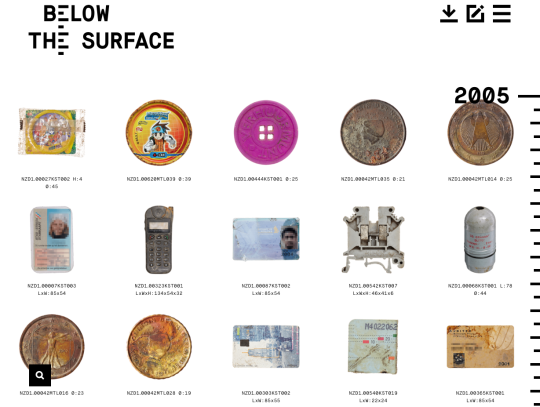
    Amsterdam started as a small trading port along the banks of the Amstel River some 800 years ago. So not surprisingly, they found a few things. Over 17,000 objects were found and all of them have been catalogued online according to time period, use, material, and location found.

    For the full catalogue of objects, click here. Screenshot of the catalogue shown above. And to learn more about the entire project, start here. There’s a lot of good stuff in there for city nerds.

  • Canada Day and Moving Day

    Happy Canada Day to the Canadian readers of this blog. Here is a picture that I took of the CN Tower a few weeks ago just after sunset from Billy Bishop Toronto City Airport (YTZ). It also symbolizes Canada for me. 80mm f/1.2 in case you’re wondering.

    In some parts of this country, July 1st has another, perhaps more laborious, significance: It is “moving day.” In 18th century Quebec it was forbidden for les seigneurs to evict farming tenants during the winter, a law that was simply inherited from France at the time.

    As time went on, this evolved into a law – baked into the Civil Code of Lower Canada (1866) – requiring that all residential leases run from May 1 to April 30. May 1 was “moving day.”

    In 1973, it was determined that May 1 was too disruptive to children in school and so an extension was granted on all leases, automatically pushing the date to July 1. It also meant moving in the summer, as opposed to in the spring when weather can be unpredictable in Quebec.

    The requirement of fixed lease terms was also removed at this time (1974 onward), but tradition has persisted and July 1 remains known as “moving day.” This seems to me like a logistical nightmare and a highly impractical way of allocating resources, but perhaps I’m just missing some of the nuances.

    In any event, whether you’re sitting on a dock reading the Canadian Constitution Act of 1867 with a Brickworks cider, moving all of your belongings (in what is a hot weekend), or doing something completely different, I hope you’re having a good one. Happy Canada Day.

  • Blackstone enters Canadian multi-family sector

    image

    A few days ago it was announced that Blackstone has entered the multi-family space in Canada through a JV with Starlight Investments. They are buying 6 undisclosed multi-family buildings. 5 in Toronto. And 1 in Montréal. The total is 746 units.

    The message in the press release is that apartment buildings in Canada are difficult to find and buy at meaningful scale. Most are held by small private investors and those owners are reluctant to sell. 

    At the same time, places like Toronto and Montréal have built relatively little purpose-built rental over the past few decades. Supply is restricted. 

    This is an interesting stat from the announcement: The Canadian rental market is about 2 million housing units. Dallas, alone, is 500,000 units. But this must only be purpose-built, investment grade, and/or some other subset of units. Because there are over 14 million private households and over 4.4 million rented households in Canada (2016 data).

    They also hint at a longer-term relationship between Blackstone and Starlight. Perhaps that will translate into some purpose-built rental development in the future.

    On a related note, I recently picked up the book, King of Capital: The Remarkable Rise, Fall, and Rise Again of Steve Schwarzman and Blackstone. It was published in 2012, so it’s not new. But as soon as I stumbled upon it, I picked it up. It was new to me.

    Once I’m finished it maybe I’ll report back here on the blog.

    Photo by Warren Wong on Unsplash

  • Inaugural meet-up: Planners on bikes getting coffee

    Remember my post from a few weeks ago about “planners on bikes getting coffee?” Well it happened. That’s the potential of blogging and Twitter. (I sold $TWTR too early.) 

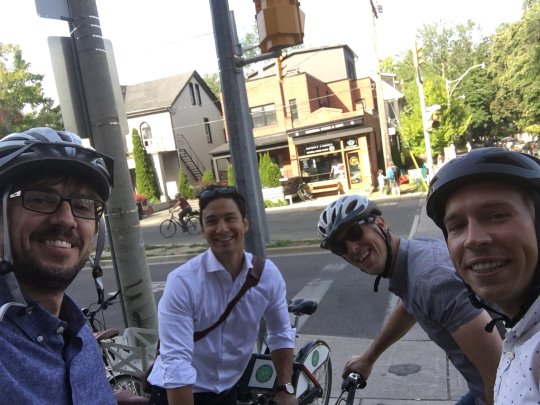
    Here is the selfie to prove it:

    Jason Thorne and I met up with Gil Meslin and Liam Hanebury (Liam needs Twitter) of Artscape and they toured us around a few of their projects, including one of their first artist live/work projects on Queen West.

    I do, however, have to confess that we didn’t have any coffee. I can’t drink coffee in the evening because it keeps me up at night. I already have too many things on my mind.

    Trying to hold a group conversation on a bike is also not as easy as talking in a car, but I would still label the inaugural session a success, even if I was posing as a planner without a bicycle helmet.

    If any of you have any suggestions for the next meet-up or I would like to join, drop me/us a line on the Twitter machine.

  • Airbnb and affordable housing

    image

    Fred Wilson published a good post last weekend on the proposed bill that went to New York City Council this week regarding new reporting requirements for Airbnb and their hosts in NYC. You can read more about his position on his blog, but he is in favor of a comprehensive bill that would properly legitimize short-term rentals. He is also not opposed to city and state taxes on the service.

    What I wanted to focus on today were his comments around housing. This is already sounding like a broken record, but Fred draws attention to the severe supply-demand imbalance that is occurring in the boroughs of Brooklyn, Queens, and the Bronx, precisely because many/most young people were priced out of Manhattan long ago and want to live in these places.

    But I particularly like his comments around what makes for good policy and what makes for good politics. I agree with his view that it is often a case of the latter over the former. I think a lot of the excitement around Airbnb is a red herring. For me, it’s akin to the fixation on foreign buyers and their impact on the local housing market in places like Toronto and Vancouver.

    Yes, they are factors. But the data suggests they are marginal ones. As Fred points out, they are almost certainly not the root cause of the problem. The reality is that we need a lot more housing – both market-rate housing and subsidized housing. The challenge is that nobody wants to pay for the latter and so we’ve instead decided to focus on things that sound like they’re going to help.

    Photo by Jon Tyson on Unsplash

  • Construction costs are no joke right now

    I don’t know what it’s like in your market, but everyone is talking about it in the industry here in Toronto. Combine these rapidly rising hard costs with higher development charges and inclusionary zoning and you get significant upward pressure on condo prices and apartment rents. 

    This is also one of the reasons – perhaps it is the main reason – why you’re seeing some projects get cancelled. These are projects that maybe sold in one market (lower revenues) and are now trying to build in another (higher costs). The math no longer works. Sorry.

    I mention this today not to complain, although I’m always up for a good industry commiseration over beers, but because I often hear people lament that Toronto needs better design. Why aren’t developers using triple-glazed windows? Why aren’t developers thermally breaking the balconies?

    I will always advocate for better design. That is core to my belief system. But everything costs money. There are very real limits in this equation. And markets have a funny way of telling you exactly what those are.

    Photo by Filip Mroz on Unsplash

  • An open house with Jeanne Gang

    image

    On Thursday, July 5th, Slate Asset Management, Studio Gang, and the rest of the project team will be hosting a community open house where we will introduce designs for a new block plan and mixed-use building at Yonge + St. Clair. This will be Studio Gang’s first project in Canada. We’re pretty excited.

    It’s important to note that while the proposed design has been influenced by some of the early discussions we had with city staff and the local Councillor, we are still very much at the beginning of this process. Which is why alongside this community open house, we are also launching yongedelisle.ca.

    This will be our “neighbourhood engagement” website as we go through the planning process. You’ll find updates from the project team as they become available, and you’ll also have a direct way to get in touch. We’re also testing out this interactive page where you can vote on the city building principles that matter most to you.

    So hopefully we’ll see you on Thursday, July 5th. Invite details above. Please RSVP, here, if you can. But if you forget to do that, don’t worry, you can still just show up. For more on Jeanne Gang, click here.

  • The cost of failure

    Kevin Rose is an internet entrepreneur. He has built a number of consumer products, including Digg in 2004. Previously he was a venture capitalist with Google Ventures, but now he’s doing that with True Ventures. He also hosts a podcast.

    This past weekend he posted the following photo to his Instagram:

    image

    Here’s the story. 

    After begging his mom to take him to the printers, he got this business card made when he was 13 years old. Foliage Software wasn’t a real company, of course. But it had business cards and he was not only a Programmer and the Owner, but a Senior Programmer and the Owner.

    I laughed as soon as I saw this post because it is exactly the sort of thing that the 13 year old version of me would have done and probably did. (The combination of upper and lower case letters on the card also helped with the humor.) I’m sure if I dug around my mother’s house I would find a trail of my failed business schemes and project ideas.

    But that’s entirely the point he is trying to make. Try. Fail. Learn. Refine. All of these actions will increase your odds of success at the next go around. Nobody will remember the failures anyways.

    Seth Godin perhaps said it best with: “The tiny cost of failure is dwarfed by the huge cost of not trying.”

  • Toronto: 2000 vs. 2025

    Last week, Joe Berridge, Partner at Urban Strategies, gave a presentation at the Institute on Municipal Finance & Governance titled, Toronto: The Accidental Metropolis. I’ve seen Joe give similar presentations to this one before, and I always thoroughly enjoy his focus on Toronto’s position as a global city.

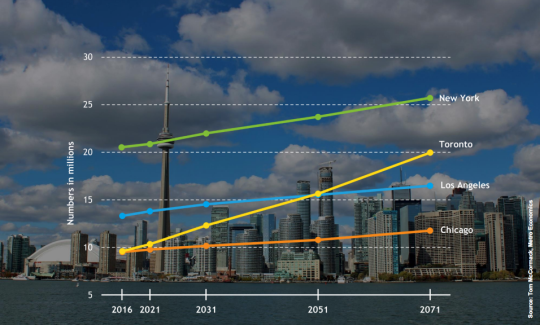
    Here is a slide from the presentation that projects out Toronto’s population to 2071 and compares it to the largest cities in the US.

    image

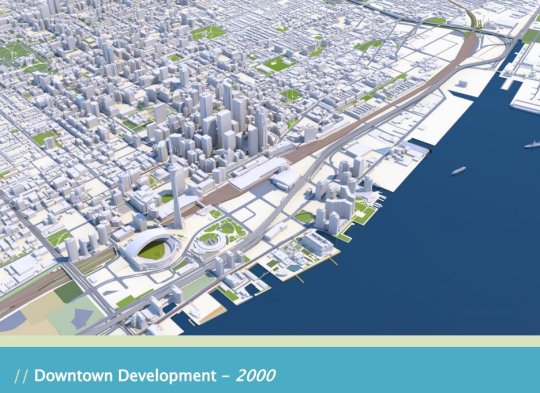
    But the two slides that have been really making the rounds online are the following ones. The first is a rendering of what downtown Toronto looked like in 2000. 

    image

    I remember this time clearly. Queen West seemed to end at Spadina. King West and Ossington weren’t things. And “Richmond and Adelaide” felt like the greatest club district in the world. (If you’re not from Toronto, these references will likely mean nothing to you. Sorry.)

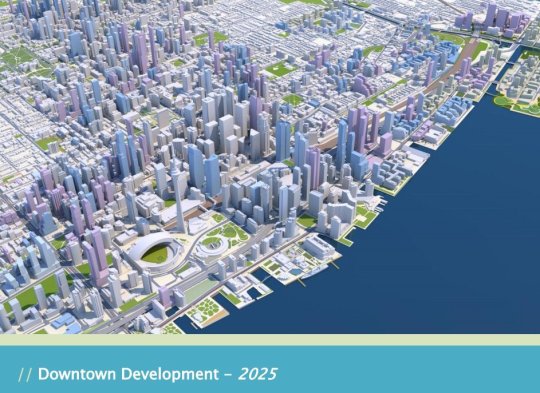
    The second slide is a rendering of what Toronto will look like in 2025. The transformation is just incredible.

    image

    I’ve seen some people comment that the Toronto of 2000 was relatively affordable; the Toronto of 2018 is unaffordable; and the Toronto of 2025 will be even more unaffordable with all of this new development.

    But I don’t understand that logic. Considering the growth rate shown in the first slide, imagine how unaffordable this city would be if we weren’t building new places for people to live and new places for people to work.

    For the full slide deck, go here. And for recent aerial photos of Toronto’s downtown core, check out my Instagram page.