Daily insights for city builders, delivered every morning at 6 AM ET. I’m Brandon Donnelly — a Toronto-based real estate developer and founder of Globizen. I’ve been writing here since 2013.
The July/August issue of Monocle is hot off the press and, as has become tradition, it includes their annual Liveable Cities Index. Now, some of this could be construed as objective, but a lot of it is of course subjective. A liveable cities index is also very different from a global cities index, which is why you won’t find New York or London, or Toronto for that matter, on this list. Click here for a video of the 25 most liveable cities in 2019.
I have been writing about algorithmic home buying on the blog since Opendoor launched back in 2014.
I don’t have anything new to report on that today, but this recent article from the WSJ is interesting in that it talks about why Phoenix, in particular, has become ground zero for algorithmic home buying, as well as for institutional investors looking to buy cheap rentals.
Across Opendoor, Offerpad, and Zillow, nearly 500 homes are now being purchased — largely by software — in Phoenix each month:
One of the reasons why Phoenix is well suited to these platforms is that the housing stock is cheap and fairly homogenous. (The WSJ calls it “stucco sprawl.”) This makes it easier for the algorithms to put a value on the homes.
A big chunk of the housing stock is also relatively new. Just over 36% of it was built in 2000 or later. And it tends to trade fairly often. Below is the percentage of homes in 2018 that were resold within a year of purchase.
It’s also worth noting that Arizona is a non-recourse state, meaning you’re typically not personally liable if you default on your home mortgage. You simply hand back the keys. So it’s viewed as a fairly risk tolerant state, which may be one of the reasons why Phoenix’s median home price chart looks like this:
I’ll end with this quote from the article: “It’s the dawn of e-commerce for real estate,” said Zillow Chief Executive Rich Barton. “Phoenix is ground zero.”
Berlin just approved a five year “rent freeze” on apartments in the German capital. The rent caps will be implemented on January 1, 2020, but will apply retroactively to all rental agreements from June 18, 2019 onward (which is when the decision was made). It is estimated that this new law will apply to some 1.5 million apartments.
The move is in response to rapidly rising apartment rents, which grew about 12% in 2017 alone. So I can appreciate where this is coming from.
From what I have read, it will not apply to new construction, which is the first thing I checked when I saw the decision. That would have almost certainly choked off any new apartment construction in the city. With a capped top line, it wouldn’t take long for costs to increase and make new rental construction infeasible.
That said, a similar squeeze is liable to happen for existing buildings. It is one thing to cap rents (revenue), but what about utility, maintenance, labor, and other operating costs (expenses)? As costs rise and operating margins tighten, it can become exceedingly difficult to reinvest in, or even maintain, an apartment building.
This week, Google announced a $1 billion investment in housing across the San Francisco Bay Area. Here is the blog post announcement by CEO, Sundar Pichai. And here are a couple of paragraphs from the post explaining how this is expected to work:
First, over the next 10 years, we’ll repurpose at least $750 million of Google’s land, most of which is currently zoned for office or commercial space, as residential housing. This will enable us to support the development of at least 15,000 new homes at all income levels in the Bay Area, including housing options for middle and low-income families. (By way of comparison, 3,000 total homes were built in the South Bay in 2018). We hope this plays a role in addressing the chronic shortage of affordable housing options for long-time middle and low income residents.
Second, we’ll establish a $250 million investment fund so that we can provide incentives to enable developers to build at least 5,000 affordable housing units across the market.
In addition to the increased supply of affordable housing these investments will help create, we will give $50 million in grants through Google.org to nonprofits focused on the issues of homelessness and displacement. This builds on the $18 million in grants we’ve given to help address homelessness over the last five years, including $3 million we gave to the newly opened SF Navigation Center and $1.5 million to affordable housing for low income veterans and households in Mountain View.
Google is not alone in its efforts to improve housing supply in the Bay Area but, according to CityLab, this is “the single largest commitment by a private employer.”
There’s a lot of debate about the value of housing supply, alone. But in 2017, the Bay Area added 3.5x as many jobs as it did housing. I think most people would agree that’s a suboptimal, and potentially unsustainable, mismatch.
Also, if large companies such as Google and Microsoft are making these sorts of investments, it is likely that they’re worried about housing unaffordability impacting their ability to attract and retain top talent going forward.
Perhaps this is a signal for just how unsustainable this mismatch has gotten.
A new Facebook-supported blockchain and cryptocurrency, called Libra, was announced today. The goal: a new global currency. But unlike other cryptocurrencies, this one will be backed by a basket of government-issued securities and other investments.
A new governing body called the Libra Association has also been formed, with its 28 founding members (see above image) contributing both capital (at least $10 million) and expertise. Going forward, they will help shape the network. It’s important to note that Facebook will have the same status as all other members of the Association.
Facebook said Tuesday the network underpinning the new cryptocurrency would be governed by the Libra Association, an independent, not-for-profit organization based in Geneva. Facebook named more than two-dozen founding partners in that association, including Uber, Visa Inc. and a handful of venture-capital firms and blockchain companies like Coinbase.
The other thing that differentiates Libra from other cryptocurrencies is that when it launches next year (2020), it will do so inside some of the most widely used consumer apps on the internet, including Facebook Messenger and WhatsApp. That translates into somewhere around 2.4 billion active users.
Many within in the industry are already speculating that this could be what finally brings the crypto ecosystem into the mainstream, which is, I guess, why companies such as Visa and Mastercard have already signed on to the project. I am also thrilled to see the Creative Destruction Lab listed above. They are a seed-stage program based out of the University of Toronto.
If you’d like to learn more about Libra, here’s the official website and here’s a good solid overview by TechCrunch.
Today was a historic day for Toronto, for Canada, and for the game of basketball in this country. The Toronto Raptors are world champions for the first time since their founding in 1995. Soak it in. Here is a photo that I took of the parade coming through the Financial District at around 2:30pm:
Some of the estimates going around are that 1 to 2 million people attended today’s championship parade. But 2 million seems like a lot, even though today was frenetic (see above photo, again). I mean, that’s 1/3 of the population of the Greater Toronto Area.
The fact that some of the “official” estimates also have a 1 million person spread tells me that, as of right now, we actually have no idea how many people were at today’s parade.
So that got me thinking: How do people count crowds? And are we using drones to do it, yet? Subway and rail ridership for the day — which surely spiked — will give us some indication. But definitely not the full picture.
It turns out that the typical approach to counting crowds is known as Jacobs’ Method. It was invented in the 1960s by a professor at UC, Berkeley, named Herbert Jacobs. He came up with the method while trying to count the number of students protesting the Vietnam War.
The concept is simple: It’s area x density. And permutations of his method usually use this same principle. What you do is take the area filled with people, break it up into a smaller grid, and then come up with a population density estimate for each square.
He had some rules of thumb for that. A light crowd was about 1 person per 10 square feet. And a dense crowd (such as a mosh pit or an NBA championship parade in Toronto) was about 1 person per 2.5 square feet.
Using this method and aerial photos of today’s parade, I would imagine that we could eventually get to a more precise estimate than 1 to 2 million people. But surely somebody has figured out how to program a drone (or other UAV) and do this even more accurately.
Crowd data is valuable information, particularly for political rallies and protests (I would imagine). If you know of a company doing this, please leave it in the comment section below. And if it doesn’t yet exist, well then, now you have a new business idea.
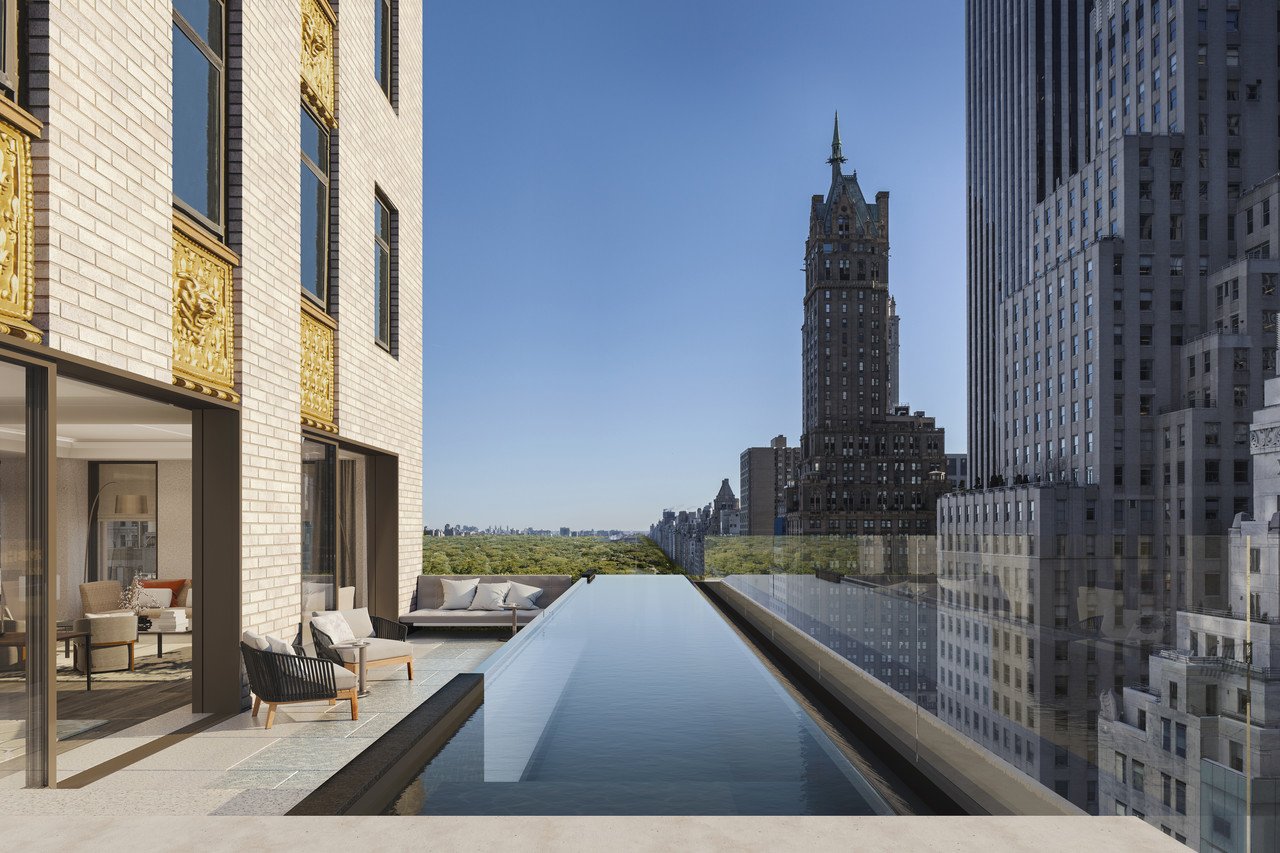
This morning I was reading about Aman’s new condo and hotel project in New York, which is planned for the 100-year-old Crown Building at 730 Fifth Avenue. It will have 83 hotel rooms and just 22 homes, and be the first urban condominium for the resort company.
Owned by OKO Group, the hospitality company is mostly known for their “sleek, minimalist hotels in secluded, far-flung destinations,” according to the WSJ. Rooms go for upwards of USD 2,500 per night and they, supposedly, have a rabid customer base known as “Amanjunkies.”
What’s interesting about this project is that (among other things) it’s a bet the Aman brand will translate to an urban context and drive above-market pricing. And it will do it at a time when the ultra high-net-worth segment of the market in NYC has been cooling because of a new “mansion tax” and probably other factors.
The five-storey penthouse, which will be built into the building’s “crown,” is asking USD 180 million. If/when it sells, it will break the record for the most expensive home ever sold in the city on a square foot basis at $14,358 psf.
If you subscribe to the WSJ, you can read the full story here. I find it valuable to see how projects position themselves.
Click here for a short video (by Monocle) about Tokyo’s nascent “kitchen car”, or food truck, scene. (The soundtrack is fun.) Historically, street food stands, or “yatai,” have had a questionable reputation in Japan. They proliferated across the country following World War II when times were tough and food was being rationed. But as Tokyo prepared to host the 1964 Olympics, local governments began to clamp down on yatai. They were seen as unhygienic and a place for drunks to hang out. There may have also been a sense of shame around the country’s post-war struggles. Whatever the case may be, these new food trucks have — aided by technology — changed the way people eat on the street.
Earlier this year, an 800 unit co-living project was approved in downtown San Jose. The developer is Starcity. And it is said to be the largest co-living project in the pipeline in the United States right now.
A few months later (presumably because of this project), San Jose also created a new “co-living” land-use classification. It is similarly thought to be a first for US cities.
I think it still remains to be seen how broad the market can be for co-living. Do older generations also want to go back to dorm-like living? Or is this a housing solution mainly for twenty-somethings?
At the same time, it’s not an entirely new housing idea. I like the parallel that Sarah Holder of CityLab draws between today’s co-living and yesterday’s single room occupancy buildings (SROs).
There are, of course, many differences, including the amount of space dedicated to common areas (the community aspect). But in both cases, part of the value proposition is about affordability.