Daily insights for city builders, delivered every morning at 6 AM ET. I’m Brandon Donnelly — a Toronto-based real estate developer and founder of Globizen. I’ve been writing here since 2013.

Month: October 2020

  • Why do haunted houses look the way that they do?

    This short 5-minute video by Vox is a perfect example of how, just like with fashion, architecture and design tastes are always changing. The things we like at one point in time may not be what we like in the future. And it can go from extreme desire to extreme disgust. In this video, Vox makes the argument that the mansions of America’s Gilded Age are the reason why all haunted houses seem to look the same in popular culture and in our imaginations.

    Once the extreme desire of America’s nouveau riche (who were clearly trying to emulate rich Europeans), they fell out of favor with the arrival of modernism and a new cultural ethos. All of a sudden it wasn’t fashionable to have copious amounts of ornament and labyrinthian-like floor plans filled with a bunch of gaudy stuff. So the rich moved on and many of these homes fell into disrepair, setting the stage for spooky thoughts.

    What’s interesting about this phenomenon is that it can make it difficult to discern what has design and cultural value and what doesn’t. Because something that has value today, may not have perceived value tomorrow (and it may also become the backdrop for future horror movies). Of course, the opposite is also true. We could hate something today, but eventually learn to love it.

    Brutalism is perhaps a good example. Though there seems to be a groundswell of people interested in preserving this style of architecture, I continue to think that it remains a generally unloved kind of built form when it comes to the general public. So does that mean it has little present and/or future value? That’s not a straightforward question.

    The other thing I find fascinating about this haunted house phenomenon is that it shows how one thing can lead to another. If the typology of haunted houses is a result of the Gilded Age mansion, then it’s also important to consider that the Gilded Age mansion is arguably a result of the new wealth that was being amassed by some Americans at the end of the 19th century.

    The Gilded Age was a period economic expansion for the United States. New fortunes were being made via rail, steel, tobacco, and other industries. (Inequality was a concern.) And this new wealth was naturally looking for a way to show off (as it usually does). That happened to manifest itself in ornate European-like mansions. But had that not happened, would haunted houses look the way that they do today?

    Happy Halloween.

  • Urbanation releases Q3-2020 market update — new condo sales reach record high

    Urbanation just released its Q3-2020 market update for the Greater Toronto Area and the data is very encouraging for the new condo market. Here are some of the highlights:

    • There were 6,730 new condominium unit sales in Q3. This represents a 30% year-over-year increase.
    • More of this growth happened in the suburbs (905) with 3,834 units sales vs. 2,536 unit sales in the City of Toronto (416).
    • Of the 6,694 units that launched for sale in Q3, about 3/4 of them sold. This is the highest absorption rate since Q4-2017.
    • The average selling price for a new condo launched in Q3 was $1,044 psf (GTA average). This is up 3.5% compared to last year.
    • New launches in the suburbs sold for an average of $915 psf. New launches in the City of Toronto sold for an average of $1,275 psf.

    I reckon that many of the people purchasing right now are looking through and to the other side of this current macro environment. They recognize that things will get better and that the Toronto region will continue to thrive. That’s certainly how I’m thinking about it.

    For the full Urbanation news release, click here.

    Photo by Warren Wong on Unsplash

  • The world’s best cities

    Whenever you see a best-of-anything ranking, you should probably ask yourself what the hell “best” even means. In this case, Resonance Consultancy is ranking the world’s cities based on six alliterative categories: place, people, programming, product, prosperity, and promotion.

    Some of these metrics are qualitative, but many are, in fact, quantitative. Number of COVID-19 infections in 2020; number of direct destinations served by the city’s airports; number of foreign-born residents; number of top-rated restaurants (TripAdvisor); most Instagram check-ins, and so on.

    The result is this list of the world’s best cities:

    1. London
    2. New York
    3. Paris
    4. Moscow
    5. Tokyo
    6. Dubai
    7. Singapore
    8. Barcelona
    9. Los Angeles
    10. Madrid
    11. Rome
    12. Chicago
    13. Toronto
    14. San Francisco
    15. Abu Dhabi

    I arbitrarily chose the top 15 cities in order to make sure that Toronto was included in this ranking. If you’d like to download a full copy of the 2021 World’s Best Cities report, you can do that over here. I recommend you check out their performance criteria.

    Toronto, for example, performs very well when it comes to “people.” That’s fairly consistent across most of these rankings. But it didn’t fare so well when it comes to “place.” That category includes things like the average number of sunny days and the number of high quality sights & landmarks.

  • Is that delay really necessary?

    The big news this week in Toronto planning & development is the province’s decision to approve three downtown development projects using a tool known as a “ministerial zoning order.” The impetus for doing this was to speed up the approval and delivery of about 1,000 affordable housing units (along with about 2,000 market-rate units).

    The province has made it clear that it wants to do what it can to reduce red tape and unnecessary delays when it comes to building new affordable housing. But this, not surprisingly, upset a number of local councillors who feel the province is overstepping and not allowing the city to govern its own city building affairs.

    Alex Bozikovic’s view in the Globe and Mail this week was: hey, maybe that’s not so bad. The planning process is painfully slow (and political). And Toronto is going to need a lot more housing over the coming years and decades. So why not speed up its delivery? Especially when there’s an affordable housing component and the architecture is exemplary.

    The reality is that our housing delivery system is rife with tensions. A big part of the process is predicated on local voters, who already live in a particular place, opining on their own interests and on the interests of people who don’t yet live there. The incentives in place are anything but aligned.

    We can debate which level of government should have more power and what might be considered an unnecessary delay, but what is clear to me is that it should not take 2-5 years to get new housing approved in this city.

  • The game of life

    “Anxiety is experiencing failure in advance.” — Seth Godin

    I mention and quote Seth Godin fairly often on this blog and so it only seems right to share this recent podcast that he did on the Tim Ferriss Show. Broadly speaking, the conversation is about “the game of life, the value of hacks, and overcoming anxiety.” I think most of you will find it useful regardless of what you do and what you’re involved in. It’s over an hour long, but there’s a full transcript available if you’d prefer to read, rather than listen. If you’re looking for something even shorter, here’s a quick video by Tim Ferris that has Seth talking about why worrying isn’t productive and that it’s really in service of our need for status quo and reassurance.

  • TikTok studios are the new multi-family amenity

    I just finished reading about an apartment building in Los Angeles that is currently retrofitting its amenity spaces to include, among other things, an appropriately spread out co-working space, two podcast rooms, and a TikTok studio. This latter amenity will be a roughly 100 square foot room with camera-ready lighting, tripods, and mirrors. It was described in the article as the perfect place for one or two people to create things and entertain themselves.

    The gist of the article is that home offices are the new must-have amenity and that developers have started to rethink apartment amenities in light of this. But I also take this to be a sign of the times. We are living in a world of content creation. Whether you’re a so-called influencer or not, TikTok has, for a lot of young people, replaced many other forms of entertainment and everybody, at this point, probably needs their own podcast.

    It is also true that there’s an “amenities arm race” going on within the apartment sector. This is nothing new and doesn’t have much, if anything, to do with this pandemic. Amenities have been how you differentiate your offering. And when you’re constantly selling (i.e. leasing all the time), they do become important. So here’s to podcast rooms and TikTok studios. If you had your pick, what kind of amenities would you like to see in your building?

  • Suicides, cities, and the concept of coupling

    I am reading Malcolm Gladwell’s latest book right now, called Talking to Strangers: What We Should Know about the People We Don’t Know, and I am intrigued by the chapter on Sylvia Plath’s unfortunate suicide and the concept of “coupling.” The idea behind coupling, which stands in contrast to displacement, is that when someone makes the very sad decision to commit suicide, it can often be coupled to a particular place or context.

    Malcolm starts by giving the example of “town gas.” Prior to it being phased out in the 1960s and 1970s, most homes in Britain relied on a form of gas that contained carbon monoxide. And sadly, it became the most popular way for people to kill themselves. When Sylvia Plath took her own life in 1962, the death-by-carbon-monoxide-poisoning stat was 44.2% of all suicides in England and Wales.

    The concept of displacement, on the other hand, surmises that if somebody wants to kill themselves, they will eventually find another way. But Malcolm convincingly argues that that is not necessarily or very often the case. As town gas was phased out of British homes, the number of suicides also declined in lockstep. Turns out that many of the previous suicides had been coupled to that particular tool.

    Why this is potentially valuable to this blog audience is that this same coupling phenomenon can happen within our cities and to particular places. Malcolm gives the example of the Golden Gate Bridge in San Francisco, which has been the site of many suicides since it was first erected in 1937. The same, of course, can be the said about many subway systems around the world.

    But again, there’s evidence to suggest that if you can save somebody on the Golden Gate Bridge (a suicide barrier was erected in 2018) or on a subway system by installing safety doors, there’s a good chance that many of those people will never actually find another way to commit suicide. In other words, you can save a bunch of lives by having the right provisions in place and not assuming that something is a foregone conclusion.

    Photo by Chris Leipelt on Unsplash

  • CloudKitchens has spent more than $130 million on property over the last two years

    According to a recent Wall Street Journal review of property and corporate records, Travis Kalanick’s ghost kitchen startup, called CloudKitchens, has spent over $130 million over the past two years buying more than 40 properties in about two dozen cities.

    Travis is co-founder and the former CEO of Uber and this latest startup provides commercial kitchens to restauranteurs who are looking for a low-cost way to launch delivery-only food concepts.

    In some ways, it can be compared to coworking spaces for delivery-only restaurants. Instead of renting a full restaurant space, you lease 200-300 square feet of real estate at a lower cost address. CloudKitchens then handles all of the distribution and fulfillment, effectively lowering the barriers to entry for food startups.

    Some of the properties that they have been buying include a vacant restaurant space in Miami Beach for $9.2 million (May 2020) and an industrial property in Queens, New York for $6.6 million (March 2020). They’ve also bought in cities like Portland and Las Vegas.

    As you might imagine, now is a pretty good time to be buying some of these properties. And if you think about it, there are some real cost advantages to what they are doing, not to mention some co-working-style arbitrage on the real estate.

    The company is apparently going to great lengths to conceal what and where they are buying. But what is perhaps more interesting is their asset-heavy approach. They’re buying lots of real estate, which is inline with what companies like Opendoor are doing, but is distinct from Uber’s asset-light approach.

    It is also different from what many other ghost kitchen startups are doing. It seems that most are leasing their spaces. There has to be a reason for this difference.

  • Super-prime property transactions in the first half of 2020

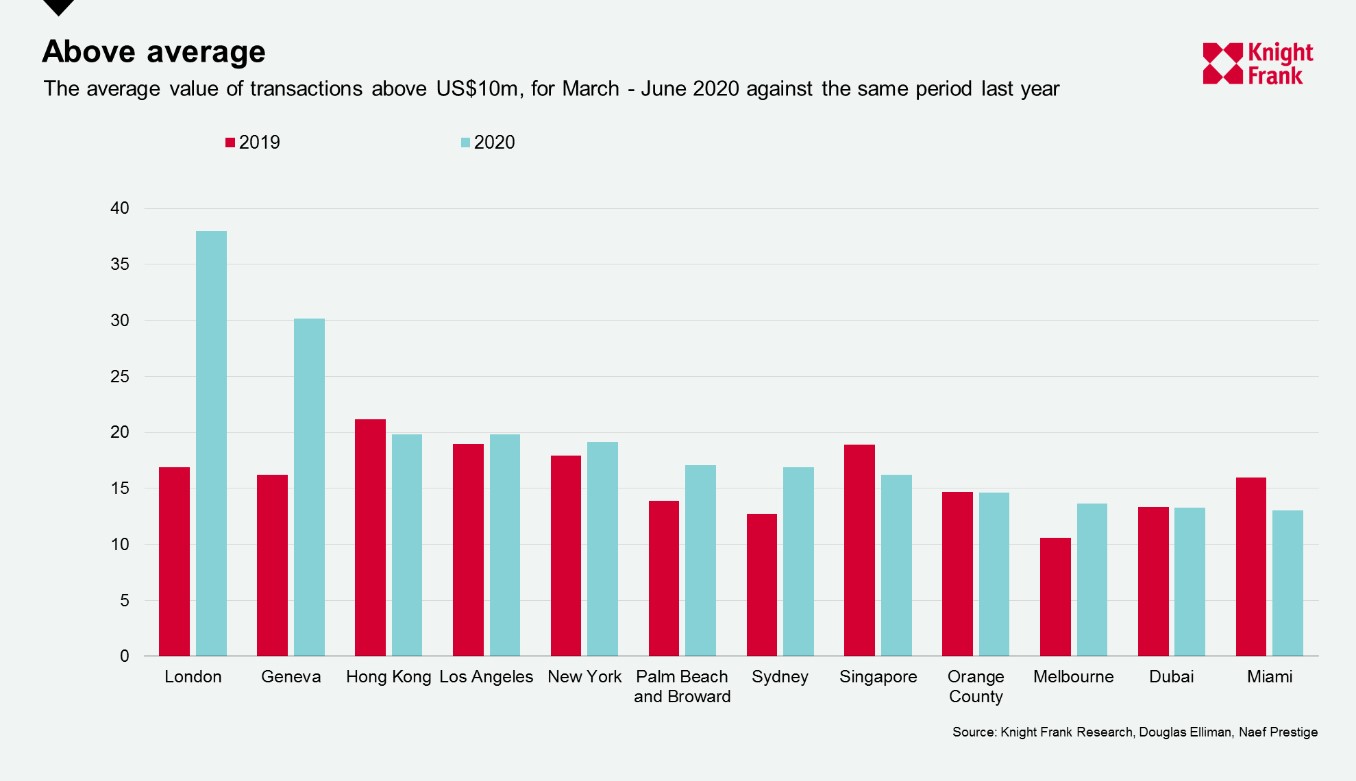
    This is a chart from Knight Frank showing the average value of “super-prime” residential real estate transactions in 12 global markets between March and June 2020, and versus the same period last year.

    Knight Frank classifies super-prime real estate as having a value greater than US$10 million and ultra-prime real estate as having a value greater than US$25 million.

    In this particular chart, London takes the top spot with an average super-prime transaction value of US$38 million. This is a big jump compared to 2019 where the average value was US$16.9 million.

    Typically it is Hong Kong that takes the top spot in this ranking, but this year it fell to third. Still, Hong Kong had the highest number of transactions with 60 super-prime sales taking place in the first half of 2020. This is down from 155 in the first half of 2019.

    Overall, Knight Frank recorded 281 super-prime transactions across these 12 cities in the first half of this year. This is, not surprisingly, a decline compared to last year, which saw 594 transactions over this same time period.

    But all things being considered and given some of these price increases, the super-prime market is certainly holding its own.

    Chart: Knight Frank

  • The Map: Geometry vs. geography

    A friend of mine sent me this video today in a brief email that basically said, “you’re gonna love it.” Naturally he was right. It’s great. The 10-minute video is about how creative agency Work & Co rethought and redesigned New York City’s subway map for today’s digital age. Rather than a static map, which is historically how all cities have communicated their transit networks, they created a digital map that changes both as you interact with and as the network itself changes (closures, time of day, etc.). This means that they no longer had to make certain design compromises. They no longer had to choose between geometry (clarity of representation) and geography (accuracy of representation). The system does both.