Daily insights for city builders, delivered every morning at 6 AM ET. I’m Brandon Donnelly — a Toronto-based real estate developer and founder of Globizen. I’ve been writing here since 2013.

Month: January 2019

  • The paperless developer

    image

    I’m working on integrating an iPad (back) into my workflow as a developer.

    I used an iPad 2 (c. 2011) while I was completing my MBA. I mainly used it for taking notes and saving money on hard copy textbooks. But after it got old and painfully slow, I stopped using it. It was a nice to have, but I never felt the need to replace it with a newer model.

    Lately, however, I have been hearing from a number of developer friends that an iPad – along with an Apple Pencil – is simply invaluable for people, like me, who are constantly reviewing, signing and marking up documents and drawings. So I have decided to reevaluate how I work.

    I am still getting set up, but I can already see how it is going to dramatically streamline some of my workflows (for one, there will be much less scanning).

    I am currently on the hunt for apps that can help with floor plan designs – something that will work like trace paper but with dimensions. We spend a lot time working to make these perfect. It’s the core product, after all. So far I’ve found TracePro by morpholio. Maybe you all know of something better.

    Outside of the office, I also think I’ll be able to replace my laptop when it comes to writing this blog and editing photos on the road. There’s Lightroom for iPad and all you need is an SD card reader to download all of your photos to it. (Too bad it isn’t possible to connect my Fujifilm directly.)

    I’ll let you know how all of this goes. But if any of you have already gone paperless, please feel free to leave your tips in the comment section below.

    Photo by Kelly Sikkema on Unsplash

  • New York City’s $35 billion nightlife economy

    image

    The Mayor’s Office of Media and Entertainment in New York City recently commissioned this report on the city’s nightlife economy. The study was completed by Econsult Solutions, the North Highland Company, and Urbane Development. (Full disclosure: I was a teaching assistant for the President of Econsult while at Penn.)

    Here’s what they found:

    The total economic impact of this industry is the sum of its direct, indirect, and induced economic impacts, as well as the ancillary spending impacts that are adjacent to nightlife activity. In 2016 (the most recent year where standardized datasets were available), the nightlife industry supported 299,000 jobs with $13.1 billion in employee compensation and $35.1 billion in economic output. This economic impact also yielded $697 million in tax revenue for New York City.

    They also found that, between 2011 and 2016, the nightlife industry has outpaced the city’s overall economy. Nightlife establishments grew by a 2% annual growth rate. Jobs in the nightlife industry grew by a 5% annual growth rate. And nightlife wages have been rising by 8% annually – about double the average for the city.

    I am a firm believer in the value of the nighttime economy. So I’m happy to see more people paying attention to it as of late. For the full report, click here.

    Photo by Markus Spiske on Unsplash

  • “Alexa, play some Miles Davis”

    Over the weekend I received an Amazon Echo as a gift. I set it up in my kitchen on Sunday morning and had it playing music and telling me the weather in no time. I also setup a couple of “routines” so that when I say things, such as “good morning”, it cycles through the weather, the news, and some other things that I might find valuable at the start of my day. It is pretty neat.

    The truth is that I have actually been avoiding voice assistants since they were first launched. As much as I consider myself an early adopter, I have been generally uncomfortable with the idea that my voice commands, and perhaps other things, are being stored by Amazon. There are ways to delete that history, but I am not yet sure if that’s enough for me. Am I going to be served an ad because of something I mention in my own home?

    Now that I’ve been trying it out for a few days, I will say that it is incredibly useful. I immediately see the value. I use it to control some of my lights. I ask it things when I’m cooking and my hands are dirty: “Alexa, how badly are the Raptors going to beat the Bucks this Thursday?” And I use it to play music. But is all of this a fair exchange for the creepy feeling that they create?

    I’m not sure. But it certainly feels like the future.

  • Spaces for the Instagram age

    In 2017, the New York Times Style Magazine ran a piece on Harry Nuriev – and his design firm Crosby Studios – titled: The man designing spaces for the Instagram age

    Since then, Harry and his firm have been in Time Magazine, have had a solo show at Design Miami, and have been named to the Architectural Digest 100, among many other things.

    There has obviously been a lot of talk over the last few years about the impact that Instagram is having on physical spaces and design #IRL (in real life). 

    Some, or perhaps many, worry that it is having a “homogenizing effect on design.” Everyone is following a kind of global minimalism that looks good on social, but is maybe getting a bit monotonous. 

    There’s no question that online is having an impact on how we design offline. But I am far less fussed about it than most. 

    Architecture, design, and art have always reflected the cultural milieu at the time, and it just so happens that we are living through a period where the internet is transforming so much of what we know.

    It is always important to question what is going on. But I think Crosby Studios is doing some really great work.

  • Do Canadians embrace winter?

    Curbed published an article this week called, Why U.S. cities should stop whining and embrace winter. It is about Canada and how we allegedly embrace winter, which is arguably true, except I think there’s still a healthy dose of whining combined with trips to the south.

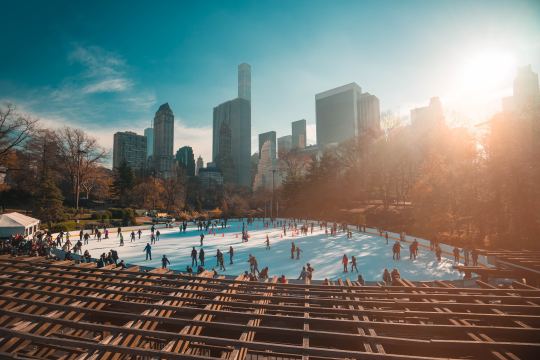
    I went ice skating a few weeks ago along the waterfront here in Toronto. It was a cold night and we debated whether we should skate or do something indoors involving Niagara’s finest red wines. We opted for skating and weren’t cold at all. It was great.

    I was reminded of this when I read the line: “The purpose is to get you skating. If you are skating, you are warm.” It is a good reminder that one of the keys to a successful winter space is physical activity. That and hot tubs.

    Photo by Joseph Barrientos on Unsplash

  • A new typology of cities

    Earlier in the week, my friend Rodney Wilts of Theia Partners sent me a JLL report called, World Cities: Mapping the Pathways to Success. I am admittedly only getting around to it now.

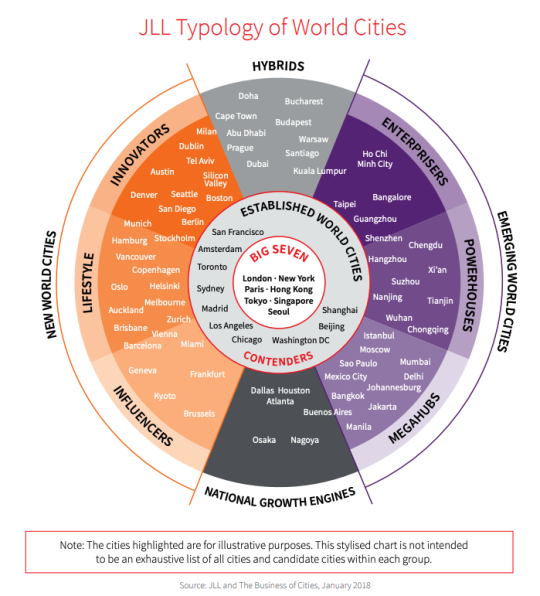
    The report proposes a new typology of world cities that looks like this:

    image

    It is based on 10 overall categories of cities, grouped into 4 main buckets. The first bucket is “Established World Cities”, within which there is the “Big Seven”, and then the “Contenders.”

    The Real Estate Highlights that accompany each category of city is a good place to start if you’re looking to do a quick scan of the report.

    Here’s a taste:

    One-quarter of all capital invested in commercial real estate globally currently lands in one of the “Big Seven” cities. And London and New York are easily at the top.

    Cities that recently graduated from “New World City” status – namely Toronto, San Francisco, Sydney, and Amsterdam – are all struggling to address housing and infrastructure deficits.

    “Lifestyle” cities – such as Vancouver, Auckland, and Oslo – are some of the most active investment markets. Biggest rental growth for prime offices (since 2000) in the “New World Cities” category.

    Click here for the full report.

  • Q4-2018 high-density land sales in Toronto

    image

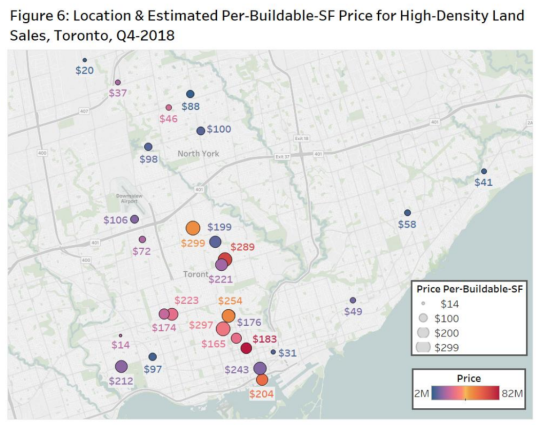
    Bullpen Research & Consulting and Batory Management just published their Q4-2018 High-Rise Land Insights Report for the Greater Toronto Area. 

    Above is a mapping of the estimated per square foot buildable prices for the land that traded hands specifically in Toronto last quarter. 

    The average is $178 per square foot. And the projected average sale (condo) price is $1,097 psf. That sounds right. You basically need that kind of end pricing to make the math work with today’s costs.

    Across the GTA, the average spread between zoned and unzoned land was almost $40 psf. $159 psf versus $120 psf, respectively.

    A full copy of the report can be downloaded here

  • Phoenix claws

    If you’ve ever watched a documentary on food, you’ve probably seen the terrible ways in which chickens are raised and farmed. If you have the means, free-range and organic is the way to go. But I appreciate that some – most according to this Economist article – must opt for whatever is cheaper.

    The Economist deals with the unfortunate side of the chicken industry, but it also talks about how chicken became the rich world’s most popular and widely traded meat. Since 1990, beef and pork consumption has remained roughly the same in OECD countries; whereas chicken consumption has increased by some 70%.

    Also interesting are the regional preferences when it comes to the parts of the chicken. Here is an excerpt from the article (and yes, I prefer white meat):

    Though Westerners prefer lean, white meat; many in Asia and Africa prefer dark meat, which includes legs and thighs. These preferences are reflected in local prices: in America breasts are 88% more expensive than legs; in Indonesia they are 12% cheaper. Differences in the price of chicken feet are even starker. The thought of eating talons is abhorrent to many Westerners, but they often feature in Cantonese recipes. China now imports 300,000 tonnes of “phoenix claws” every year.

    I reckon that a lot of this popularity has to do with chicken’s reputation as a healthy meat. That is certainly the primary motivation for me. Though I do get thrown off when I see the size of chickens on antibiotics. The Dutch have a word for this: plofkip. It translates to “exploded chicken.”

    I realize that this post has little to do with cities, other than the inference that Hong Kong is likely a major buyer of feet. But if you’re at all curious about the stuff you put inside your body – I clearly am – here’s the full article.

  • Largest airport in the world

    I just finished scrolling through these photos (from the Atlantic) of Beijing Daxing International Airport, which is currently under construction about 46 kilometers south of Tiananmen Square. The first phase is expected to open in the second half of this year. It will be about 7.5 million square feet and be capable of handling some 72 million passengers per year (100 million at full build out). 

    Supposedly all of this will make it the largest airport in the world, which is pretty impressive considering Beijing Capital International Airport is already one of the busiest in the world. It too moves around 100 million passengers a year and is likely to overtake Hartsfield-Jackson Atlanta in the near term (if it hasn’t already).

    But in addition to being the biggest and baddest, two other things stand out to me about the design of Beijing Daxing. 

    The first is its starfish design. This was done to minimize the amount of walking between security and gate. Check-ins happen in the middle of the starfish and then the most you’ll ever have to walk is 600m (to end of one of the limbs). That’s in line with what most people would consider a reasonable urban transit radius.

    The second is the fact that the check-in area provides an aerial view of the gates below. You can see this layering in the photos from the Atlantic. This was done to create a visual connection between passengers and their family and friends. Usually, the goodbye waves happen at or before security. Here you get a bit more time. (Will security be an issue?)

    For the full set of photos from the Atlantic, click here. I have a thing for airports, so I thought this was a great set.

    Image: Wang Mingzhu via the Atlantic 

  • Archival street life footage

    Guy Jones is a videographer who specializes in archival footage, or at least that is what his YouTube account suggests. He edits old videos and makes them more watchable by doing things like adding sound and slowing them down to a natural rate. 

    (Older films often appear sped up because they were recorded at less than 24 frames per second and then later played at 24 or more frames per second.)

    I’ve blogged about one of his videos before. This one of New York City in 1911. But he has so many other fascinating films on his channel – including a frozen Ottawa from 1942 – that I figured I would share it in its entirety today

    For the city builders in the room, here are some street life videos of Paris in la Belle Époque (1896-1900), New York City in 1927, and London in 1967. Among other things, it is fascinating to see how quickly the car crept its way into our cities.

    The video of Paris is all horses and moving walkways. The video of New York City (1927) is all cars. And if you look at the other video of New York from 1911, you’ll see a city in the midst of that transition.