Daily insights for city builders, delivered every morning at 6 AM ET. I’m Brandon Donnelly — a Toronto-based real estate developer and founder of Globizen. I’ve been writing here since 2013.

Month: December 2018

  • Documenting a city

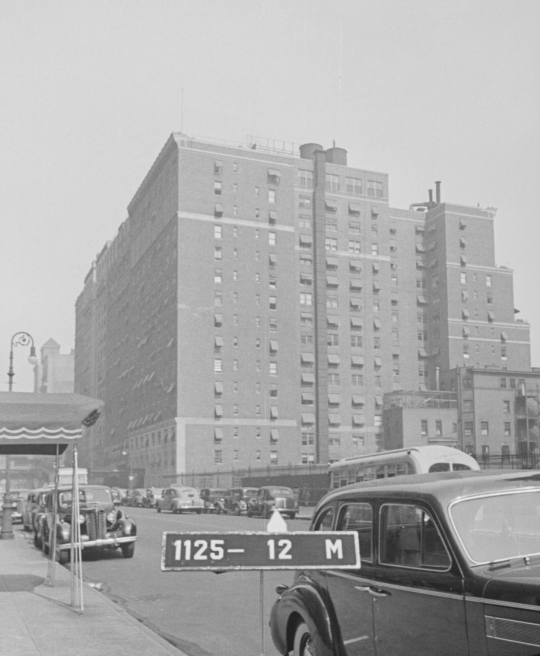
    Starting in the late 1930s, New York City began hiring photographers to document each and every building in the city. It did this to improve the accuracy of its tax assessments, and so every photo was taken with a sign board indicating the building’s block and lot number. The photos looked like this (taken from here):
    image

    The initiative produced over 700,000 black and white photos, all of which have been recently digitized according to the New York Times. The Times also recently published this interactive piece where they go back to these archival photos to see how the city has and hasn’t changed. 

    In the late 1930s and early 1940s, documenting a city and its buildings was clearly a manual endeavor. Today we have Google Street View (launched in 2007), which has now photographed much of the world. Many countries, including all of North America, are reported as having “mostly full coverage.”

    But already autonomous vehicles (and their supporting services) are starting to scan and map our cities in new ways. So it will be interesting to see what ends up getting built on top of this data. I am certain it will empower much more than just better tax assessments.

    Happy New Year, friends. Thanks for reading over the last year.

  • Neural machine translation

    I have been using Google Translate a lot on this trip. Few people here in Rio de Janeiro speak English.

    It is an incredible app that also works without cell service. You just download whatever language(s) you need to your phone.

    There’s a conversation feature that allows you to go back and forth with someone in real time (almost). 

    There’s a camera feature that is invaluable for translating restaurant menus.

    And there are a number of smaller features that I have also found really useful. 

    For example, if you rotate your phone into landscape mode, it will show you your translation in big text like a flash card.

    It looks like this (trust me it is useful):

    imageimage

    I also just learned that, since November 2016, the Translate app has been using a neural machine translation system developed by Google.

    It is capable of understanding and translating complete sentences, and that has reduced translation errors by about 60% compared to the previous system.

    Rather than translate word-by-word or phrase-by-phrase, Google’s NMT network encodes the “semantics of sentences.”

    To learn more about GNMT, click here.

  • Impact of temperature on economic production

    In 2015, Marshall Burke, Sol Hsiang, and Ted Miguel published a paper in Nature that looked at the relationship between temperature (climate) and economic output. They examined the historical impact of temperature changes (1960-2010) on 166 countries and then used this data to try and predict the potential future impacts of climate change on GDP per capita.   

    What they discovered is that temperature has a non-linear impact on economic production. Put differently, there’s an optimal annual average temperature. And it turns out to be 13 degrees celsius. If a country sits below this average number, then warming increases productivity. But if a country sits above this number, then warming has a negative impact on productivity. And the impact gets worse (stronger negative correlation) at higher temperatures.

    Some of you are probably wondering whether the correlations they found should be interpreted as causation. For what it’s worth, the study tries to correct for non-temperature related economic changes (such as a recession or policy changes) and it also looks at how individual countries perform against themselves during temperature fluctuations. So the control and treatment groups are arguably pretty tight.

    All of this suggests that there are a number of countries that stand to benefit from climate change (at least from this perspective). They are the ones that are cold today. 

    For more on the study, click here.

  • A door and a street — walking Copacabana

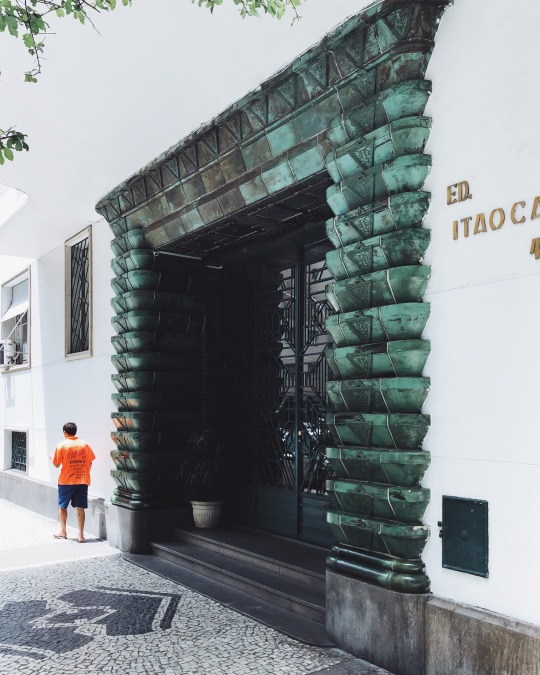
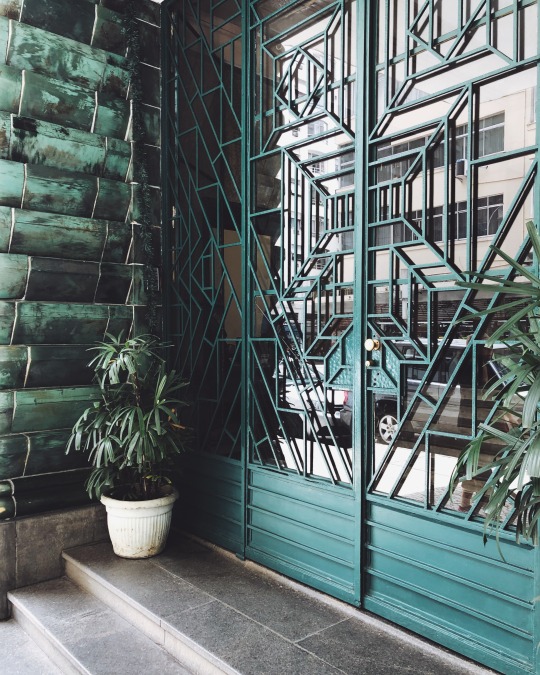
    Rio de Janeiro has some pretty spectacular entranceways. Here is one that I found today on Rua Duvivier in Copacabana:

    imageimage

    It is a magical front door located exactly one block from the beach.

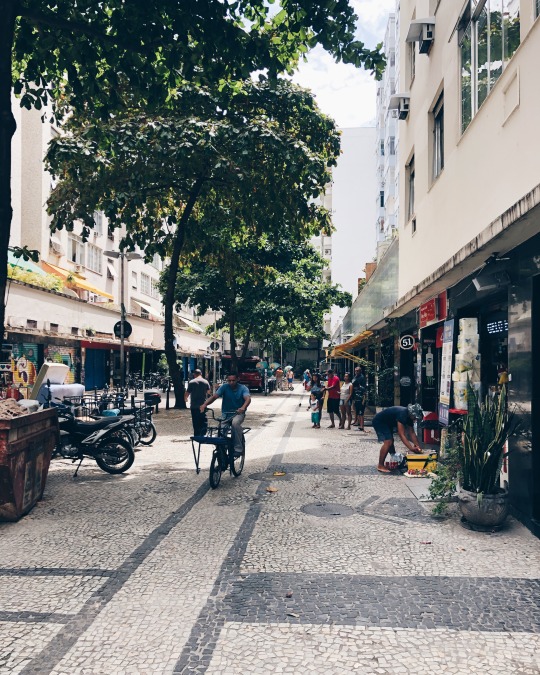
    The other gem I stumbled upon today was Rua Carvalho de Mendonça, pictured here:

    image

    Toward the left (above) is a narrow bollard-separated lane for cars. The rest of the right of way is dedicated to pedestrians and bicycles.

    When I was there today the sun was shining and the retail was in full swing.

    image

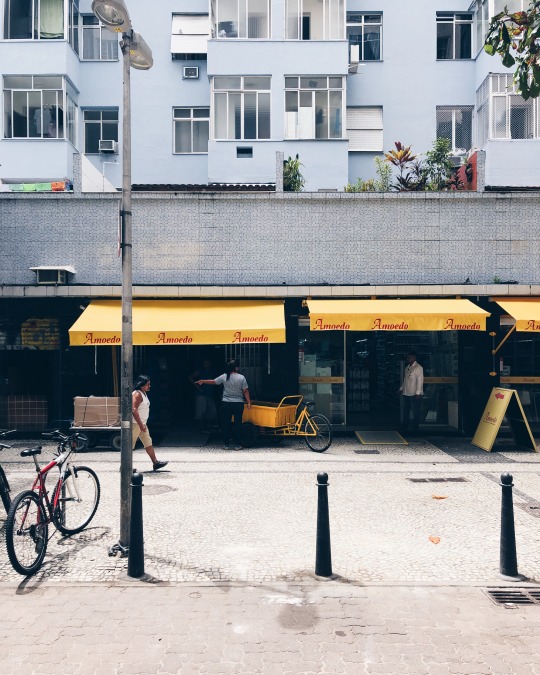
    But perhaps my favorite thing about this street is the residential terraces sitting on top of the single storey “retail podiums.”

    They add life (and eyes) to the street.

  • Gustavo Capanema Palace

    Brazil has been on my travel bucket list for many years, if not decades. Whenever I tell someone that they often ask me why that is the case.

    In addition to its breathtaking natural beauty, sunny beaches, beautiful people, and lively culture, Brazil is also one of the first countries outside of Europe to have adopted modern architecture.

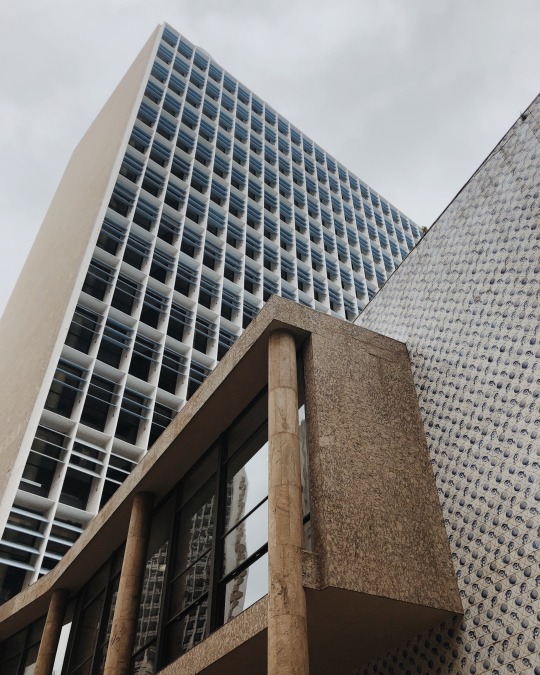
    The best example of this is, arguably, Gustavo Capanema Palace, which is also known in architectural circles as the Ministry of Health and Education Building. At the time of its construction, Rio de Janeiro was the capital of Brazil. Brasilia took its place in 1960.

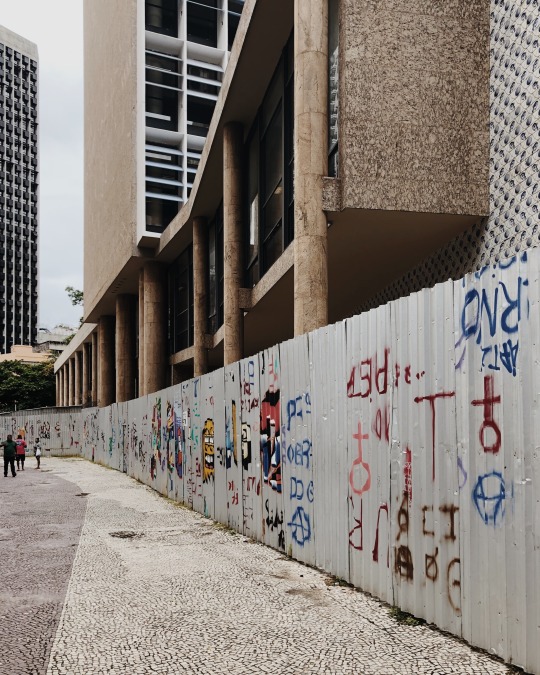
    Here are two photos of the building from this afternoon:

    imageimage

    Sadly, the building is currently under renovation and I wasn’t able to get as close as I would have liked.

    All the same, Gustavo Capanema Palace is one of the first modernist buildings in Brazil and, apparently, the first modernist government building in all of the Americas.

    Designed in the 1930s, there were a whole slew of architects involved in this project, including Lucio Costa (master planner for Brasilia), Affonso Eduardo Reidy, Ernani Vasconcellos, Carlos Leão, Jorge Machado Moreira, Roberto Burle Marx, and Oscar Niemeyer.

    But most notable in the roster was Le Corbusier. And the building is everything you would expect from the Swiss-French architect. Pilotis. Brises-soleil. Glass facades. And mid-level programming.

    However, it also incorporated local elements, such as azulejos (glazed tilework common to Portuguese and Spanish buildings). And in my view that makes it a more interesting varietal of modernist architecture.

    So even though I wasn’t able to get inside today, I am still glad that I was able to finally see Gustavo Capanema Palace.

  • Human Development Index

    The Human Development Index (HDI) is a composite index that ranks countries based on four key indicators (3 dimensions):

    • Life expectancy in years (health)
    • Expected years of schooling (education)
    • Mean years of schooling (education)
    • Gross national income per capita (standard of living)

    Equal weighting (1/3) is given to each of the above dimensions: (1) health, (2) education, and (3) standard of living.

    And the resulting index value is a normalized number between 0 and 1, with the latter number representing the maximum possible value.

    Generally speaking, a country is thought to be developed or advanced when it has an HDI greater than 0.8.

    The way you calculate each dimension’s index value is by using the minimum and maximum limits set out by the United Nations.

    To give you an example, for gross national income per capita (standard of living), the minimum is $100 and the maximum is $75,000. (Logic behind these numbers, here.)

    Once you know the boundaries, you then use this formula for each dimension:

    Dimension Index = (Actual Value – Minimum Value) / (Maximum Value – Minimum Value)

    Each of the individual dimension indices are then aggregated together to create that country’s HDI.

    In 2017, the country with the highest HDI was Norway at 0.953. Brazil, which is what got me started thinking about this, was at 0.759. So not quite developed.

    Canada and the US were on top of each other at 0.926 and 0.924, respectively.

  • Merry Christmas

    Merry Christmas from Rio de Janeiro. 

    Even though I am still practicing my daily blogging ritual, this is about the only time of the year where I find it’s possible to “disconnect” a little. So hopefully you’re doing a bit of that yourself and spending time with family and friends, regardless of whether you celebrate Christmas or not.

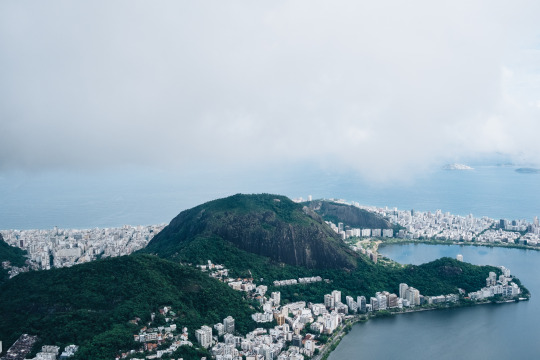
    The above photo was taken from the feet of the Christ the Redeemer statue at the top of Corcovado mountain. Excluding its base, which is about 8m tall, the statue itself is 30m in height. That’s basically the same height as Junction House (a 9 storey midrise condominium).

  • Unfinished: The Museum of Image & Sound

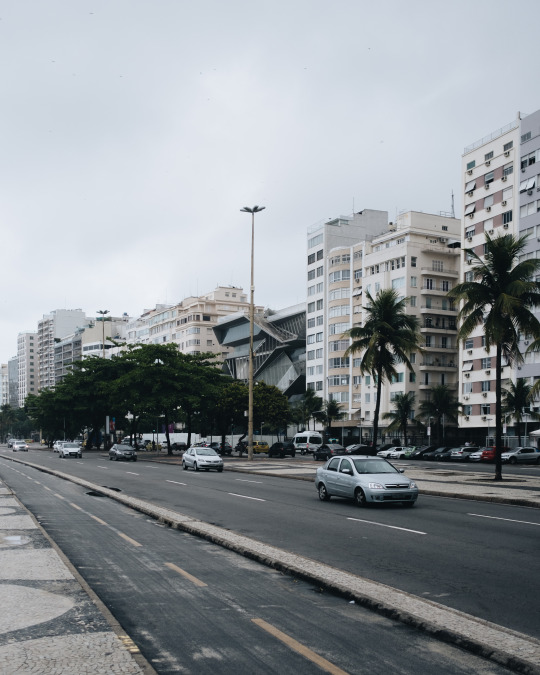
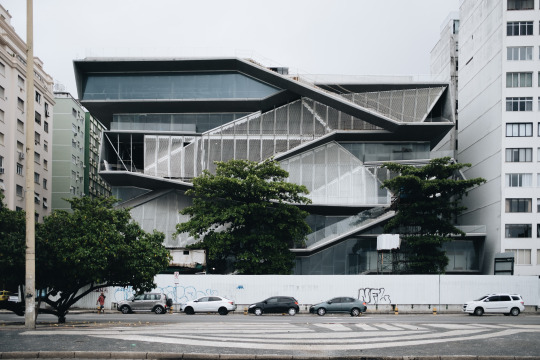
    Here are two images of the unfinished Museum of Image & Sound in Rio de Janeiro by Diller Scofidio + Renfro.

    imageimage

    The building sits across from Copacabana’s famed beach and tiled boardwalk. The street you’re looking at is Avenida Atlântica.

    The idea behind the architecture was to create a kind of “vertical boulevard” on the building’s beachside facade. Clever.

    It is particularly impactful when you see it within the context of Copacabana’s delightfully formidable streetwall and curving promenade.

    But it is unclear when the building will ultimately be finished. Construction started in 2010 and it first stalled in 2012. Too bad.

  • Oi Rio

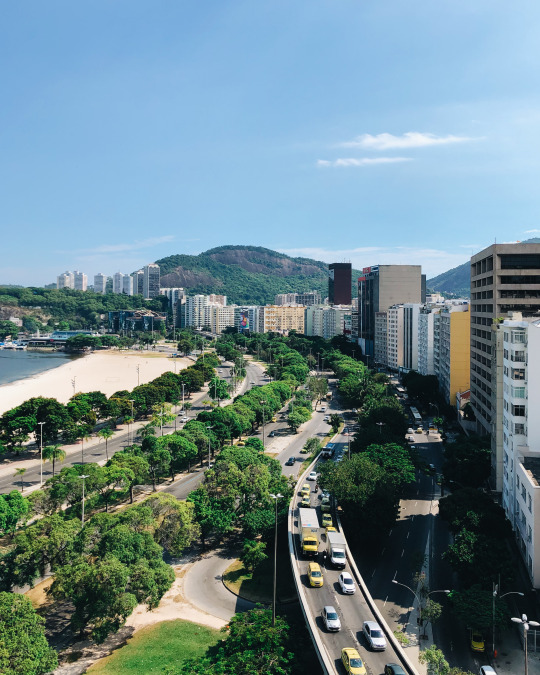
    I just arrived in Rio de Janeiro, which is where I’ll be for the next ten days. Here is a photo looking south from the rooftop of our hotel (more photos to follow on Instagram):

    image

    Today was a fairly relaxed day after many hours of travel. But tomorrow the architecture and design tour begins. 

    I am still trying to get a feel for the city. The first thing people tell you after you arrive is to be careful. Don’t go out at night. And take Ubers. 

    Uber is a significant advantage in a place like Rio where few people seem to speak English and you may be concerned about somebody taking you for a ride.

    Not only was the Uber from GIG about R$80 less expensive than a taxi (I was probably quoted the gringo rate), but you also get perfect information in terms of where you are going.

    This emphasis on safety and security is, of course, highly evident as you walk around the city. Lots of gates and lots of cameras.

    It’s perhaps a bit ironic to see so many places sealed off from the outside when you consider how great the climate is and how friendly the people are.

  • Maple Valley? No.

    At this time of year, I am always amazed by the number of mass emails that I receive from unknown people and companies. They have my email address, clearly, and yet I only receive one email a year from them – a happy holidays email. I am not opposed to holiday cheer. I love Christmas. But if you’re looking to build any sort of meaningful rapport with an audience, my sense is that you ought to send more than one email a year.

    In other news, the Economist published an article this past week talking about how Toronto is attracting disaffected (Indian) tech workers from the US and, more particularly, Silicon Valley. It is largely a story of immigration and diversity. But at the end of it, the Economist also reports that some people are now calling Toronto, Maple Valley. Toronto immediately reacted to this moniker – negatively.

    Nobody refers to Toronto as Maple Valley. And these sorts of names are stupid. In the 1990s, the Flatiron District in Manhattan started being called Silicon Alley (at least by some). That name was also stupid. New York is New York. And Toronto is Toronto. If you’re going to assign a nickname, it should not be derivative. And in the case of Toronto, you probably also want to avoid kitschy Canadian stereotypes.